Project-1: Powertrain for aircraft in runways
1.0
Here's a list of various types of aircraft and their approximate weight ranges, divided into several categories. Please note that the weights mentioned are approximate and can vary depending on the specific model and configuration of the aircraft.
Light Sport Aircraft (LSA):
- Cessna 162 Skycatcher: 830 kg (1,830 lbs)
- Tecnam P2002 Sierra: 600 kg (1,323 lbs)
- Flight Design CTLS: 600 kg (1,320 lbs)
- General Aviation / Single-Engine Piston:
- Cessna 172 Skyhawk: 1,111 kg (2,450 lbs)
- Piper PA-28 Cherokee: 1,157 kg (2,550 lbs)
- Cirrus SR22: 1,636 kg (3,600 lbs)
Multi-Engine Piston:
- Piper PA-34 Seneca: 2,177 kg (4,800 lbs)
- Beechcraft Baron G58: 2,540 kg (5,600 lbs)
- Diamond DA62: 1,999 kg (4,407 lbs)
Turboprop:
- Cessna Caravan 208B Grand: 4,082 kg (9,000 lbs)
- Pilatus PC-12: 4,740 kg (10,450 lbs)
- Beechcraft King Air 350: 6,804 kg (15,000 lbs)
Light Business Jets:
- Embraer Phenom 100: 4,750 kg (10,472 lbs)
- HondaJet HA-420: 4,808 kg (10,600 lbs)
- Cessna Citation M2: 4,850 kg (10,700 lbs)
Midsize Business Jets:
- Bombardier Learjet 75: 9,379 kg (20,700 lbs)
- Cessna Citation XLS+: 9,163 kg (20,200 lbs)
- Embraer Praetor 500: 8,536 kg (18,800 lbs)
Large Business Jets:
- Bombardier Global 7500: 48,850 kg (107,850 lbs)
- Gulfstream G650ER: 47,400 kg (104,600 lbs)
- Dassault Falcon 8X: 33,113 kg (73,000 lbs)
Regional Airliners:
- Bombardier CRJ-900: 38,330 kg (84,500 lbs)
- Embraer E175: 38,790 kg (85,500 lbs)
- ATR 72-600: 23,000 kg (50,706 lbs)
Narrow-Body Airliners:
- Airbus A320neo: 73,800 kg (162,700 lbs)
- Boeing 737 MAX 8: 80,286 kg (177,000 lbs)
- Comac C919: 61,234 kg (135,000 lbs)
Wide-Body Airliners:
- Airbus A350-900: 268,000 kg (590,841 lbs)
- Boeing 787-9 Dreamliner: 254,011 kg (560,000 lbs)
- Boeing 777-300ER: 351,534 kg (775,000 lbs)
2.0
Yes, there is a difference between ground speed and airspeed. Here's an explanation of each term:
- Ground Speed: Ground speed refers to the actual speed at which an aircraft is moving relative to the ground or the Earth's surface. It is the speed measured with respect to a stationary observer on the ground. Ground speed takes into account the aircraft's true airspeed and factors such as wind speed and direction. Ground speed can be affected by headwinds (wind blowing opposite to the aircraft's direction of travel) or tailwinds (wind blowing in the same direction as the aircraft's travel).
- Airspeed: Airspeed, also known as indicated airspeed (IAS), is the speed of an aircraft relative to the surrounding air mass. It is measured using an airspeed indicator on the aircraft. Airspeed provides information about the aerodynamic forces acting on the aircraft and is used for flight performance, maneuvering, and control. It does not directly account for the effects of wind.
3.0
Using aircraft engine power to move the aircraft on the ground at an airport is generally not recommended for several reasons:
- Safety concerns: High-powered jet engines can produce powerful jet blasts behind the aircraft, which can cause damage to nearby equipment, structures, or other aircraft. The jet blast can also pose a risk to airport personnel working on the ground.
- Debris ingestion: Using engines to taxi can increase the risk of foreign object debris (FOD) being sucked into the engine, which may cause damage to the engine or other components. FOD ingestion can lead to costly repairs and lengthy downtime for the aircraft.
- Fuel consumption: Taxiing an aircraft using its engines is inefficient and consumes more fuel compared to using a ground-based towing system, such as a tug. Increased fuel consumption not only raises operational costs but also contributes to higher greenhouse gas emissions.
- Noise pollution: Running aircraft engines on the ground generates significant noise pollution, which can be disruptive to both airport personnel and nearby communities. Noise restrictions and regulations at many airports limit the use of engines on the ground.
- Engine wear and tear: Ground taxiing using engines puts additional stress on the engines and may contribute to accelerated wear and tear. This can result in more frequent maintenance and potentially higher operating costs.
- Ground handling: Maneuvering aircraft on the ground using engine power alone can be challenging, especially in tight spaces or crowded ramps. Tugs or tow tractors offer better precision and control for moving aircraft in the airport environment.
For these reasons, airports and airlines typically rely on ground-based towing systems to move aircraft around the airport. These systems provide a safer, more efficient, and environmentally friendly method of ground handling.
4.0
When an aircraft is ready to take off, it is typically pushed back from the gate or parking position using a ground vehicle called a pushback tug or tow tractor. The pushback procedure is as follows:
- Preparation: Before the pushback, the ground crew communicates with the cockpit crew to coordinate the pushback operation. The ground crew ensures that the aircraft's engines are shut down, the parking brake is engaged, and the necessary safety measures are in place.
- Attachment: The pushback tug is positioned and attached to the nose landing gear or a designated tow point on the aircraft's fuselage. The attachment is secured using a towbar or a towbarless system, depending on the equipment available.
- Communication: The ground crew communicates with the cockpit crew via radio or intercom to confirm that the aircraft is ready for pushback. The cockpit crew acknowledges and prepares the aircraft's systems for the maneuver.
- Pushback: The pushback tug slowly applies force to move the aircraft backward away from the gate or parking position. The tug's driver controls the speed and direction of the pushback, ensuring a smooth and controlled movement.
- Steering: During the pushback, the tug driver steers the aircraft by maneuvering the tug. This allows the aircraft to follow the desired path and align with the taxiway leading to the runway.
- Disconnecting: Once the aircraft is in the appropriate position and aligned with the taxiway, the pushback tug is disconnected from the aircraft. The ground crew ensures that all connections and equipment are properly stowed, and the tug clears the area.
- Engine Start and Taxi: After the pushback, the aircraft's engines are started, and the cockpit crew receives clearance from air traffic control to taxi the aircraft to the runway. The aircraft then proceeds under its own power using its engines and is guided by air traffic control instructions and ground markings.
The pushback procedure ensures that the aircraft can safely and efficiently maneuver on the ground, allowing it to taxi to the runway for take-off. It is a coordinated effort involving ground crew, tug operators, and cockpit crew to ensure the aircraft's smooth movement and adherence to safety protocols.
5.0
- Take-off power: Take-off power refers to the maximum engine thrust an aircraft can generate during take-off. During this phase, engines typically operate at or near their maximum output to generate sufficient thrust for the aircraft to accelerate down the runway, lift off the ground, and climb safely. This level of thrust is only used for a short period to minimize engine wear and tear.
- Tire design: Aircraft tires are designed to withstand extreme loads, high speeds, and harsh operating conditions. Key aspects of aircraft tire design include:
- Ply construction: Aircraft tires use a bias-ply construction, with multiple layers of fabric or steel cords embedded in the rubber to provide strength and durability.
- Tread pattern: Tread patterns are designed to provide good traction, maintain stability, and reduce aquaplaning on wet runways.
- Sidewall: The tire sidewalls are reinforced with thick layers of rubber and plies, allowing them to handle high loads and maintain shape under heavy loads.
- Rolling resistance: Rolling resistance is the force that opposes the motion of a tire as it rolls over a surface. In aircraft tires, rolling resistance is influenced by factors such as tire deformation, hysteresis, and tire-road interaction. Minimizing rolling resistance is important for reducing the amount of energy required to move an aircraft on the ground and to optimize fuel consumption during taxiing and take-off.
- Tire pressure: Aircraft tires are designed to operate at high pressures to handle the heavy loads placed on them during landing and take-off. High tire pressure allows the tire to maintain its shape and distribute the load evenly across its contact patch. Correct tire pressure is crucial for maintaining good traction, reducing wear, and preventing tire failure.
- Brake forces when landing: The braking system on an aircraft is designed to dissipate the kinetic energy generated during landing and to bring the aircraft to a safe and controlled stop. Key components of the aircraft braking system include:
- Disc brakes: Aircraft brakes typically use multiple discs made from materials such as steel or carbon-carbon, providing a large surface area for heat dissipation.
- Anti-skid system: Modern aircraft are equipped with anti-skid systems that prevent wheel lock-up and ensure optimal braking performance, even on wet or slippery surfaces.
- Brake cooling: Effective cooling systems are vital for dissipating heat generated during braking, as excessive heat can lead to brake fade or failure.
6.0
To calculate the force and power required to push or pull an aircraft by a towing vehicle, we need to make some assumptions and gather some data. Here's a simplified example:
Assumptions:
Aircraft weight: 50,000 kg (This is a generic assumption; actual weight depends on the specific aircraft type and its load)
Rolling resistance coefficient (Cr): 0.02 (This value can vary depending on tire and runway conditions)
Acceleration (a): Assume we want to accelerate the aircraft at a rate of 0.5 m/s^2.
Velocity (v): Assume the towing vehicle moves at a constant speed of 5 km/h (1.39 m/s) when towing the aircraft.
Step 1: Calculate the rolling resistance force (Fr) Fr = Cr × Weight Fr = 0.02 × 50,000 kg Fr = 1,000 N
Step 2: Calculate the force required to accelerate the aircraft (Fa) Fa = Mass × Acceleration Fa = 50,000 kg × 0.5 m/s^2 Fa = 25,000 N
Step 3: Calculate the total force required (Ft) Ft = Fr + Fa Ft = 1,000 N + 25,000 N Ft = 26,000 N
The towing vehicle needs to exert a force of 26,000 N to push or pull the aircraft.
Step 4: Calculate the power required (P) P = Force × Velocity P = 26,000 N × 1.39 m/s P = 36,140 Watts or 36.14 kW
The towing vehicle requires a power output of 36.14 kW to push or pull the aircraft at the given assumptions.
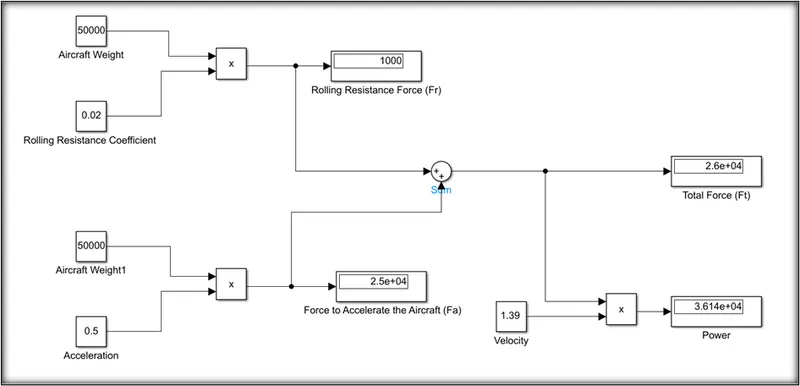
Simulink model of the above calculations
7.0
Choose a motor type: For this example, let's assume we will use a permanent magnet synchronous motor (PMSM) for its high efficiency, good power density, and torque characteristics.
Power rating: Based on the previous example, I found that the towing vehicle requires a power output of 36.14 kW. Considering efficiency losses and some additional margin, let's assume we choose a PMSM with a power rating of 40 kW.
Energy requirement: To calculate the energy requirement, we need to consider the time the towing vehicle will be operating. Let's assume the towing vehicle operates for 1 hour (3600 seconds) at maximum power. The energy requirement (E) can be calculated using the formula E = P × t, where P is the power rating (40 kW) and t is the time (3600 s).
E = 40 kW × 3600 s = 144,000 kWs or 144 kWh