Project-1: Powertrain for aircraft in runways
PART A:
1.ANS:
List out the total weight of various types of aircrafts:
MTOW = Maximum take-off weight, MLW = Maximum landing weight
Type MTOW [kg] MLW [tonnes]
Antonov An-225 640,000 591.7
Scaled Composites Model 351 Stratolaunch 589,670
Airbus A380-800 575,000 394
Boeing 747-8F 447,700 346.091
Boeing 747-8 443,613 306.175
Boeing 747-400Er 412,770 295.742
Antonov An-124-100M 405,060 330
Boeing 747-400 396,900 295.742
Lockheed C-5 Galaxy 381,000 288.417
Boeing 747-200 377,840 285.700
Boeing 747-300 377,840 260.320
Airbus A340-500 371,950 240
Airbus A340-600 367,400 256
Boeing 777F 347,800 260.816
Boeing 777-300ER 351,800 251.29
Boeing 777-200LR 347,450 223.168
Boeing 747-100 340,200 265.300
Airbus A350-1000 308,000 233.5
Boeing 777-300 299,370 237.68
Boeing 777-200ER 297,550 213.00
Airbus A340-300 276,700 190
McDonnell Douglas MD-11 273,300 185
Airbus A350-900 270,000 175
Ilyushin Il-96M 270,000 195.04
McDonnell Douglas DC-10 256,280 183
Boeing 787-9 254,000 192.777
Boeing 787-10 254,000 201.849
Airbus A340-200 253,500 181
Airbus A330-900 251,000 191
Ilyushin IL-96-300 250,000 175
Airbus A330-300 242,000 185
Airbus A330-200 242,000 180
Lockheed L-1011-500 231,300 166.92
Boeing 787-8 228,000 172.365
Lockheed L-1011-200 211,400
Ilyushin IL-86 208,000 175
Boeing 767-400ER 204,000 158.758
Airbus A300-600R 192,000 140
Boeing 767-300ER 187,000 136.08
Concorde 185,000 111.1
Airbus A300-600 163,000 138
Boeing 767-300 159,000 136.078
Airbus A310-300 157,000 124
Vickers VC10 152,000 151.9
Boeing 707-320B 151,000 97.5
Boeing 707-320C 151,000 112.1
Douglas DC-8-61 147,000
Airbus A310-200 142,000 123
Airbus A400M 141,000 122
Douglas DC-8-32 140,000
Douglas DC-8-51 125,000
Boeing 757-300 124,000 101.6
Boeing 707-120B 117,000 86.3
Boeing 757-200 116,000 89.9
Boeing 720B 106,000 79.5
Boeing 720 104,000 79.5
maximum take off mass (MTOM) of the aircraift is the maximum weghit of the ploit is allowed to attempt to take off due to the strcuture or other limits
maximum loading weghit(MLW) is the maximum aircrafit gross weghit due to the design or operational limitanoal at which permitteded land.
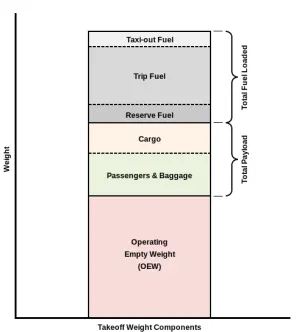
Aircraft gross weight is the total aircraft weight at any moment during the flight or ground operation.
An aircraft's gross weight will decrease during a flight due to fuel and oil consumption. An aircraft's gross weight may
also vary during a flight due to payload dropping or in-flight refuelling.
At the moment of releasing its brakes, the gross weight of an aircraft is equal to its takeoff weight.
2.ANS:
Air speed:
true airspeed is simply the speed at which an aircraft is moving relative to the air it is flying in. As such, it’s also the
speed at which the air is flowing around the aircraft’s wings.
Ground speed:
Ground speed, on the other hand, is the aircraft’s speed relative to the ground. One thing that should be noted here is
that it’s its horizontal rather than vertical speed – an aircraft climbing completely vertically would have a ground speed
of zero.
Difference between ground speed and air speed?
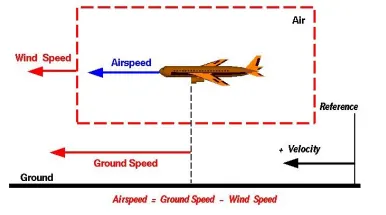
In other words, while airspeed is what determines whether there is enough airflow around an aircraft to make it fly,
ground speed is what determines how fast an aircraft will get to its destination.
The relationship between airspeed and ground speed is fairly simple. Ground speed is simply the sum of airspeed and
wind speed.
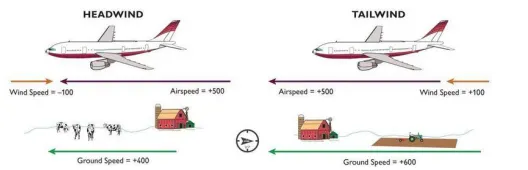
If the aircraft is flying in the same direction as the wind is blowing, the aircraft experiences tailwind, and its ground speed
is higher than its airspeed. On the other hand, if the wind is blowing against the direction the aircraft is traveling in, the
aircraft experiences headwind, and its ground speed is lower than its airspeed.
3.ANS:
Why is it not recommended to use aircraft engine power to move it on the ground at Airport?
The term Aircraft Ground Running is usually used to describe the operation of some or all of the engines of an aircraft,
whilst on the ground, for the purpose of functionally checking the operation of either engines or aircraft systems.
The risks which may arise from engine ground running relate to the potential for loss of control of the aircraft by those
persons occupying the pilot seats in the flight deck. In most cases, such persons will be maintenance personnel holding
specific company-issued approval for the required tasks. The consequences of loss of control during taxi or towing are
the same as apply to these operations generally and this article is concerned only with the risks arising from the static
running of one or more aircraft engines. Unwanted consequences from such static running are mainly related to those
arising from the unintended movement of the aircraft during engine running - effectively a loss of control - especially
during high power engine running. Damage can occur to the aircraft itself, other aircraft nearby or to airside structures.
In addition, there is a risk of injury to ground support personnel who may be in relatively close proximity to the aircraft.
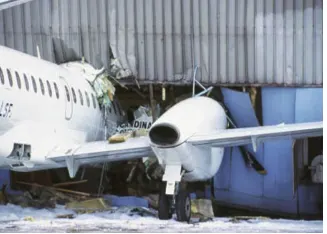
The forward movement of an aircraft, usually with engines off, using the power of a specialised ground vehicle attached
to or supporting the nose landing gear. It may occur for the movement of both in service and out of service aircraft. This
will affect the promulgation of procedures and the required qualification for those occupying the flight crew seats on the
aircraft during the manoeuvre. As part of out of service repositioning of aircraft supervised by maintenance personnel, it
may follow the Pushback from a nose-in gate of an empty aircraft with engines off.
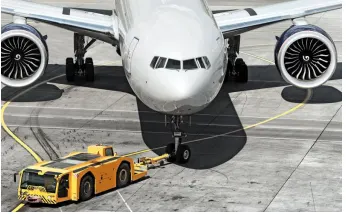
4. How an aircraft is pushed to runway when its ready to take off?
Airplanes have engines, and they can use them to move forward along the ground. So they push themselves to the
runway.
It is true that most of the time, a small vehicle is needed to push the larger commercial airplanes backwards away from
the terminal building, because even if a plane can reverse it’s thrust, it’s not always safe to hit the buildings with that
reverse thrust. So the little trucks push the bigger planes back away from the buildings, but after that, the planes can
apply a small amount of engine power to roll forward just as all airplanes can.
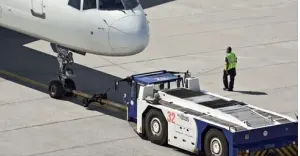
Aircrafit push themselves to the runway
5. Learn about take off power, tyre design, rolling resistance, tyre pressure, brake forces when landing.
Take off power:
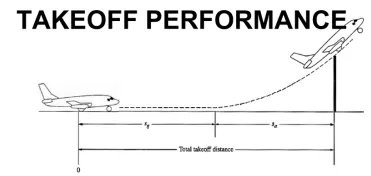
An airplane is motionless at the end of a runway. This is denoted by location O. The pilot releases the brakes and pushes
the throttle to maximum takeoff power, and the airplane accelerates down the runway. At some distance from its
starting point, the airplane lifts into the air. The distance the airplane cover along the runway before it lifts into the air is
called the ground roll (sg). The total takeoff distance also includes the extra distance covered over the ground after the
airplane is airborne but before it clears an obstacle of 50 ft for military aircraft and 35 ft for commercial aircraft. This is
denoted by sa. The sum of sg and sa is the total takeoff distance.
Typical takeoff air speeds for jetliners are in the range of 240–285 km/h (130–154 kn; 149–177 mph). Light aircraft, such as
a Cessna 150, take off at around 100 km/h (54 kn; 62 mph).
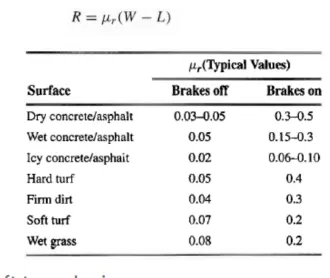
Rolling resistance:
Rolling resistance, sometimes called rolling friction or rolling drag, is the force resisting the motion when a body.
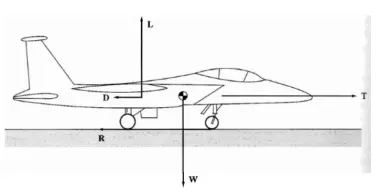
In addition to the familiar forces of thrust(T), weight(W), lift(L), and drag(D), there is a rolling resistance (R), caused by
friction between the tires and the ground.
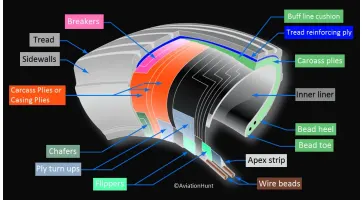
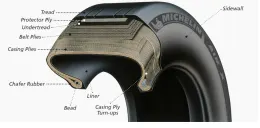
Aircraft tyre design
Carcass plies are used to form the tire. They are sometimes called casing plies. An aircraft tyre is constructed for the
purpose it serves.
1. They support the weight of an aircraft while it is on the ground.
2. It also provides the necessary traction for braking and stopping of an aeroplane.
3. Tyre also helps to absorb the shock of landing and provide cushioning the roughness of takeoff, roll-out, and taxi
operations.
Unlike an automobile or truck tyre, it does not have to carry a load for a long period of continuous operation. However,
an aircraft tyre absorbs the high impact loads of landing, and also it’s operating at high speeds for a short time.
Tyre Pressure:
The high-flying rubber is typically inflated to 200 psi, roughly six times what you put in an automobile tire, and the tires
on an F-16 fighter are pumped to 320 psi. “It's really pressurized air that's so strong,” he says.
The tires themselves aren't terribly large--- a Boeing 737 rides on 27x7.75 R15 rubber. In English, that means it is 27 inches
in diameter, 7.75 inches wide, and wrapped around a 15-inch wheel. The sidewalls aren't terribly thick, and the strength
of the tire lies in the cords embedded below the tread, Bartholomew says. They're typically nylon, and more recently a
variety known as aramid. Each layer of the casing contributes to its load bearing and air pressure resisting capabilities.
Of course, tires can fail, especially when under-inflated or overloaded. Treads can come off and casings can blow out.
Brake forces when landing:
Airplanes rely on a braking system to safely land on runways. At cruising altitude, most commercial airplanes fly at a
speed of roughly 500 to 600 mph. When landing, however, they must reduce their speed. A typical 747, for instance, has
a landing speed of about 160 to 170 mph. And upon touching the runway, airplanes must quickly brake until they come
to a complete stop. How do airplanes brake when landing exactly.
Wing Spoilers
Many airplanes use wing spoilers to assist with braking when landing. Not to be confused with ailerons, spoilers are
extendable flaps on the ends of an airplane’s wings. Pilots can raise the spoilers to decelerate the airplane as it
approaches the runway. And even while on the runway, pilots will typically leave the wing spoilers raised. Raised wing
spoilers create drag, which essentially slows down the airplane so that it’s able to brake more quickly.
Disc Brakes
In addition to wing spoilers, airplanes use disc brakes. Airplane disc brakes are similar to the braking system in
automobiles. They consist of a pair of calipers that, when engaged, squeeze pads against the rotors of an airplane’s
landing gear.
Disc brakes are designed to remain static at all times. In other words, they don’t rotate with the wheels of an airplane’s
landing gear. As the wheels turn, the disc brakes will remain static and stationary. They are a vital component of an
airplane’s braking system because they are designed to apply pressure to the airplane’s wheels. Disc brakes will
squeeze the wheels, thereby slowing down the speed at which they spin. In turn, this reduces the speed of the airplane
so that it can come to a complete stop on the runway.
Reverse Thrust
Finally, many jet airplanes use reverse thrust to assist with braking during landings. Reverse thrust is a feature in jet
engine airplanes that, as the name suggests, involves the reversal of the engines’ thrust. When flying, the thrust is
projected out the rear of an airplane’s engines. When landing, however, pilots may use the reverse thrust feature.
Reverse thrust changes the direction of the engines’ thrust. Rather than projecting out the rear, the thrust will be
projected out the front. This reversal of thrust provides deceleration that allows airplanes to slow down more quickly when landing.
6. A. With necessary assumptions, calculate the force and power required to push / pull an aircraft by a towing
vehicle.
Assumed values:
Weight of the towing vehicle = 1000kg
Here aircraft(Boeing 737-900) taken as load weight = 85000kg
Total mass of the veichle = 86000kg
Gravity(g) = 9.80 m/s^2
Coefficent of rolling resistance (car tires on rolled gravel) = 0.02
Air density = 1.25 kg/m^3
Frontal area(A) = Height * width = 1 * 1.5 = 1.5m^2
Drag Coefficient(Cd)(Trucks ,road trains) = 0.8
Velocity(V) = 12.5m/s
Formulae:
Total Tractive Foce = Rolling Resistane Force + Aerodynamic Drag Force + Linear Acceleration + Angular acceleration

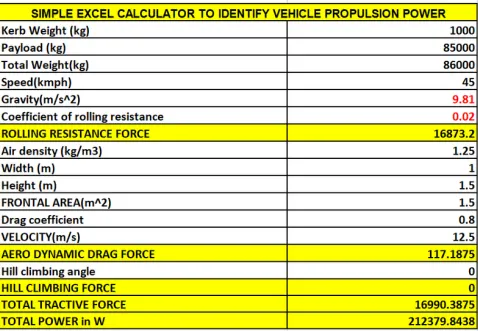
Hence obtained the Total tractive force and power is 19990.387N and 212379.843W respectivly.
6.B.ANS:
To develop the model for the calculated force and power using Simulink
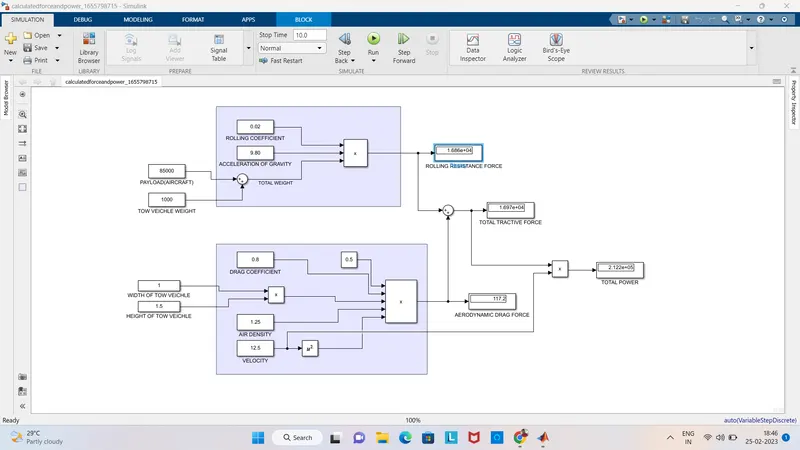
Hence caluculated the total tractive force and total power using excel and also developed the simulink model.
7.A.ANS:
To design an electric powertrain with type of motor, it’s power rating, and energy requirement to fulfill aircraft towing
application in Simulink:
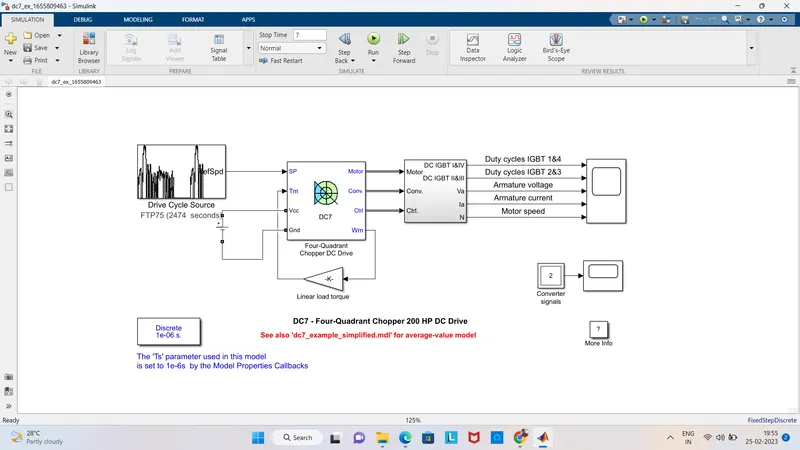
Here giving the assumed values calculated before power and force .
Wheel radius of the towing veichle is 0.4m
Input power of towing vehicle =300kw
The torque is required for the veichle to move, T = Force * Radius of the vehicle
= 16990.387 * 0.4
= 6796 N-m
Duty cycle = Output power/Input power
= 212.379/300
= 0.70
Duty cycle of towing vehicle = 70%
RESULTS:-
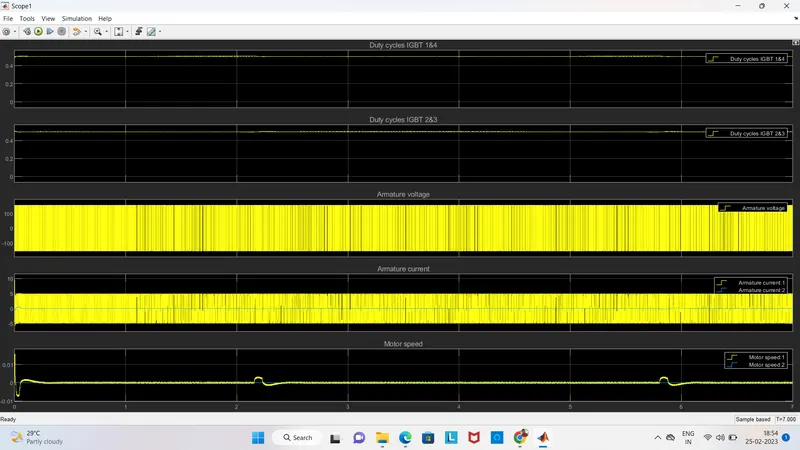
7.B ans:-
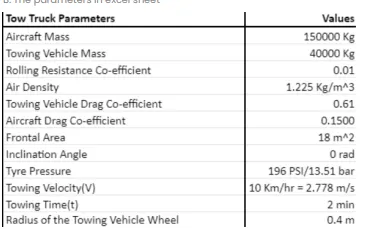
The parameters in excel sheet