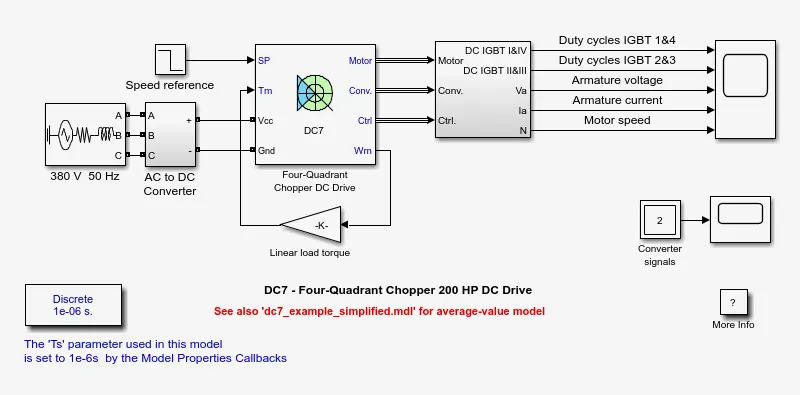
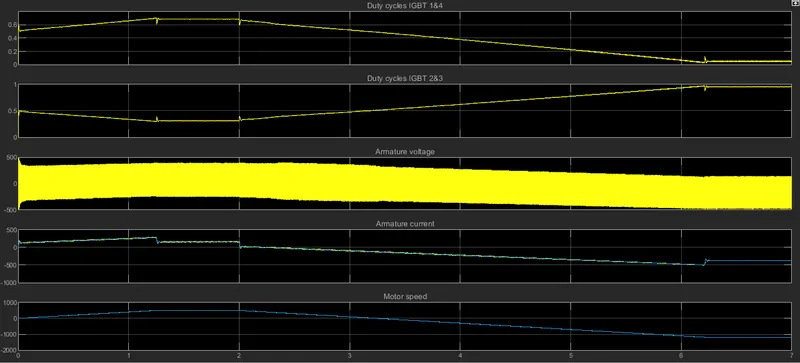
The plot consists of the duty cycles of the contoller igbt swithes,
Armature voltage of the motor
armature current of motor
motor speed and torque.
2. Difference between ground speed and air speed :
Ground speed :
Ground speed is how fast an airplane is traveling, relative to a fixed point on the ground. Think of it this way: Ground speed is how fast an airplane's shadow would move across the land. If there's a strong wind pushing an aircraft, that's reflected in the ground speed.
air speed :
Airspeed, in contrast, is how fast an airplane is really flying strictly under its own power, which is calculated by subtracting the wind speed from the ground speed
The aircraft operates on both ground as well as in the air so we need to obsreve how these speeds are related.
The ground speed and air speed are usually depend on the wind speed.if the wind speed changes these speeds may change.
if we consider there is no wind speed then the air sped is equal to the ground speed .
If the wind is flowing in the same direction of the flight then (air speed < ground speed ) so air speed =ground speed -wind speed.
If the wind is flowing in the opposite to direction of the flight then (air speed > ground speed ) so air speed =ground speed+wind speed.
3. Why is it not recommended to use aircraft engine power to move it on the ground at Airport :
Taxiing :
Taxiing refers to the movement of an airplane while on the runway
is the movement of an aircraft on the ground, under its own power, in contrast to towing or pushback where the aircraft is moved by a tug. The aircraft usually moves on wheels.
Although many aircrafts moves in back ward using reverse thrust as a result
The jet blast or prop wash might damage the terminal billding and other eqiuipment .
Engine close to ground may aliso damage the engine.
THis may cause the huge damage to the aircraft.
Thats why pushback trucks are provided for the backword movement of crafts in airports.
A push back truck lifts the front wheel of the aircraft .
Their (push back truck )role is to move the aircraft away from the parking area
During high power engine running damage can occur itself to the aircraft
It is easier to the truck driver to to see the outside and drive the vehicle compared to the pilot.
The push back driver konows well about the airport compred to pilot.
The another main thing is it saves the huge fuel for such a small thing
These may damge the aircrafts which are next to it in reversing by it self.
Huge risk of jet blast and sourrounding buildings,
4.How an aircraft is pushed to runway when its ready to take off :
The aircraft is in parking place before it goes to the runway the thing is when it needs to fly it needs to come back to the runway to fly.
The aircraft can itself move backwords although it is risky for the aircraft and the sourroundings it useses the towing system.
Towing :
The forward movement of an aircraft, usually with engines off, using the power of a specialised ground vehicle attached to or supporting the nose landing gear. It may occur for the movement of both in service and out of service aircraft.
Before the aircraft to be towed is moved, a qualified person must be in the flight deck to operate the brakes in case the tow bar fails or becomes unhooked. The aircraft can then be stopped, preventing possible damage.
Towing aircraft can be a hazardous operation, causing damage to the aircraft and injury to personnel, if done recklessly or carelessly. ... The aircraft can then be stopped, preventing possible damage. Some types of tow bars available for general use can be used for many types of towing operations.
Taxiing :
Taxiing refers to the movement of an airplane while on the runway
is the movement of an aircraft on the ground, under its own power, in contrast to towing or pushback where the aircraft is moved by a tug. The aircraft usually moves on wheels.
5.Take off power, tyre design, rolling resistance, tyre pressure, brake forces when landing :
Take off power :
Take is the situation where the vehicle leaves ground and enters into the air.
Initially the aircraft runs on runway for tipical time reach the max speed and to get into the air.
The more power is required to take off but the thing we should consider the engine performance for better operation and life .
On take-off, in order to position the aircraft to a safe height away from terrain and obstacles (i.e. a flight path of maximum height and minimum ground distance desired), the engine thrust is set to a high ‘take-off power’ setting (although this is not necessarily full power) and the aircraft attitude is pitched up to maintain a specific speed (usually in the region of V2 + 15kts).
Once the ‘safe height’ is reached the engine thrust can therefore be reduced to a more appropriate (i.e. efficient) setting and the aircraft flight path can be changed to a more appropriate (i.e. efficient) flight path.
In order to achieve that described above and also to provide minimum noise disturbance to the area surrounding the airport, regulatory procedures require aircraft to fly one of the two profiles given below during every departure.
Tyre design :
- When it comes to saftey tyres are one of the most important components of aircraft.
- They help to absorb the shock of landing and provide cushioning. It also provides the necessary traction for braking and stopping of an aircraft.
- An aircraft tyre is designed to withstand extremely heavy loads while landing, take off, taxing, and parking.
- The number of wheels required for aircraft increases with the weight of the aircraft, as the weight of the aeroplane needs to be distributed more evenly
- They support the weight of an aircraft while it is on the ground.
- It also provides the necessary traction for braking and stopping of an aeroplane.
- Tyre also helps to absorb the shock of landing and provide cushioning the roughness of takeoff, roll-out, and taxi operations.
some of the techincal asspects of the air craft tyre :
Retreading – Retreading is methods of restoring a worn tyre by renewing the tread area or by renewing the tread area plus one or both sidewalls. Repairs are included in the tyre retreading process.
Load Rating – Load rating is the maximum permissible load at a specified inflation pressure.
Ply Rating – Ply Rating is used to identify the maximum recommended load rating and inflation pressure for a specified tyre. It is an index of tyre strength.
Speed Rating – The speed rating is the maximum takeoff speed to which the tyre has been tested.
Skid Depth – Skid depth is the distance between the tread surface and the deepest groove as measured in the mould.
Tube or tube less : Tubeless tyres are more advantageous over tube-type. There is no longer the use of tube-type tyre in recent aviation. Nowadays all airliners are using tubeless tyres. Tubeless that are meant to be used without a tube has the word TUBELESS on the sidewall of the tyre.
Rolling resistance :
as we know that the force offered to the tyre .This is the force offred to the tire of the aircraft.
It depends upon the tire pressure ,tire
material ,temparature around the tyre,structure of the tyre.
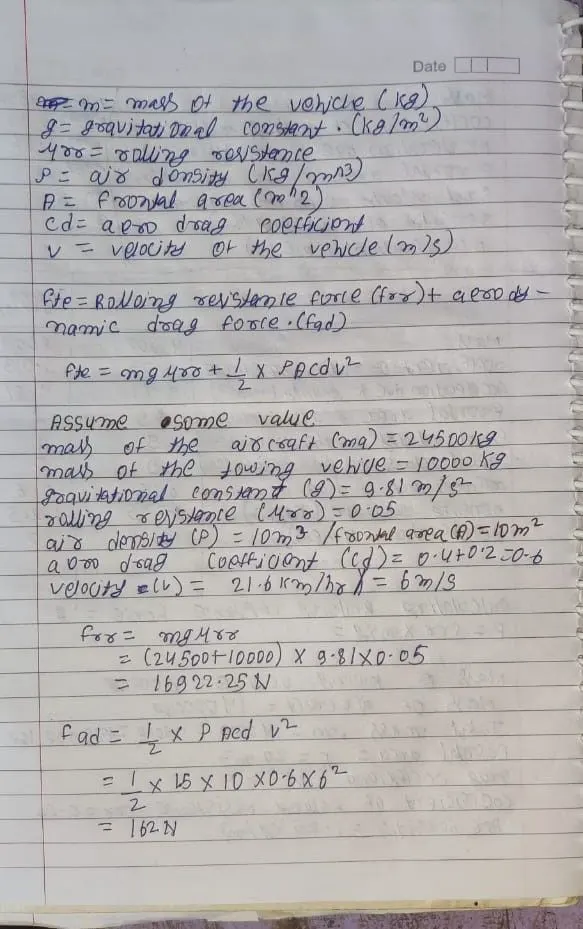
we that the force required to overcome the rolling resstance is given by
Frr=μrr*m*g
where,
μrr=coeficient of rolling resistance
m=mass on the tire
g=gravitational constant
Tire pressure :
The amount of air inside the tyre is known as tire pressure .
Tyre pressure makes a major role vehicle dynamics .
If the tyre pressure is less the rolling resistance force applied on the vecle will be more .
μrr=coeficient of rolling resistance
as the tire pressure decrese the μrr will increse this will increse the rolling resistance force so it leads to more energy requirement.
So the vehicle can't achive the high speed . and it tyres can't sustain the total weight of the vehicle.
coming to the aircrfts these should withstand for high load weight and high speeds on runway .
The typical airliner tire can handle a 38-ton load. It can meet the ground 500 times before needing a re-tread, a refresh it can take on seven times in its life.
Brake forces when landing :
As the aircraft lands with high speed it requires huge amount of force.
This speed should be controlled by suitable brakes withot damage or effects .
Brakes work by dissipating energy as heat through the action of friction. An aircraft wheel rotating at speed possesses a large amount of kinetic energy. By contacting the wheel with a semi-metallic or ceramic brake pad, an enormous amount of heat is generated as a result of the friction between the two contacting surfaces.
The large frictional forces generated during braking cause the pads to wear and so careful inspection and maintenance of the system is required to ensure the brakes continue to operate as designed.
Brakes are usually hydraulically actuated, but in some cases may be operated through a mechanical actuation system.
Traditionally, brakes are fitted to the upper half of the rudder pedals and are actuated through the pilot applying pressure to the top of each pedal. This toe-brake configuration is widely used and allows the pilot to apply differential braking by varying the pressure applied on each toe brake.
Many smaller light sport aircraft do not make use of toe brakes, preferring to use a simpler single lever mechanism.
Disc brakes are the most common braking system in use today and consist of a disc which rotates with the wheel and a stationary brake calliper which actuates onto the disc to affect a braking force. The calliper is the name given to the assembly that contains the brake pads and piston(s). The pads are connected to the piston which actuates under hydraulic pressure applied either through a toe brake or a brake lever in the cockpit.
1.list out the total weight of various types of aircrafts :
There are many factors that lead to efficient and safe operation of aircraft. Among these vital factors are proper weights and balance control.
The maximum allowable weight for an aircraft is determined by design considerations. The manufacturer provides the aircraft operator with the empty weight of the aircraft and the location of its empty weight center of gravity (EWCG) at the time the certified aircraft leaves the factory.
The maximum design taxi weight or maximum design ramp weight (MDRW) is the maximum certificated design weight for aircraft ground manoeuvres as limited by aircraft strength and airworthiness requirements.
air craft gross weight :
It is the total aircraft weight at any moment during the flight or ground operation. This decreases during flight due to fuel and oil consumption.
The gross weight of the wehicle is gives in the maximum take off weight of the vehicle
The total weight W of the aircraft is simply the sum of the weight of all of the individual components.
W = w(fuselage) + w(wing) + w(engines) + w(payload) + w(fuel)
| Aircraft |
Empty Weight |
Max Fuel Weight |
Max Cargo Weight |
Max Gross Takeoff Weight |
| Antanov AN-225 |
628,000 lbs
285,000 kg |
661,400 lbs
300,000 kg |
417,000 lbs
190,000 kg |
1,411,000 lbs
640,000 kg |
| Airbus A380-800 |
611,000 lbs
277,000 kg |
560,000 lbs
254,000 kg |
185,000 lbs
84,000 kg |
1,268,000 lbs
575,000 kg |
| Boeing 747-800 |
485,300 lbs
220,100 kg |
427,400 lbs
194,000 kg |
295,000 lbs
134,000 kg |
987,000 lbs
447,700 kg |
| Airbus A340-500 |
370,000 lbs
168,000 kg |
386,300 lbs
175,000 kg |
119,000 lbs
54,000 kg |
820,000 lbs
372,000 kg |
| Boeing 777-300ER |
370,000 lbs 168,000 kg |
320,800 lbs 145,500 kg |
148,000 lbs
67,100 kg |
776,000 lbs
352,000 kg |
| Boeing 787-10 |
299,000 lbs 135,500 kg |
223,500 lbs
101,500 kg |
126,300 lbs 57,300 kg |
560,000 lbs
254,000 kg |
| Boeing 737-900 |
98,500 lbs
44,700 kg |
53,100 lbs
24,000 kg |
44,600 lbs
20,200 kg |
187,000 lbs
85,000 kg |
| Airbus A320-100 |
93,900 lbs
42,600 kg |
48,700 lbs
22,100 kg |
44,000 lbs
20,000 kg |
150,000 lbs
68,000 kg |
| Embraer 190 |
63,500 lbs
28,800 kg |
28,600 lbs
13,000 kg |
28,800 lbs
13,100 kg |
106,000 lbs
48,000 kg |
| Gulfstream G650 |
54,000 lbs 24,500 kg |
48,200 lbs 21,900 kg |
6,500 lbs
3,000 kg |
100,000 lbs
45,200 kg |
| Bombardier CRJ900 |
48,160 lbs 21,850 kg |
19,600 lbs 8,900 kg |
6,075 lbs 2,760 kg |
80,500 lbs
36,500 kg |
| Bombardier Q400 |
39,300 lbs
17,800 kg |
11,700 lbs
5,300 kg |
18,700 lbs
8,500 kg |
62,000 lbs
28,000 kg |