Project-1: Powertrain for aircraft in runways
AIM:- 1.Search and list out the total weight of various types of aircrafts.
Solution:-The maximum allowable weight for an aircraft is determined by design considerations. The manufacturer provides the aircraft operator with the empty weight of the aircraft and the location of its empty weight center of gravity (EWCG) at the time the certified aircraft leaves the factory.
However, the maximum operational weight may be less than the maximum allowable weight due to such considerations as high-density altitude or high-drag field conditions caused by wet grass or water on the runway. The maximum operational weight may also be limited by the departure or arrival airport’s runway length.
As per federal aviation department, aircraft gross weight is defined as the total weight at any moment during flight or ground operation.
The aircraft gross weight dicreases during flight due and oil consumption.In some case gross weight (aircraft) may vary due to drop in payload or inflight refueling,where as on the other hand when the brakes are released the gross weight will be equal to take off weight.
During flight an aircraft gross weight will be refered as inflight weight.
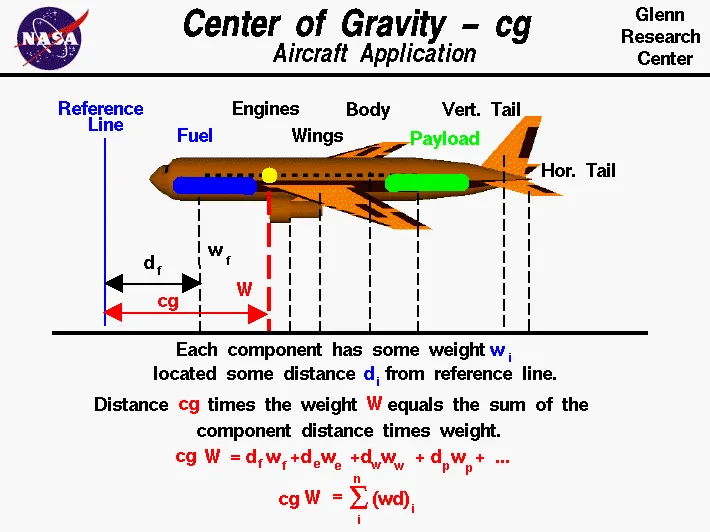
Various of types of aircraft weights are the following:
1)Manufatures empty weight:
-It includes the weight of aircraft of the entire flight with its intergal working parts,but excludes baggage ,passenger and fuels.
2)zero fuel weight:
-It includes total weight of aeroplanes including unuseable fuels but excludes total weight of useable fuel at board.
3)Payload:
-It is load carrying capacity of an aircraft which includes passenger ,cargo and fuels,But if it is in the case of cargo flight it determines the total load of logistics weight of the container which it needs to transport.
4)Maximum take off weight:
-This is the maximum weight at which the aircraft would be made to takeoff .
5)Regulated take off weight:
-Depending on different factors (flap setting,altitude,lenght of runway),RTOW varies for each take off,but can never be high for MTOW.
6)Maximum landing weight:
-It is maximum weight at which an aircraft is permitted to land.
7)Maximum Ramp weight:
-It is the maximum weight used for manuevering (towing) aircraft on the ground.
2.Is there any difference between ground speed and air speed:-
Ground speed:-
Ground speed, on the other hand, is the aircraft’s speed relative to the ground. One thing that should be noted here is that it’s its horizontal rather than vertical speed – an aircraft climbing completely vertically would have a ground speed of zero.
In other words, while airspeed is what determines whether there is enough airflow around an aircraft to make it fly, ground speed is what determines how fast an aircraft will get to its destination.
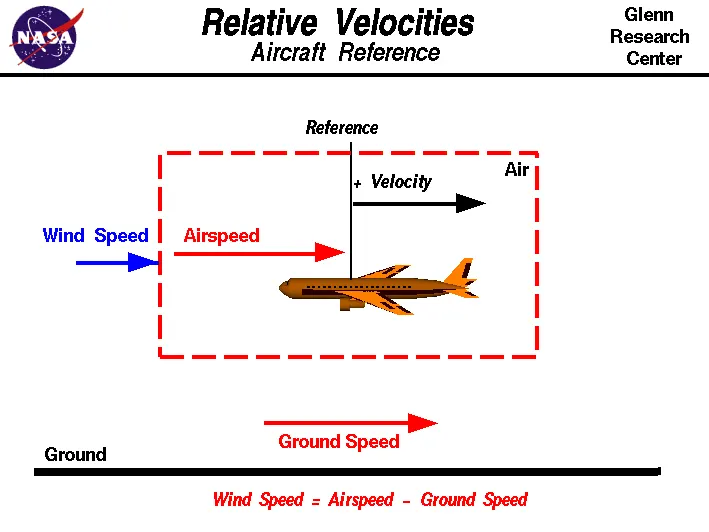
The relationship between airspeed and ground speed is fairly simple. Ground speed is simply the sum of airspeed and wind speed.
If the aircraft is flying in the same direction as the wind is blowing, the aircraft experiences tailwind, and its ground speed is higher than its airspeed. On the other hand, if the wind is blowing against the direction the aircraft is traveling in, the aircraft experiences headwind, and its ground speed is lower than its airspeed.
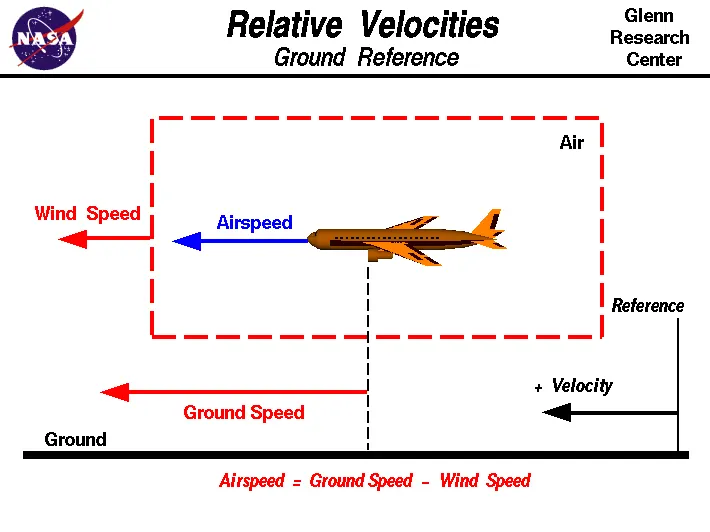
Air Speed:-As mentioned above, true airspeed is simply the speed at which an aircraft is moving relative to the air it is flying in. As such, it’s also the speed at which the air is flowing around the aircraft’s wings.
Type of Air Speed:-
Indicated airspeed is an airspeed that is calculated directly off an aircraft’s pitot-static system. It’s the calculated off the aircraft’s dynamic pressure – the difference between its total pressure and static pressure.
Calibrated airspeed is indicated airspeed adjusted for a variety of errors.
True airspeed is, as has been mentioned numerous times in this article, the actual speed at which an aircraft is moving relative to the air it is traveling in. It’s calibrated airspeed adjusted for the the exact conditions (altitude, air temperature, etc.) that the aircraft is flying in.
3. Why is it not recommended to use aircraft engine power to move it on the ground at Airport?
Solution:-Although many aircrafts are capable of moving in backward using reverse thrust, as result the jet blast or prop wash might cause damage to the terminal building or equipment. Engine close to ground may also blow sand and debris forward and then suck them into the engine, causing damage to the engine.
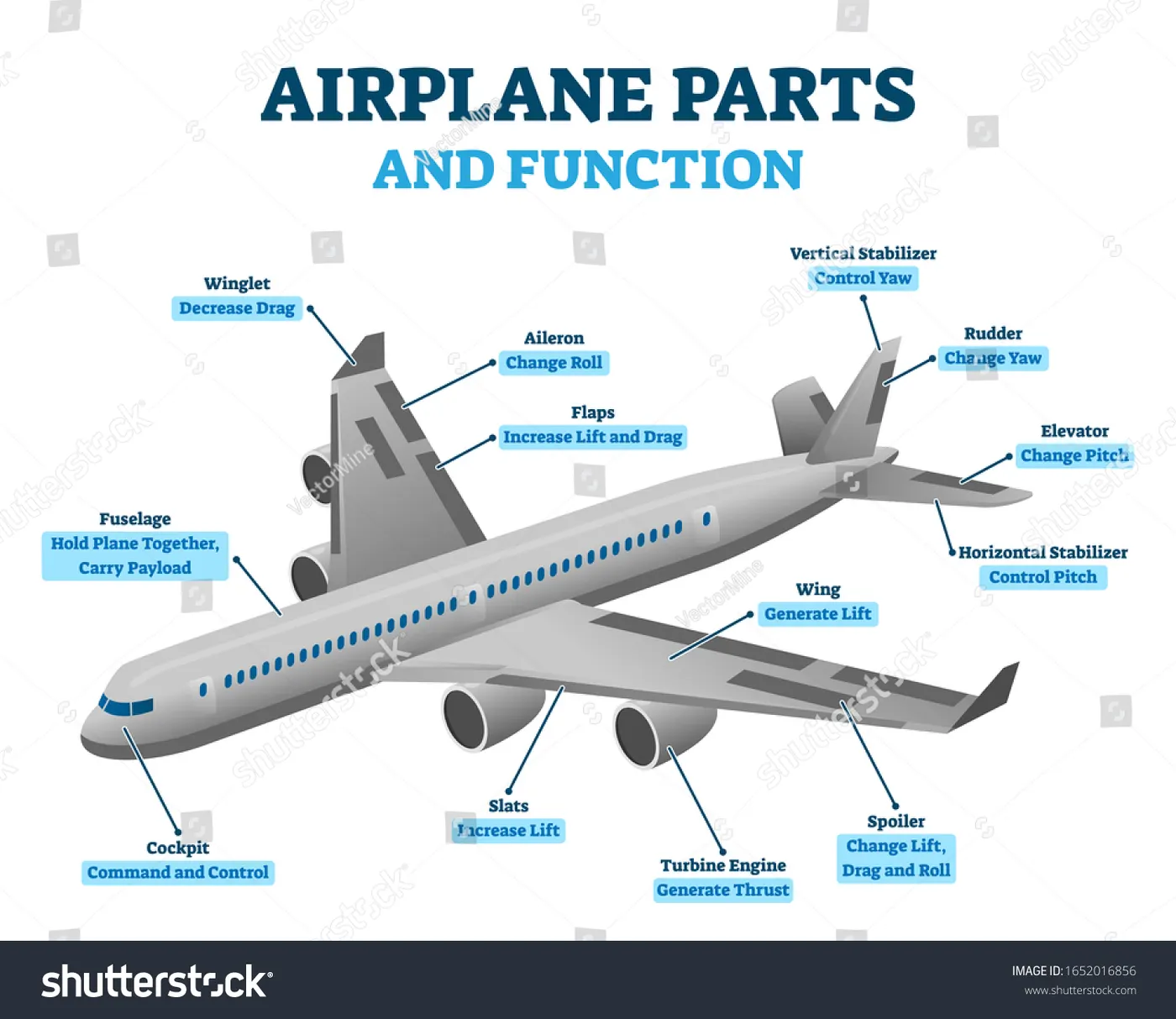
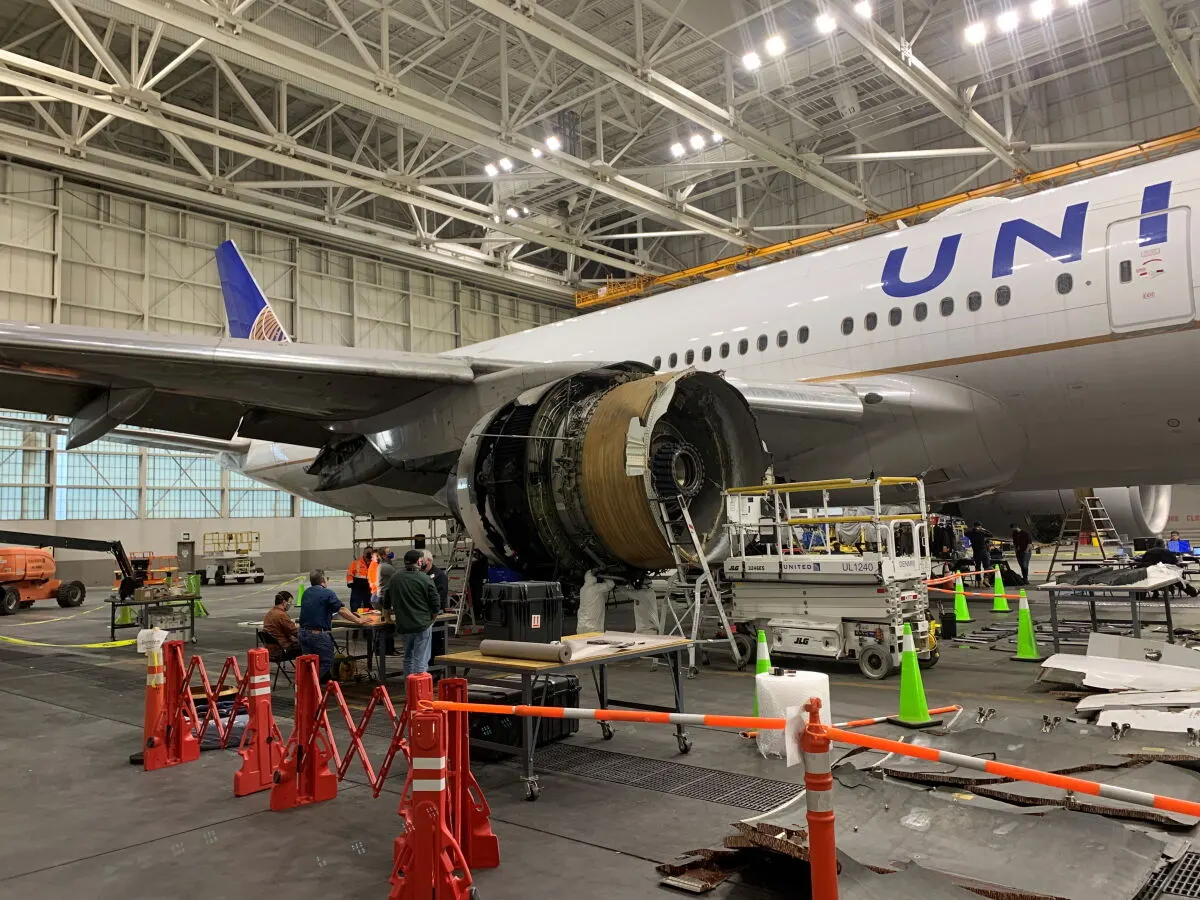
Today's modern airplanes are powered by turbofan engines. These engines are quite reliable, providing years of trouble- free service. However, because of the rarity of turbofan engine malfunctions, and the limitations of simulating those malfunctions, many flight crews have felt unprepared to diagnose engine malfunctions that have occurred.
The purpose of this text is to provide straightforward material to give flight crews the basics of airplane engine operational theory. This text will also provide pertinent information about malfunctions that may be encountered during the operation of turbofan- powered airplanes, especially those malfunctions that cannot be simulated well and may thus cause confusion.
While simulators have greatly improved pilot training, many may not have been programmed to simulate the actual noise, vibration and aerodynamic forces that certain malfunctions cause. In addition, it appears that the greater the sensations, the greater the startle factor, along with greater likelihood the flight crew will try to diagnose the problem immediately instead of flying the airplane.
4.How an aircraft is pushed to runway when its ready to take off.
To solve this kind of issue we use a towing vehicle which helps to tow the vehicle in reverse dierection and it eill be tugged until it reaches a safe place and from there onwards airplane will move by itself for further take off.
5.Learn about take off power, tyre design, rolling resistance, tyre pressure, brake forces when landing.
Having analyzed different variants of the system the conception of the movable sledge was chose which uses the Inductrack system. The conception supposes the use of a levitating vehicle in the formof a sledge on which a cart is placed; the aircraft stays still on the cart. Thecart will move on the track of the Inductrack system constructed of two rails in the form of a laminateconsisting of many sheets of copper. This system of levitation is currently the cheapest to construct.
Take off is the phase of the flight in which an aeroplane leaves ground and becomes airbone.For lighter aircraft full power is given durong take off where as on the other hand large cargo carriers aircraft make use of less power during take off inorder to inrease the life span of engine,reduce maintenance cost ,reduce engine heat and also for a smooth take off flight.
The forces involved during take off are the following:
T=Thrust froce pushes the aircraft in forward dierection on the runway.
D=Drag force resist the forward motion of the aircraft.
F=Rolling resistance force when wheel comes in contact with the gorund during landing and take off.
During take off on the runway the imbalance froce will cause an acceleration along the runway and it is given by the formula:
dv/dt=T−D−Fm
Now when the pilot is ready to take off the aircraft will accelerated to a speed which would be given by aircraft controlling department.Then after take off the flight will be elevated to a certain angle and hieght.then it will be made to stabilies in an equilibrium manner.
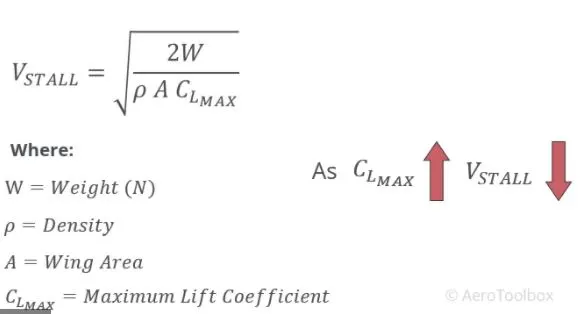
Here safe speed or rotational speed is defined as Vr which act as a critical factor for determining take off performance.For safety reasons Vr is usually determined as 1.1*Vstall(lowest speed that aircraft can be flown before the air starts to seperate from the wings when the angle of attract becomes too great.
Vstall can be calculated by using a formula given:
Tire design of aeroplain:-Aircraft tires are usually inflated with nitron to minimize expansion and contraction from extreme changes in ambient temperature and pressure experienced during flight. Dry nitrogen expands at the same rate as other dry atmospheric gases (normal air is about 80% nitrogen), but common compressed air sources may contain moisture, which increases the expansion rate with temperature.
The number of tires required for an aircraft depends on the total weight of aircraft as the weight needs to be distributed evenly.
Aircraft tyre are designed to facillitate stability in high crosswind condition,to chanalize the water away for preventing skidding and helps to give a good braking effect.
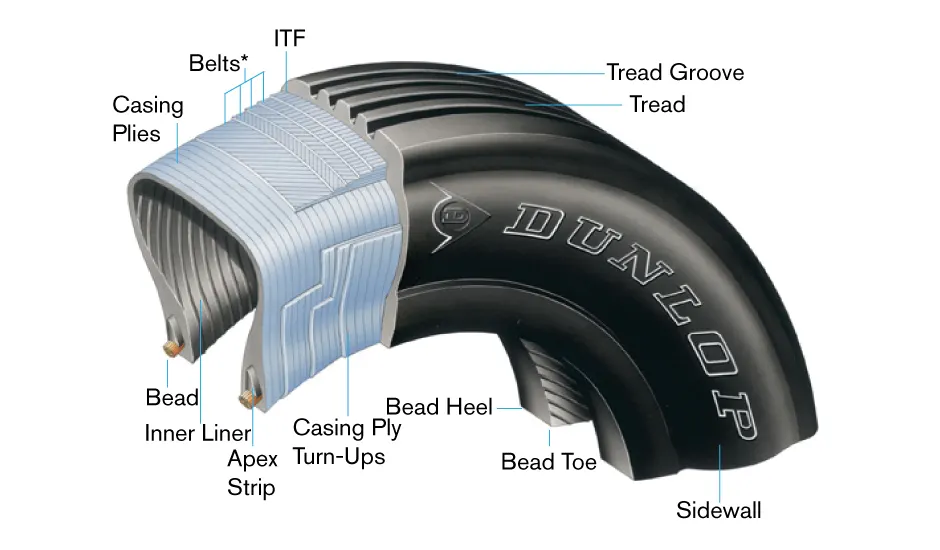
Aircraft tire design are set into an aircraft based on its application and also suffeicient clearance with the ground for allowing tyre growth which happens when centrifugal force is at high speed.
Rolling resistance:-
In the broad sense, specific "rolling resistance" (for vehicles) is the force per unit vehicle weight required to move the vehicle on level ground at a constant slow speed where aerodynamic drag (air resistance) is insignificant and also where there are no traction (motor) forces or brakes applied. In other words, the vehicle would be coasting if it were not for the force to maintain constant speed. This broad sense includes wheel bearing resistance, the energy dissipated by vibration and oscillation of both the roadbed and the vehicle, and sliding of the wheel on the roadbed surface (pavement or a rail).
But there is an even broader sense that would include energy wasted by wheel slippage due to the torque applied from engine This includes the increased power required due to the increased velocity of the wheels where the tangential velocity of the driving wheel(s) becomes greater than the vehicle speed due to slippage. Since power is equal to force velocity and the wheel velocity has increased, the power required has increased accordingly.
The "rolling resistance coefficient" is defined by the following equation:

- where
 is the rolling resistance force (shown as
  in figure 1),
 is the dimensionless rolling resistance coefficient or coefficient of rolling friction (CRF), and
 is the normal force , the force perpendicular to the surface on which the wheel is rolling.
Tyre Pressure:-
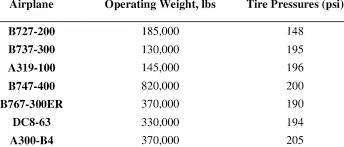
Tests of airliner aircraft tires have shown that they are able to sustain pressures of maximum 800 psi (55 bar; 5,500 kPa) before bursting.During the tests the tires have to be filled with water, to prevent the test room being blown apart by the energy that would be released by a gas when the tire bursts.
Aircraft tires are usually inflated with nitrogen to minimize expansion and contraction from extreme changes in ambient temperature and pressure experienced during flight. Dry nitrogen expands at the same rate as other dry atmospheric gases (normal air is about 80% nitrogen), but common compressed air sources may contain moisture, which increases the expansion rate with temperature.
Brake forces:-In aeronautics, air brakes or speed brakes are a type of flight control surface used on an aircraft to increase the drag on the aircraft. Air brakes differ from spolier in that air brakes are designed to increase drag while making little change to lift, whereas spoilers reduce the lift to drag ratio and require a higher angle of attack to maintain lift, resulting in a higher stall speed.
Braking an aircraft is a challenging job for most of the pilots especially during landing in a rainy and cross wind environment.
Inorder to encounter this kinds of problem pilots usually make use of spoilers and reverse thust method inorder to have a safe landing so that the energy required to apply brakes on tires can be reduced and henceforth they do not skid.
Now there is method which determines the brake force for aircrafts and they are as follows:
k=12mv
`where m= mass of aircraft and v=velocity of aircraft.A typical commercial landing speed will range between 150 to 165 MPH.And for passenger flight it is about 166 to 172mph`
6A. With necessary assumptions, calculate the force and power required to push / pull an aircraft by a towing vehicle.
Solution:-
Calculation:-
let us assume that,
Mass of Towing Vehicle= 40,000kg
Mass of aircraft = 155,000kg
Total mass (m)= 40,000+155,000 =195,000kg
Frontal Area of the aircraft (A) =18 m2
Speed of the vehicle ( ) =25Kmph
converting it into m/sec
= 25*(1000/3600)=6.9445m/sec
Drag coefficient (Cd) =0.75
Air density (  ) =1.225Kg/m3
Calculating Rolling resistance Force (Frr) = *m*g
= 0.01*195,000*9.8
= 19,110N
Calculating Aerodynamic Drag Force (Fd)=0.5* * Cd*A* v^2
=0.5*1.225*18*0.75*(6.9445)2
=398.769N
Therefore the total Force required to push/pull the aircrcraft by the towing vehicle
(F) = Frr+ Fd
= 19,110+ 398.769
= 19,508.769 N
Calculating the power (p) = Force*Velocity
= 19508.769* 6.9445
=135.478kW
B. Developing the model for the calculated force and power using Simulink:-
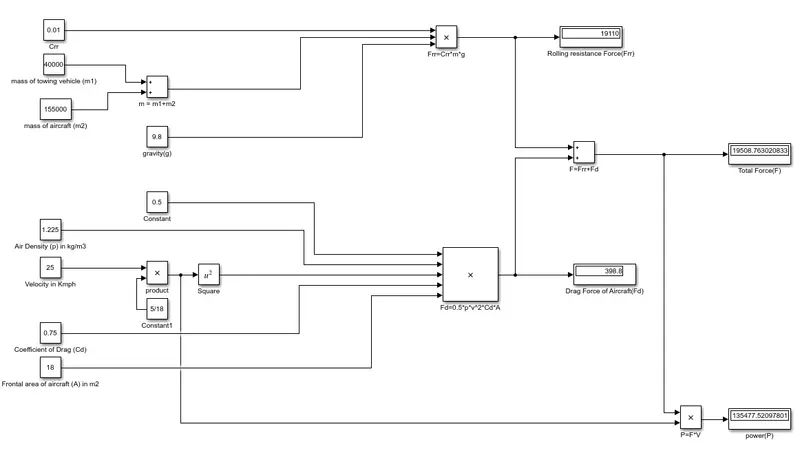
In order to understand the above simulink model we do reverse engineering.
- For calculating power we have to multiply both total force(F) and velocity in m/sec for this we have used 'product' block (P=F*V).
- For calculating the Total Force(F) we have added both Frr & Fd by using 'Sum' block as shown in the above figure.
- To find the value of rolling resistance (Frr) we used product to multiply the values Crr, Total mass(m) & gravity (g) which are to be entered in the 'Constant' block.
- Similarly for calculating Drag force(Fd) we have to multiply the velocity in m/sec,Drag coefficient, Frontal area of aircraft(A) and a constant value 0.5 which are to be entered in 'constant' block.
- In order to convert velocity in Kmph to m/sec we have multiplied it with 5/18.
7.A. Design an electric powertrain with type of motor, it’s power rating, and energy requirement to fulfill aircraft towing application in Simulink.
Electric powertrain with type of motor:-Electric Vehicle are not something new to this world, but with the technological advancement and increased concern on controlling pollution has given it a tag of future mobility. The core element of the EV, apart from Electric vehicle battery, which replaces the Internal Combustion engines is an Electric motor. The rapid development in the field Power electronics and control techniques has created a space for various types of electric motors to be used in Electric Vehicles. The electric motors used for automotive applications should have characteristics like high starting torque, high power density, good efficiency, etc.
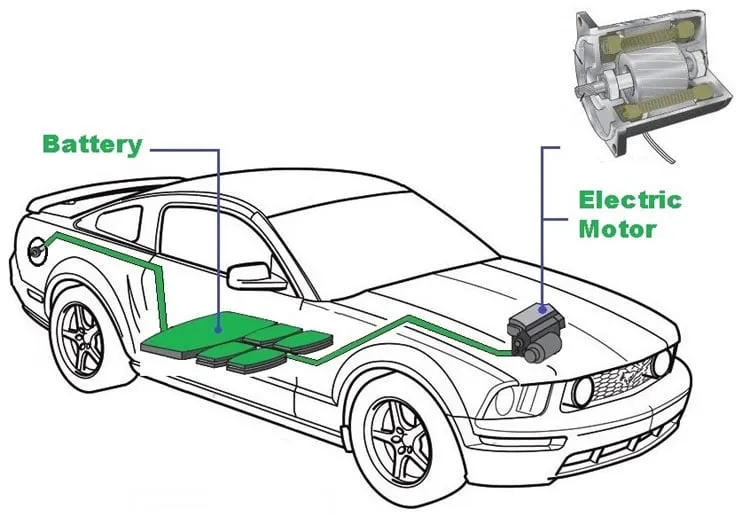
Various types of Electric Motors used in Electric Vehicles
- DC Series Motor
- Brushless DC Motor
- Permanent Magnet Synchronous Motor (PMSM)
- Three Phase AC Induction Motors
- Switched Reluctance Motors (SRM)
Based on the calculations done in 6A.
Force required to push/pull the aircraft =19.508 KN
Power required =135.478 kw
Let us assume,
The Radius of the Tyre for the Tug = 25inches =0.635m
Gear ratio = 8
Transmission Effeciency (ηt) =87%
Motor Efficiency (ηm)=95%
then,
Torque required for the wheels (Tw)=Total Force *Radius in meters
=19.508*0.635
= 12.387KNm
Motor Torque= Wheel torque/(Gear ratio*ηt)
= 12.387 / (8*0.87)
= 1.778KNm
For ηm =95%, The required motor Torque (Tm)= 1.778/0.95 =1.871 kNm
Similarly, The total power required by the motor considering all the efficiencies(Pt) = 135.478/(0.87*0.95)=163.917Kw
Let us assume the towing operation was done for a 15 minutes (0.25Hrs) duration.
Then, Total Energy consumed = 163.917*0.25 = 40.98 KWh
If we consider the battery capacity =220 kw is used by the towing vehicle then, The duty cycle range to control the speed from 0 to max speed (3m/s) is given as
Duty Cycle (d) = (Required Power)/ (Rated power)= 163.917/220 =0.75
Therefore the controller will be able to provide a duty cycle ranging from 0 to 75% in order to control the towing speed.
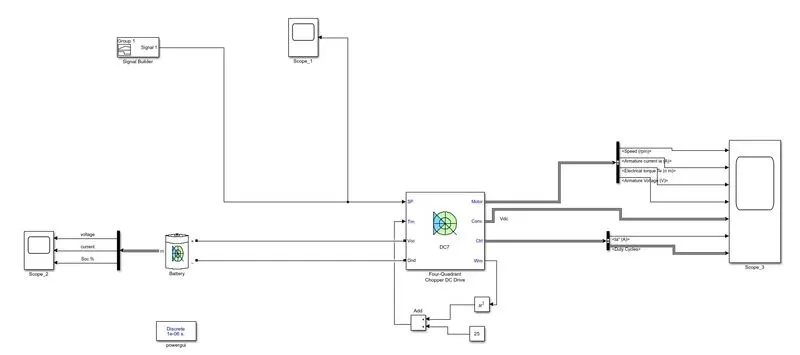
Simulink Diagram of powertrain:-
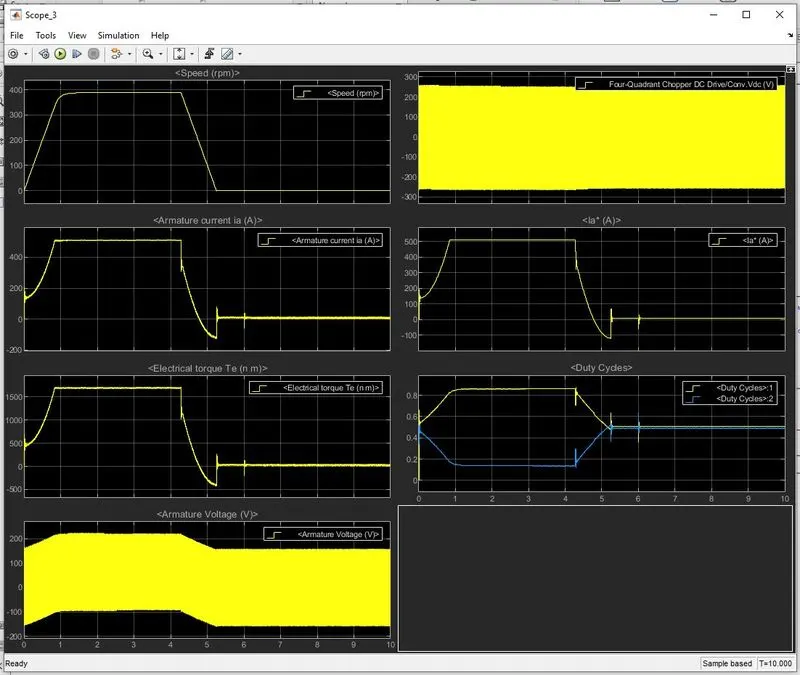
Output:-
Draw a block diagram of powertrain:-
B.Design the parameters in excel sheet.
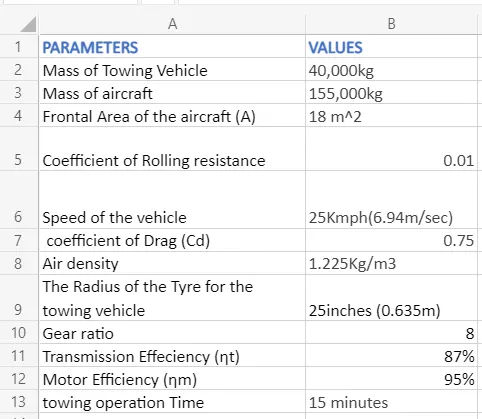 .
.