Project-1: Powertrain for aircraft in runways
Introduction to HEV Using Matlab & Simulink
Project-1: Powertrain for aircraft in runways
Part A:
- Search and list out the total weight of various types of aircraft's.
The following are the different aircraft and their different weight condition.
|
Aircraft Type |
Empty WEIGHT |
Max Fuel Weight |
Max Cargo Weight |
Gross Weight |
|
Antanov AN-225 |
285,000 kg |
300,000 kg |
190,000 kg |
640,000 |
|
Airbus A-380-800 |
277,000 kg |
254,000 kg |
84,000 kg |
575,000 |
|
Boeing 747-800 |
220,100 kg |
194,000 kg |
134,000 kg |
447,700 |
|
Airbus A340-500 |
168,000 kg |
175,000 kg |
54,000 kg |
372,000 |
|
Boeing 777-300ER |
168,000 kg |
145,500 kg |
67,100 kg |
352,000 |
|
Boeing 787-10 |
135,500 kg |
101,500 kg |
57,300 kg |
254,000 |
|
Boeing 737-900 |
24,000 kg |
20,000 kg |
20,200 kg |
85,000 |
|
Airbus A320-100 |
42,600 kg |
22,100 kg |
20,000 kg |
68,000 |
|
Embraer 190 |
28,800 kg |
13,000 kg |
13,100 kg |
48,000 |
|
Gulfstream G650 |
24,000 kg |
21,900 kg |
3,000 kg |
45,200 |
|
Bombardier CRJ900 |
21,850 |
8,900 |
2,760 |
36,500 |
|
Bombardier Q400 |
17,800 |
5,300 |
8,500 |
28,000 |
|
Learjet 75 |
6,300 |
2,750 |
1,300 |
9,700 |
|
Cessna Citation CJ4 |
4,700 |
2,650 |
1,000 |
7,800 |
|
Beechcraft King Air B100 |
3,200 |
1,450 |
1,900 |
5,400 |
|
Diamond DA50RG |
1,450 |
155 |
560 |
2,000 |
|
Beechcraft Bonanza G36 |
1,150 |
200 |
385 |
1,660 |
|
Cessna 206H |
990 |
235 |
520 |
1,630 |
|
Sirrus SR22 |
1000 |
220 |
430 |
1,630 |
|
Cessna 172R |
770 |
170 |
255 |
1,100 |
- Is there any difference between ground speed and air speed?
True Air Speed (TAS) is defined as the speed at which an aircraft is moving relative to the air it is flying in. As such we can say the speed at which the air is flowing around the aircraft's wings.
Where ground speed on the other hand, is the aircraft’s speed relative to ground, the important thing here is that ground speed is the horizontal speed rather than vertical speed- an aircraft climbing completely vertical would have a ground speed of zero.
Yes there is lot of difference between ground speed and airspeed.
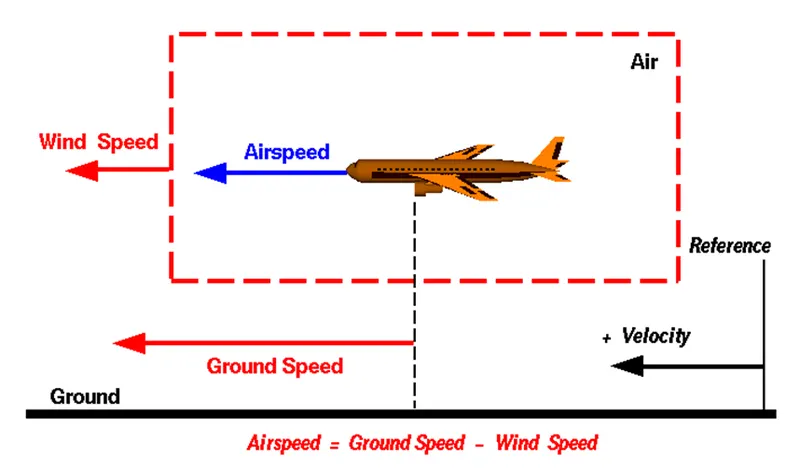
Relation between ground and airspeed:
The relationship between airspeed and ground speed is fairly simple. Ground speed is simply the sum of airspeed and wind speed
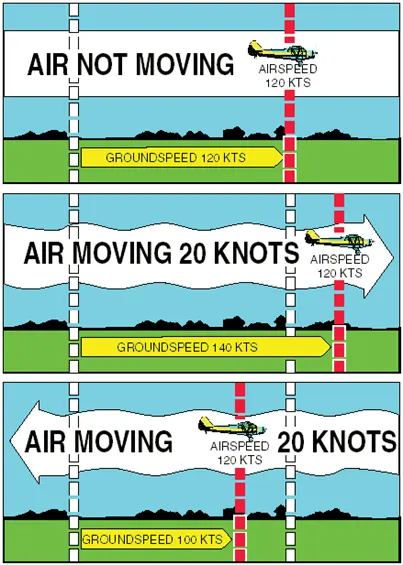
If the aircraft is flying in the same direction as the wind is blowing, the aircraft experiences tailwind, and its ground speed is higher than its airspeed. On the other hand, if the wind is blowing against the direction the aircraft is traveling in, the aircraft experiences a headwind, and its ground speed is lower than its airspeed.
3.Why is it not recommended to use aircraft engine power to move it on the ground at Airport?
For the moment on the ground, the aircraft uses the thrust produced by its own engine power, which is called taxing.
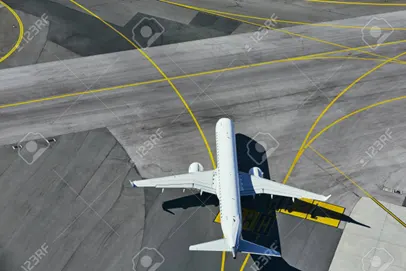
Although many aircraft are capable of moving in backward using reverse thrust, as a result, the jet blast or prop wash might cause damage to the terminal building or equipment. Engines closer to the ground may also blow sand and debris forward and then suck them into the engine which causes damage to the engine, therefore there are pushback trucks in the airport, these trucks lift the front wheel of the aircraft, their role is to move the aircraft away from a parking spot on to the taxiways, which is called as towing.
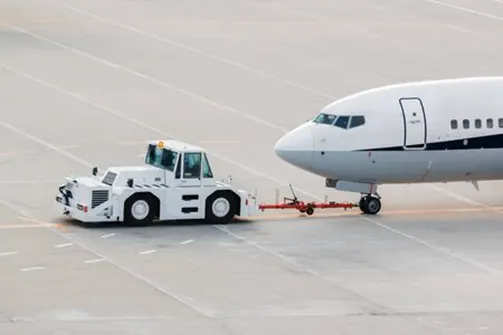
If a heavy aircraft having a heavy engine uses its own power to reach the aircraft parking gate, in case of any loss of control might damage the aircraft itself or any neighbor aircraft or the airport structures which results in a huge loss of money and loss of lives may also happen, to avoid such conditions towing is done for a safer operation of aircraft.
4.How an aircraft is pushed to runway when its ready to take off?
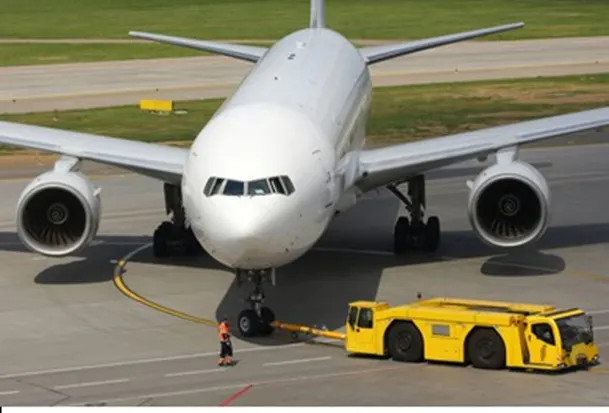
When an aircraft is ready to take off, it is necessary to get the aircraft to the taxing way from the parking gate, which is carried out by using a ground vehicle known as towing truck sometimes also called a towing tractor, it holds the aircraft’s nose gear using a towing bar (Mechanical structure connects the towing truck and aircraft).
When many people hear the word “taxiing,” they envision a ground vehicle physically moving an airplane on the runway. Taxiing, though, specifically involves the use of an airplane’s own propulsion system to move while on the runway. Towing, on the other hand, refers to the use of a ground vehicle. Known as a tug, these ground vehicles connect to airplanes so that they can move and turn airplanes.
5. Learn about take off power, tyre design, rolling resistance, tyre pressure, brake forces when landing.
Take Off Power:
The amount of power that an engine is allowed to produce for a limited period of time for take-off. The use of take-off power is usually limited to min for reciprocating engines and to 2 1/2 min for gas turbine engines. This may not always be the case. Specifically, with respect to reciprocating engines, it is the brake horsepower developed under standard, sea-level conditions and under the maximum conditions of the crankshaft rotational speed and the engine manifold pressure approved for the normal take-off. It is limited in continuous use to the period of time shown in the approved engine specifications. With respect to gas turbine engines, it is the thrust developed under the static condition at a specified altitude and under atmospheric conditions.
Tyre Design:
Tyre help to absorb the shock of landing and provide cushioning. It also provides the necessary traction for the braking and stopping of an aircraft.
An aircraft tire is designed to withstand extremely heavy loads while landing, take-off, taxing, and parking. The number of wheels required for aircraft increases with the weight of the aircraft, as the weight of the airplane needs to be distributed more evenly.
Carcass plies are used to form the tire. They are sometimes called casing plies. An aircraft tire is constructed for the purpose it serves.
- They support the weight of an aircraft while it is on the ground.
- It also provides the necessary traction for the braking and stopping of an airplane.
- Tyre also helps to absorb the shock of landing and provides cushioning for the roughness of take-off, roll-out, and taxi operations.
Technical Aspects Of The Tyre:
Re-treading:
Re-treading is a method of restoring a worn tire by renewing the tread area or by renewing the tread area plus one or both sidewalls. Repairs are included in the tire re-treading process.
Load Rating:
The load rating is the maximum permissible load at a specified inflation pressure.
Ply Rating:
Ply Rating is used to identify the maximum recommended load rating and inflation pressure for a specified tire. It is an index of tire strength.
Speed Rating:
The speed rating is the maximum take-off speed to which the tire has been tested.
Skid Depth:
Skid depth is the distance between the tread surface and the deepest groove as measured in the mold.
Rolling Resistance:
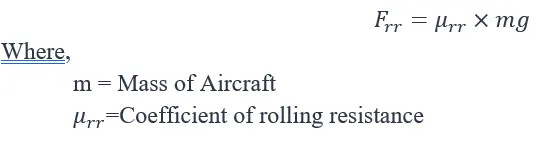
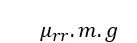
It is the resistance that the tires offer against the motion while on the ground. In the case of aircraft, rolling resistance can be experienced while take-off and while landing. The rolling resistance force is given by the following expression.
Tyre Pressure:
Aircraft tires are usually inflated with nitrogen to minimize expansion and contraction from extreme changes in ambient temperature and pressure experienced during flight. Dry nitrogen expands at the same rate as other dry atmospheric gases (normal air is about 80% nitrogen), but common compressed air sources may contain moisture, which increases the expansion rate with temperature
The requirement that an inert gas, such as nitrogen, be used instead of air for inflation of tires on certain transport category airplanes was prompted by at least three cases in which the oxygen in air-filled tires combined with volatile gases given off by a severely overheated tire and exploded upon reaching autoignition temperature. The use of inert gas for tire inflation will eliminate the possibility of a tire explosion
Aircraft tires generally operate at high pressures, up to 200psi (14 bar; 1400 kPa) for airliners, and even higher for business jets
Brake Force:
An electrical signal is sent from the flight deck to hydraulic actuators near the main landing gear. Here, hydraulic fluid at 3,000 pounds per square inch is used to force the brake unit against the wheel, thus slowing it down
Part B
6.A. With necessary assumptions, calculate the force and power required to push / pull an aircraft by a towing vehicle.
Consider an aircraft and towing vehicle model for parameters considerations
Towing vehicle Model: BA10G40 from BEML
Aircraft Model : Airbus A320
The calculations can be done using a simple excel sheet calculator by considering some real parameters from OEM specifications of trucks and aircraft, other environmental factors are assumed.
The calculations are done by without taking Gradability into consideration
|
Force and Power Required to Push/Pull an Aircraft with a towing vehicle. |
||
|
Parameters |
Values |
Comments |
|
Kerb weight of Towing Vehicle(kg) |
10000 |
BEML, B6D105-1 |
|
Driver weight (kg) |
100 |
|
|
Aircraft weight along with Fuel |
66000 |
Airbus A320 |
|
Gross Weight |
76100 |
|
|
Gravity 'g' (m/s2) |
9.81 |
|
|
Rolling resistance (urr) |
0.03 |
|
|
Force required for Rolling Resistance 'Frr'(N) |
22396.23 |
 |
|
Air Density (kg/m^3) ρ |
1.11 |
|
|
Frontal area 'A' (Towing truck + aircraft) (m^2) |
19.553 |
|
|
Drag Coefficient Cd |
0.27 |
|
|
Speed (kmph) |
10 |
Towing speed does not exceed 10kmph |
|
Velocity V (m/s) |
2.777777778 |
|
|
Force due to Aerodynamic drag Fad (N) |
22.60815625 |
 |
|
Nominal Power Of Motor (KW) |
62.27455043 |
82KW(110BHP) motor is used in Towing vehicle |
|
Force required for Tractive Effort Fte (N) |
22418.83816 |
Frr+Fad |
|
Vehicle Propulsion Power Pte (KW) |
62.27455043 |
|
6.B. Develop the model for the calculated force and power using Simulink.
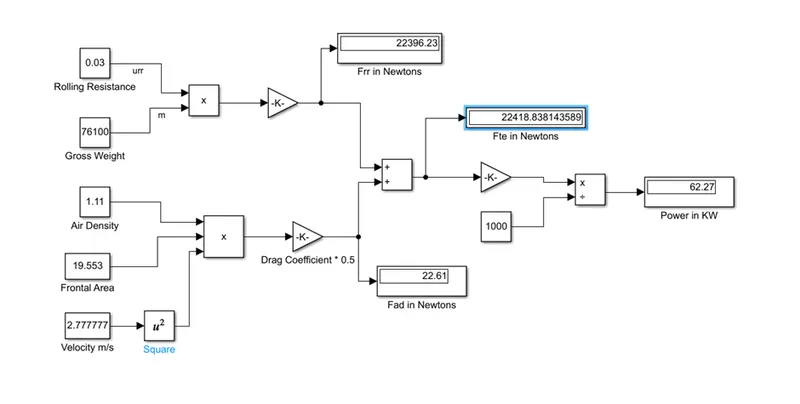
7.A Design an electric powertrain with type of motor, it’s power rating, and energy requirement to fulfill aircraft towing application in Simulink. Estimate the duty cycle range to control the aircraft speed from zero to highest. Make all required assumptions. Prepare a table of assumed parameters. Draw a block diagram of powertrain.
Assumptions made for Powertrain design:
|
Variables |
Value |
|
Aircraft Mass |
66000 kg |
|
Towing vehicle mass |
10000 kg |
|
Rolling resistance Co-efficient |
0.03 |
|
Air density |
1.11 m/s² |
|
Towing vehicle drag Co-efficient |
0.27 |
|
Aircraft Drag Co-efficient |
0.27 |
|
Frontal area |
19.553 m² |
|
Inclination Angle |
0 |
|
Tyre pressure |
203 PSI |
|
Towing velocity (V) |
10km/h or 2.778m/s |
|
Towing Time (t) |
5min = 0.083 hr |
|
Towing vehicle tyre radius r (m) |
0.38m |
From the Excel Force and power calculator we have got
Total Tractive Force Fte = 22418.83 Newtons
Required Power Pte = Fte × V = 22412.95 × 2.778 = 62.274 KW
We can get Torque at the Wheels T = Fte × r = 22418.83 × 0.38m= 8519.1544 N.m
Towing time (Hours)= 0.083 hrs (5min)
Required Energy (E) for towing
E = Pte × Towing Time (Hrs) = 62.274× 0.083 = 5.168 KWH
For this application an induction motor or a BLDC motor can be employed in vehicle powertrain.
For this application an induction motor or a BLDC motor can be employed in vehicle powertrain.
|
O/p Mechanical Power |
Motor HP |
No of phases |
Input voltage |
Input Current |
efficiency |
|
90 KW |
120 |
3 |
380 |
163.3A |
94.10% |
The motor output power is the input power of the towing vehicles so to obtain maximum speed, the duty cycle needed is calculated as shown below
Duty Cycle = Output power/Input Power = (62.27/90)*100 = 69.188%
The duty cycle range to control the towing truck speed is 69.188%
Block Diagram Of Powertrain for Towing Vehicle:
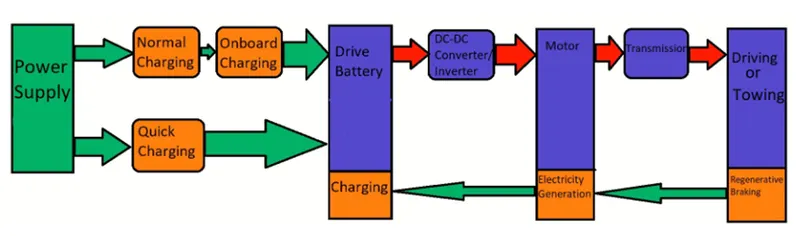
Electric vehicles consist of a battery, connected to an electric motor through an inverter and a motor controller. As automotive batteries generally operate on DC current, while the grid operates AC, a converter is needed to transfer power to the battery. One of the key advantages of an EV will achieve a system efficiency of 80% from battery to wheel, while with a conventional IC engine it is more like 15-25%. this is largely due to the fact that an IC engine is a heat engine, and the heat produced is simply getting wasted.
7.B Also, Design the parameters in excel sheet.
|
Force and Power Required to Push/Pull an Aircraft with a towing vehicle. |
||
|
Parameters |
Values |
Comments |
|
Kerb weight of Towing Vehicle(kg) |
10000 |
BEML, B6D105-1 |
|
Driver weight (kg) |
100 |
|
|
Aircraft weight along with Fuel |
66000 |
Airbus A320 |
|
Gross Weight |
76100 |
|
|
gravity 'g' (m/s2) |
9.81 |
|
|
Rolling resistance (urr) |
0.03 |
|
|
Force required for Rolling Resistance 'Frr'(N) |
22396.23 |
|
|
Air Density (kg/m^3) ρ |
1.11 |
|
|
Frontal area 'A' (Towing truck + aircraft) (m^2) |
19.553 |
|
|
Drag Coefficient Cd |
0.27 |
|
|
Speed (kmph) |
10 |
Towing speed does not exceed 10kmph |
|
Velocity V (m/s) |
2.77777778 |
|
|
Force due to Aerodynamic drag Fad (N) |
22.6081563 |
|
|
Nominal Power Of Motor (KW) |
62.27455043 |
82KW(110BHP) motor is used in Towing vehicle |
|
Towing time in hrs |
0.083333333 |
5min |
|
Radius of the wheel (m) |
0.38 |
|
|
Torque at Wheels (N.m) |
8519.158499 |
|
|
Force required for Tractive Effort Fte (N) |
22418.83816 |
Frr+Fad |
|
Vehicle Propulsion Power Pte (KW) |
62.27455043 |
|
|
Energy Consumed for 5min of Towing |
5.18954587 |
in KWH |