Project-1: Powertrain for aircraft in runways
AIM:
Part A:
1. Search and list out the total weight of various types of aircrafts.
2. Is there any difference between ground speed and air speed?
3. Why is it not recommended to use aircraft engine power to move it on the ground at Airport?
4. How an aircraft is pushed to runway when its ready to take off?
5. Learn about take off power, tyre design, rolling resistance, tyre pressure, brake forces when landing.
Part B:
6. A. With necessary assumptions, calculate the force and power required to push / pull an aircraft by a towing vehicle.
B. Develop the model for the calculated force and power using Simulink.
7. A. Design an electric powertrain with type of motor, it’s power rating, and energy requirement to fulfill aircraft towing application in Simulink. Estimate the duty cycle range to control the aircraft speed from zero to highest. Make all required assumptions. Prepare a table of assumed parameters. Draw a block diagram of powertrain.
(Hint :DC7 Block)
B. Also, Design the parameters in excel sheet.
solution
1. Search and list out the total weight of various types of aircrafts.
Answer:
Basic Nomenclature:
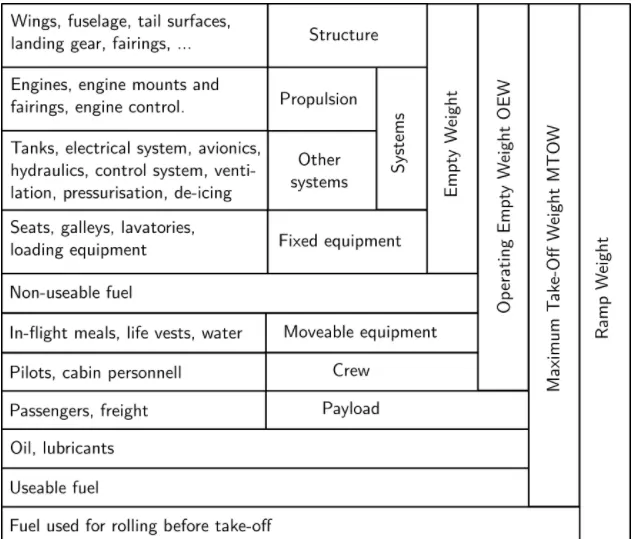
| AUW | Aircraft Gross Weight AUW: Total Aircraft wieght at any moment during flight or grounded Aircraft Gross weight will decrease during flight due to fuel /oil consumption and payload dropping |
| ATOW | Actual take off Weight: which is used for take-off performance calculation. |
| MDTOW | MAXIMUM DESIGN TAKEOFF WIEIGHT(MOTOW) Maximum weight authorized at brake release for take off |
| ALW | Actual Landing Weight current gross wight to determine the final approach speed is ALW |
| Type | MDTOW kg |
| Glider | 110-200 |
| Powered lift | 160 |
| Fighter Jets | 135000 |
| Aerobatic | 771 |
| Airbus A380 | 640000 |
| Airbus A350 | 270000 |
| Airbus A330 | 242000 |
| Boeing 747 | 450000 |
| Boeing 777-300 | 300000 |
2. Is there any difference between ground speed and air speed?
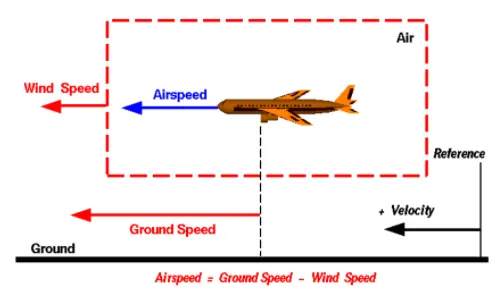
| Ground Speed | Speed of Aircraft relative to the ground. Independent of Airspeed |
| Air Speed | It is relative speed between object and the air. It is measured from ground and wind speed or vector difference between them. |
3. Why is it not recommended to use aircraft engine power to move it on the ground at Airport?
Answer:
The use of aircraft power to move on ground is called Taxing. The reason for not using the aircraft jet engine for ground movement
high fuel consumption which can be superseded by electric motor
- Risk of JEt blast
- Out of control issues
- Chances of ground particles to get into engine causing damage
- Damage to nearby structures due to propulsion
4. How an aircraft is pushed to runway when its ready to take off?
Answer:
option -1: Taxing without acclerating run before take off and decelerating run after landing
Option -2: Pushback/Towing- external power or source to push aircraft using special low profile vehicles
5. Learn about take off power, tyre design, rolling resistance, tyre pressure, brake forces when landing.
Answer:
| Take off power | phase where the flight leaves the gournd to air Forces Involved: T- Thrust of propulsion system D- Aerodynamic Drag F-Rolling resistance Acceleration during take off along run way at mass m of vehicle dV/dt = (T-D-F)/m |
| Rolling resistance | Friction between the aircraft and runway is proportional to normal force exerted by the aircraft on the runway F=µ(W-L) µ- Friction coefficient 0.02 W- Aircraft weight L- Lift |
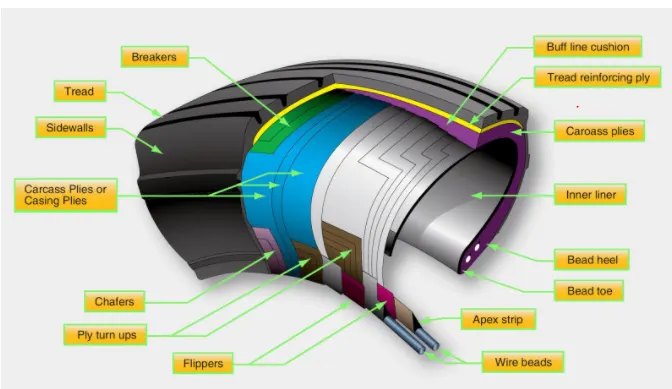
| Tyre Design: | Tyres of aircraft are designed to absorb the shock during landing and provide necessary traction for braking. Withstand heavy load No. of wheels is proportional to the weight of aircraft to distribute the load uniformly Carcass Piles are used to form tires to support load, give necessary traction and absorb shock. Tread: crown area of tires designed to make contact with ground having high heat resistant and traction/adhesion capability |
| Tyre Pressure | Ranges upto 200 psi/14 bar for domestic and international |
| Braking Forces | Braking is achieved by electrical signal actuated hydraulic brake unit system. Fluid press ure around 3000 psi is used to apply the brake and generate required force;. 3 types of braking forces - Engine Power, Wheel Brakes and Mechanical Spoilers |
Part B:
6. A. With necessary assumptions, calculate the force and power required to push / pull an aircraft by a towing vehicle.
Answer:
| Assumption | |||
| force acting on pushback truck - Rolling resistance force and Aerodynamic drag force | |||
| Aerodynamic Force to move air plane on flat run way - neglible | |||
| Input | |||
| Parameter | Value | Unit | Formula |
| mass of Airbus 'm' | 164000 | kg | |
| Coeff of friction 'mu' | 0.02 | ||
| Acceleration due to gravity 'g' | 9.81 | m/s^2 | |
| Aircraft Rolling resitance force'Frr1' | 32177 | N | mu*m*g |
| Pushback truck friction'u' | 0.02 | ||
| Pushback truck weight 'm1' | 35000 | kg | |
| Pushback truck 'Frr2' | 6867 | N | u*m1*g |
| Total rolling resitance ' Frr' | 39044 | N | Frr1+Frr2 |
| Front area of flight | 693.63 | m^2 | |
| density of air 'rho' | 1.225 | kg/m^3 | |
| velocity of aircraft 'v' | 5.56 | m/s | |
| Coeff of discharge 'Cd' | 0.0265 | ||
| Aerodynamic Force 'Fad' | 348.04 | N | 0.5*rho*A*Cd.v^2 |
| Net Force Fnet | 39392 | N | Frr+ Fad |
| Velociy of push back truck 'V' | 5.56 | m/s | |
| Power | 219.02 | KW | Fnet*V/1000 |
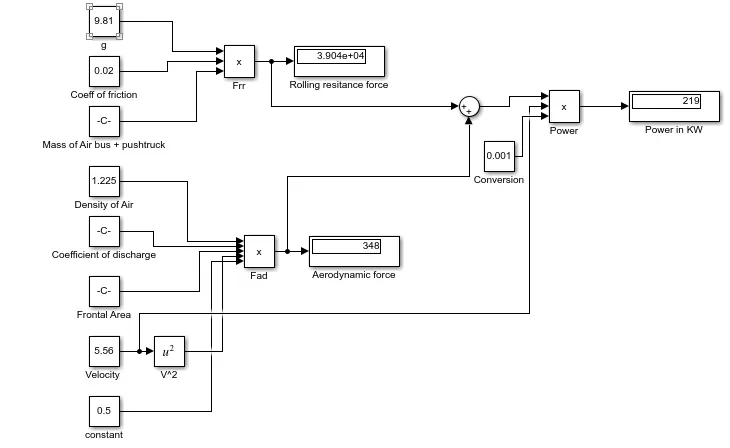
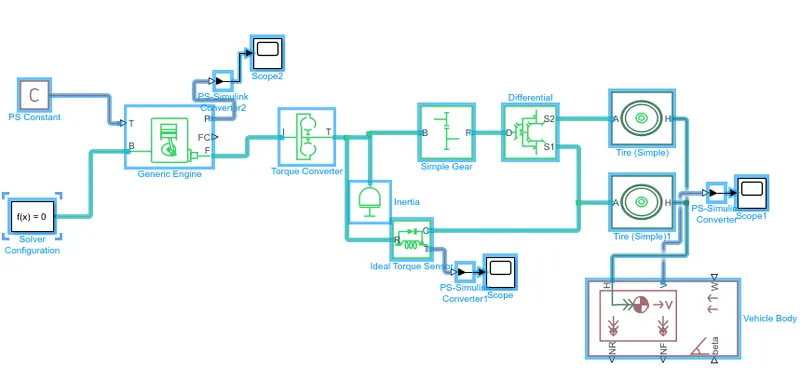
B. Develop the model for the calculated force and power using Simulink.
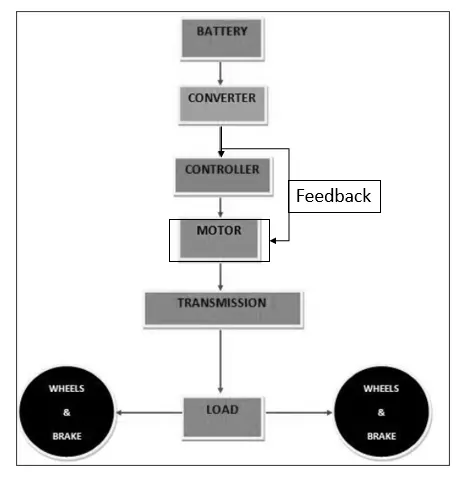
7. A. Design an electric powertrain with type of motor, it’s power rating, and energy requirement to fulfill aircraft towing application in Simulink. Estimate the duty cycle range to control the aircraft speed from zero to highest. Make all required assumptions. Prepare a table of assumed parameters. Draw a block diagram of powertrain.
(Hint :DC7 Block)
B. Also, Design the parameters in excel sheet.
Block Diagram:
| Assumption | |||
| force acting on pushback truck - Rolling resistance force and Aerodynamic drag force | |||
| Aerodynamic Force to move air plane on flat run way - neglible | |||
| Input | |||
| Parameter | Value | Unit | Formula |
| mass of Airbus 'm' | 164000 | kg | |
| Coeff of friction 'mu' | 0.02 | ||
| Acceleration due to gravity 'g' | 9.81 | m/s^2 | |
| Aircraft Rolling resitance force'Frr1' | 32177 | N | mu*m*g |
| Pushback truck friction'u' | 0.02 | ||
| Pushback truck weight 'm1' | 35000 | kg | |
| Pushback truck 'Frr2' | 6867 | N | u*m1*g |
| Total rolling resitance ' Frr' | 39044 | N | Frr1+Frr2 |
| Front area of flight | 693.63 | m^2 | |
| density of air 'rho' | 1.225 | kg/m^3 | |
| velocity of aircraft 'v' | 5.56 | m/s | |
| Coeff of discharge 'Cd' | 0.0265 | ||
| Aerodynamic Force 'Fad' | 348.04 | N | 0.5*rho*A*Cd.v^2 |
| Net Force Fnet | 39392 | N | Frr+ Fad |
| Velociy of push back truck 'V' | 5.56 | m/s | |
| Power output | 219.02 | KW | Fnet*V/1000 |
| Electric Motor Parameters | |||
| Input battery Voltage | 400 | V | |
| Power continuous | 60-70 | KW | |
| Torque max | 300 | Nm | |
| Weight | 22 | kg | |
| Cooling | Air | ||
| battery Current | 620 | A | |
| Power Input | 248000 | Watts | Motor Voltage* current |
| Power input in kw | 248 | kw | |
| Correction factor | 0.9 | ||
| Considering 10 % losses to increase demand voltage by 10 % | |||
| Duty cycle | 0.8831 | power output/ power input | |
| Time to tow in Hour | 0.3333 | 20 min/60 | |
| Energy to tow | 73.006 | power output/ power input | |