Powertrain for aircraft in runways
Powertrain for Aircraft in runways
Objectives:
1. Listing out the various types of aircrafts with their weight.
2. Finding out whether ground speed and air speed are different terminologies.
3. Justify, why it is not recommended to use aircraft engine power to move it on the ground at Airport.
4. How is an aircraft pushed to runway when its ready to take off?
5. To learn about take off power, tyre design, rolling resistance, tyre pressure, brake forces when landing.
6. Calculating the force and power required to push/pull an aircraft by a towing vehicle, with necessary assumptions.
7. Designing an electric powertrain with type of motor, it’s power rating, and energy requirement to fulfill aircraft towing application. Estimating the duty cycle range to control the aircraft speed from zero to highest. Taking all required assumptions. Preparing a table of assumed parameters. Creating a block diagram of powertrain.
Description:
Study 1: Listing out the various types of aircrafts with their weigh
The list of different aircrafts with their weight is provided in the table below.
MTOW=Maximum Take-Off Weight, MLW=Maximum Landing Weight.
| Type | MTOW [kg] | MLW [tons] |
|---|---|---|
| Antonov An-225 | 640,000 | 591.7 |
| Airbus A380-800 | 575,000 | 394 |
| Boeing 747-8F | 447,700 | 346.091 |
| Boeing 747-8 | 443,613 | 306.175 |
| Boeing 747-400ER | 412,770 | 295.742 |
| Antonov An-124-100M | 405,060 | 330 |
| Boeing 747-400 | 396,900 | 295.742 |
| Lockheed C-5 Galaxy | 381,000 | 288.417 |
| Boeing 747-200 | 377,840 | 285.700 |
| Boeing 747-300 | 377,840 | 260.320 |
| Airbus A340-500 | 371,950 | 240 |
| Airbus A340-600 | 367,400 | 256 |
| Boeing 777F | 347,800 | 260.816 |
| Boeing 777-300ER | 351,800 | 251.29 |
| Boeing 777-200LR | 347,450 | 223.168 |
| Boeing 747-100 | 340,200 | 265.300 |
| Airbus A350-1000 | 308,000 | 233.5 |
| Boeing 777-300 | 299,370 | 237.683 |
| Boeing 777-200ER | 297,550 | 213.00 |
| Airbus A340-300 | 276,700 | 190 |
| McDonnell Douglas MD-11 | 273,300 | 185 |
| Airbus A350-900 | 270,000 | 175 |
| Ilyushin Il-96M | 270,000 | 195.04 |
| McDonnell Douglas DC-10 | 256,280 | 183 |
| Boeing 787-9 | 254,000 | 192.777 |
| Boeing 787-10 | 254,000 | 201.849 |
| Airbus A340-200 | 253,500 | 181 |
There are many aircrafts other than the above mentioned. Let's consider a Airbus A318 and design a powertrain for towing this aircraft of 59,000kg weight.
Study 2: Finding out whether ground speed and air speed are different terminologies.
Ground speed and Air speed are totally different concepts. Depending upon the presence of wind and the direction of wind we can determine the airspeed of any object.
Ground Speed: It is the speed of a flying object when measured from a point on the ground.
to understand Air speed we first have to know Wind Speed.
Wind speed: It is the speed of wind measured from a point on the ground.
Ground speed and Wind speed are both vector quantities. Their direction is of measure concern when solving.
Air speed: It is the difference between ground speed and wind speed.
Air speed = Ground speed - Wind speed
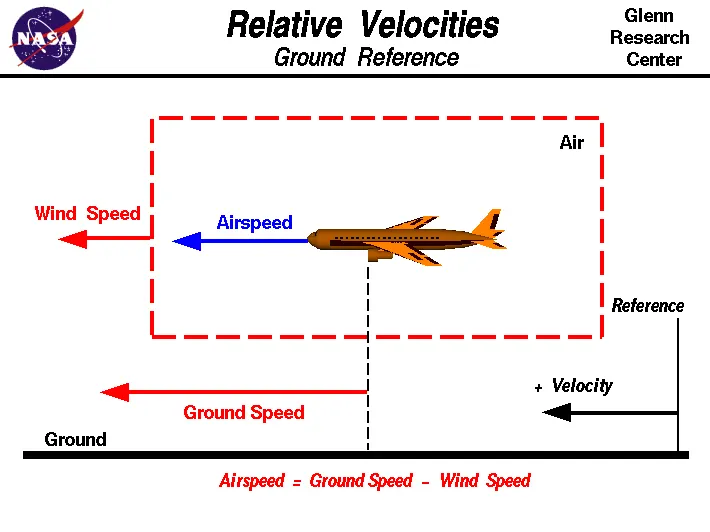
Let's assume, an aircraft flying with a speed of 50m/s from east to west. Also, wind is flowing around the plane with a speed of 10m/s from same direction east to west.
Always take the direction of the flying object as positive. If the wind is in same direction as of the flying object, then take it positive. If it is in opposite direction to that of the flying object take it negative.
Now, Air speed = ground speed - wind speed ; Air speed = (+50) - (+10) = 40m/s.
Hence the Ground speed of the object is 50m/s and Air speed is 40m/s.
Similarly, if the wind is blowing from west to east with 10m/s,
then, Air speed = ground speed - Wind speed = (+50) - (-10) = 60m/s.
So, even is its ground speed is 50m/s. the Air speed of the object is 60m/s.
Hence, ground speed and air speed of an object are different, and they are differed by wind speed.
Study 3: why it is not recommended to use aircraft engine power to move it on the ground at Airport.
The use of an aircraft's engine is not very preferred to move it on the ground at the airport, because of following main reasons:
- Fuel consumption: A lot of fuel is used by the aircraft engine because it is used to generate high power for propulsion and if we use it for moving around the airport it will cause wastage of fuel and unnecessary expense.
- Wear and tear on the engine: When the engines are running on the ground, the downwards acting thrust blows the air from the ground in the air. This contains particles from the ground and air. There are quite high chances of the engine sucking these particles in and causing damage to its parts. This particles causing damage is termed as Foreign Object damage(FOD).
- Unnecessary noise and damage to the surroundings: The engines create a lot of noise that can irritate the people around. Also, the thrust blow can damage the surrounding infrastructure.
Study 4: How is an aircraft pushed to runway when its ready to take off?
An aircraft uses two methods to move on the ground prior to take off and after landing.
The method in which engine powers the movement is called Taxiing. An airplane uses taxiways to taxi from one place to another on an airport. For example, when moving from a hangar to the runway. The term "taxiing" is not used for the accelerating run along a runway prior to takeoff, or the decelerating run immediately after landing, which are called the takeoff roll and landing rollout, respectively.
The method in which the engines are not used for movement is called pushback or towing. It uses a low-profile vehicle to push the aircraft backwards from the gate terminal. These vehicles are called as pushback tractors or tugs.
Although many aircraft are capable of moving themselves backwards on the ground using reverse thrust, the resulting jet blast or prop wash might cause damage to the terminal building or equipment. Engines close to the ground may also blow sand and debris forward and then suck them into the engine, causing damage to the engine. A pushback is therefore the preferred method to move the aircraft away from the gate.
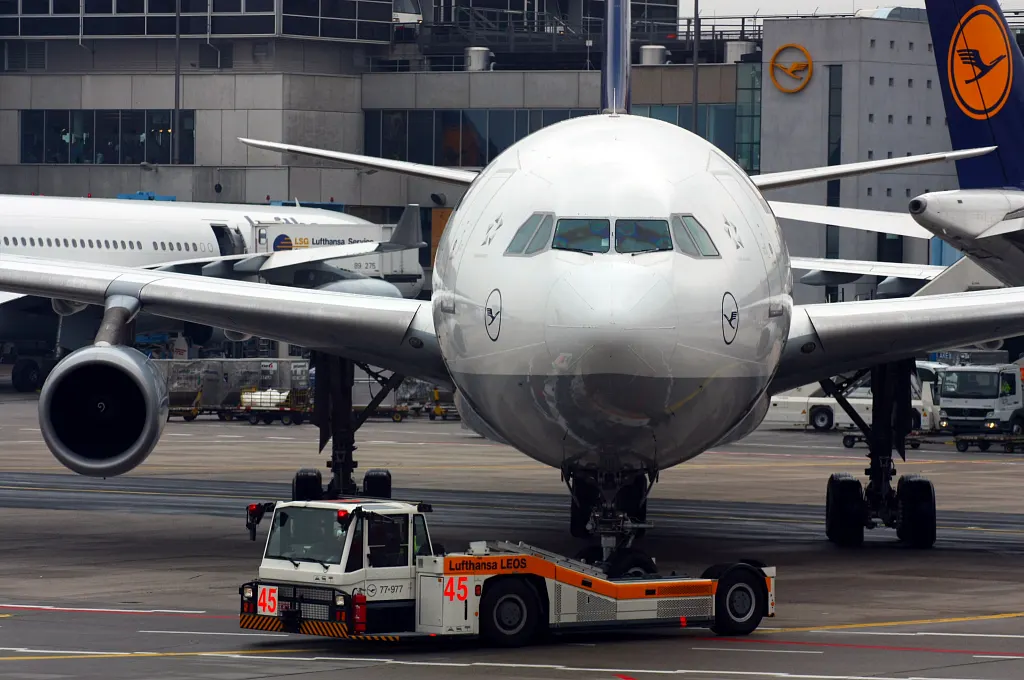
In this image a tug is used to transport a Lufthansa Airbus 340-300.
In short, firstly the pushback or towing method is used to move the aircraft out of the gate with the help of a tug. Secondly, the taxxing is done by the aircraft on its own power till it starts the take-off roll. So, in order to push an aircraft to runway, towing is done.
Study 5: To learn about takeoff power, tyre design, rolling resistance, tyre pressure, brake forces when landing.
Takeoff power:
Takeoff is the phase of flight in which an aerospace vehicle leaves the ground and becomes airborne. For aircraft that take off horizontally, this usually involves starting with a transition from moving along the ground on a runway. For baloons, helicopters and some specialized fixed-wing aircraft, no runway is needed. Takeoff is the opposite of landing.
When a plane is moving on the ground, the forces ating on it are the gravity, thrust and the drag. The lift is also acting, but as the plane is on the ground, the lift force is obviously less than gravity that is why its on ground. In order to take off, the amount of thrust with the required speed of the plane results in generation of lift force. This thrust force and the speed gives the power product. It has to overcome the gravity by generating lift and drag by generating thrust. This is how an aircraft take off takes place.
Tyre Design:
An aircraft tire is designed to withstand extremely heavy loads for short durations. The number of tires required for aircraft increases with the weight of the aircraft, as the weight of the airplane needs to be distributed more evenly. Aircraft tire tread patterns are designed to facilitate stability in high crosswind conditions, to channel water away to prevent hydroplaning, and for braking effect.
Aircraft tires also include fusible plugs(which are assembled on the inside of the wheels), designed to melt at a certain temperature. Tires often overheat if maximum braking is applied during an aborted takeoff or an emergency landing. The fuses provide a safer failure mode that prevents tire explosions by deflating in a controlled manner, thus minimizing damage to aircraft and objects in the surrounding environment.
Design and construction:
An aircraft tyre are constructed for the following purposes.
- They support the weight of an aircraft while it is on the ground.
- It also provides the necessary traction for braking and stopping of an aeroplane.
- Tyre also helps to absorb the shock of landing and provide cushioning the roughness of takeoff, roll-out, and taxi operations.
Unlike an automobile or truck tyre, it does not have to carry a load for a long period of continuous operation. However, an aircraft tyre absorbs the high impact loads of landing and also it’s operating at high speeds for a short time when required.
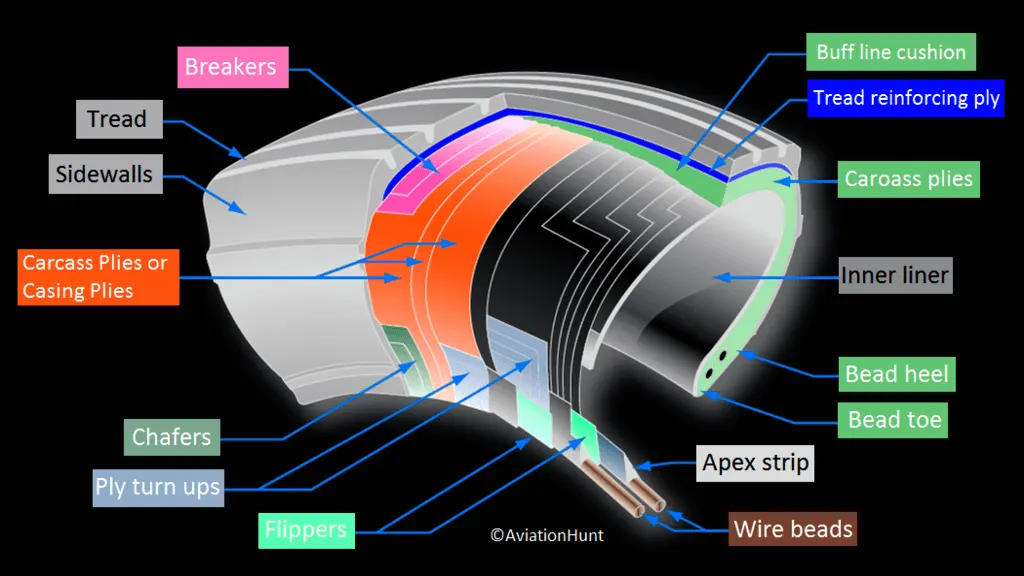
Some terminologies used in an Aircraft tyre:
Retreading – Retreading is methods of restoring a worn tyre by renewing the tread area or by renewing the tread area plus one or both sidewalls. Repairs are included in the tyre retreading process.
Load Rating – Load rating is the maximum permissible load at a specified inflation pressure.
Ply Rating – Ply Rating is used to identify the maximum recommended load rating and inflation pressure for a specified tyre. It is an index of tyre strength.
Speed Rating – The speed rating is the maximum takeoff speed to which the tyre has been tested.
Skid Depth – Skid depth is the distance between the tread surface and the deepest groove as measured in the mould.
Aircraft tyres must have an approved speed and load rating and have sufficient clearance when retracted through landing gear to allow for tyre growth. Tyre growth is the increase in the size of the tyre due to centrifugal forces at high speed.
Rolling Resistance:
Rolling resistance, sometimes called rolling friction or rolling drag, is the force resisting the motion when a body (such as a ball, tire, or wheel) rolls on a surface. It is mainly caused by non-elastic effects; that is, not all the energy needed for deformation (or movement) of the wheel, roadbed, etc., is recovered when the pressure is removed.
The rolling resistance coefficient is defined by the following equation:
- where
- F =is the rolling resistance force
- ur =is the rolling resistance coefficient
- N =is the normal force, the force perpendicular to the surface on which the wheel is rolling.
Tyre pressure:
Making sure that the aircraft tires are properly inflated is a crucial part of preflight and routine service checks which can go a long way to maximizing tire utilization and minimizing risks to safe operations.
A Boeing 777 uses 14 tires, Airbus' A380 carries 22, and the Antonov An-225 demands 32. The key to their remarkable durability is maximizing the air pressure. The high-flying rubber is typically inflated to 200 psi, roughly six times what you put in an automobile tire, and the tires on an F-16 fighter are pumped to 320 psi.
Aircraft tires are amazing when you think about it. The typical airliner tire can handle a 38-ton load. It can meet the ground 500 times before needing a re-tread, it can be done seven times in its life. Basically, A tire can last 3500 flights.
Breaking Forces:
A short landing run requirement for an aircraft is important from economic, operational and strategic considerations. Too strong a braking produces skid, which is an undesirable condition, while weak breaking results in a long landing run. The shortest possible (optimal) landing run without any skidding requires a variable braking force to match the frictional force at all times.
In aeronotics, air brakes or speed brakes are a type of flight control surfaces used on an aircraft to increase drag or increase the angle of approach during landing. Air brakes differ from spoilers in that air brakes are designed to increase drag while making little change to lift, whereas spoilers reduce the lift-to-drag-ratio and require a higher angle of attack to maintain lift, resulting in a higher stall speed.
Study 6: Calculating the force and power required to push/pull an aircraft by a towing vehicle, with necessary assumptions.
Tugs do not need that much horsepower, even the biggest tugs only have around 400bhp. What they do need is lots of torque for push/pull power, lots of weight to give it plenty of inertia, and big grippy tires to transfer the power to the surface.
The force to move an air plane on an absolute flat runway with no wind at constant low speed is equal to the rolling resistance between the plane and the tarmac.
For simplification, let's assume that the aircraft is the payload on the towtractor and calculate the force required to move it.
Let's assume our aircraft is Airbus A318. It's weight is 59,000kg. The towtruck used to carry this is Eagle XM-20, and weighs around 10,500kg.
The rolling resistance on the towtruck can be calculated as,
Fr = u mr ag
where
Fr = rolling resistance (N)
u = rolling resistance coefficient of the twotruck tyre
mr = rolling mass (kg) (mass of aircraft + mass of towtruck)
ag = acceleration of gravity (9.81 m/s2)
Fr = [0.01*(59000+10500)*9.8]
Fr = 6817 N
The aerodynamic drag force acting on the towtruck can be calculated as,
`Fad = 1/2* rho*A*v^2*cd`
Fad = aerodynamic drag force;
`rho`= air density kg/m3;
A = frontal area of the towtruck(we are not calculating w.r.t. aircraft's drag and frontal area, assuming it as payload)
v = velocity at which towing takes place;
cd = drag coefficient of the towtruck;
frontal area of the towtruck is 4.41m2;
The speed at which this towing takes place is around 4.5kmph. And the maximum speed of the towtruck is 5.1kmph.
velocity = 4.5kmph x 1000/3600 = 1.25m/s;
drag coefficient is assumed to be 0.5, since the front is near about flat vertically;
`Fad = 1/2* rho*A*v^2*cd`
`Fad =0.5*1.225*4.41*1.25^2*0.5`
`Fad =2.11 N`
Total force = Fr + Fad
Force = 6817+2.11 = 6819.11N
Hence, the force required to push/pull the aircraft is 6819.11 N.
For power reuired: Force multiplied by the velocity of the object gives the power.
Power = force x velocity
= 6819.11 x 1.25
Power = 8523.88 watt
The power required to push or pull the Airbus A318 is 8523.88 watt.
Study 7: Designing an electric powertrain with type of motor, it’s power rating, and energy requirement to fulfill aircraft towing application. Estimating the duty cycle range to control the aircraft speed from zero to highest. Taking all required assumptions. Preparing a table of assumed parameters. Creating a block diagram of powertrain.
We know the power required is 8523.88 watt. Hence, the motor required to do this job should have power rating above 8523.88 watts or 11.5HP.
Type of motor to use: DC brushless motor and AC motor are the two motors which can be used efficiently for propulsion of vehicles with the help of inverters and controllers. However, AC motor can give high starting torque compared to DC. Also, there is a 12.5HP motor available which can quite perfectly meet our requirement as they produce high starting torque.
We are moving the load with a speed not above 5kmph, and require high starting torque. Hence, AC motor of 12.5HP is suitable for our purpose.
Power Rating of the motor:
| Motor Rating | Power | 220V AC | 240V AC | 380V AC | 415V AC | 550V AC |
| 9.3KW | 12.5HP | 34 | 32 | 20 | 18 | 14 |
| 10 kW | 13.5 | 37 | 34 | 22 | 20 | 15 |
| 11 kW | 15 | 41 | 37 | 23 | 22 | 16 |
These are the motor with power rating above 8523.88watt. The average current at full load w.r.t. specific voltage supply is given in the table.
From the table the motor with 11KW power rating is selected with 415V battery and 22amp current settings.
This provides with a power of 415 x 22 = 9130watt.
Energy required = Power required x time taken
To calculate energy required, we know the power required. Assuming the time taken by the towtractor to push the aircraft as 5 min(300sec).
Hence the energy required to fulfill the towing application is 8523.88 x 300 = 2557.164 J.
Duty Cycle: Duty cycle is a concept that decides the on off period for a semicounductor switch, generally used to varry the amount of voltage to be supplied to the battery.
The maximum duty cycle is given by, d=Pout/Pin
d = 8523.88/9130 = 0.93
Also P = V x I
Electrical Power(i.e. input) = 415 Battery Voltage x 22Amp = 9130 Watt
Power required is 8523.88 = V x 22Amps
Voltage = 387.45V
Hence, duty cycle = Vout/Vbattery = 387.45/415 = 0.93
Duty cycle=93%
Hence, duty cycle range for the selected battery and motor is in between 0 and 0.93.
Powertrain of the vehicle:
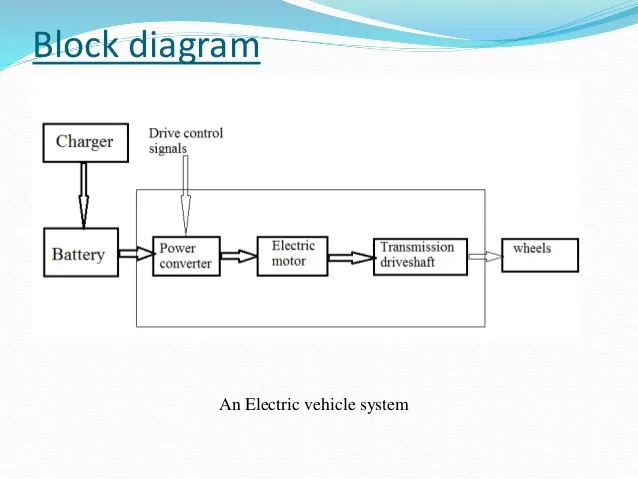
The powertrain of the vehicle consists of the battery, motor controller(inverter with drive signals), electric motor, transmission driveshaft, and wheels.
Battery stores the DC form of electricity. As we are using a AC induction motor, DC to AC converter is needed. Also there is need of duty ratios to control the battery output voltage, in order to generate required output. The motor controller does the work of inverting the supply from DC to AC and also generating the duty ratios. Next comes the motor and then the trnsmission driveshaft to transfer the power to the wheels.
The image below shows the powertrain block diagram for electric towtractor.