Project-1: Powertrain for aircraft in runways
What is an Aircraft?
An aircraft is a vehicle that is able to fly by gaining support from the air. It counters the force of gravity by using either static lift or by using the dynamic lift of an air foil, or in a few cases the downward thrust from jet engines. Common examples of aircraft include airplanes, helicopters, airships (including blimps), gliders, paramotors and hot air balloons.
Aircraft weight
Manufacturer's empty weight (MEW) also called Manufacturer's Weight Empty (MWE) or Licensed Empty Weight
- It is the weight of the aircraft "as built" and includes the weight of the structure, power plant, furnishings, installations, systems and other equipment that are considered an integral part of an aircraft. This excludes any baggage, passengers, or usable fuel.
Zero-fuel weight (ZFW)
- This is the total weight of the airplane and all its contents (including unusable fuel), but excluding the total weight of the usable fuel on board. As a flight progresses and fuel is consumed, the total weight of the airplane reduces, but the ZFW remains constant.
Operating empty weight (OEW) (Roughly equivalent to basic empty weight on light aircraft)
- It is the basic weight of an aircraft including the crew, all fluids necessary for operation and all operator items and equipment required for flight but excluding usable fuel and the payload.
Payload
- It is the carrying capacity of an aircraft. It includes cargo, people, extra fuel. In the case of a commercial airliner, it may refer only to revenue-generating cargo or paying passengers.
Maximum takeoff weight (MTOW)
- This is the maximum weight at which the pilot of the aircraft is allowed to attempt to take off.
Regulated takeoff weight (RTOW)
- Depending on different factors (e.g. flap setting, altitude, air temperature, length of runway), RTOW or maximum permissible takeoff weight varies for each takeoff. It can never be higher than MTOW.
Maximum Landing weight (MLW)
- This maximum weight at which an aircraft is permitted to land.
Maximum ramp weight (MRW) also called maximum taxi weight (MTW)
- It is the maximum weight authorized for maneuvering (taxiing or towing) an aircraft on the ground.
Aircraft gross weight
- It is the total aircraft weight at any moment during the flight or ground operation. This decreases during flight due to fuel and oil consumption.
Classification of Aircrafts based on thier weights
This is a list of aircraft sorted by maximum takeoff weight.
MTOW = Maximum take-off weight,
MLW = Maximum landing weight,
TOR = Take-off run (SL, ISA+15°, MTOW),
LR = Landing run (SL, ISA+15°, MLW)
|
Type |
MTOW [kg] |
MLW [tons] |
TOR [m] |
LR [m] |
ICAO category |
FAA category |
|
6,40,000 |
591.7 |
3500 |
- |
Heavy |
Super |
|
|
5,89,670 |
- |
3660 |
- |
Heavy |
Super |
|
|
5,75,000 |
394 |
3100 |
1930 |
Heavy |
Super |
|
|
4,47,700 |
346.091 |
3100 |
1800 |
Heavy |
Heavy |
|
|
4,43,613 |
306.175 |
3100 |
- |
Heavy |
Heavy |
|
|
4,12,770 |
295.742 |
3090 |
- |
Heavy |
Heavy |
|
|
4,05,060 |
330 |
2520 |
900 |
Heavy |
Heavy |
|
|
3,96,900 |
295.742 |
3018 |
2179 |
Heavy |
Heavy |
|
|
3,81,000 |
288.417 |
2530 |
1494 |
Heavy |
Heavy |
|
|
3,77,840 |
285.7 |
3338 |
2109 |
Heavy |
Heavy |
|
|
3,77,840 |
260.32 |
3222 |
1905 |
Heavy |
Heavy |
|
|
3,71,950 |
240 |
3050 |
2010 |
Heavy |
Heavy |
|
|
3,67,400 |
256 |
3100 |
2100 |
Heavy |
Heavy |
|
|
3,47,800 |
260.816 |
2830 |
- |
Heavy |
Heavy |
|
|
3,51,800 |
251.29 |
3100 |
- |
Heavy |
Heavy |
|
|
3,47,450 |
223.168 |
3000 |
- |
Heavy |
Heavy |
|
|
3,40,200 |
265.3 |
- |
- |
Heavy |
Heavy |
|
|
3,08,000 |
233.5 |
- |
- |
Heavy |
Heavy |
|
|
2,99,370 |
237.683 |
3380 |
- |
Heavy |
Heavy |
|
|
2,97,550 |
213 |
3380 |
1550 |
Heavy |
Heavy |
|
|
2,76,700 |
190 |
3000 |
1926 |
Heavy |
Heavy |
|
|
2,73,300 |
185 |
2990 |
1890 |
Heavy |
Heavy |
|
|
2,70,000 |
175 |
2670 |
1860 |
Heavy |
Heavy |
|
|
2,70,000 |
195.04 |
3115 |
2118 |
Heavy |
Heavy |
|
|
2,56,280 |
183 |
2990 |
1890 |
Heavy |
Heavy |
|
|
2,54,000 |
192.777 |
2900 |
- |
Heavy |
Heavy |
|
|
2,54,000 |
201.849 |
- |
- |
Heavy |
Heavy |
|
|
2,53,500 |
181 |
2990 |
- |
Heavy |
Heavy |
|
|
2,50,000 |
175 |
2600 |
1980 |
Heavy |
Heavy |
|
|
2,42,000 |
185 |
2500 |
1750 |
Heavy |
Heavy |
|
|
2,42,000 |
180 |
2220 |
1750 |
Heavy |
Heavy |
|
|
2,31,300 |
166.92 |
2636 |
- |
Heavy |
Heavy |
|
|
2,28,000 |
172.365 |
3300 |
1695 |
Heavy |
Heavy |
|
|
2,11,400 |
- |
- |
- |
Heavy |
Heavy |
|
|
2,08,000 |
175 |
- |
- |
Heavy |
Heavy |
|
|
2,04,000 |
158.758 |
3414 |
- |
Heavy |
Heavy |
|
|
1,92,000 |
140 |
2385 |
1555 |
Heavy |
Heavy |
|
|
1,87,000 |
136.08 |
2713 |
1676 |
Heavy |
Heavy |
|
|
1,85,000 |
111.1 |
3440 |
2220 |
Heavy |
Heavy |
|
|
1,63,000 |
138 |
2324 |
1536 |
Heavy |
Heavy |
|
|
1,59,000 |
136.078 |
2713 |
1676 |
Heavy |
Heavy |
|
|
1,57,000 |
124 |
2290 |
1490 |
Heavy |
Heavy |
|
|
1,52,000 |
151.9 |
- |
- |
Heavy |
Heavy |
|
|
1,51,000 |
97.5 |
- |
- |
Heavy |
Heavy |
|
|
1,51,000 |
112.1 |
- |
- |
Heavy |
Heavy |
|
|
1,47,000 |
- |
- |
- |
Heavy |
Heavy |
|
|
1,42,000 |
123 |
1860 |
1480 |
Heavy |
Heavy |
|
|
1,41,000 |
122 |
980 |
770 |
Heavy |
Heavy |
|
|
1,40,000 |
- |
- |
- |
Heavy |
Heavy |
|
|
1,25,000 |
- |
- |
- |
Medium |
Large |
|
|
1,24,000 |
101.6 |
2550 |
1750 |
Medium |
Large |
|
|
1,17,000 |
86.3 |
- |
- |
Medium |
Large |
|
|
1,16,000 |
89.9 |
2347 |
1555 |
Medium |
Large |
|
|
1,06,000 |
79.5 |
- |
- |
Medium |
Large |
|
|
1,04,000 |
79.5 |
- |
- |
Medium |
Large |
|
|
1,04,000 |
80 |
- |
- |
Medium |
Large |
|
|
1,04,000 |
87.5 |
2250 |
- |
Medium |
Large |
|
|
87,500 |
- |
- |
- |
Medium |
Large |
|
|
85,000 |
66.36 |
2500 |
1704 |
Medium |
Large |
|
|
85,000 |
71.35 |
2804 |
1829 |
Medium |
Large |
|
|
84,000 |
70.1 |
- |
- |
Medium |
Large |
|
|
83,000 |
77.8 |
2200 |
1540 |
Medium |
Large |
|
|
79,000 |
65.32 |
2308 |
1634 |
Medium |
Large |
|
|
78,000 |
68.1 |
- |
- |
Medium |
Large |
|
|
73,000 |
63.28 |
- |
- |
Medium |
Large |
|
|
72,500 |
62.4 |
- |
- |
Medium |
Large |
|
|
72,500 |
62.4 |
- |
- |
Medium |
Large |
|
|
71,000 |
64.41 |
2165 |
1520 |
Medium |
Large |
|
|
70,700 |
- |
- |
- |
Medium |
Large |
|
|
70,000 |
58.06 |
1921 |
1415 |
Medium |
Large |
|
|
68,000 |
66 |
1955 |
1490 |
Medium |
Large |
|
|
68,000 |
54.9 |
2540 |
1540 |
Medium |
Large |
|
|
68,000 |
- |
- |
- |
Medium |
Large |
|
|
67,000 |
- |
- |
- |
Medium |
Large |
|
|
66,000 |
54.66 |
1796 |
1340 |
Medium |
Large |
|
|
65,000 |
57.61 |
1890 |
1494 |
Medium |
Large |
|
|
65,000 |
- |
- |
- |
Medium |
Large |
|
|
64,000 |
62.5 |
1850 |
1470 |
Medium |
Large |
|
|
63,000 |
51.7 |
1939 |
1396 |
Medium |
Large |
|
|
60,000 |
49.9 |
1832 |
1360 |
Medium |
Large |
|
|
59,000 |
50.8 |
1463 |
1356 |
Medium |
Large |
|
|
59,000 |
57.5 |
1375 |
1340 |
Medium |
Large |
|
|
55,000 |
47.174 |
1950 |
- |
Medium |
Large |
|
|
55,000 |
- |
- |
- |
Medium |
Large |
|
|
54,000 |
- |
- |
- |
Medium |
Large |
|
|
50,000 |
46.265 |
1950 |
- |
Medium |
Large |
|
|
50,000 |
- |
- |
- |
Medium |
Large |
|
|
48,600 |
- |
- |
- |
Medium |
Large |
|
|
48,500 |
- |
- |
- |
Medium |
Large |
|
|
48,000 |
43 |
2056 |
1323 |
Medium |
Large |
|
|
46,000 |
- |
- |
- |
Medium |
Large |
|
|
46,000 |
39.95 |
1621 |
1350 |
Medium |
Large |
|
|
44,000 |
- |
- |
- |
Medium |
Large |
|
|
42,000 |
36.74 |
- |
- |
Medium |
Large |
|
|
39,000 |
- |
- |
- |
Medium |
Large |
|
|
37,500 |
32.8 |
2244 |
1304 |
Medium |
Large |
|
|
36,500 |
33.345 |
1778 |
1596 |
Medium |
Large |
|
|
36,000 |
32.8 |
1644 |
1274 |
Medium |
Large |
|
|
33,000 |
30.39 |
1564 |
1478 |
Medium |
Large |
|
|
33,000 |
- |
- |
- |
Medium |
Large |
|
|
30,400 |
- |
- |
- |
Medium |
Large |
|
|
28,000 |
28.01 |
1219 |
1295 |
Medium |
Large |
|
|
23,000 |
21.319 |
1918 |
1479 |
Medium |
Large |
|
|
22,800 |
22.35 |
1333 |
914 |
Medium |
Large |
|
|
22,800 |
21.5 |
1300 |
- |
Medium |
Large |
|
|
22,000 |
19.3 |
2270 |
1380 |
Medium |
Large |
|
|
18,600 |
18.3 |
1165 |
1126 |
Medium |
Small |
|
|
13,150 |
12.93 |
1300 |
1030 |
Medium |
Small |
|
|
11,500 |
11.25 |
1560 |
1380 |
Medium |
Small |
|
|
10,890 |
10.57 |
1493 |
826 |
Medium |
Small |
|
|
9,752 |
8.709 |
1353 |
811 |
Medium |
Small |
|
|
8,300 |
7.665 |
893 |
724 |
Medium |
Small |
|
|
8,150 |
7.65 |
956 |
677 |
Medium |
Small |
|
|
7,765 |
7.605 |
1036 |
853 |
Medium |
Small |
|
|
7,761 |
7.103 |
1039 |
896 |
Medium |
Small |
|
|
7,000 |
- |
- |
- |
Medium |
Small |
|
|
4,800 |
4.43 |
975 |
741 |
Light |
Small |
2) Difference between ground speed and air speed
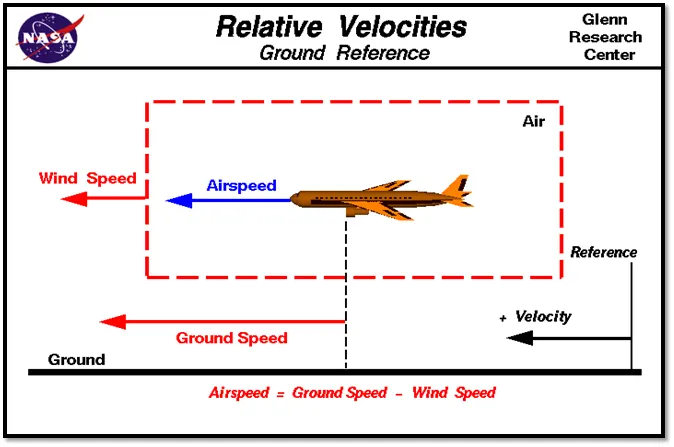
Wind Speed
For a reference point picked on the ground, the air moves relative to the reference point at the wind speed.
Notice that the wind speed is a vector quantity and has both a magnitude and a direction. Direction is important.
A 20 mph wind from the west is different from a 20 mph wind from the east.
The wind has components in all three primary directions (north-south, east-west, and up-down).
A positive velocity is defined to be in the direction of the aircraft's motion.
We are neglecting cross winds, which occur perpendicular to the flight path but parallel to the ground, and updrafts and downdrafts, which occur perpendicular to the ground.
Ground Speed
For a reference point picked on the ground, the aircraft moves relative to the reference point at the ground speed.
Ground speed is also a vector quantity so a comparison of the ground speed to the wind speed must be done according to rules for vector comparisons
Airspeed
The important quantity in the generation of lift is the relative velocity between the object and the air, which is called the airspeed.
Airspeed cannot be directly measured from a ground position, but must be computed from the ground speed and the wind speed.
Airspeed is the vector difference between the ground speed and the wind speed.
Airspeed = Ground Speed - Wind Speed
On a perfectly still day, the airspeed is equal to the ground speed. But if the wind is blowing in the same direction that the aircraft is moving, the airspeed will be less than the ground speed.
3) Reason for not using airplanes engines for airplane movement on the ground at Airport
Pushback using the jet-engine's thrust-reverser is a highly fuel-consuming and noisy process and also potentially hazardous for personnel working near the plane.
Although many aircraft are capable of moving themselves backwards on the ground using reverse thrust (a procedure referred to as a power back), the resulting jet blast or prop wash light cause damage to the terminal building or equipment.
Engines close to the ground may also blow sand and debris forward and then suck them into the engine, causing damage to the engine. A pushback is therefore the preferred method to move the aircraft away from the gate.
Once the plane is tugged away to a safe distance from the terminal, the plane begins using its own engine power for the rest of the taxing process.
5) Airplane Take OFF
Takeoff is the phase of flight in which an aeroplane leaves the ground and becomes airborne. This usually involves starting with a transition from moving along the ground on a runway.
For light aircraft, usually full power is used during takeoff.
Large transport category (airliner) aircraft may use a reduced power for takeoff, where less than full power is applied in order to prolong engine life, reduce maintenance costs and reduce noise emissions.
In some emergency cases, the power used can then be increased to increase the aircraft's performance.
The aircraft is permitted to accelerate to rotation speed (often referred to as Vr).
The nose is raised to a nominal 5°–15° nose up pitch attitude to increase lift from the wings and effect liftoff.
The speeds needed for takeoff are relative to the motion of the air (indicated airspeed). A headwind will reduce the ground speed needed for takeoff, as there is a greater flow of air over the wings.
Typical takeoff air speeds for jetliners are in the range of 240–285 km/h . Light aircraft, take off at around 100 km/h . Ultralights have even lower takeoff speeds.
The takeoff speed required varies with air density, aircraft gross weight, and aircraft configuration (flap or slat position, as applicable).
V1, VR and V2 speeds
Operations with transport category aircraft employ the concept of the takeoff V-speeds, V1, VR and V2.
These speeds are determined not only by the above factors affecting takeoff performance, but also by the length and slope of the runway and any peculiar conditions, such as obstacles off the end of the runway.
Below V1, in case of critical failures, the takeoff should be aborted; above V1 the pilot continues the takeoff and returns for landing.
After the co-pilot calls V1, he/she will call VR or "rotate," marking speed at which to rotate the aircraft.
The VR for transport category aircraft is calculated such as to allow the aircraft to reach the regulatory screen height at V2 with one engine failed.
Then, V2 (the safe takeoff speed) is called. This speed must be maintained after an engine failure to meet performance targets for rate of climb and angle of climb.
Tyre design
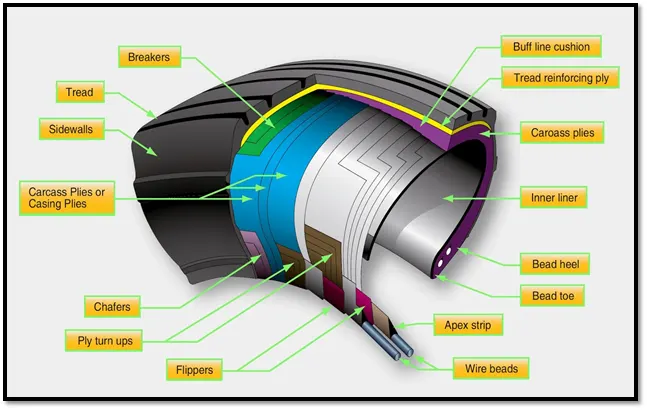
An aircraft tire or tyre is designed to withstand extremely heavy loads for short durations.
The number of tires required for aircraft increases with the weight of the aircraft, as the weight of the airplane needs to be distributed more evenly.
Aircraft tire tread patterns are designed to facilitate stability in high crosswind conditions, to channel water away to prevent hydroplaning, and for braking effect.
Inflation
Aircraft tires are usually inflated with nitrogen to minimize expansion and contraction from extreme changes in ambient temperature and pressure experienced during flight.
Dry nitrogen expands at the same rate as other dry atmospheric gases (normal air is about 80% nitrogen), but common compressed air sources may contain moisture, which increases the expansion rate with temperature.
The use of an inert gas for tire inflation will eliminate the possibility of a tire explosion
Rolling resistance
Rolling resistance, sometimes called rolling friction or rolling drag, is the force resisting the motion when a body (wheel) rolls on a surface.
It is mainly caused by non-elastic effects; that is, not all the energy needed for deformation (or movement) of the wheel, is recovered when the pressure is removed.
The "rolling resistance coefficient" is defined by the following equation:
`F=C_rr N`
F - the rolling resistance force
- the dimensionless rolling resistance coefficient or coefficient of rolling friction (CRF), and
N - the normal force, the force perpendicular to the surface on which the wheel is rolling.
Usually airplanes have very low rolling resistance coefficient of such as 0.06.
Rolling resistance for an aircraft depends upon a lot of factors such as aircraft weight, runway condition, tyre conditions, tyre pressure and environmental factors (such as weather conditions)
Tyre pressure
Aircraft tyres are designed to withstand extremely heavy loads for short durations, with the number of tyres required increasing with the weight of the plane in order to better distribute the weight.
Tests of airliner aircraft tires have shown that they are able to sustain pressures of maximum 800 psi (55 bar; 5,500 kPa) before bursting.
There are 2 primary hazards associated with tyres:
- Deflation;the tyre deflates in a controlled manner with minimal direct consequence to other systems.
- Explosive break-up;the tyre (and sometimes the wheel holding the tyre) deflates or breaks-up in an uncontrolled manner with a significant probability of secondary damage to other unrelated systems.
These hazards are associated with 4 distinct periods of aircraft operation:
- Ground operations e.g. taxiing
- Take-off (up to gear retraction)
- Post take-off (gear stowed)
- Landing (to the end of the roll-out)
The various combinations of hazard and flight period can have markedly different influences, but all can affect operations to some degree.
Landing:
A number of issues can arise from landing with a deflated tyre:
Handling issues may arise during the landing roll-out phase, and in severe cases may cause the aircraft to depart the prepared surface.
Landing with a deflated tyre will put additional strain on the remaining tyres, with an increased potential for one or more to subsequently suffer an explosive deflation due to overstress. The implication for secondary damage to the aircraft is high and the potential for rapid aircraft arrest and evacuation is enhanced.
Brake forces
Bringing an aircraft to a safe stop is the most important part of a flight. In order to do this, pilots have a number of facilities available to them.
The brakes bear the brunt of the hard work with the spoilers and reverse thrust lending a helping hand to ensure maximum efficiency.
The autobrake system helps keep the deceleration nice and smooth whilst the anti-skid system reduces the distances needed to stop by modulating the brakes on individual wheels and stopping them from skidding.
Aircraft can also depart with part of the braking system not working.
By carrying out a performance calculation before every takeoff and landing, we ensure that the aircraft will stop safely in the given conditions, even at maximum takeoff weight.
A rough estimate for the maximum energy that the A380’s 16 brakes need to dissipate during landing can be obtained by calculating the kinetic energy of the aircraft (neglecting the effects of thrust reversers, air brakes, tailwinds, headwinds and runway slope).
kinetic energy (KE) is a function of mass (m) and velocity (v) according to the equation:
KE = ½mv2
Typical landing speed for an A380 is around 130kts to 140kts
The kinetic energy of the A380 during Landing is calculated as follows:
KE = 0.5 * 575,000 kg * (87.4556 m/s)2 = 1.49131922169 x 10⁹ J = 1.49 GJ
To generate the necessary frictional forces and to handle this much energy within the length of a runway, large commercial transport aircraft typically require multiple discs per brake assembly and brakes on most, if not all, of their wheels.
6) Force and Power required to push / pull an aircraft by a towing vehicle.
The Embraer E-Jet family is a series of narrow-body short- to medium-range twin-engine jet airliners, carrying 66 to 124 passengers
For the calculation purposes the specifications E-195 model is used.
E-195 weight specifications.
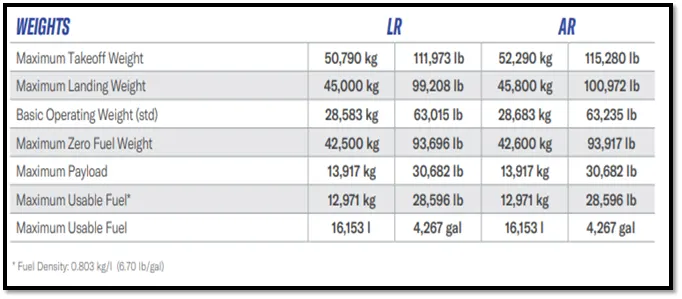
The maximum take off weight is 52,290 Kg. Aircraft business is very stringent in safety measurements. Thus the aircraft is never operated at its maximum limitations.
Assuming the maximum aircraft weight during taxing is limited to only 95% of it's maximum take off weight, the design of aircraft is done at 54,900 kg
The main forces acting during taxing of an aircraft are
rolling resistance <![if !vml]><![endif]>
and darg force (due to atmospheric air)
Rolling resistance of the aircraft
rr_a = (59400*0.006*9.81) rolling resistance coefficient of aircraft tires is taken as 0.006
Rolling resistance of aircraft = 3496.2840 N
Rolling resistance of the Tug ( Towing vehicle)
rr_t = (7620*0.01*9.81) rolling resistance coefficient of towing vehicle tires is taken as 0.01
Rolling resistance of tug = 747.522 N
Drag force while taxing the aircraft
The drag force D exerted on a body traveling through a fluid is given by
`D= 1/2 CρAv^2`
Where:
C is the drag coefficient, which can vary along with the speed of the body. Here it is assumed as 0.25
ρ is the density of the fluid through which the body is moving . Air density vale of 1.225 kg/m3 is taken
v is the speed of the body relative to the fluid. Taxing velocity is assumed to be 4.5 m/s
A is the projected cross-sectional area of the body perpendicular to the flow direction (that is, perpendicular to v). Frontal area is taken as 2 m2.
drag_force = (0.25*1.22*2*4.5*4.5)/2
Drag force = 6.17 N
Total force required by a tug to pushback the aircraft is = Rolling resistance of aircraft + Rolling resistance of tug + Drag force
= 3496.2840 N + 747.522 N + 6.17 N
= 4249.98 N
Assuming the wheels of the tug are 17.5 inches (0.4445 m) in diameter, the torque required by the Tug is
Torque required of the wheels of the Tug to pushback the aircraft = Force * Radius
= 4249.98 N * 0.4445
= 1889
Power required by the Tug to pushback the aircraft = Force * velocity
= 4249.98 N * 4.5 m/s
= 19.12 x 10³ W
= 19.12 kW
7) Electric powertrain with type of motor, it’s power rating, and energy requirement to fulfill aircraft towing application and the duty cycle range to control the aircraft speed from zero to highest.
Electric powertrain has three main components
Battery ------- Power Converter -------Motor
First motor ratings is calculated, then power converter ratings are calculated and finally battery capacity is also calculated
Motor Design
Torque calculation
The Electric Tug is assumed to have a gear ratio of 1:10. Thus the torque produced by motor is multiplied by a factor 10 at wheels.
Torque required of the wheels of the Tug to pushback the aircraft = 1889.11 Nm
Required motor torque = 1889.11 /10 = 188.911 Nm (Assuming there are no transmission losses)
Assumtions made
motor loss = 10%
Transmission losses = 20%
Required motor torque = 188.9 + 188.9(0.1+0.2)
= 245 Nm
Power calculation
The power required = 19.12 Kw
Assumptions made
motor efficiency = 90%
motor is designed to run at 80% of the full capacity for the safety purposes
Required motor power = 19.12/(0.9*0.8)
= 26.5 kW (or) 35.563906 HP
Thus the required motor specifications are
Torque rating = 245 Nm
Power rating = 35.56 HP
With these motor requirements the below mentioned motor is chosen and its specifications are given below
The Danaher Motion - 80V A/C Brushless
MOTOR SPECIFICATIONS |
|
|
Power Train |
80V A/C ELECTRIC |
|
Traction Motor |
Danaher Motion - 80V A/C Brushless |
|
Output @ 1300 rpm |
55 HP / 41 kW (Peak) |
|
Torque (Electric) |
210 ft lbs / 284 Nm |
Power converter
Required power is 26.52 kW and the motor's full rated power is 41kW
Thus a DC-AC converter such as sine wave inverter with 41 kW handling capacity is chosen
Duty cycle calculation = 26.52/41 = 0.64
The duty cycle range is from 0 to 0.64%.
Battery Capacity
Assuming an average taxing time for E-195 aircraft is about 10 minutes. The energy required to move the aircraft for 10 minutes is calculated
Time = 10 mins (600 seconds)
Energy = power*time*60
= 26.5*10*60
= 15900 KJ
= 15.900 MJ or 4.4167 kWh
= 4.4167 kWh
Thus for operating the Tug for 10 minutes to tow one aircraft the energy required is 4.4 kWh.
Apart from towing the aircraft, the Tug should move from its parking place to tow the aircraft and then comeback from runway to parking place. To accommodate this travel an additional 0.6 kWh is added to required energy.
Thus for single towing operation the energy required is 4.4 kWh + 0.6 kWh = 5.0 kWh.
This is the energy required for single operation. Assuming a single full charge of battery the Tug can perform 25 Towing operations.
The required battery capacity is = 5.0 kWh * 25 = 125 kWh
Electric Powertrain
Motor specifications - Torque 284 Nm Power 41 kW (Peak)
Power inverter specifications - The duty cycle range is 0 to 0.64%. Handling capacity - 41 kW
Battery capacity - 125 kWh