Project 1 - Parsing NASA thermodynamic data
Code for Parsing and Plotting NASA Data:
clear all
close all
clc

%Reading the header from Thermo data file

f1 = fopen('THERMO.dat','r');

line1 = fgetl(f1);
disp(line1);

line2 = fgetl(f1);
disp(line2);

Header = strsplit(line2,' ');

R = 8.314;

global_low_temp = str2num(Header{2});
global_mid_temp = str2num(Header{3});
global_high_temp = str2num(Header{4});


for i = 1:3
    info_line = fgetl(f1);
    disp(info_line);
end


%Reading the species block from THERMO data file

for i = 1:53
    Line1 = fgetl(f1);
    species_desc = strsplit(Line1,' ');
    species_name = species_desc{1};


    a = flip(species_desc);

    local_low_temp = str2num(a{4});
    local_mid_temp = str2num(a{3});
    local_high_temp = str2num(a{2});

    temp = linspace(local_low_temp, local_high_temp,500);

    Line2 = fgetl(f1);
    a = findstr(Line2,'E')
    Line3 = fgetl(f1);
    b = findstr(Line3,'E');
    Line4 = fgetl(f1);
    c = findstr(Line4,'E');


    %High temperature coefficients

    a1 = str2double(Line2(1:a(1)+3));
    a2 = str2double(Line2(a(1)+4:a(2)+3));
    a3 = str2double(Line2(a(2)+4:a(3)+3));
    a4 = str2double(Line2(a(3)+4:a(4)+3));
    a5 = str2double(Line2(a(4)+4:a(5)+3));
    a6 = str2double(Line3(1:b(1)+3));
    a7 = str2double(Line3(b(1)+4:b(2)+3));


    %Low temperature coefficients

    b1 = str2double(Line3(b(2)+4:b(3)+3));
    b2 = str2double(Line3(b(3)+4:b(4)+3));
    b3 = str2double(Line3(b(4)+4:b(5)+3));
    b4 = str2double(Line4(1:c(1)+3));
    b5 = str2double(Line4(c(1)+4:c(2)+3));
    b6 = str2double(Line4(c(2)+4:c(3)+3));
    b7 = str2double(Line4(c(3)+4:c(4)+3));

    specific_heat =  sp_heat_file_pa(a1,a2,a3,a4,a5,b1,b2,b3,b4,b5,R,temp,local_mid_temp);
    enthalpy = enthalpy_file_pa(a1,a2,a3,a4,a5,a6,b1,b2,b3,b4,b5,b6,R,temp,local_mid_temp);
    entropy = entropy_file_pa(a1,a2,a3,a4,a5,a7,b1,b2,b3,b4,b5,b7,R,temp,local_mid_temp);
    Mw = molecular_weight_file_pa(species_name);

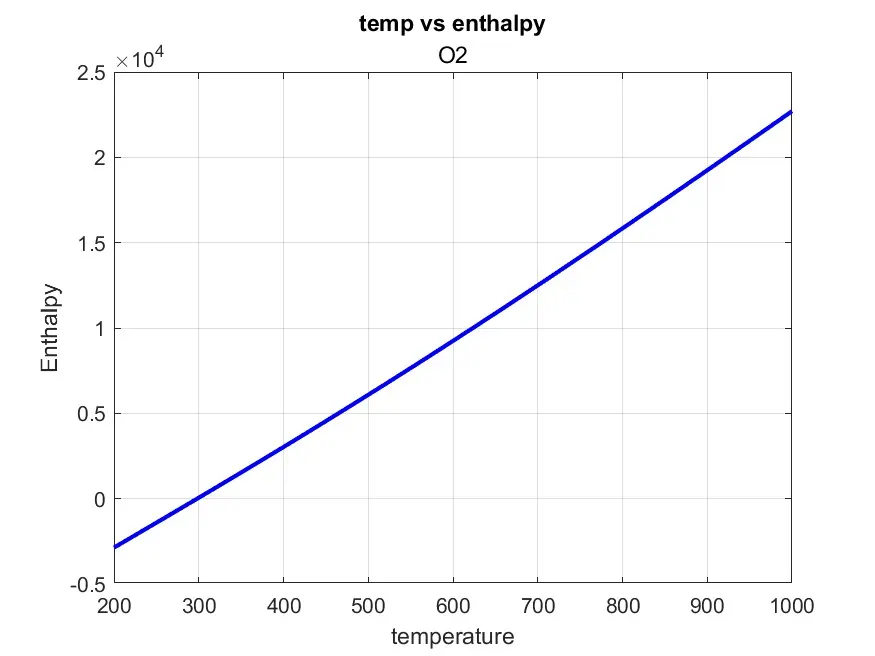
    figure(1)
    plot(temp,enthalpy,'linewidth',2,'color','b')
    title('temp vs enthalpy',species_name)
    xlabel('temperature')
    ylabel('Enthalpy')
    grid on


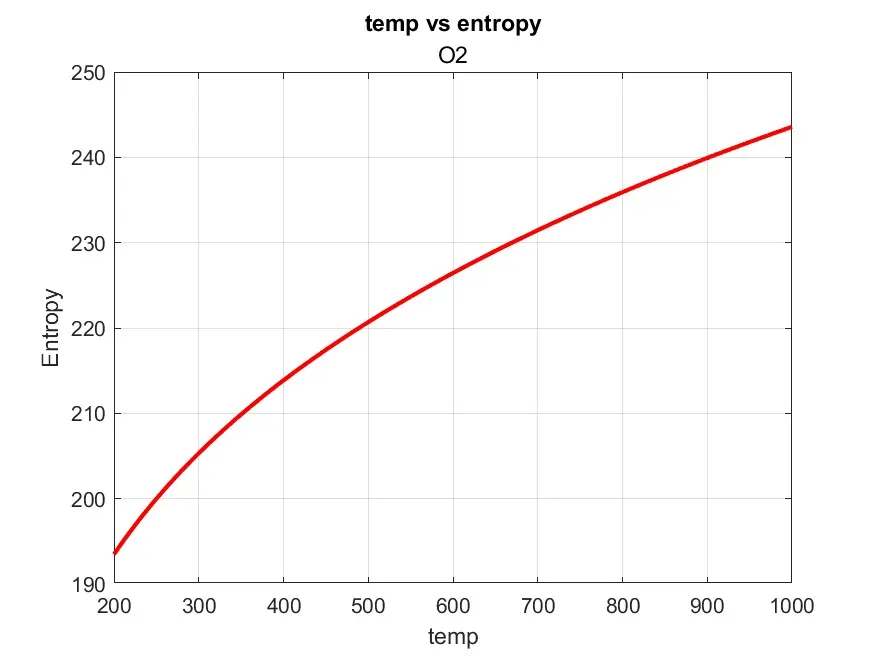
    figure(2)
    plot(temp,entropy,'linewidth',2, 'color','r')
    title('temp vs entropy',species_name)
    xlabel('temp')
    ylabel('Entropy')
    grid on


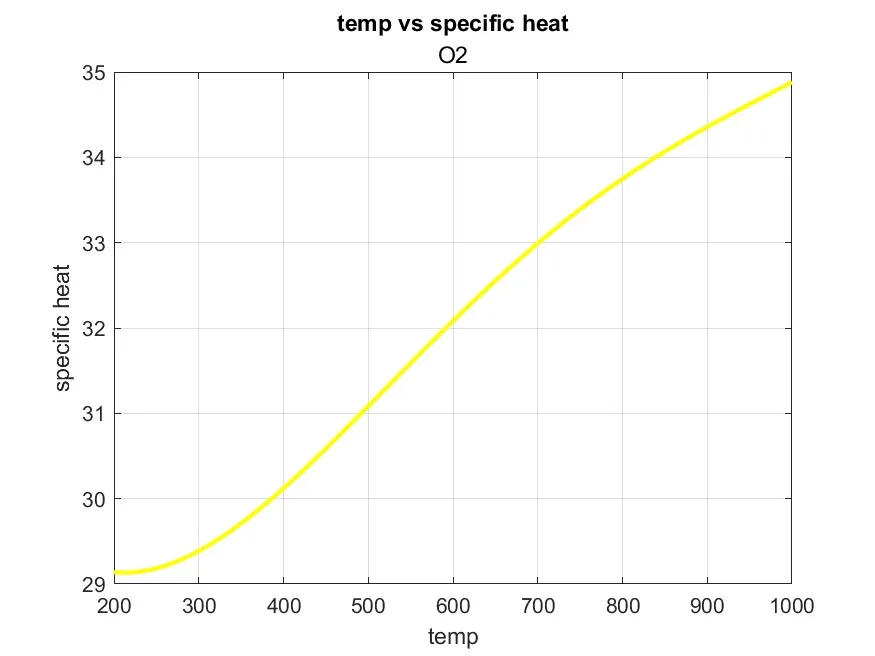
    figure(3)
    plot(temp,specific_heat,'linewidth',2,'color','y')
    title('temp vs specific heat',species_name)
    xlabel('temp')
    ylabel('specific heat')
    grid on

    mkdir(species_name);
    %directory=(['D:Skill lync', species_name]);
    cd(species_name);

    saveas(1,'enthalpy.jpg')
    saveas(2,'entropy.jpg')
    saveas(3,'specific_heat.jpg')
    cd  ..
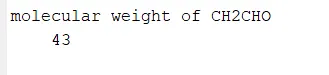
 disp(['molecular weight of ',species_name]);
 disp(Mw)
end

fclose(f1);
Explaination of the code:
To read the given Nasa file, fopen command is used and fgetl command is used to skip the line (i.e. to go to next line) First, the three lines of code (i.e. Header information) is read by strsplit command, which reads the individual strings by splitting the information with space between them. Str2num is used to convert strings to numbers.
From given data file, 53 species block are read using for loop, which will run 53 times to read species. The line is read by same strsplit command and given space to distinguish the information. Species name is given as first element as per the given data file.
To read the local temperatures of each and every species, flip command is used to easily read the line from end and then the elements are read by converting strings to numbers. Temperature is plotted from low local temperature to high local temperature with 500 parts using linspace command.
Then to read the coefficients, findstr command is used, by which Exponential (E) is located in each coefficient. With reference to that exponential, high temp and low temp coefficients are plotted as given in the problem. Then the functions of enthalpy, entropy, specific heat and molecular weight called in the main program and graph of temp vs enthalpy, entropy and specific heat are plotted for each species. By calling molecular weight, molecular weight of each element is displayed in the command window.
Function to determine Specific Heat:
function [C_p] = sp_heat_file_pa(a1,a2,a3,a4,a5,b1,b2,b3,b4,b5,R,temp,local_mid_temp)

if temp <= local_mid_temp
    C_p = R*((b1+ (b2.*temp)+ (b3.*((temp).^2))+ (b4.*((temp).^3))+ (b5.*((temp).^4))));
else
    C_p = R*((a1+ (a2.*temp)+ (a3.*((temp).^2))+ (a4.*((temp).^3))+ (a5.*((temp).^4))));
end
end
Function to determine Enthalpy:
function[h] = enthalpy_file_pa(a1,a2,a3,a4,a5,a6,b1,b2,b3,b4,b5,b6,R,temp,local_mid_temp)
if temp <= local_mid_temp
    h = R*temp.*(b1+ (b2.*(temp./2))+ (b3.*(((temp).^2)./3))+ (b4.*(((temp).^3)./4))+ (b5.*(((temp).^4)./5)) + b6./temp);
else
   h = R*temp.*(a1+ (a2.*(temp./2))+ (a3.*(((temp).^2)./3))+ (a4.*(((temp).^3)./4))+ (a5.*(((temp).^4)./5)) + a6./temp);
end
end
Function to determine Entropy:
function[s] = entropy_file_pa(a1,a2,a3,a4,a5,a7,b1,b2,b3,b4,b5,b7,R,temp,local_mid_temp)
if temp<= local_mid_temp
    s = R.*(b1.*log(temp) + (b2.*temp) + (b3.*(((temp).^2)./2)) + (b4.*(((temp).^3)./3)) + (b5.*(((temp).^4)./4)) + b7);
else
    s = R.*(a1.*log(temp) + (a2.*temp) + (a3.*(((temp).^2)./2)) + (a4.*(((temp).^3)./3)) + (a5.*(((temp).^4)./4)) + a7);
end
end
Function to determine Molecular weight:
function[Mw] = molecular_weight_file_pa(species_name)

elements = ['H', 'C', 'N', 'O', 'A'];
atomic_weight = [1, 12, 14, 16, 40];

Mw = 0;
for i = 1: length(species_name)
    for j = 1: length(elements)
        if strcmp(species_name(i),elements(j))
            Mw = Mw + atomic_weight(j);
            a = j;
        end
    end
    n = str2double(species_name(i));
    if n>1
        Mw = Mw + atomic_weight(a)*(n-1);
    end
end
end
Explanation:
All the elements and their atomic weights are taken inside the program. Initially the molecular weight is takes as 0.
To calculate molecular weight for loop is used. For a species name for for loop will search if the elements in the species name are similar with predefined elements and will add their respective atomic weight with initial molecular weight. For loop will do this for all the elements of one species.
In order to get the molecular weight of the species, n is given as numerical value for the concentration of each element. If condition is used when n is greater than 1, (i.e. concentration of one element is more in the given species for example. H2O) then molecular weight will get from the above formula as molecular weight of the first element plus the molecular weight of second element as per the list of elements from first to last and this is then multiplied by n-1 in order to get the actual weight. (For example Mw of O + Mw of H2*(2-1) will get the molecular weight of H2O)
Result of Molecular weight:
Result:
Plots of O2 :
Enthalpy Vs Temp
Entropy vs Temp
Specific heat vs temp
Folders: