Project 1 Mechanical design of battery pack
Objective: To prepare a detailed battery pack drawing with cells of ANR26650M1-B with a capacity of 18kWh with its enclosure.
Dimensions and features of ANR26650M1-B cells:
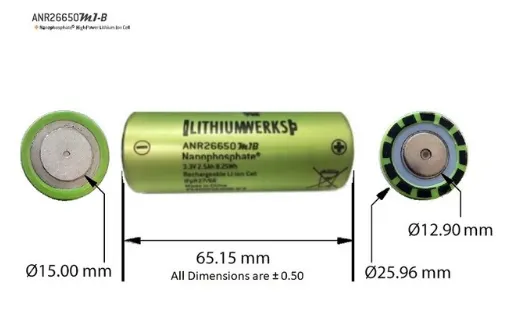
Each has a electrical properties as follows:
Nominal Ratings
Voltage: 3.3 Volts
Capacity: 2.5 Ah
Energy: 8.25 Wh
Specific Power: 2600 W/kg
Impedance (1KHz AC Typical) 6 mΩ
Cycle Life at 1C/1C, 100% DOD: > 4000 cycles
Cell Type: 26650 Lithium Ion Power Cylindrical Cell
Discharging
Max Continuous Discharage: 50 A
Max Pulse Discharge Current >50% SOC (10s): 120 A
Minimum Voltage: 2 Volts
Temperature: -30ºC to 55ºC
Charging
Recommended Standard Charge: 2.5 Amps
Max Charge Rate: 10 Amps
Max Pulse Charge Current <50% SOC (10s): 25 A
Float Voltage: 3.45 Volts
Recommended charge V & Cut-off Current: 3.6 Volts, taper to 125mA
Temperature
(reduce charging current to 250mA when under 0ºC): 0ºC to 55ºC
And the dimensions of the cell is
Diameter: Ø25.96 +/- 0.5 mm (1.0")
Length: 65.15 +/- 0.5 mm (2.6")
Mass: 76 g
Volume: 34.466 cubic cm
The calculation to make an 18kWh battery assuming that it has a nominal voltage of 330V for easier calculation is as follows:
For the nominal voltage to be 360V, 110 cells are to be connected in series. Let's consider it to be one module
For the battery pack of 18kWh number of modules connected in series is 18000/360 = 20 modules in parallel.
So in total 2200 cells are required to make a battery pack of 18kWh.
And a battery would have a nominal voltage of 360V and a nominal capacity of 20Ah.
Arranging 11 cells in each row of the module with 10 columns the surface area required for each assuming a clearance of 2mm between each cell would be 307.56*10 = 3075.6 square cm which is approximately 3076 square cm of the space with each modules dimension being 307.56*279.6 cm inside without protective covers and the height would be around 65.15+35 mm assuming all the electrical connections and holder to be of 35mm.
Electrical connections used in the lithium-ion battery pack:
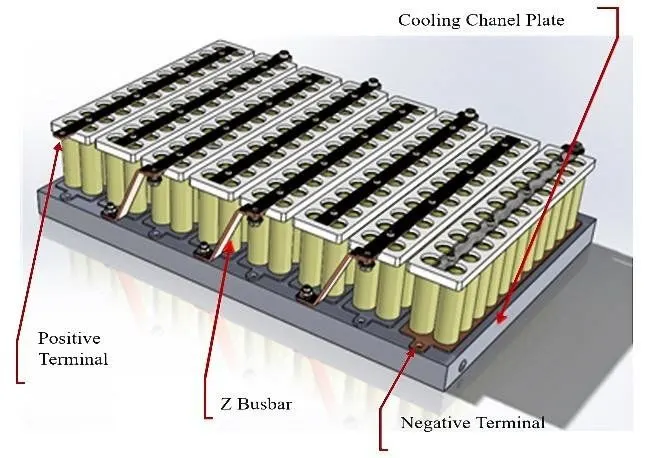
For the electrical connection, a bus bar connection can be used for more rigid connections and the cooling channels should be connected as shown in the figure above with a water-glycol used as a refrigerant.
And the weight of each module would be (76gm+24gm)*100 10kg each assuming the weight of the protective cover and electrical connection to be 24gm per cell.
And as 20 modules are to be connected in parallel so the weight of the battery be around 200kg and the dimension of the battery pack with modules arranged in a horizontal configuration with 2 modules stacked upon each other and 5 rows and 2 columns would be (100.15*2)*(279.6*5)*(307*56*2) cm
which would be 200.3*1398*615.12 cm