Project 1 - Design and Develop an IOT-based Wireless Wearable Health Monitoring System
Product Name : VitalSense
Listed below are the 5 major parameter measured using the device
Electrocardiogram (ECG):
- Frequency range: 0.05 Hz to 100 Hz (commonly)
- Amplitude range: Typically in millivolts (mV)
- Sensor: ECG electrodes placed on the skin to detect electrical signals generated by the heart.
Heart Rate:
- Frequency range: Typically measured in beats per minute (BPM)
- Amplitude range: No specific amplitude range as heart rate is a derived parameter from the ECG signal or pulse signal.
- Sensor: ECG electrodes, photoplethysmography (PPG) sensors, or heart rate sensors placed on the body to measure heart rate.
Pulse Oximeter (SpO2):
- Frequency range: Typically 0.1 Hz to 10 Hz
- Amplitude range: Typically in percentage (%), representing the oxygen saturation level in the blood.
- Sensor: PPG sensors, commonly using LEDs and photodetectors to measure changes in blood volume and oxygen saturation.
Cuffless Blood Pressure:
- Frequency range: No specific frequency range, as blood pressure is typically measured as discrete values.
- Amplitude range: Typically in millimeters of mercury (mmHg), representing systolic and diastolic pressure.
- Sensor: Various techniques are being explored, including pulse transit time (PTT) measurement, photoplethysmography (PPG) sensors, and ballistocardiography (BCG) sensors.
Body Temperature:
- Frequency range: No specific frequency range, as body temperature is a relatively stable parameter.
- Amplitude range: Typically measured in degrees Celsius (°C) or degrees Fahrenheit (°F).
- Sensor: Thermistors, infrared sensors, or wearable temperature sensors placed on the body to measure body temperature.
From the above I'm choosing ECG electrode attached to the skin, PPG Sensor & Temperature Sensor.
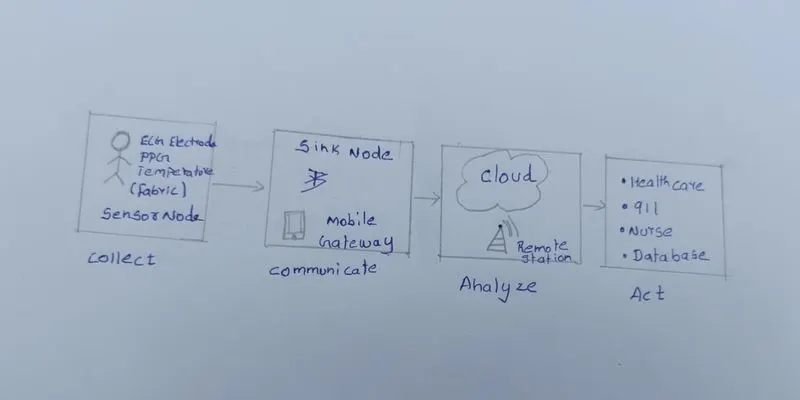
In the collect Block Senosrs are attached to the Patient using Fabric technology By the help of sensor date collected data is send to the Communication Block. Sink node preprocessed the data and remove the noise then it is send to the cloud using mobile communication, Blue tooth is used. After that Signal is processed using AI Driven Algorithm and data is send to the health care professional later it store at the hospital data base. If there is any significant change in the Parameters Emergency services will be provided.
Design Factors Considered:
- Communication Technology : Ensure connection among different Entities in IoT, Protocols used for establishig connection among the objects within a finite range or a Boday Area Network[BAN]. Distance varies from few CM to Several Meters. - Bluetooth Technology is used
- Sensors are SMART and SWaP optimized it need to be ruggedized, Qualified and Easily deployable.
- Cellular communication : It is based on the geographic devision of the communication vocerage area inot cells and withing cells. Each cell is allocated a given number of frequency that allow a large no. of subscriber to conduct converstations simultaneously.
- Always ON
- Battery Life -Low Power Consumption
- Noise Removal
- Network - Interconnection of devices or terminals or nodes using communication links. Star Topology is used.
- Security and Privacy - Secure communication, Ensure data not being Hacked.
- User interfaces
When measuring signals such as ECG, SpO2, temperature, heart rate, and blood pressure, various types of noises can affect the accuracy and quality of the measurements. Here are some common types of noises and potential methods to overcome them:
-
Electrical Interference: Electrical interference, such as power line noise and electromagnetic interference (EMI) from electronic devices, can introduce artifacts in the measured signals. To mitigate electrical interference, shield the measurement equipment and cables, ensure proper grounding, and use filtering techniques such as analog filters or digital signal processing algorithms.
-
Motion Artifacts: Movements or muscle contractions can introduce noise into the signals, especially for ECG and SpO2 measurements. To reduce motion artifacts, ensure the patient is as still as possible during the measurement. Some devices incorporate motion detection algorithms to identify and discard data affected by motion artifacts.
-
Baseline Drift: Baseline drift refers to slow variations in the baseline level of a signal over time. It can occur due to electrode or sensor movement, changes in skin impedance, or environmental factors. Techniques like high-pass filtering and baseline correction algorithms can help minimize baseline drift.
-
Ambient Light Interference: Ambient light can affect the accuracy of SpO2 measurements, as it can interfere with the detection of the pulsatile blood signals. Properly designed sensors and algorithms that account for ambient light can help minimize its impact.
- Physiological Noise: Some signals, such as ECG and blood pressure, can be affected by physiological noise, including muscle noise and respiration artifacts. Careful positioning of electrodes or sensors, signal processing techniques, and filtering can help minimize the impact of physiological noise.
Communication Protocol: Bluetooth is a short-range wireless communication protocol that enables devices to establish low-power connections and exchange data wirelessly. 2.4 GHz is used, Data protection in the form of authentication. It is Low cost and Energy efficiency.
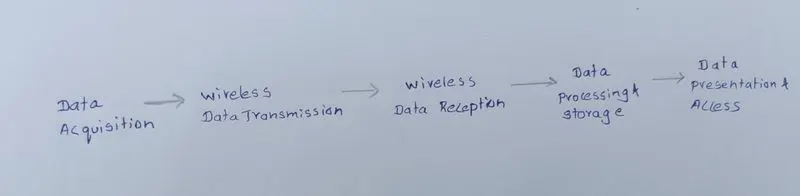
Flow Diagram and explanation:
-
Data Acquisition:
- Sensors or measurement devices collect data from the respective parameters (e.g., ECG, SpO2, temperature, heart rate, blood pressure).
- The acquired data is processed and digitized by the measurement devices or sensor modules.
- The processed data is ready for transmission.
-
Wireless Data Transmission:
- The measurement devices or sensor modules have wireless communication capabilities to transmit the data.
- The data is sent over the chosen communication protocol (e.g., Wi-Fi, Bluetooth, Zigbee, Cellular, LoRaWAN).
- The data is packaged into appropriate data packets for transmission.
-
Wireless Data Reception:
- A receiver or gateway device is set up to receive the transmitted data.
- The receiver is connected to the internet or a local network, depending on the communication protocol used.
- The receiver decodes the received data packets.
-
Data Processing and Storage:
- The received data is processed to extract meaningful information and perform any necessary computations or analytics.
- The processed data can be stored in a database or cloud storage for further analysis or retrieval.
-
Data Presentation and Access:
- Users can access the data through user interfaces, such as web applications, mobile apps, or dedicated software.
- The data can be visualized in real-time or historical trends, allowing users to monitor the parameters and track changes.
When incorporating cloud computing to build intelligence into the data received from IoT sensors, several features can be built into the system to enhance its capabilities. Basic feature inclue Connect, Analyze & Integrate Here are some key drill down features that can be implemented:
-
Data Storage and Management: The system can utilize cloud storage services to securely store and manage the incoming sensor data. This includes features such as data deduplication, compression, encryption, and indexing for efficient retrieval and scalability.
-
Real-time Data Processing: Implement real-time data processing capabilities in the cloud to analyze incoming sensor data as it arrives. This can include data filtering, aggregation, anomaly detection, and event-triggered actions based on predefined rules or machine learning algorithms.
-
Machine Learning and AI: Leverage cloud-based machine learning and artificial intelligence capabilities to extract insights from the IoT sensor data. This can involve developing predictive models, anomaly detection algorithms, and pattern recognition techniques to identify trends, make predictions, and provide intelligent recommendations.
-
Advanced Analytics: Utilize cloud-based analytics tools and frameworks to perform in-depth analysis of the sensor data. This can include statistical analysis, data visualization, and exploratory data analysis techniques to gain a deeper understanding of the collected data and derive actionable insights.
-
Remote Device Management: Incorporate cloud-based device management features to monitor and control the IoT sensors remotely. This includes functionalities such as firmware updates, device configuration, over-the-air (OTA) updates, and diagnostics to ensure the sensors are functioning optimally.
-
Scalability and Elasticity: Cloud computing offers the ability to scale resources up or down based on demand. Implement auto-scaling mechanisms to handle fluctuations in data volume and processing requirements, ensuring the system can handle increasing sensor deployments and varying workloads effectively.
-
Security and Privacy: Ensure robust security measures are in place to protect the IoT sensor data during transmission, storage, and processing. This includes encryption, access control, authentication mechanisms, and adherence to relevant privacy regulations and best practices.
-
Integration and Interoperability: Enable seamless integration with other systems, platforms, or third-party services. This can involve APIs, web services, or data connectors to facilitate data exchange, integration with external applications, or interoperability with other IoT ecosystems.
Emergency Situation Handling with Abnormal Sensor Values and False Alarms
-
Sensor Data Acquisition:
- IoT sensors continuously monitor vital signs such as heart rate, blood pressure, and oxygen saturation.
- The sensors transmit the data to a cloud-based monitoring system in real-time.
-
Data Processing and Analysis:
- The cloud-based system receives and processes the sensor data.
- An anomaly detection algorithm examines the incoming data for abnormal values or patterns.
- Abnormal values are flagged as potential emergency situations.
-
Emergency Alert Generation:
- Upon detecting abnormal values, the system triggers an emergency alert.
- Emergency personnel or designated contacts, such as healthcare providers or family members, are immediately notified via multiple channels (e.g., SMS, email, mobile app notifications).
-
Emergency Response:
- The designated contacts assess the situation and take appropriate actions based on the severity of the alert.
- If the abnormal values indicate a critical emergency, emergency medical services (EMS) are contacted for immediate assistance.
- If the situation allows, the designated contacts may try to establish communication with the individual at risk to gather more information and provide instructions.
-
Confirmation and Validation:
- Upon arrival, emergency responders assess the individual's condition and evaluate the accuracy of the alert.
- They validate whether the abnormal values are due to an actual emergency or if there was a false alarm triggered by sensor inaccuracies or external factors.
-
False Alarm Handling:
- If it is determined that a false alarm occurred, emergency responders take the necessary steps to ensure the individual's safety and well-being.
- The system may automatically recalibrate the sensors, perform additional checks, or consult with healthcare professionals to minimize false alarms in the future.
- False alarms are recorded and analyzed to improve the system's accuracy and reliability.
-
Post-Emergency Analysis and Follow-up:
- After the emergency situation has been resolved, healthcare professionals or designated personnel review the collected sensor data and analyze the events leading up to the abnormal values.
- They assess the individual's overall health, provide necessary medical interventions or adjustments, and plan for follow-up care if required.
The handling of abnormal sensor values and false alarms in emergency situations involves a combination of automated detection, human intervention, and collaboration between the monitoring system, designated contacts, and emergency responders. Regular system evaluations, updates, and improvements help minimize false alarms and enhance the system's effectiveness in identifying and responding to genuine emergencies.
Parameters that are measured are sent to the Health care personnal upon confirmation data is stored in Hospitacl centrailized database.
User can store the acquired data in a centralized database and retrieve it efficiently based on various criteria using the appropriate query methods and optimizations. It's important to regularly monitor the database performance, apply updates, and perform maintenance tasks to ensure smooth data storage and retrieval operations.
To implement automatic detection of abnormal conditions in the parameters and generation of alarms in an IoT-based system, follow the below steps
- Define Normal Ranges of the parameters -Determine the normal ranges for each parameter based on medical standards and guidelines. These ranges will serve as a baseline for detecting abnormal values.
- Real-time Processing - Receive and process the sensor data in real-time using cloud-based or edge computing capabilities.
- Abnormality Detection Algorithm & thresholds - Develop or select suitable algorithms for detecting abnormalities in the parameter values.Train or configure the algorithm using labeled or historical data to identify patterns and deviations from the normal ranges.Set threshold values that indicate a significant deviation from the normal range, warranting attention and potential emergency response.
- Alarm Generaion and notification - When an abnormality surpasses the set thresholds, generate alarms or notifications.
- Emergency Response workflow - Determine the sequence of actions, such as contacting emergency services, initiating remote communication, or following predefined protocols for specific emergency scenarios.
- Integration with communication channels - Ensure the system has mechanisms to escalate alarms if initial notifications are not acknowledged or acted upon within a specified timeframe.
- Testing and Refinement - Thoroughly test the system for different scenarios and validate its effectiveness in detecting abnormalities and generating alarms accurately.
To enhance the security aspects of the IoT-based remote monitoring system, several measures can be implemented. Here are some key security considerations:
-
Secure Communication
-
Access Control
-
Data Encryption and Privacy
-
System Monitoring and Logging
-
Firmware and Software Security
-
Regular Security Audits and Penetration Testing
-
Security Awareness and Training
Implementing these security measures can help safeguard the IoT-based remote monitoring system and protect sensitive data from unauthorized access, ensuring the privacy and safety of individuals involved. Regular monitoring, updates, and adherence to industry best practices are essential to maintain the security posture of the system.
To launch a product in the market, Below points need to be considered
- Product Development and Testing
- Standard identification and Requirement alignment
- Regulatory Compliance
- Customer Support and Feedback
Star Topology is used. All 10 devices connected via hub/Switch and cetrally controlled.