Project 1 - Creation of user defined data type to implement the user interfaces for working with ‘Set’ (Mathematical Set theory) using Linked List
Aim:
- To Create two linked lists from user-provided input.
- To Find the intersection of these two lists.
- To Find the union of these two lists.
- To Print the original lists, intersection list, and union list.
Objectives:
- To Prompt the user to enter 4 integers for two separate arrays.
- To Convert the input arrays into two separate linked lists (head1 and head2).
- To Find the common elements between the two lists and store them in a new list (intersecn).
- To Find all unique elements from both lists and store them in a new list (unin).
- To Print the original lists, the intersection list, and the union list.
Code for this program:
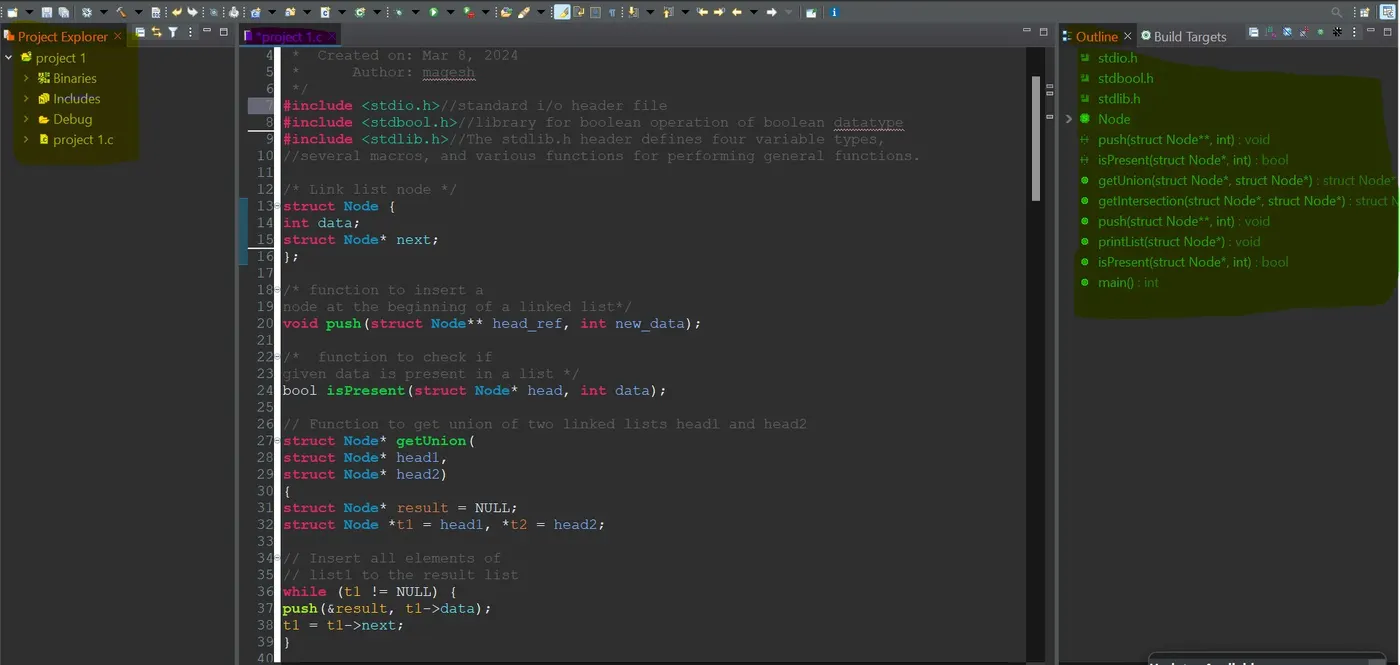
/*
 * project 1.c
 *
 *  Created on: Mar 8, 2024
 *      Author: magesh
 */
#include <stdio.h>//standard i/o header file
#include <stdbool.h>//library for boolean operation of boolean datatype
#include <stdlib.h>//The stdlib.h header defines four variable types,
//several macros, and various functions for performing general functions.

/* Link list node */
struct Node {
int data;
struct Node* next;
};

/* function to insert a
node at the beginning of a linked list*/
void push(struct Node** head_ref, int new_data);

/*  function to check if
given data is present in a list */
bool isPresent(struct Node* head, int data);

// Function to get union of two linked lists head1 and head2
struct Node* getUnion(
struct Node* head1,
struct Node* head2)
{
struct Node* result = NULL;
struct Node *t1 = head1, *t2 = head2;

// Insert all elements of
// list1 to the result list
while (t1 != NULL) {
push(&result, t1->data);
t1 = t1->next;
}

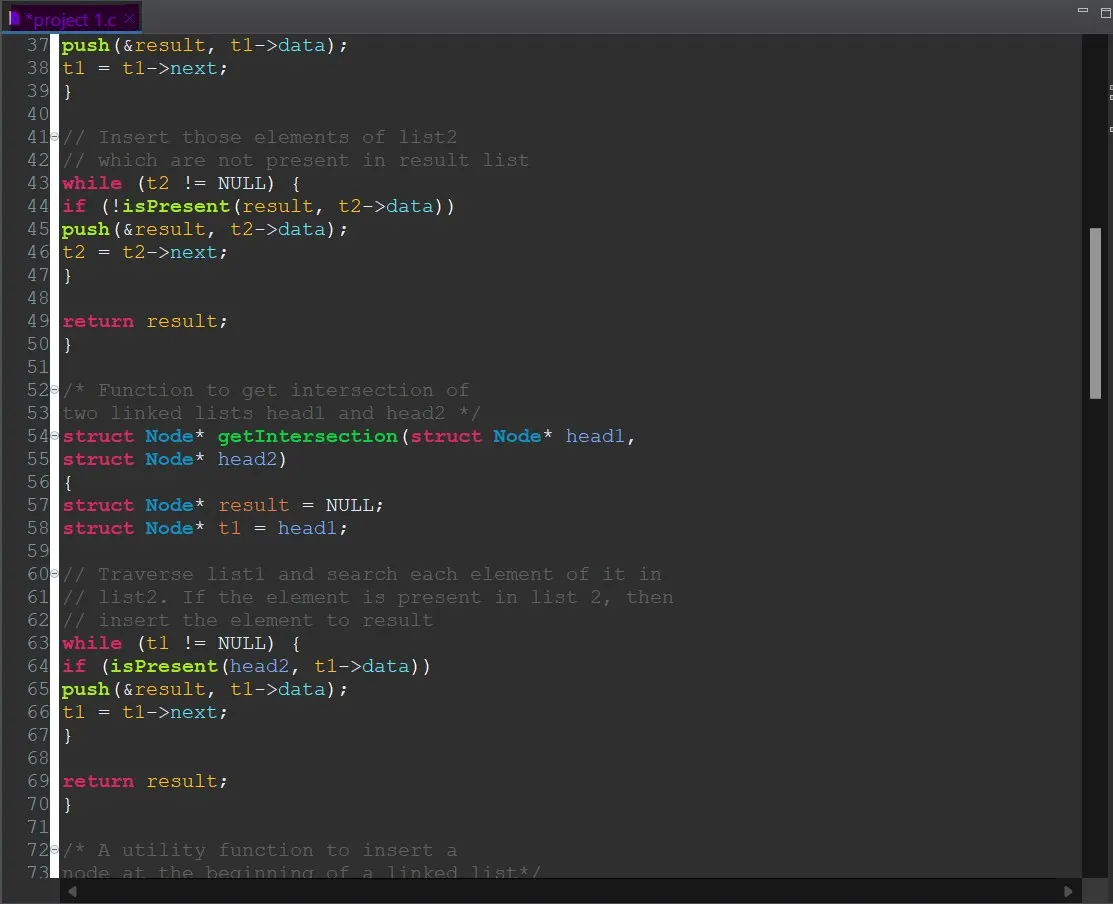
// Insert those elements of list2
// which are not present in result list
while (t2 != NULL) {
if (!isPresent(result, t2->data))
push(&result, t2->data);
t2 = t2->next;
}

return result;
}

/* Function to get intersection of
two linked lists head1 and head2 */
struct Node* getIntersection(struct Node* head1,
struct Node* head2)
{
struct Node* result = NULL;
struct Node* t1 = head1;

// Traverse list1 and search each element of it in
// list2. If the element is present in list 2, then
// insert the element to result
while (t1 != NULL) {
if (isPresent(head2, t1->data))
push(&result, t1->data);
t1 = t1->next;
}

return result;
}

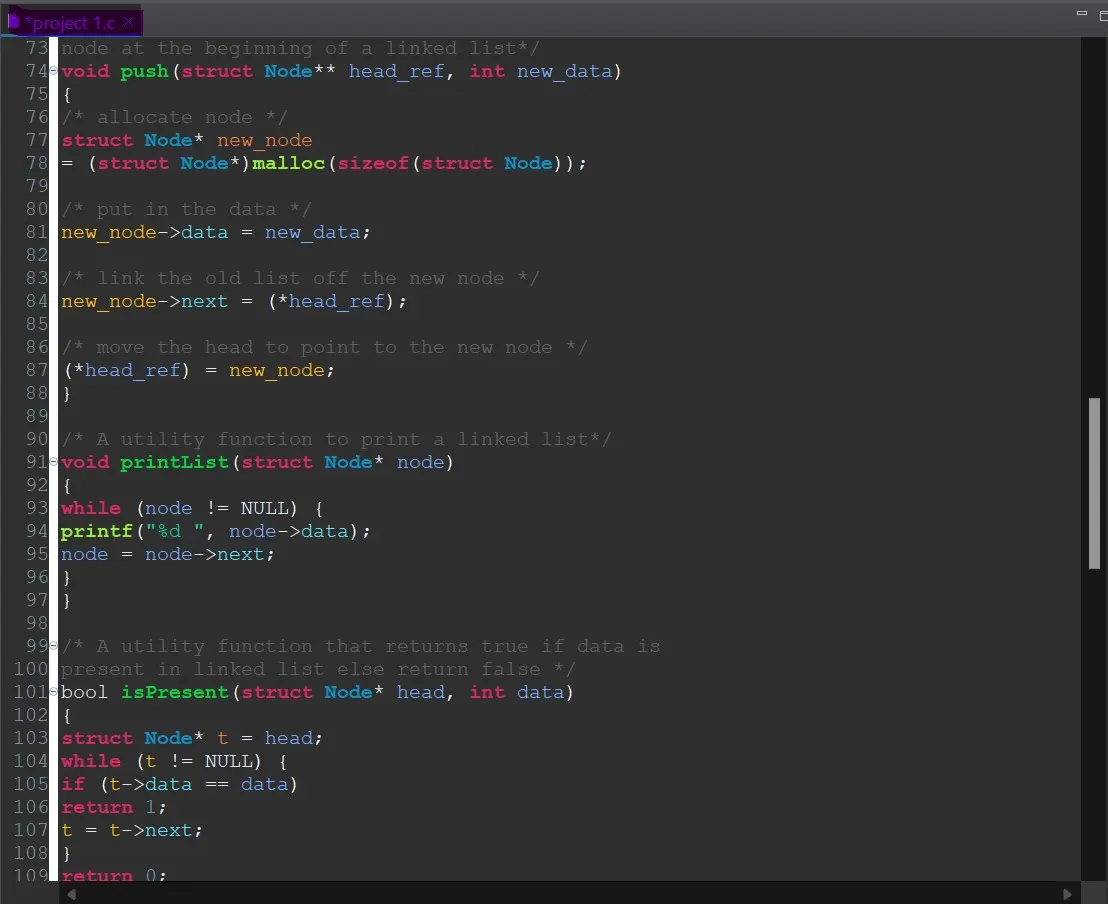
/* A utility function to insert a
node at the beginning of a linked list*/
void push(struct Node** head_ref, int new_data)
{
/* allocate node */
struct Node* new_node
= (struct Node*)malloc(sizeof(struct Node));

/* put in the data */
new_node->data = new_data;

/* link the old list off the new node */
new_node->next = (*head_ref);

/* move the head to point to the new node */
(*head_ref) = new_node;
}

/* A utility function to print a linked list*/
void printList(struct Node* node)
{
while (node != NULL) {
printf("%d ", node->data);
node = node->next;
}
}

/* A utility function that returns true if data is
present in linked list else return false */
bool isPresent(struct Node* head, int data)
{
struct Node* t = head;
while (t != NULL) {
if (t->data == data)
return 1;
t = t->next;
}
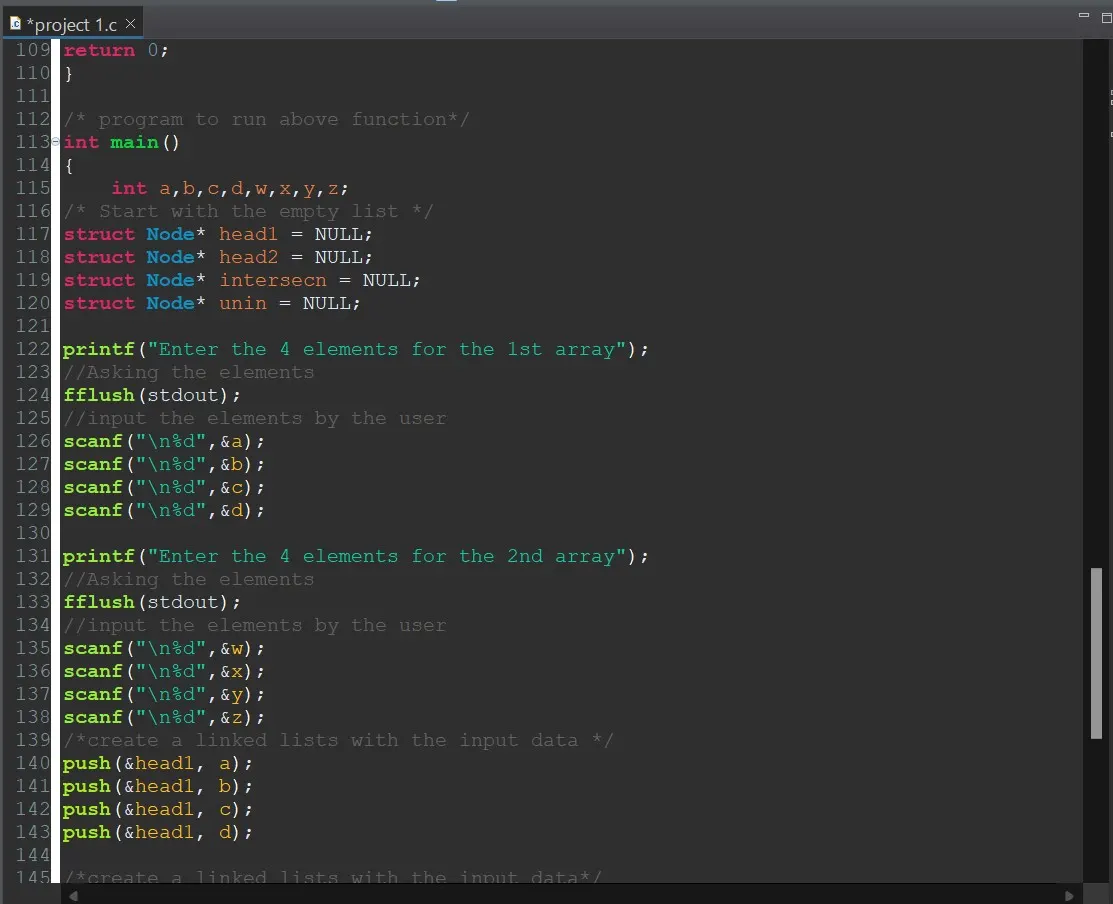
return 0;
}

/* program to run above function*/
int main()
{
    int a,b,c,d,w,x,y,z;
/* Start with the empty list */
struct Node* head1 = NULL;
struct Node* head2 = NULL;
struct Node* intersecn = NULL;
struct Node* unin = NULL;

printf("Enter the 4 elements for the 1st array :\n");
//Asking the elements
fflush(stdout);
//input the elements by the user
scanf("\n%d",&a);
scanf("\n%d",&b);
scanf("\n%d",&c);
scanf("\n%d",&d);

printf("Enter the 4 elements for the 2nd array:\n");
//Asking the elements
fflush(stdout);
//input the elements by the user
scanf("\n%d",&w);
scanf("\n%d",&x);
scanf("\n%d",&y);
scanf("\n%d",&z);
/*create a linked lists with the input data */
push(&head1, a);
push(&head1, b);
push(&head1, c);
push(&head1, d);

/*create a linked lists with the input data*/
push(&head2, w);
push(&head2, x);
push(&head2, y);
push(&head2, z);

intersecn = getIntersection(head1, head2);
unin = getUnion(head1, head2);

printf("\n First list is \n");
printList(head1);

printf("\n Second list is \n");
printList(head2);

printf("\n Intersection list is \n");
printList(intersecn);

printf("\n Union list is \n");
printList(unin);

return 0;
}
Logic & Explination:
Include Header Files:
- The program includes three standard header files: stdbool.h, stdio.h, and stdlib.h.
- These header files are necessary for using boolean data type, input/output operations, and memory allocation functions respectively.
Define Node Structure:
- The program defines a structure named Node to represent a node in the linked list.
- Each node contains an integer data field and a pointer next to the next node.
Function Declarations:
- Several functions are declared:
- 'push': Inserts a new node at the beginning of a linked list.
- 'isPresent': Checks if a given data value is present in the linked list.
- 'getUnion': Finds the union of two linked lists.
- 'getIntersection': Finds the intersection of two linked lists.
- 'printList': Utility function to print the elements of a linked list.
Main Function:
- Declares variables a, b, c, d, w, x, y, z to store user input.
- Initializes four pointers head1, head2, intersecn, and unin to NULL.
- Asks the user to input 4 elements for both arrays.
- Constructs linked lists head1 and head2 using the input elements.
- Finds the intersection and union of head1 and head2.
- Prints the original lists, intersection list, and union list.
Function Definitions:
- push: Allocates memory for a new node, assigns the data, and inserts it at the beginning of the list.
- isPresent: Traverses the list to check if a given data value is present.
- getUnion: Creates a new list containing elements from both lists, avoiding duplicates.
- getIntersection: Creates a new list containing elements common to both lists.
Input:
- The program prompts the user to enter 4 integers each for two arrays.
Output:
- The program prints the original lists, intersection list, and union list.
Memory Management:
- Dynamic memory allocation is used to create nodes for the linked list using malloc.
Execution:
- The main function controls the flow of the program, calling other functions as necessary to perform operations on linked lists and displaying the results.
screenshots of the progarm:
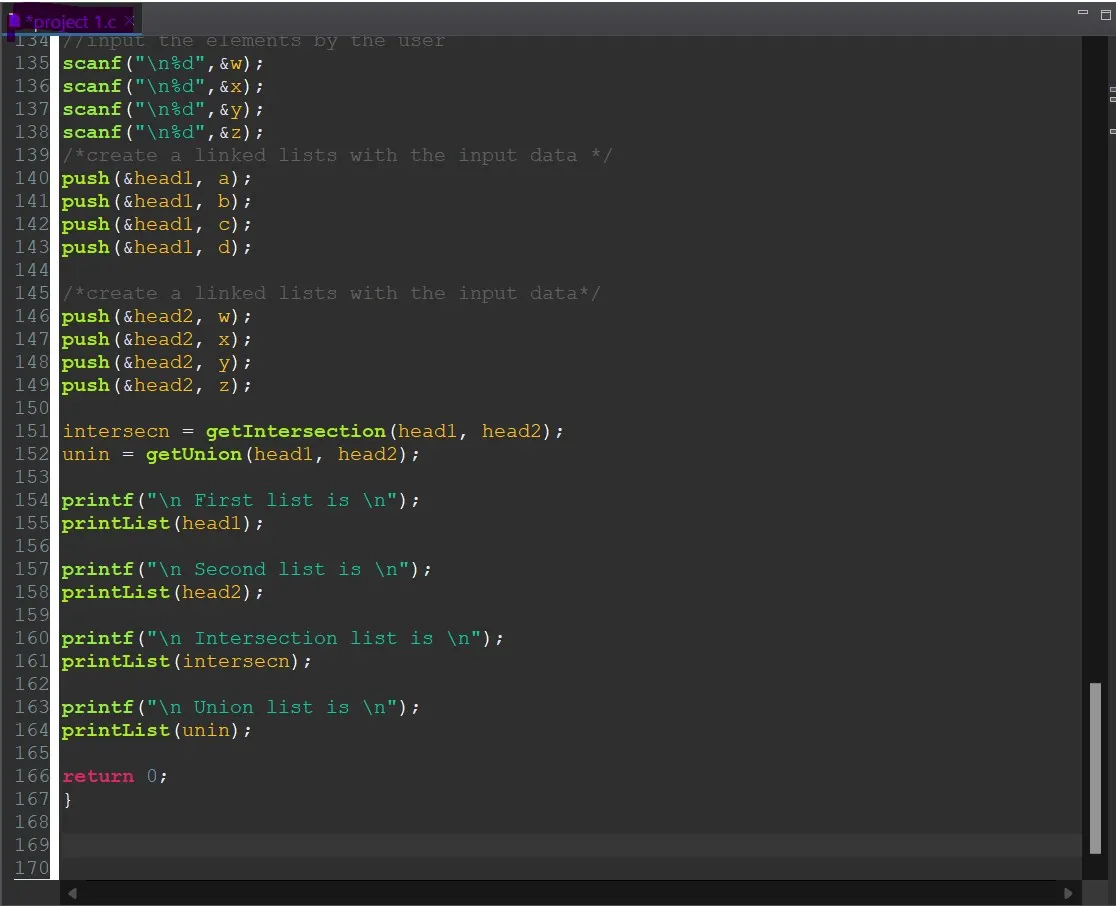
Screenshots of the output:
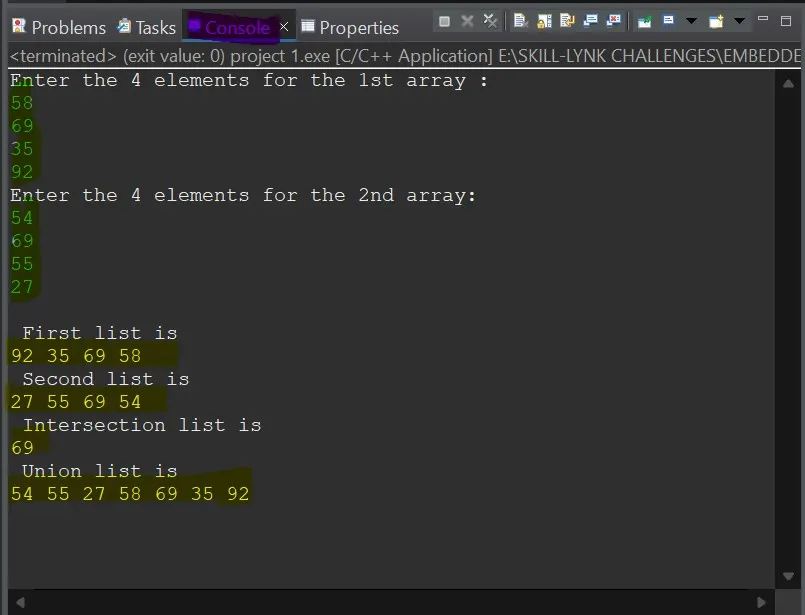
Comments:
- #include <stdio.h> (included standard input & output library, to use the printf and scanf functions).
- #include <string.h> (included string manupulation library).
- #include <stdbool.h> (library for boolean operation of boolean datatype)
- printf() (use to print the output or result of the program)
- scanf() (use to read and store the values )
- fflush() (to flush the output buffer of the specific file stream)
- push() (Allocates memory for a new node, assigns the data, and inserts it at the beginning of the list.)
- isPresent (Traverses the list to check if a given data value is present.
- getUnion (Creates a new list containing elements from both lists, avoiding duplicates.
- getIntersection (Creates a new list containing elements common to both lists.
- return result ( statement allows the caller of these functions to access the resulting linked list after the union or intersection operation has been performed)
- struct (keyword to create an alias for a structure)
- if(condition) (if condition is used to iteratinon of the loop)
- while(conditopn) (This while loop is responsible for reading characters from the input file)
- int main() (starting point of the program ,main function)
- void (void is used in several contexts, including function declarations, function definitions, and as a data type specifier)
- int (use to declare the variable type as integer type )
- %d (use as placeholder for the interger at print function)
- & (this is the address of operator, it retrives the memory address where that variable stored)
- return 0 (indicate successful execution of the program)