Project 1
21 Effective Customer Satisfaction Questionnaire Examples
Need some examples to craft your own Customer Satisfaction Questionnaire?
Here’s a guide to help you design the perfect customer satisfaction questionnaire that would aptly gauge your customer base’s pulse without bothering them much.
21 Effective Customer Satisfaction Questions to ask your customers
If you are wondering how to create an impactful customer satisfaction questionnaire, here’s a tip for you. Include questions that belong to these five sections in your questionnaire. This way, you can get a holistic idea of what prompted your customer to choose your services and how you can better your product to be ahead of the competition.
Here’s a simple Customer Satisfaction Questionnaire created using SurveySparrow:
Want to create similar Customer satisfaction surveys?
Demography Based Questions
Demographic questions may sound general and too dull. But these questions let you easily segment the customers into different categories that would further help you uncover some hidden trends and patterns.
With that said, minimize the number of demographic questions you ask (maximum three). Respondents can get easily annoyed by it and don’t forget to include the option “rather not say.” This way, if the customer isn’t comfortable, they can simply opt-out of answering it.
1. What is your age?
2. Where do you live?
3. What’s your gender?
4. What’s your marital status?
Product-related questions
Product or service-related questions focus on knowing how helpful were the products and whether the customers are satisfied with the results. Based on your goals, you can use different types of questions, but you shouldn’t ask them to describe their experience in a paragraph. Include rating scale questions, multiple questions, or simple open-end questions to get maximum insights.
5. On a scale of 1 to 10, How satisfied are you with our products or services?
6. What qualities of your product did please you the most?
7. What qualities of our product did you like the least?
8. Are you willing to repurchase our product based on your previous experience?
9. What aspect of the product do you think requires serious attention from our side?
Customer support based questions
The customer satisfaction surveys should also inquire about the quality of the service your representatives provided. The inputs received from this section will help you train your representatives accordingly and equip them to serve your customers better.
10. Are you satisfied with the service provided by our Customer care executive?
11. Did our customer support representative help you with your query?
12. Do you find our customer care executive knowledgeable about the product?
13. Were our representatives polite to you?
14. How can we improve our services to serve you better?
Customer experience and technical questions
This section inquiries all about how the user interaction with the brand went. The questions could be directed at the technical aspects and user experience of your official website or mobile app. The responses received from this section will help you better the channels through which the customers can access your services.
15. On a scale of 1 to 10, how user-friendly was our website?
16. Was it easy to find the services you were looking for from our mobile app?
17. Were you able to navigate easily through the different sections of the website?
18. How would you rate the responsiveness of our mobile app/website?
Competitor based questions
Even though this section isn’t a mandatory part of a customer satisfaction questionnaire, you can throw in one or two questions to know whether your competitors influenced the customer’s decision-making process.
19. What were the other brands in consideration before buying our product?
20. What made you choose our product over the competitor’s product?
21. Compared to other products in our market, would you say our product is better than the competitors?
Now that you have all these examples in hand, let’s dig a bit deep into what can be considered as a Customer Satisfaction Questionnaire and why is it essential for businesses.
What Is A Customer Satisfaction Questionnaire?
A customer satisfaction questionnaire entails a series of questions that inquiries your customers about your services, customer support, and everything related to your brand. The main aim of this questionnaire is to determine what the market thinks of your product and how it can be improved to meet their expectations.
With proper execution of these surveys, you can quickly identify what exactly your customer expects and what you should deliver to provide them with the WOW experience. The surveys can be rolled out at various touchpoints throughout the customer journey. Your aim as a brand is to constantly work on the feedback and help the customer smoothly transition from their query phase to the happy consumer phase.
With that said, a customer satisfaction survey would mean nothing to your business if you couldn’t extract the required statistical data from it. For this, you need to keep in mind three things while you prepare the questionnaire:
- Specify the goal of the survey
- Prepare highly directed questions that align with the goals
- Prepare an action framework to be followed once you extract the data from the survey
Why is a Customer Satisfaction Questionnaire Necessary for your Business?
Have you ever wondered why big brands care about the feedback they get and constantly work on it to improve their services? The logic is simple:
Retaining the existing customers costs way less than finding new ones.
A customer satisfaction questionnaire is an essential tool that helps you to retain your existing customers. If a slight improvement in your service can WOW your customer and add them to the loyal customer base, why waste it?
Establish your business as a brand
There’s a massive difference between a brand and a business. To establish yourself as a brand, you need customers who actively recommend your products to their peers and close ones. The publicity achieved via word-of-mouth is much more powerful than any advertising or marketing campaign.
The words of a satisfied customer speak volumes. When the number of happy customers increases, you establish your business as a brand.
When you roll out customer satisfaction surveys at regular intervals, you get to know the current perception of your business. The positive can be used for marketing campaigns. At the same time, you can do some homework to convert the negatives to positives next time.
Further, when you roll out follow-up surveys, you would know if the customers well received the changes you made in your products or not.
Know your customer up close
When you roll out the surveys, it becomes kind of personal for the customers. They can express whatever grief they have about your services. Further, it would be a cherry on top if you personally contact them and take sudden action.
Customers love it when companies go the extra mile to ensure that their needs are met. I mean, who wouldn’t!
Wrapping Up…
Voila, you have now mastered the art of creating the perfect Customer Satisfaction Questionnaire that yields the required data for your business. Remember always to take the necessary action once you have the responses in hand.
How to write customer satisfaction survey questions to master your market [with examples]
Happy, successful customers are the lifeblood of any business. They’re what transforms your growth from a funnel into a flywheel. You can create happy customers, but to do it you have to truly understand them and how they think about you.
So how do you know what they’re thinking? You have to ask!
My name is Michael Redbord, and I helped build HubSpot's support and service teams, working with customers for over eight years. Today, I’m the General Manager of HubSpot's newest product line, Service Hub, which helps our customers grow through exceptional service.
At HubSpot, we use feedback to understand our customers and what the market demands. This approach has driven dramatic changes over the years—taking us from a small marketing app to the more complete front-office software suite we are today.
Today, I’m sharing the most important things I’ve learned about customer satisfaction surveys, so you can take some of my learnings and use them to adopt a practice of customer feedback at your business and grow better by mastering your market. I cover:
What is a customer satisfaction survey?
A customer satisfaction survey is a questionnaire designed to help businesses understand what their customers think about their products or services, their brand, and their customer support. Customer satisfaction surveys allow companies to improve products strategically, optimize user experience, and deliver exactly what the market demands.
At HubSpot, we use customer satisfaction surveys to understand the micro-level experiences of individual users and address their concerns, but we always return to macro-level questions like “Where is the market going,” “How is our product on the cutting edge,” and “Where do we need to improve?” as well.
4 types of customer satisfaction surveys
There are several ways to understand if your customers are happy, loyal, and satisfied with your product or service, and each can help you learn something about your users' experience. Here are four of the most effective surveys you can use to understand your customers.
1. Customer Satisfaction Score (CSAT)
Customer Satisfaction surveys usually contain a simple question with a binary response (e.g., yes/no, happy face/sad face). They ask things like “Did our product do what you wanted it to do?”
These scores are usually high (in the 98%+ range), so a sudden spike in negative scores tells you there’s an issue that needs immediate attention.
2. Net Promoter Score (NPS®)
A Net Promoter Score survey asks customers to rate how likely they are to recommend your company/product to a friend or colleague on a scale of 0-10. You then compare your percentage of detractors (0-6 answers) to that of promoters (9-10 answers) to see where your company stands—the more promoters you have, the more you can infer people are satisfied with you.
We've done the hard work for you and pre-built a CSAT & NPS survey.
Get started with this survey today (it takes just 1 minute to set up).
💡 An NPS software tool like Hotjar can help you learn more about your customers' needs
3. Customer Effort Score (CES)
The Customer Effort Score measures how much effort it takes for customers to either use your product or fix a problem through customer support.
At HubSpot, we send a CES survey after we close each support ticket. A CES question will ask “How easy was it to solve your problem?,” and customers are typically given a 5-point scale with options like ‘very difficult’, ‘somewhat difficult’, ‘about as easy as I expected’, ‘somewhat easy’, ‘very easy'.
4. Milestone surveys
Milestone surveys are questionnaires sent out at key moments in the customer journey to help understand the user experience better. A milestone can either be time-based (e.g., sending a survey 60-days after signup) or experience-based (e.g., sending after onboarding is complete).
5 customer satisfaction survey templates to jump-start your customer satisfaction survey
To get started right away, we created and shared five customer satisfaction survey templates you can follow.
🔥 How it works: click on each image to see a live version of the survey; you can interact with each to see how they work—if you submit your feedback, we'll see it! Each survey will also direct you to a Google Doc template where we listed all the relevant questions, so you can simply copy-paste them into your own survey as they are or tweak them as needed.
1. Net Promoter Score® (NPS) survey template
2. Customer satisfaction (CSAT) survey template
3. Customer effort score (CES) survey template
4. Point-of-conversion survey template
5. Retention survey template
4 other ways to understand your customers
User personas
User personas are semi-fictional characters based on real data about the people who use your website. Getting to know your users will help you stay on top of the market by giving them what they want.
Market research
Market research is a collection of techniques used to understand your target market. Good research identifies customer needs, fears, drives, and frustrations. You can use this information to design better products and improve the customer experience.
Heatmaps
Hotjar Heatmaps are a visual representation of user behavior that shows where users click, tap, and scroll. They help you understand what page elements are being interacted with or ignored, so you can start forming a clearer idea of what works, and doesn’t, on your website.
Session recordings
Hotjar Session recordings can show the anonymous activity of individual users, which you can tie to their survey answers. In other words, if someone tells you they’re having a hard time using your product, you can watch a recording of their activity to gain insights about their experience.
Asking the right customer satisfaction survey questions can tell you much more than whether your customers are simply satisfied or dissatisfied. The answers reveal feedback that can help you retain business, validate business decisions and strategies, and ultimately grow your brand.
So, to help you create effective surveys, here’s a list of customer satisfaction (CSAT) questions to ask.
General customer satisfaction survey questions
Here are sample feedback questions that help you target opinions on overall experience, product or service usage, as well as customer motivations:
- On a scale of 1 to 10, how satisfied are you with our product or service?
- On a scale of 1 to 10, how satisfied are you with your experience on our site today?
- How would you rate your experience with our product or services today?
- How would you rate us on the following? (Follow with a list of products, services, or activities)
- How often do you use our product or service?
- Has our product or service helped you achieve your goals?
- On a scale of 1 to 10, how likely are you to recommend our product or service?
- Which three of these [features/offerings/etc.] matter more to you when you use our product?
- For what purpose are you using [product or service]? (Follow with a list and include ‘other’ as an option.)
- What’s the biggest gain you’ve seen while you’ve been using our product or service?
- What would you change about our product or service?
- What can we improve in our product or service?
- How can we improve our customer service?
- What would stop you from buying from us again?
- Have you ever had a negative experience with us and if so, can you describe what happened?
- How have you used our services in the past?
- What can we do better?
You can send these general survey questions to your customer base periodically or directly after an event. For example, video and messaging apps like Hangouts and Viber will ask you about the quality of video and audio right after you finish calls.
RELATED
Want to ask for feedback from your customers via email?
Try these seven email templates (plus tips to encourage your customers to reply).
Post onboarding survey questions
Here are questions that will help you understand whether your onboarding process works and where you can potentially make improvements:
- On a scale of 1 to 10, how satisfied are you with your onboarding experience?
- How would you rate your level of knowledge of what our product can do? (Follow with a list from low to high.)
- During the onboarding process, were you set up with everything you needed to use our product?
- Do you feel empowered to be successful with the product?
- Do you feel our product is going to help you achieve the goals that you want to achieve?
- Is there anything critical to your success that wasn’t covered during our onboarding process?
Post training survey questions
This is mostly relevant to SaaS, but if your industry also does customer training, you can modify these questions to specifically reference your services.
- How satisfied are you with your training?
- How confident are you about using our product/service?
- How well do you feel you know our product’s features after your training?
- Did you feel you got what you needed out of your training?
- Were all your questions answered during the training?
- What can we improve in our training process?
- What suggestions do you have for our team regarding training?
New product launch survey questions
Here are some questions to help you evaluate whether a new product has a future or whether it needs fine tuning:
- On a scale of 1 to 10, how useful is our new product to you?
- How would you rate our new product?
- How satisfied are you with our new product?
- Have you tried our new product?
- Have you used our new feature?
- Is our new product easy to understand?
- Do you have suggestions for improving our product?
Download all questionsWant to save all 57 questions for later? Make a copy of the full list.
Post purchase survey questions
Here are sample customer satisfaction survey questions to help you evaluate customer experience after purchases:
- How would you rate your shopping experience with us?
- How easy was it for you to navigate our site?
- How would you rate our communications while you were making your purchase?
- How would you rate our post-purchase communications?
- Was your order delivered in the timeframe you expected?
- Did you feel you were able to check your order status at any time?
- Was the item you purchased as described?
- Was our product or service as you thought it would be?
- How could we have improved your purchase experience?
- If you faced any challenges while you were shopping what were they?
The exact timing and length of your post-purchase CSAT or email surveys will depend on what you want to know. If you just want to gauge the overall feeling of your customers towards their purchasing experience, you can ask simple broad questions.
To inform more in-depth analysis, you can send a survey with multiple questions about price, site navigation, delivery time, and ask the customer to rate each one of them on a Likert scale. Amazon, for example, may ask you to rate a seller based on factors like speed of delivery, the accuracy of description, etc.
Post customer support survey questions
Here are customer satisfaction survey questions to help you assess how well your support team resolved customer issues or provided them the information they needed:
- How would you rate your experience with our support team?
- How would you rate the responsiveness of our support team?
- How would you rate the professionalism of our support team?
- How effective was our chatbot in understanding your question?
- How easy was it for you to navigate our help center?
- Did you get help in a timely manner?
- Did our chatbot help you get the answers you needed?
- Did you find what you needed in our help center?
- What would you change in our help center if you could?
- Please help us improve by giving us your opinion on our support process.
These types of questions can be sent automatically to customers when a support ticket closes.
How to create customer satisfaction survey questions
To make the most of your customer satisfaction survey, keep these tips in mind:
1. Plan your customer survey correctly
2. Consider the different types of customer satisfaction survey questions
3. Follow best practices when creating survey questions
Here are some more details:
1. Plan your customer survey correctly
Think about:
- Survey timing. Is it a generic quarterly survey or is it taking place after a critical milestone like a product order or customer onboarding? If the survey is in relation to a particular interaction, it’s important you don’t leave too much time between the two.
- Target audience. B2B and B2C companies often vary significantly in the questions they ask customers. Similarly, when your buyer isn’t the same as your end-user, you might end up asking different questions depending on who takes the survey.
- Survey Purpose. Decide your desired survey outcome first, i.e., do you want general customer satisfaction feedback or actionable qualitative data to inform your strategy? What other metrics are you trying to measure (e.g. customer effort score (CES) or net promoter score)?
RELATED
Are you prioritizing the right CS KPIs?
Learn how CS leaders are measuring their teams' impact on growth and revenue.
2. Consider the different types of customer satisfaction survey questions
There are different types of questions based on the response format and the reason behind the question. Having a mix of these types can help you get better insight. Here are some examples:
- Multiple choice questions (e.g. choose A, B, C)
- Likert scale questions (e.g. choose on a rating scale of 1 to 10)
- Matrix questions (e.g. how satisfied are you with each of the following aspects of your experience? Very satisfied to very dissatisfied)
- Open-ended questions (e.g. explain your answer)
- Demographic questions (e.g. age, gender, education category)
- Ranking questions (e.g. rank these items in order of importance)
- Image choice questions (e.g. choose the image showing the better user experience)
- Click map questions (e.g. click on the part of the image you like the most)
- Slider questions (e.g. drag the slider to rate your answer)
3. Follow best practices when creating survey questions
- Avoid double negatives. For example, don’t ask “Do you dislike not having product notifications?” These questions confuse respondents.
- Ask why instead of if. For example, ask, “Why do you like our product” instead of “Do you like our product”. With this approach, you maximize the amount of actionable feedback.
- Avoid leading questions. Don’t ask, “Are you satisfied with our award-winning customer support?” This may make respondents feel uncomfortable sharing their true views.
- Ensure questions match response formats. If you ask “Are you satisfied?”, the answer should automatically be yes or no. If you want to use a Likert scale (e.g 1 to 10), modify the question to something like “How satisfied are you?” If you want to use a star rating, change it to “How many stars would you give us?” and so on.
- Use open-ended questions whenever it makes sense. Open-ended questions draw out deeper insight, but they’re more time-consuming to respond to and more difficult to analyze. Use them sparingly for only the most cutting questions.
- Be careful with demographic questions. If you want to collect demographic data, do it at the end of the survey and only ask for the information you absolutely need. Be sure to be inclusive, too, and keep an eye out for laws. For example, some countries forbid asking for age unless the question is optional.
Be serious about feedback
Although sending targeted CSAT surveys is important, successful companies are open to feedback constantly. Apart from sending surveys with tools like Delighted, Typeform, and SurveyMonkey, try to cultivate a level of trust that will encourage your customers to proactively tell you what they think.
For example, you can include a link to anonymous surveys in every email communication. Or, you could place a link in a prominent position on your site. You could even use your chatbot to collect feedback from customers 24/7.
Most importantly, show that you care about your customer’s voice. And the best way to do that? Act on the feedback you get. Many customers don’t believe that companies act on the feedback they provide. So, this is a great opportunity to positively surprise them.
Check out how the Acquire platform helps you offer the customer experience people want.
Understanding Product Quality: What It Is and Why It Matters
For companies, product quality earns customer loyalty, helps establish brand recognition and manages costs. Customers often buy more from companies they know and trust, and businesses can reduce costs that result from product returns, defects and losses through product quality control. By ensuring product quality, you can help customers get to know your brand, encourage them to buy your products and increase your revenue.
In this article, we discuss product quality for businesses, why product quality is important and how to develop a product quality strategy, plus we take a look at four common methodologies of product quality control.
What is product quality?
Product quality refers to how well a product satisfies customer needs, serves its purpose and meets industry standards. When evaluating product quality, businesses consider several key factors, including whether a product solves a problem, works efficiently or suits customers' purposes.
Companies may also evaluate product quality based on various perspectives that show how different groups perceive the usefulness of a product. Perspectives to consider when assessing product quality include customer perspectives, manufacturing perspectives, product-based and value-based perspectives and transcendental perspectives, which perceive a product's value in relation to its cost. Using these perspectives, you can define product quality according to:
-
Performance and intended function
-
Reliability of the product within a specific time frame
-
Conformity to product specifications
-
Product durability and lifespan
-
Product serviceability
-
Physical features of the product
-
Customers' perception of the product
Why is product quality important?
Product quality is important because it affects the success of the company and helps establish its reputation in customer markets. When companies can create high-quality products that continue to meet customer demands, it can lead to fewer production costs, higher investment returns and increases in revenue.
Product quality also matters to the customers who depend on a company's attention to detail and customer demand. Companies create products to fill a need in the market, and consumers expect products to meet that need as the company advertises them. They want products that help them establish a connection with a brand so they know they can rely on the company's offerings. Quality products provide customers with safe, effective ways to solve their problems.
Developing a product quality strategy
Before you decide on a product quality strategy, it's important to research the factors that can affect the quality of your products so you know where you need to make changes. Then, you can determine areas of improvement and identify the elements that define product quality management. Consider the following concepts to create a strategy for monitoring performance and success:
Influential factors
The quality of your products begins with how you manufacture them. After companies design a product concept, production teams determine the types and quantities of resources they need.
Some factors that can impact product quality include technology and materials for product creation, labor availability and product transportation, storage and distribution. Using these factors when creating strategies can help your company develop high-quality products that meet customer needs and generate revenue efficiently.
Components of quality management
Product quality management, or PQM for short, is a method that helps businesses identify product defects and record customer concerns. Product and project managers then apply the information they record to mitigate problems and make future improvements to product quality. PQM covers four distinct areas of product quality evaluation, including planning, control, quality assurance and improvement.
Methodologies for improving product quality
A good product quality strategy contributes to the successful creation and production of products that perform well on the market. Organizations can use one or more approaches to establishing long-term efficiency, which can increase the quality of their products. Here are several strategies you can implement to improve the quality of your products:
Six Sigma methodology
Six Sigma is a method that production teams apply to create and maintain effective project processes within organizations. The methodology is most applicable to the software design and development processes, however, businesses can apply the methodology for physical product design, too.
Six Sigma covers the design, measurement, analysis, improvement and control stages of product development and gives leaders an effective structure to follow that minimizes product defects and increases quality
Total quality management methodology
Total quality management is a methodology that involves empowering all staff members within an organization to commit to high standards of work. The total quality management method consists of a few key principles:
-
Customer focus
-
Leadership
-
Employee involvement
-
Process approach
-
Strategic management approach
-
Continual improvement
-
Factual approach to making decisions
-
Mutually beneficial communications with suppliers
This method also focuses on customer satisfaction, which has a major role in determining the quality of a product. This approach offers many potential benefits to companies, including increases in profits and productivity, reduction or elimination of product defects and reductions in cost.
Theory of constraints methodology
The theory of constraints is a methodology for assuring product quality that emphasizes the importance of fixing production issues. This methodology allows production teams to resolve issues during manufacturing to make operations more effective.
The focus of this theory is constraints, which are parts of a system that can impede the full potential of product development. The primary constraints include physical or tangible flaws, policy constraints, paradigm constraints and market constraints. The primary goal of this method is to overcome constraints and improve manufacturing processes to reduce the number of defective products.
Lean method of manufacturing
Lean manufacturing focuses on increasing profits by eliminating every form of waste in all areas of the organization. The concept is that by eliminating unnecessary resources, companies can create better products that better meet customers' needs. The five steps of lean thinking processes include specification, identification, flow, pull and perfection of the product.
Leaders who use the lean manufacturing method for improving product quality first focus on customers' perception of value. Then, they use the information to document every step in the production process to see where the company is performing well and where it can improve. The benefits of this approach include fewer defects, faster development and higher profits.
What Does “Product Quality” Really Mean?
In this article, the author reviews and synthesizes the varying definitions of product quality arising from philosophy, economics, marketing, and operations management. He then goes on to build an eight-dimensional framework to elaborate on these definitions. Using this framework, he addresses the empirical relationships between quality and variables such as price, advertising, market share, cost, and profitability.
Product quality is rapidly becoming an important competitive issue. The superior reliability of many Japanese products has sparked considerable soul-searching among American managers.1 In addition, several surveys have voiced consumers’ dissatisfaction with the existing levels of quality and service of the products they buy.2 In a recent study of the business units of major North American companies, managers ranked “producing to high quality standards” as their chief current concern.3
Despite the interest of managers, the academic literature on quality has not been reviewed extensively. The problem is one of coverage: scholars in four disciplines — philosophy, economics, marketing, and operations management — have considered the subject, but each group has viewed it from a different vantage point. Philosophy has focused on definitional issues; economics, on profit maximization and market equilibrium; marketing, on the determinants of buying behavior and customer satisfaction; and operations management, on engineering practices and manufacturing control. The result has been a host of competing perspectives, each based on a different analytical framework and each employing its own terminology.
At the same time, a number of common themes are apparent. All of them have important management implications. On the conceptual front, each discipline has wrestled with the following questions: Is quality objective or subjective? Is it timeless or socially determined? Empirically, interest has focused on the correlates of quality. What, for example, is the connection between quality and price? Between quality and advertising? Between quality and cost? Between quality and market share? More generally, do quality improvements lead to higher or lower profits?
Five Approaches to Defining Quality
Five major approaches to the definition of quality can be identified: (1) the transcendent approach of philosophy; (2) the product-based approach of economics; (3) the user-based approach of economics, marketing, and operations management; and (4) the manufacturing-based and (5) value-based approaches of operations management. Table 1 presents representative examples of each approach.
What is Product Quality? 7 Steps of Products Quality Management
In simple terms, you can understand product quality as a characteristic that is a further conglomeration of different features for fulfilling the customer needs and maintaining the industry standards, so the product does not include any deficiency.
There are different factors such as raw materials, implementations of product technologies, workforce expertise, and production-related overheads, etc. to decide the quality of a product. In this article, we will be diving deep into the world of Product Quality and try to understand its classifications and how you can maintain good quality for your products. So, let us get started right away-
In recent years, the companies reached out to their consumers to get to know even if the customers are happy with the product or not. As a result of this process, they concluded that some of the consumers are dissatisfied with their products.
So taking those feedbacks into account, the companies started to improve the quality of their product to meet the consumer’s expectations. This whole process is known as products quality.
It consists of two different types of characteristics- Measured Characteristics & Attributes Characteristics
Let us have a look upon the both here and now-
1) Measured Characteristics of Products Quality
Such sorts of aspects comprise size, shape, color, appearance, strength, weight, height, diameter, thickness, volume, diameter, consumption, fuel, and sorts of traits of a product.
2) Attributes Characteristics of Products Quality
It deals with the checking and controlling of deficiencies per item, defective units per item, cracks in ceramic, number of a mistake on avg. Basis, discoloring of garments, and sorts of feature sets of any product.
Paying heed upon these characteristics and making sure that the product has the adept inclusion of such features based upon the consumer needs, their past feedbacks, and Industry standards are the products quality management.
How these qualities are incorporated into a product decide if the product is of good quality or bad quality.
Let us now go more in-depth and understand the concept in a more comprehensive manner-
What is Products Quality?

The definition of products quality is complicated.
Products quality is making a product flawless and useful, thereby meeting all the requirements/expectations of the consumers.
Also, if any complication is raised in the future about the usage of that product, rectifying it for the better and make it the best again.
So, the products quality is not a static term; it is always dynamic as it evolves to meet the consumer’s requirement of the product.
Products Quality decides the overall goodness of a product and maintaining it is very important for businesses. Let us understand why-
Why is Products Quality crucial to a company?
Products quality is essential to a company, as any business functions because of the consumer’s inclinations, preferences, and loyalties their product.
Hence, without the satisfaction of the customer, there is nearly no future for the company.
It is the customer who decides the business of the company. If the consumers are not happy with the product they are getting, then it won’t turn up well for the company.
So, that is the reason why products quality is vital to a company.
In today’s time and age, consumers are even ready to pay any price to get top-quality products. You must have noticed the recent increase in the selling and consumption of organic foods.
All this is happening because consumers are looking for untouched items in their purest form without any compromise with the quality. Businesses who USP has first-rate products quality always enjoy a more trusted market presence with better loyalty, customer retention, lead generations and conversions.
7 Steps of Products Quality Management
There are lots of factors involved in deciding the products quality.
These factors will explain to you how the products quality of a product is decided and how it plays a role in improving a product.
Below mentioned are seven different factors that are relevant in determining products quality.
1) Checking for the Conformance
When a product is designed and executed, the manufacturer of that product will ensure that the product has met all the requirements. The product will be checked under different circumstances to ensure that the product has absolute dimensions and durability.
They also will check the product for different usage circumstances to ensure that the usage of the product will meet the requirement of the consumers. The design and outcome of a product are seriously viewed because this is the first and foremost factor in creating high products quality.
2) Checking if the product is fit for the purpose
All the products that are manufactured in a company mainly intend to solve an environmental problem that is faced by the people daily.
So, the products quality also comes into the consideration of the fit of the purpose of that product. If there isn’t any requirement for that product in the world, then the product is an utter waste, and there will not be a future either for the product or the company.
3) Paying heed to the feedbacks
The success of a product is mainly based on customer satisfaction. So satisfying all the stream of customers with one product is also a more significant challenge for a company. To find the fulfillment of the customers, the company needs feedback from the customer to improve their product.
It is one of the crucial factors which decide the products quality. The negative feedback from the customers can help the company to improve its product, and reload it with the missing features that are asked by the customer. By doing this process, the company and the product will evolve as per the changing needs of new generations.
4) Checking the Reliability of the product
If the customer can’t rely on the product due to any reason, then the products quality of the product is low. That is the reason why the feedbacks and conformance are helping the company to understand the requirement of the customers, so the company can make an improved and reliable product that will allow the customers to rely on them at every use of it.
Establishing an authentic product is also a challenging factor for every company. For example, take the iPad pro-2019, it had lots of missing features in it, but after hearing the feedbacks of the customers, the company made a new OS separately for the iPad which satisfied every customer’s need and requirement.
5) Analyzing Safety and Security of the product
It is crucial to create a product safe and secure. If the product is neither safe nor secure, it can damage the whole repetition of a company. The product that is created by a company should have all the safety measures and security, so that, the customer can rely on the product without any unease.
These are continuously checked in the conformance session from the start of selecting the raw material to the end of the end product. Even if single gone wrong, the whole repetition of that company will be lost. For example, take Samsung note 9, it had blasted while using the mobile, it somehow made the repetition of the company to low.
6) Analyzing the Efficiency of the product
It is the first and foremost consideration of a product. The quality of a product is mainly decided on its effectiveness. If a product is not efficient, the customers can rely on them every time.
That can slowly spoil the repetition of the product and the company low. So creating a product with maximum efficiency is the first and foremost consideration. The companies all streams always try to create the product with maximum efficiency.
7) Ensuring better user experience with the product management
The user experience of a product is also essential. If the consumers find difficulties to use your product because of your complicated interface, there is a chance for that product to become a failure. The companies always face many challenges to create a user-friendly interface for their products.
But there are numerous challenges in creating interfaces like making the creative and different interface for their product which will make their product distinctive from other company’s products.
These are the factors that decide the product quality of a product. All the companies always follow these factors to make their products in high product quality. But the explanation and usage of these factors vary depending on the product.
How is the quality of a product decided?

The quality of a product is decided depending on various factors. If you need to understand how the quality of a product you should choose, you need to understand the definition of quality.
To define quality is not straightforward because the definition of quality is defined by many terms and many concepts by many philosophers and economists. The description of quality is confusing, but there are some facts by which you can clearly understand the same.
These facts are the collections of explanations and thoughts of quality which is explained by many people.
- The fitness of the purpose of the need
- Making a product flawlessly and defect-free
- Maximum efficiency and completely user-friendly
- Creating the product with good material and precise design
- Come up with a suitable design that will suit the environment
- To introduce the correct solution at the right time
- Giving the product that can fill the problem of environment
- Pricing the product with reasonable value and a worthy product
- To meet all the requirement of the customer
- Understanding customer needs and giving them the correct product
- Giving updates of the product frequently and appropriate to consumer’s feedback
These are facts that explain the quality of the products. This explanation varies depending on the product and the company.
Maintaining Products Quality
Creating a product within a safe and secure circumstance is essential. Maintaining product quality throughout production is a crucial factor.
Considering this factor, the companies have differentiated the maintaining process of product quality into three sections. They are-
- Before production
- During production
- After production
1) Before production
Before the production process, companies will try to find the problems that are faced by people daily. After seeing the problem, the companies will define the problem and give a name to it.
By naming it, the companies will gather information about the identified problem and categorize it based on the preference. The company will try to find a solution during this phase.
2) During production
In this section, the company will design and ideate the answer to the problem that they found previously. They will make a prototype and test it for its compatibility and durability.
If the prototype becomes a success, they will proceed that to the production, and they will plan all the administration and financial report to that product. They will manufacture the complete product in this section.
3) After production
After production, the company will check the product under different possible situations and circumference to test its durability and particle applications.
If the quality of the product clears the entire test and comes within the limits the company fixed, then the product will proceed for the launch.
Products Quality Wrap Up!
Product quality is one of the basic terms in industries and companies. The product quality is the factor that will make a company or an industry to sustain. Without product quality, no product can be said as the right product.
So, if you come across any product from pencil to airplane, all have their product quality, and they are consistently tested and improve by the feedbacks of the consumers continuously.
Paying attention to the product quality and maintaining it as per the feedbacks of the consumers is one of the inevitable functions upon which the success of every business depends.
It is one of the most significant factors behind trust-building, credibility and sustainable existence for any business. So, what are your thoughts about the significance of product quality in running a business?
What according to you, is the most important factor for products quality management? Share your perspectives with us in the comments.
Alternatively, check out the Marketing91 Academy, which provides you access to 10+ marketing courses and 100s of Case studies.
28 Questionnaire Examples, Questions, & Templates to Survey Your Clients
The adage "the customer is always right" has received some pushback in recent years, but when it comes to conducting surveys, the phrase is worth a deeper look. In the past, representatives were tasked with solving client problems as they happened. Now, they have to be proactive by solving problems before they come up.
Salesforce found that 63% of customers expect companies to anticipate their needs before they ask for help. But how can a customer service team recognize these customer needs in advance and effectively solve them on a day-to-day basis?
→ Free Download: 5 Customer Survey Templates [Access Now]
A customer questionnaire is a tried-and-true method for collecting survey data to inform your customer service strategy. By hearing directly from the customer, you'll capture first-hand data about how well your service team meets their needs. In this article, you'll get free questionnaire templates and best practices on how to administer them for the most honest responses.
Table of Contents:
- Questionnaire Definition
- Survey vs. Questionnaire
- Questionnaire Templates
- Examples of Good Survey Questions
- Questionnaire Examples
- Questionnaire Design
- How to Make a Questionnaire
Questionnaire Definition
A questionnaire is a research tool used to conduct surveys. It includes specific questions with the goal to understand a topic from the respondents' point of view. Questionnaires typically have closed-ended, open-ended, short-form, and long-form questions.
The questions should always remain as unbiased as possible. For instance, it's unwise to ask for feedback on a specific product or service that’s still in the ideation phase. To complete the questionnaire, the customer would have to imagine how they might experience the product or service rather than sharing their opinion about their actual experience with it.
Ask broad questions about the kinds of qualities and features your customers enjoy in your products or services and incorporate that feedback into new offerings your team is developing.
What makes a good questionnaire?
A good questionnaire seeks to determine what you need versus what you want. It should be valuable and come from the respondent’s point of view. It should also be specific to the topic and have open-ended, long-form, or short-ended questions. Questionnaires should be concise and simple while offering the respondent’s experience with your business.
In-Depth Interviews vs. Questionnaire
Questionnaires can be a more feasible and efficient research method than in-depth interviews. They are a lot cheaper to conduct. That’s because in-depth interviews can require you to compensate the interviewees for their time and provide accommodations and travel reimbursement.
Questionnaires also save time for both parties. Customers can quickly complete them on their own time, and employees of your company don't have to spend time conducting the interviews. They can capture a larger audience than in-depth interviews, making them much more cost-effective.
It would be impossible for a large company to interview tens of thousands of customers in person. The same company could potentially get feedback from their entire customer base using an online questionnaire.
When considering your current products and services (as well as ideas for new products and services), it's essential to get the feedback of the existing and potential customers. They are the ones who have a say in purchasing decisions.
Survey vs. Questionnaire
A questionnaire is a tool that’s used to conduct a survey. A survey is the process of gathering, sampling, analyzing, and interpreting data from a group of people.
The confusion between these terms most likely stems from the fact that questionnaires and data analysis were treated as very separate processes before the internet became popular. Questionnaires used to be completed on paper, and data analysis occurred later as a separate process. Nowadays, these processes are typically combined since online survey tools allow questionnaire responses to be analyzed and aggregated all in one step.
However, questionnaires can still be used for reasons other than data analysis. Job applications and medical history forms are examples of questionnaires that have no intention of being statistically analyzed. The key difference between questionnaires and surveys is that they can exist together or separately.
Below are some of the best free questionnaire templates you can download to gather data that informs your next product or service offering.
What makes a good survey question?
To make a good survey question, you have to choose the right type of questions to use. Include concise, clear, and appropriate questions with answer choices that won’t confuse the respondent and will clearly provide data on their experience.
A good survey happens when good questions can give a business good data to examine. A good survey has:
- A goal in mind
- Clear and distinct answers and questions
- Separate questions
1. A Goal in Mind
To make a good survey, consider what you are trying to learn from it. Understanding why you need to do a survey will help formulate clear and concise questions that need to be asked to complete your goal. The more your questions focus on one or two objectives, the better your data will be.
2. Clear and Distinct Answers and Questions
You have a goal in mind for your survey. Now you have to write the questions and answers depending on the form you’re using.
For instance, if you’re using ranks or multiple choice options in your survey, be clear. Here’s an example of a good and poor multiple choice answer:
Poor Example
California:
- Contains the tallest mountain in the United States.
- Has an eagle on its state flag.
- Is the second largest state in terms of area.
- Was the location of the Gold Rush of 1849.
Good Example
What is the main reason so many people moved to California in 1849?
- California land was fertile, plentiful, and inexpensive.
- Gold was discovered in central California.
- The east was preparing for a civil war.
- They wanted to establish religious settlements.
In the poor example, the respondent would be confused about what is being asked. The survey didn’t fully explain the question, and the options are also confusing. Whereas in the good example, the question doesn’t confuse the respondent, and they know how to answer. Always make sure answers and questions are clear and distinct to give the respondent the best outcome when completing the survey.
3. Separate questions
A good survey asks one question at a time. For example, a bad survey question would read, “What is your favorite sneaker and clothing apparel brand?” This is bad because you’re asking two questions at once, not separately. Each question should focus on getting specific pieces of information.
By asking two questions simultaneously, you may confuse your respondents and get unclear answers. Instead, ask, “What is your favorite sneaker brand?” then, “What is your favorite clothing apparel brand?” By separating the questions, you allow your respondents to give separate and precise answers.
Questionnaire Templates
1. Free HubSpot Questionnaire Template
HubSpot offers a variety of free customer surveys and questionnaire templates to analyze and measure customer experience. Choose from five templates: net promoter score, customer satisfaction, customer effort, open-ended questions, and long-form customer surveys.
5 Customer Survey Templates
Featured Resource


2. Client Questionnaire Template
It's a good idea to gauge your clients' experiences with your business to uncover opportunities to improve your offerings. That will, in turn, better suit their lifestyles. You don't have to wait for an entire year to pass before polling your customer base about their experience either. A simple client questionnaire, like the one below, can be administered as a micro survey several times throughout the year. These types of quick survey questions work well to retarget your existing customers through social media polls and paid interactive ads.
1. How much time do you spend using [product or service]?
- Less than a minute
- About 1 - 2 minutes
- Between 2 and 5 minutes
- More than 5 minutes
2. In the last month, what has been your biggest pain point?
- Finding enough time for important tasks
- Delegating work
- Having enough to do
3. What's your biggest priority right now?
- Finding a faster way to work
- Problem-solving
- Staff development

3. Website Questionnaire Template
Whether you just launched a brand new website or you're gathering data points to inform a redesign, you'll find customer feedback to be essential in both processes. A website questionnaire template will come in handy to collect this information using an unbiased method.
1. How many times have you visited [website] in the past month?
- None
- Once
- More than once
2. What is the primary reason for your visit to [website]?
- To make a purchase
- To find more information before making a purchase in-store
- To contact customer service
3. Are you able to find what you're looking for on the website homepage?
- Yes
- No
4. Customer Satisfaction Questionnaire Template
If you've never surveyed your customers and are looking for a template to get started, this one includes some basic customer satisfaction questions. These will apply to just about any customer your business serves.
1. How likely are you to recommend us to family, friends, or colleagues?
- Extremely unlikely
- Somewhat unlikely
- Neutral
- Somewhat likely
- Extremely likely
2. How satisfied were you with your experience?
1 | 2 | 3 | 4 | 5 | 6 | 7 | 8 | 9 | 10
3. Rank the following items in terms of their priority to your purchasing process.
- Helpful staff
- Quality of product
- Price of product
- Ease of purchase
- Proximity of store
- Online accessibility
- Current need
- Appearance of product
- Self
- Family member
- Friend
- Colleague
- On behalf of a business
- Other
5. Please rate our staff on the following terms:
- Friendly __ __ __ __ __ Hostile
- Helpful __ __ __ __ __ Useless
- Knowledgeable __ __ __ __ __ Inexperienced
- Professional __ __ __ __ __ Inappropriate
6. Would you purchase from our company again?
- Yes
- No
7. How can we improve your experience for the future?
________________________________.
5. Customer Effort Score Questionnaire Template
The following template gives an example of a brief customer effort score (CES) questionnaire. This free template works well for new customers to measure their initial reaction to your business.
1. What was the ease of your experience with our company?
- Extremely difficult
- Somewhat difficult
- Neutral
- Somewhat easy
- Extremely easy
2. The company did everything they could to make my process as easy as possible.
- Strongly disagree
- Somewhat disagree
- Neutral
- Somewhat agree
- Strongly agree
3. On a scale of 1 to 10 (1 being "extremely quickly" and 10 being "extremely slowly"), how fast were you able to solve your problem?
1 | 2 | 3 | 4 | 5 | 6 | 7 | 8 | 9 | 10
4. How much effort did you have to put forth while working with our company?
- Much more than expected
- Somewhat more than expected
- As much as expected
- Somewhat less than expected
- Much less than expected
6. Demographic Questionnaire Template
Here's a template for surveying customers to learn more about their demographic background. You could substantiate the analysis of this questionnaire by corroborating the data with other information from your web analytics, internal customer data, and industry data.
1. How would you describe your employment status?
Employed full-time
Employed part-time
Freelance/contract employee
Self-employed
Unemployed
2. How many employees work at your company?
0-20
21-50
51-100
101-1,000
1,001+
3. How would you classify your role?
Individual Contributor
Manager
Director
VP
Executive
4. How would you classify your industry?
Technology/software
Hospitality/dining
Services
Consulting
Entertainment
Good Survey Questions
- What is your favorite product?
- Why did you purchase this product?
- How satisfied are you with [product]?
- Would you recommend [product] to a friend?
- Would you recommend [company name] to a friend?
- If you could change one thing about [product], what would it be?
- Which other options were you considering before [product or company name]?
- Did [product] help you accomplish your goal?
- How would you feel if we did not offer this product, feature, or service?
- What would you miss the most if you couldn't use your favorite product from us?
- What is one word that best describes your experience using our product?
- What's the primary reason for canceling your account?
- How satisfied are you with our customer support?
- Did we answer all of your questions and concerns?
- How can we be more helpful?
- What additional features would you like to see in this product?
- Are we meeting your expectations?
- How satisfied are you with your experience?
1. "What is your favorite product?"
This question is a great starter for your survey. Most companies want to know what their most popular products are, and this question cuts right to the point.
It's important to note that this question provides you with the customer's perspective, not empirical evidence. You should compare the results to your inventory to see if your customers' answers match your actual sales. You may be surprised to find your customers' "favorite" product isn't the highest-selling one.
2. "Why did you purchase this product?"
Once you know their favorite product, you need to understand why they like it so much. The qualitative data will help your marketing and sales teams attract and engage customers. They'll know which features to advertise most and can seek out new leads similar to your existing customers.
3. "How satisfied are you with [product]?"
When you have a product that isn't selling, you can ask this question to see why customers are unhappy with it. If the reviews are poor, you'll know that the product needs reworking, and you can send it back to product management for improvement. Or, if these results are positive, they may have something to do with your marketing or sales techniques. You can then gather more info during the questionnaire and re-strategize your campaigns based on your findings.
4. "Would you recommend [product] to a friend?"
This is a classic survey question used with most NPS® surveys. It asks the customer if they would recommend your product to one of their peers. This is extremely important because most people trust customer referrals more than traditional advertising. So, if your customers are willing to recommend your products, you'll have an easier time acquiring new leads.
5. "Would you recommend [company name] to a friend?"
Similar to the question above, this one asks the customer to consider your business as a whole and not just your product. This gives you insight into your brand's reputation and shows how customers feel about your company's actions. Even if you have an excellent product, your brand's reputation may be the cause of customer churn. Your marketing team should pay close attention to this question to see how they can improve the customer experience.
6. "If you could change one thing about [product], what would it be?"
This is a good question to ask your most loyal customers or ones that have recently churned. For loyal customers, you want to keep adding value to their experience. Asking how your product can improve helps your development team identify flaws and increases your chances of retaining a valuable customer segment.
For customers that have recently churned, this question provides insight into how you can retain future users that are unhappy with your product or service. By giving these customers a space to voice their criticisms, you can either reach out and provide solutions or relay feedback for consideration.
7. "Which other options were you considering before [product or company name]?"
If you're operating in a competitive industry, customers will have more than one option when considering your brand. Additionally, if you sell variations of your product or produce new models periodically, customers may prefer one version over another.
For this question, you should provide answers to choose from in a multiple-selection format. This will limit the types of responses you'll receive and help you obtain the exact information you need.
8. "Did [product] help you accomplish your goal?"
The purpose of any product or service is to help customers accomplish a goal. Therefore, you should be direct and ask them if your company steered them toward success. After all, customer success is an excellent retention tool. If customers are succeeding with your product, they're more likely to remain loyal to your brand.
9. "How would you feel if we did not offer this product, feature, or service?
Thinking about discontinuing a product? This question can help you decide whether or not a specific product, service, or feature will be missed if you were to remove it.
Even if you know that a product or service isn't worth offering, it's important to ask this question anyway because there may be a certain aspect of the product that your customers like. They'll be delighted if you can integrate that feature into a new product or service.
10. "If you couldn't use your favorite product from us, what would you miss the most about it?"
This question pairs well with the one above because it frames the customer's favorite product from a different point of view. Instead of describing why they love a particular product, the customer can explain what they'd be missing if they didn't have it at all. This type of question uncovers "fear of loss," which can be a very different motivating factor than "hope for gain.”
11. "What word best describes your experience using our product?"
Your marketing team will love this question. A single word or a short phrase can easily sum up your customers’ emotions when they experience your company, product, or brand. Those emotions can be translated into relatable marketing campaigns that use your customers’ exact language.
If the responses reveal negative emotions, it's likely that your entire customer service team can relate to that pain point. Rather than calling it "a bug in the system," you can describe the problem as a "frustrating roadblock" to keep their experience at the forefront of the solution.
12. "What's the primary reason for canceling your account?"
Finding out why customers are unhappy with your product or service is key to decreasing your churn rate. If you don't understand why people leave your brand, it's hard to make effective changes to prevent future turnover. Or worse, you might alter your product or service in a way that increases your churn rate, causing you to lose customers who were once loyal supporters.
13. "How satisfied are you with our customer support?"
It's worth asking customers how happy they are with your support or service team. After all, an excellent product doesn't always guarantee that customers will remain loyal to your brand. Research shows that one in three customers will leave a brand they love after just one poor service experience.
14. "Did we answer all of your questions and concerns?"
This is a good question to ask after a service experience. It shows how thorough your support team is and whether or not they're prioritizing speed too much over quality. If customers still have questions and concerns after a service interaction, your support team is focusing too much on closing tickets and not enough on meeting customer needs.
15. "How can we be more helpful?"
Sometimes it's easier to be direct and simply ask customers what else you can do to help them. This shows a genuine interest in your buyers' goals which helps your brand foster meaningful relationships with its customer base. The more you can show that you sincerely care about your customers' problems, the more they'll open up to you and be honest about how you can help them.
16. What additional features would you like to see in this product?
With this question, your team can get inspiration for the company's next product launch. Think of the responses as a wish list from your customers. You can discover what features are most valuable to them and whether they already exist within a competitor's product.
Incorporating every feature suggestion is nearly impossible, but it's a convenient way to build a backlog of ideas that can inspire future product releases.
17. "Are we meeting your expectations?"
This is a really important question to ask because customers won't always tell you when they're unhappy with your service. Not every customer will ask to speak with a manager when they're unhappy with your business. In fact, most will quietly move on to a competitor rather than broadcast their unhappiness to your company. To prevent this type of customer churn, you need to be proactive and ask customers if your brand is meeting their expectations.
18. "How satisfied are you with your experience?"
This question asks the customer to summarize their experience with your business. It gives you a snapshot of how the customer is feeling in that moment and their perception of your brand. Asking this question at the right stage in the customer's journey can tell you a lot about what your company is doing well and where you can stand to improve.
Below, we have curated a list of questionnaire examples that do a great job of gathering valuable qualitative and quantitative data.
4 Questionnaire Examples
1. Customer Satisfaction Questions
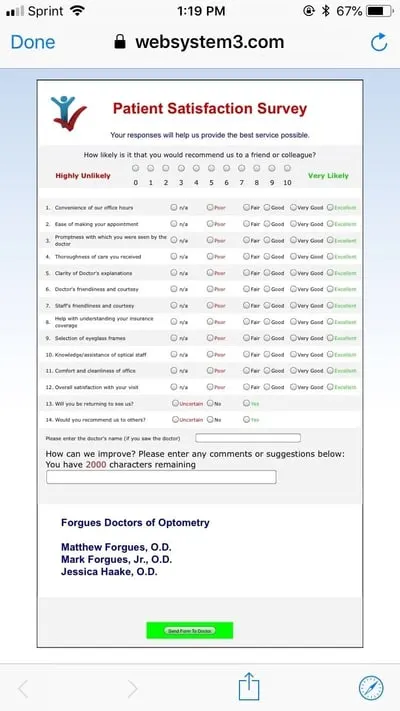
I received this questionnaire after an annual appointment with my optometrist. This specific questionnaire targets patient satisfaction. Since the company specializes in medical services and not products, there isn't a lot of input patients can give on new things for the company to ideate and produce.
This questionnaire is effective because it's clear and concise. As someone with a pretty busy daily schedule, I wouldn't want to invest more than a couple of minutes in a company questionnaire.
This was also a mobile-friendly questionnaire. All the questions fit on one screen, which saved me from loading several pages. The open-ended question was optional, and since I had no strong feelings on the matter, I left it blank. However, offering an open-ended question is a great way to get more in-depth feedback.
2. Customer Effort Score (CES) Questions
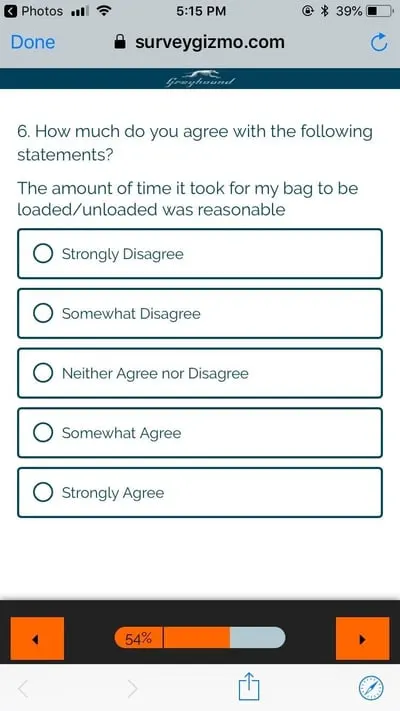
Recently, I took a Greyhound bus to and from New York City, and I received this survey via email. This is an example of a Customer Effort Score (CES) question. These questions measure the ease of a customer's experience, not just their satisfaction with the overall experience.
This specific Greyhound survey measured:
- How easy my experience with checking luggage was.
- Whether or not an employee helped me load and unload my luggage.
- How long the loading and unloading process took.
- How all of that experience affected my overall trip.
It was easy for me to complete the questionnaire with clear close-ended questions. As a result of this questionnaire, Greyhound will measure how much effort their customers need to put into their bus journeys and potentially find ways to make their trips easier.
3. Psychographic Questions
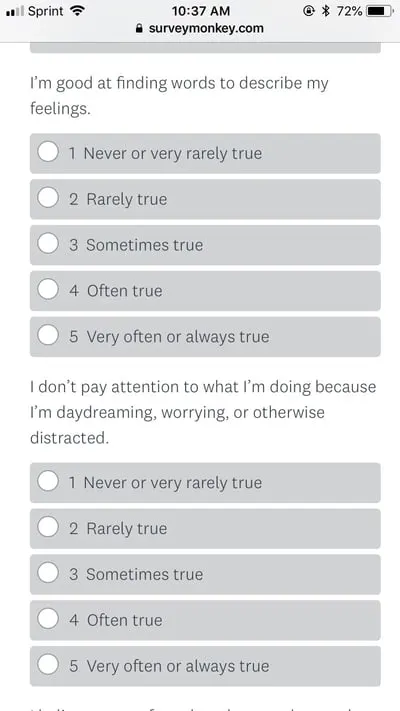
Emerson College's Center for Spiritual Life sent me the above survey during the spring semester. Since it was directed at students, its goal was to improve the direction and reach of the Center for Spiritual Life.
As a student, I don't typically fill out surveys because my time is spent completing assignments. Emerson College recognized this and has started offering to enter students into drawings to win prizes if they complete certain surveys. Offering incentives in exchange for getting customers to fill out your surveys is an excellent tactic. And, often, the prize can be cost-effective, like a gift card or small cash prize.
4. Demographic Questions
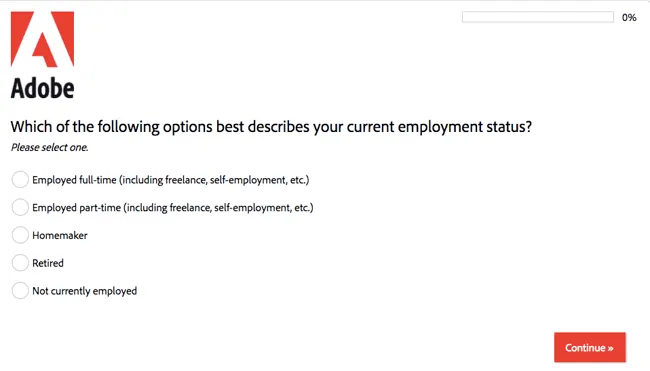
Adobe sent my coworker, Sophia Bernazzani, this questionnaire recently. It's solely composed of close-ended questions. Rather than learning about a customer's experience with the brand, it focuses on gaining demographic information. The goal of this kind of questionnaire is to collect user data.
Demographic questions require less effort for customers to fill out than customer experience ones. Made up of multiple-choice questions, it also takes less time. It’s effective for customers who don't have the time to prioritize company questionnaires. This is a simple way for companies to collect data about their customer base, which will help them understand their target audience in the future when planning campaigns and new products.
Based on these examples, we've included some tips and best practices below for mastering the design of your next questionnaire.
Questionnaire Design
Questionnaire design is a critical part of the survey creation process. It involves creating questions that accurately measure the opinions, experiences, behaviors, or actions of the respondents. Questionnaire design includes question development, writing, organization, and testing.
Questionnaire Length
The number of questions in your questionnaire should depend on the information you're looking to collect. You should also think about your customer journey map and consider customer needs when the questionnaire is presented. If the customer is in a hurry, it may not be the time to display a 10-question survey. Where they are in the buyer's journey will dictate how many questions you'll be able to ask.
A good rule of thumb is most customers spend about five minutes filling out a 10-question survey. That means your 50-question form takes about half an hour to complete. Unless you're offering an incentive in return, that's a big ask to your busy customers.
Questionnaire Presentation
The way a questionnaire is presented can make a big impact on how the survey is perceived. Just about everything can affect the respondent's experience with the survey. They can be affected by the spacing between questions, the number of questions, design and layout, and how instructions and questions are written.
Some presentation elements that make a great questionnaire include a progress bar, back and forward buttons, clear text boxes, beck boxes, and radio buttons for selecting the appropriate response to a question.
Spend some time in the questionnaire presentation and design stage to develop a survey your customers want to complete.
Question Progression
Question progression refers to the order and layout of your questionnaire. Most surveys begin with a multiple-choice format or rating scale. These questions take less time to answer and make the questionnaire seem to take a shorter amount of time. Once these questions are out of the way, the questionnaire should conclude with short-answer or open-ended questions. These sections typically take more time to complete depending on how much time your customer will spend on it.
Questionnaire Goal
Understanding your questionnaire goal will help you create your questionnaire. Make sure the goal is clear. If it’s confusing, so will the questionnaire. The respondents will be bewildered, and that can harm your data. However, if you know the goal of the questionnaire, you will have more concise and clear data.
The goal of a questionnaire is to make sure the business gets what they need from the respondents. Knowing and explaining what you need will get you what you want.
Questionnaire Terminology
The words you use in your questionnaire are important. Don’t use business jargon the respondents won’t understand. For instance, if you’re asking the respondent how your fast AI benefitted them, explain what an AI is (whether you think they know it or not). This will help your questionnaire stay clear.
Your questions should be simple and to the point and use straightforward language. Lastly, always make sure you frame your questions based on your subject. Look at social and economic factors to make sure the questions can be answered clearly.
Next, let's dig into some tips for creating your own questionnaire.
How to Make a Questionnaire
Start with templates as a foundation. Know your question types. Keep it brief when possible. Choose a simple visual design. Use a clear research process. Create questions with straightforward, unbiased language. Ensure every question is important. Ask one question at a time. Order your questions logically. Consider your target audience. Test your questionnaire.
1. Use questionnaire templates.
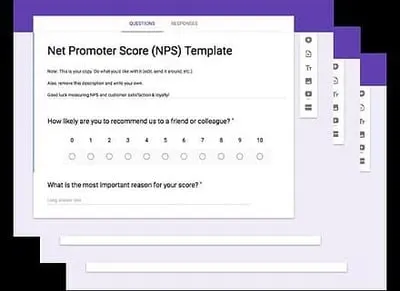
Rather than build a questionnaire from scratch, consider using questionnaire templates to get started. HubSpot's collection of customer-facing questionnaire templates can help you quickly build and send a questionnaire to your clients and analyze the results right on Google Drive.
2. Know your question types.
A simple "yes" or "no" doesn't cut it. To get feedback that actually matters, you need to give customers options that go in-depth. There's a method to getting accurate feedback from your questionnaire, and it starts by choosing the appropriate types of questions for the information you want to know. Vrnda LeValley, customer training manager at HubSpot, recommends starting with an alignment question like, "Does this class meet your expectations?" because it gives additional context to any positive or negative scores that follow. She continues, "If it didn't meet expectations, then there will potentially be negative responses across the board (as well as the reverse)."
Here are a few more types of questions you can use in your questionnaire to collect different types of data.
3. Multiple-Choice
Multiple-choice questions offer respondents several options of answers to choose from. This is a popular choice of questionnaire formats since it's simple for people to fill out and for companies to analyze. Multiple-choice questions can be in single-answer form (respondents can only select one response) or multiple-answer form (respondents can select as many responses as necessary).
4. Rating Scale
Rating scale questions offer a scale of numbers (typically one 10) and ask respondents to rate various items based on the sentiments assigned to that scale. This is effective when assessing customer satisfaction.
3. Likert Scale
Likert scale questions assess whether or not a respondent agrees with the statement, as well as the extent to which they agree or disagree. These questions typically offer five or seven responses, with sentiments ranging from items such as "strongly disagree" to "strongly agree."
4. Open-Ended
Open-ended questions ask a broader question or possibly elaboration on a particular response to one of the close-ended questions above. They are accompanied by a text box that leaves room for respondents to write freely. This is particularly important when asking customers to expand on an experience or recommendation.
3. Keep it brief, when possible.
Most questionnaires don't need to be longer than a page. For routine customer satisfaction surveys, it's unnecessary to ask 50 slightly varied questions about a customer's experience when those questions could be combined into 10 solid questions.
The shorter your questionnaire is, the more likely a customer will complete it. In addition, a shorter questionnaire means less data for your team to collect and analyze. Based on the feedback, it will be a lot easier for you to get the information you need to make the necessary changes in your organization and products.
4. Choose a simple visual design.
There's no need to make your questionnaire a stunning work of art. As long as it's clear and concise, it will be attractive to customers. When asking questions that are important to furthering your company, it's best to keep things simple. Select a font that’s common and easy to read, like Helvetica or Arial. Use a text size that customers of all abilities can navigate.
A questionnaire is most effective when all the questions are visible on a single screen. The layout is important. If a questionnaire is even remotely difficult to navigate, your response rate could suffer. Ensure that buttons and checkboxes are easy to click and that questions are visible on both computer and mobile screens.
5. Use a clear research process.
Before planning questions for your questionnaire, you'll need to have a definite direction for it. A questionnaire is only effective if the results answer an overarching research question. After all, the research process is an important part of the survey, and a questionnaire is a tool that's used within the process.
In your research process, you should first come up with a research question. What are you trying to find out? What's the point of this questionnaire? Keep this in mind throughout the process.
After coming up with a research question, it's a good idea to have a hypothesis. What do you predict the results will be for your questionnaire? This can be structured in a simple "If … then …" format. A structured experiment — yes, your questionnaire is a type of experiment — will ensure that you're only collecting and analyzing data necessary to answer your research question. Then, you can move forward with your survey.
6. Create questions with straightforward, unbiased language.
When crafting your questions, it's important to structure them to get the point across. You don't want any confusion for your customers because this may influence their answers. Instead, use clear language. Don't use unnecessary jargon, and use simple terms in favor of longer-winded ones.
You may risk the reliability of your data if you try to combine two questions. Rather than asking, "How was your experience shopping with us, and would you recommend us to others?" separate it into two separate questions. Customers will be clear on your question and choose a response most appropriate for each one.
Additionally, you should always keep the language in your questions unbiased. You never want to sway customers one way or another because this will cause your data to be skewed. Instead of asking, "Some might say that we create the best software products in the world. Would you agree or disagree?" it may be better to ask, "How would you rate our software products on a scale of 1 to 10?" This removes any bias and ensures that all of the responses are valid.
7. Ask only the most important questions.
When creating your questionnaire, keep in mind that time is one of the most valuable commodities for customers. Most aren't going to sit through a 50-question survey, especially when they're being asked about products or services they didn't use. Even if they do complete it, most of these will be half-hearted responses from fatigued customers who simply want to be finished with it.
If your questionnaire has five or 55 questions, make sure each has a specific purpose. Individually, they should be aimed at collecting certain pieces of information that reveal new insights into different aspects of your business. If your questions are irrelevant or seem out of place, your customers will be easily derailed by the survey. And, once the customer has lost interest, it'll be difficult to regain their focus.
8. Ask one question at a time.
Since every question has a purpose, ask them one at a time. This lets the customer focus and encourages them to provide a thoughtful response. This is particularly important for open-ended questions where customers need to describe an experience or opinion.
By grouping questions together, you risk overwhelming busy customers who don't have time for a long survey. They may think you're asking them too much, or they might see your questionnaire as a daunting task. You want your survey to appear as painless as possible. Keeping your questions separated will make it more user-friendly.
9. Order your questions logically.
A good questionnaire is like a good book. The beginning questions should lay the framework, the middle ones should cut to the core issues, and the final questions should tie up all loose ends. This flow keeps customers engaged throughout the entire survey.
When creating your questionnaire, start with the most basic questions about demographics. You can use this information to segment your customer base and create different buyer personas.
Next, add in your product and services questions. These are the ones that provide insights into common customer roadblocks and where you can improve your business's offerings. Questions like these guide your product development and marketing teams looking for new ways to enhance the customer experience.
Finally, you should conclude your questionnaire with open-ended questions to understand the customer journey. These questions let customers voice their opinions and point out specific experiences they've had with your brand.
10. Consider your target audience.
Whenever you collect customer feedback, you need to keep in mind the goals and needs of your target audience. After all, the participants in this questionnaire are your active customers. Your questions should be geared towards the interests and experiences they've already had with your company.
You can even create multiple surveys that target different buyer personas. For example, if you have a subscription-based pricing model, you can personalize your questionnaire for each type of subscription your company offers.
11. Test your questionnaire.
Once your questionnaire is complete, it's important to test it. If you don't, you may end up asking the wrong questions and collecting irrelevant or inaccurate information. Start by giving your employees the questionnaire to test, then send it to small groups of customers and analyze the results. If you're gathering the data you're looking for, then you should release the questionnaire to all of your customers.
How Questionnaires Can Benefit Your Customer Service Strategy
Whether you have one customer or 1000 customers, their opinions matter when it comes to the success of your business. Their satisfaction with your offerings can reveal how well or how poorly your customer service strategy and business are meeting their needs. A questionnaire is one of the most powerful, cost-effective tools to uncover what your customers think about your business. When analyzed properly, it can inform your product and service launches.
Use the free questionnaire templates, examples, and best practices in this guide to conduct your next customer feedback survey.
Now that you know the slight difference between a survey and a questionnaire, it’s time to put it into practice with your products or services. Remember, a good survey and questionnaire always start with a purpose. But, a great survey and questionnaire give data that you can use to help companies increase the way customers respond to their products or services because of the questions.
Net Promoter, Net Promoter System, Net Promoter Score, NPS, and the NPS-related emoticons are registered trademarks of Bain & Company, Inc., Fred Reichheld, and Satmetrix Systems, Inc.
24 powerful customer satisfaction survey questions (+ templates)
Table of Contents
Customer feedback surveys are important because they give you an insight into what your customers are thinking and feeling. This information can help you make decisions about your product, your customer service, and your overall business strategy. Customer satisfaction surveys (CSAT) are an important way to measure how your customers feel about their experience with your company.
Creating customer satisfaction surveys is reasonably straightforward, but you have to make sure you’re asking the right questions. If you ask too many questions, customers won’t fill out the whole survey. Ask the wrong questions, and they won’t tell you what’s really happening with your business.
To help you create a survey that will get you the high-quality customer feedback you need, we’ve put together a list of more than 20 customer satisfaction survey questions. We’ve also included some example CSAT survey templates you can use to measure customer satisfaction and get started today.
Why customer satisfaction surveys are important
Customer satisfaction surveys help you to understand your customer’s needs and wants. They also allow you to track customer satisfaction over time, so you can see if your company is making improvements. Additionally, customer satisfaction surveys can help you identify areas where your company needs to make changes.
This is important, because customer satisfaction data shows that satisfied customers are more likely to be repeat customers and continue doing business with you. They’re also more likely to refer new customers by telling their friends and family about your company. On the other hand, dissatisfied customers are more likely to take their business elsewhere.
We’ve written a “What Is CSAT?” guide that explains the customer satisfaction survey format in more detail.
What makes a good customer satisfaction survey question?
The questions you ask in your survey can make a big difference in the quality of the data you collect. There are a few things to keep in mind when you’re creating customer survey questions:
Make sure the questions are relevant to your business
You want to ask questions that will help you understand your customer’s experience and how you can improve it. For example, “How easy is it to find the customer service number on our website?” is a relevant question for a company that offers customer service.
Keep the questions short and simple
The survey should be quick and easy for customers to fill out. Customers are more likely to answer short, simple questions than long, complicated ones. So avoid long, complicated questions. For example, “How would you rate the customer service you received on a scale of 1 to 5, with 5 being the best?” is a simple question that can be easily answered.
Aim to make questions specific
Vague questions won’t give you the specific data you need to improve your customer’s experience. For example, “How was your customer service experience?” is too vague. A better question would be, “How satisfied are you with the customer service you received?”
Avoid asking leading questions
Leading questions are those that suggest a particular answer. For example, “Was our customer service friendly?” is a leading question because it suggests that the customer service was friendly. Leading questions can bias your results.
Make sure that questions are clear
Ambiguous questions can be confusing for customers and lead to inaccurate answers. For example, “How do you feel about our customer service?” is an ambiguous question. A better question would be, “How satisfied are you with the customer service you received?”
Now that you know what to keep in mind when creating your survey questions, let’s take a look at some customer feedback survey sample questions you can use to measure customer satisfaction.
20+ customer satisfaction survey questions to get better feedback
CSAT surveys can unlock valuable insights for companies that use them, but if you’re not asking the right questions, you won’t get the accurate data you need to make better decisions. Or, as we like to say, “The quality of the data is only as good as the quality of the questions.”
It’s important to remember that sharing good feedback is hard. Customers rarely enjoy filling out surveys, so it’s your job to make sure that questions are clear, concise, and relevant.
Writer’s block is common when it comes to customer satisfaction surveys, so we’ve compiled a list of consumer satisfaction survey questions that you can use as a starting point.
Questions to understand the experience
Understanding how people experience your product or service is key to understanding customer satisfaction. By asking these types of questions, you can identify areas where your customer experience could be improved. This can also help you better meet your customer’s needs.
- 1. How satisfied are you with the quality of the product/service?
- 2. Did our product/service meet your expectations?
- 3. How likely are you to recommend our product/service to a friend or family member?
- 4. How satisfied are you with the speed of our product/service?
- 5. How satisfied are you with the price of our product/service?
Questions about specific touchpoints
These questions can help you understand how your customer feels about specific touchpoints in their customer journey. By asking these types of questions, you can identify moments of delight, points of friction, and customer pain points.
- 1. How easy was it to find what you were looking for?
- 2. How easy was it to purchase the product/service you were looking for?
- 3. Did you experience any issues when using our product/service?
- 4. What was your overall impression of our product/service?
- 5. What was the most memorable part of your experience?
Questions about customer demographics
By understanding your customer’s demographics, you can tailor the customer experience to better meet their needs. These types of questions can also help you segment your customer base and target your marketing efforts.
- 1. What is your age?
- 2. What is your gender identity?
- 3. Where do you live?
- 4. What is your approximate annual income?
- 5. What is your employment status?
- 6. What is the highest level of education you have completed?
- 7. Do you have children under the age of 18?
- 8. What is your marital status?
- 9. What is your primary language?
Questions about personal preferences, behaviour and desires
While demographic data can help you understand your customer base, it’s also important to understand how they behave and what motivates them. Taking psychographic information into account, like personal beliefs and values, allows you to develop experiences that people will remember.
- 1. What is the most important thing to you in a product/service?
- 2. What type of product/service do you usually purchase?
- 3. What would motivate you to purchase our product/service again?
- 4. What is your favourite thing about (the industry related to your product/service)?
- 5. Is there anything you don’t like about (the industry related to your product/service)?
Customer satisfaction survey templates
Now that you know what customer satisfaction questions to ask, it’s time to put together your survey. To make things easier, we’ve created some customer satisfaction survey examples and templates that you can use as a starting point.
Basic CSAT survey template
This basic customer satisfaction survey template can be used to collect feedback about any type of product or service. Choose this customer satisfaction questionnaire template if you need a great starting point for creating your own customer satisfaction survey.
Retail survey template
This CSAT template is designed specifically for retail businesses. It covers all the key areas that are important to customers when they’re shopping, such as customer service, product selection, and value.
Restaurant survey template
This template is designed specifically for restaurants and the food service industry. It covers all the key areas that are important to customers when they’re dining out, such as food quality, service, and value.
Hotel survey template
This guest survey template is designed specifically for hotels. It covers all the key areas that are important to customers when they’re staying at a hotel, such as cleanliness, comfort, and value.
Banking survey template
This customer satisfaction survey is designed specifically for banks. It covers all the key areas that are important to customers when they’re banking, such as customer service, fees, and accessibility.
Event survey template
This CSAT template is designed specifically for events. It covers all the key areas that are important to customers when they’re attending an event, such as the venue, food, and entertainment.
Spa/Salon survey template
This CSAT survey template is designed specifically for spas and salons. It covers all the key areas that are important to customers when they’re getting a spa or salon treatment, such as customer service, cleanliness, and value.
Barbershop survey template
This customer satisfaction survey is designed specifically for barbershops. It covers all the key areas that are important to customers when they’re getting a haircut, such as customer service, quality of the haircut, and value.
Client satisfaction survey template
For client satisfaction survey examples specifically designed for businesses that work with clients, check out this template. It covers all the key areas that are important to clients, such as customer service, quality of work, and value.
IT help desk survey template
This questionnaire covers the essential IT help desk customer satisfaction survey questions. IT department customer satisfaction survey questions can be very specific, so it’s a great starting point for creating your own customer satisfaction survey for an IT help desk or support team.
We add new customer satisfaction survey samples every week. Sign up to get alerts whenever new a customer satisfaction survey form sample is added.
Remember, the survey is just the start. Once you’ve collected customer feedback, it’s important to take action on the results. Use customer satisfaction survey results to improve the customer experience, increase customer loyalty, and boost your bottom line.
FAQs
How do you write a customer feedback survey?
Follow these four principles to write a good customer feedback survey.
- Keep it short: customer surveys should be short and to the point.
- Ask the right questions: make sure you’re asking questions that will actually give you useful insights into customer satisfaction.
- Make it easy to respond: make sure the survey is easy to complete, with clear instructions and obvious answers.
- Follow up: once you’ve collected customer feedback, make sure you take action on the results.
What are some good customer satisfaction survey questions?
The best customer satisfaction survey question is usually the most obvious - “How satisfied are you with our product/service?” - allow customers to answer this using a rating scale, then follow-up with additional questions that allow them to tell you greater details using their own words.
How effective are customer satisfaction surveys?
Customer satisfaction surveys are a powerful way to collect customer feedback. The insights that you gain from a good customer experience survey/questionnaire can help you improve customer satisfaction, increase customer loyalty, and boost your bottom line.
Why are surveys good for customer satisfaction?
Surveys alone aren’t going to magically improve customer satisfaction. But they are a powerful tool that, when used correctly, can give you valuable insights into your customer’s needs and wants.
Using surveys as part of your customer success and marketing strategy will enable you to make data-driven decisions that will improve customer satisfaction
How often should you send customer satisfaction surveys?
How often you should survey customers will depend on your business and customer needs. If you’re just starting out, you may want to send a survey after each customer interaction. As you get more data, you may want to send surveys less frequently.
A good rule of thumb is to send a customer satisfaction survey at least once a quarter, or after any major customer service interaction.
How do you create a customer satisfaction survey?
Creating a customer satisfaction survey is easy with a dedicated feedback platform, such as TRACX. The benefits of using an all-in-one tool are that it’s easy to create beautiful surveys that are optimised for customer engagement, and you can easily track and analyse customer feedback over time.
What are the types of survey questions?
Most survey questions will fall under one of three main categories:
- Open-ended questions - These are questions that allow the customer to answer in their own words. They’re great for understanding customer sentiment, but can be difficult to analyse.
- Closed questions - These are questions that can be answered with a yes/no or multiple choice answer. They’re easier to analyse, but may not give you as much detail as open-ended questions.
- Likert and Rating scale questions - These are questions that ask the customer to answer on a scale, such as “Very Satisfied” to “Very Unsatisfied”. They’re easy to analyse and a good way to segment customer feedback quickly.
Read more about the different types of survey questions.
Does customer satisfaction impact your Net Promoter Score?
Your Net Promoter Score (NPS) is a customer loyalty metric that measures how likely your customers are to recommend your product or service to others. It’s calculated using a special survey, called an NPS survey.
Customer satisfaction is just one of the factors that can impact your Net Promoter Score. Other factors can include customer engagement, customer effort, and customer retention.
Does customer effort impact your Customer Satisfaction Score?
Yes, your customer effort score can have a big impact on customer satisfaction. In fact, customer effort can be as good as NPS when it comes to predicting customer loyalty.
How do you improve customer satisfaction?
There are many ways to improve customer satisfaction. One of the easiest ways to start is simply by asking for feedback on a regular basis, and making sure that you act on it.
How do you guage customer satisfaction?
A good way to gauge customer satisfaction is through the use of CSAT surveys. To learn more about what CSAT means, we recommend starting with our “What is CSAT” guide.
9 Ways to Improve Your Customer Service Response Time
Customers are the most vital part of your business. To keep a steady flow of income, you need to retain loyal customers and gain new ones. One of the best ways to keep repeat customers happy and attract new ones is by offering great customer service.
A very important aspect of quality customer service is responding to consumers in a timely manner. In the digital age, customers expect all of their questions to be answered right away. If they feel ignored, they’ll likely try to get what they need elsewhere.
In this article, we’ll teach you what customer response time is and why it’s important. Then we’ll provide tips you can use to achieve faster response times. Use the links below to skip from section to section.
- What is customer service response time?
- Ways to reduce customer service response time
- Does fast customer response time really matter?
- Standard customer service response time
- Calculate your average customer service response time
What is customer service response time?
Customer service response time is the average time it takes for your business to answer customer queries or complaints.
Today’s consumers have a variety of ways to contact your business. They may make contact by phone, email, or even on social media. The channel a customer uses to get in touch can affect how long they’re willing to wait for service.
Not only is it important to follow up with customers quickly, but your response also needs to be helpful of course. Sending quick, useful responses is a great way to earn customers’ trust and loyalty.
If you need help improving your current response times, Upwork’s database of customer service experts will introduce you to professionals who may be able to help you upgrade your support strategies.
Ways to reduce customer service response time
While it’s inevitable that some inquiries will take your service team multiple interactions with a customer to work out, the goal should be to solve their problem in one message.
Consider these actions as you work to improve your customer service response time.
1. Define real goals
Setting goals for your customer response time is the first step to improving it. Do some research to see what the benchmark average response time is in your industry. To set goals, you’ll have to measure your company’s results.
Customer relationship management (CRM) tools like HubSpot CRM or Zoho CRM can help maintain a record of your business’s key performance indicators (KPIs) and give you reports when you need them. Customer service KPIs you might want to measure include:
- First response time (FRT) is the amount of time it takes for your service team to initially get back to a customer’s request. While automated emails are often helpful tools, they’re not considered adequate first responses to a customer.
- Average handling time (AHT) refers to the amount of time it takes for a customer service rep to complete an interaction with a customer over the phone. It includes talk and transfer time, the time a customer spends on hold, and the time it takes for the rep to complete service tasks after a call.
- Ticket resolution time is the total amount of time it takes for service staff to sort out an inquiry and satisfy the customer. Some issues may take several interactions, while others might be solved in just one.
Here’s an example of a goal you might set: You manage a finance app. Your company’s average response time to customer emails is 16 hours. However, the average email first response time in the financial industry is 14 hours. One of your goals might be to decrease your service team’s response time to under 14 hours.
2. Set up a first automated response
You can’t rely on an automated message to fully satisfy a customer’s needs. However, a good automated response can serve as a placeholder for a reply, save your service team some time, and help you manage customer expectations. Sometimes, an automated message is even able to guide a customer toward finding the information they’re looking for.
Autoresponder software tools like AWeber and GetResponse serve to help automate messages for customer inquiries that come through platforms like email and social media.
Quality automated messages are helpful to your customers and can make your reps’ jobs easier. A good automated message should:
- Assure the customer you’ve received their request and let them know when they can expect a response. It might say, “A customer service rep will be contacting you within the next 24 hours.” If you respond sooner, you’ll impress them. If a query comes in on a day your business is closed (like a weekend), let the customer know what your business hours are.
- Have links to any knowledge bases where customers are able to find answers for themselves. If you’ve created a frequently asked questions (FAQ) page or a guide for handling your product’s common problems, tell your customers where to find them.
Let’s say your e-commerce company sells Bluetooth headphones. An automated email message might look something like this: “Thank you for your inquiry! We value your business, and a customer service representative will be reaching out to you via email within the next 24 hours. If it’s Saturday or Sunday, please give us until the following Monday to respond, as we’re closed on weekends.
“In the meantime, please take a look at our FAQ page [embedded link] for answers to some of our most commonly asked questions. We also have helpful guides on our website for things like connecting your headphones to your smartphone [embedded link] and downloading our companion app [embedded link].”
3. Prioritize the requests
Customer tickets have varying levels of urgency and importance. Some have the potential of causing massive problems if they’re not handled immediately, while others might not be as dire. That’s why it’s vital to split up customer tickets based on how critical or pressing they are.
For example, let’s say your company offers a digital payment platform (similar to PayPal). One of your biggest customers is an e-commerce business that sells electronics. They use your software to process all of their customer payments.
It’s the day before Cyber Monday (the biggest online sales day of the year) and their portal isn’t processing payments. If the issue isn’t resolved before Monday, the company stands to lose hundreds of thousands of dollars in sales and your business will lose tens of thousands of dollars in processing fees.
This doesn’t mean that other tickets aren’t important. Ideally, you want to solve every ticket quickly. One way to ensure that urgent tickets are prioritized is to designate experienced and knowledgeable members of your customer service department to handle critical inquiries or tickets from valuable customers. This leaves your newer staff to take care of less complex issues.
4. Prepare customer service response templates
There’s no reason your customer service reps should have to rewrite the same responses to common questions over and over. Create templates for your team members to use to respond to the customer requests that come in all the time.
Templates can save time, give every customer a comparable level of service, and help you establish a consistent brand voice. Set up the templates to respond to customer questions you receive over email, social media, or any other platform.
If you have an online subscription service, for example, a common problem could be that users forget their username or password information. Here’s an example of a template your rep could use to address this issue:
“I’m sorry you’re having trouble signing in. If you’ve forgotten your username or password, don’t worry. We’ll help you find it. Please select an option below to help us better serve you:
I don’t remember my username [embedded link].
I don’t remember my password [embedded link].”
5. Set up time-based email alerts
Customer inquiries might sometimes be overlooked for a number of reasons. Your agents might need more information to answer a customer’s request or they might delay answering questions that aren’t urgent.
Keeping track of all the inquiries in your queue can be hard. Time-based email alerts remind you how long a customer has been waiting for a response. Customer service email tools like Help Scout or Hiver are helpful for setting up email alerts.
Let’s say your staffing firm has a goal to deliver a helpful first response to every inquiry within 12 hours. You could set up a time-based email alert to notify you if an email has been in your queue for 11 hours so you have time to respond to it within the target time.
6. Study common requests to identify and anticipate them
As your business operates, you’ll get an idea of what questions seem to pop up frequently. Make sure your customer service team is prepared to handle these issues quickly. Also, bring any new employees up to speed so they know what to expect.
You can use tools like Typeform and Jotform to create customer service forms to help you categorize and keep track of different types of customer service requests. Design forms with a list of problem types for your customers to choose from.
If your e-commerce business ships clothing, for example, a common issue your customers might have is submitting the wrong shipping address. If you train your service reps to change the address on a customer’s order fast, they’ll have more time to handle other complex requests.
7. Create an FAQ page
Sometimes, customers like the opportunity to solve their own problems. By setting up a knowledge base or FAQ (frequently asked questions) page for your business, you give your consumers the opportunity to find solutions to their problems on their own.
Programs like Document360 or KBase are helpful for creating FAQ pages. A good FAQ page will save your company and service reps a lot of time solving user problems. Include a link to your FAQ page in emails, on your website, in automated messages, and on your business’s social media pages.
Even though the FAQ answers may be helpful to your customers, though, don’t depend on them alone to solve your customers’ issues. Customer service experts should still respond to every inquiry personally.
An FAQ page can work great for a variety of businesses. For example, if your company sells computers, you might have questions and answers that tell your customers how to handle common problems like frozen screens and interrupted internet connections.
8. Use customer service software
You have a variety of customer service tools to choose from. The best software tools for your company will depend on factors like what type of business you run and what your customer service goals are. Here are a few types of customer service software:
- CRM tools like Salesforce and Zendesk store customer information, which can help you increase customer loyalty.
- Chat and messaging tools like LiveChat and Smartsupp help you provide customer support over short message service (SMS), email, and social media channels.
- Chatbot platforms like ManyChat and ChatBot.com create AI robots to help your visitors solve common issues. Chatbots may help reduce your service team’s workload.
- Knowledge base tools like Wix Answers and Bloomfire can help you provide resources for your customers to research their own solutions.
Great customer service software can help your business improve its response time in a few ways:
- It helps save time by automating processes and workflows, for example, by sending auto-responses.
- It helps you keep track of certain information, such as how long specific customers have been waiting for a response.
- It helps you measure performance metrics like your business’s average first response times.
- It provides a platform that may help your team collaborate more efficiently.
9. Add more customer service experts
If you’ve tried all of the above strategies and you’re still having trouble meeting your response time goals, it might be time to engage more customer service experts to handle the workload.
Upwork can help you find the very best customer service reps from around the world with the skills you need to improve your response times and scale your company’s customer support processes.
Does fast customer response time really matter?
A quick customer response time is absolutely crucial for your business. The market research organization Forrester discovered that over three-fourths of the consumers they surveyed said the most important aspect of customer service is that a business respects its customers’ time.
Forrester’s research also found that over half of their participants would give up on an online purchase if they had an issue they couldn’t find an answer to quickly.
Reducing your customer response time is one of the best things you can do to promote customer satisfaction, build a loyal customer base, and attract new customers.
Standard customer service response time
When a consumer has a problem, they want an immediate response. In fact, a survey conducted by Jeff Toister and SuperOffice found that a third of customers expected a company to respond to a new email within one hour. Meanwhile, around 11% believed a company should respond within 15 minutes.
How do most companies measure up? Another customer service study found that the majority of businesses don’t answer emails at all; of those that do (around 38%), the average email response time is 12 hours and 10 minutes.
The average response time for your particular industry might be different. Consistently beating the industry average response time will go a long way toward helping you create a positive customer experience. Here are the average email response times for a few business types:
- Supply chain logistics—12 hours
- Financial services—14 hours
- Retail—17 hours
- Real estate—15 hours
- Corporate travel agencies—36 hours
Calculate your average customer service response time
In the next few sections, we’ll teach you how to figure out the customer response time for your business using two different methods.
1. Record the time that passes between receiving the message and providing the response
One way to track all of your response times is by recording the amount of time it takes to respond to every customer query. You can document each response time in a spreadsheet like Google Sheets or Microsoft Excel. Use the AVERAGE function to find your average customer response time.
| 12 hrs. |
|---|
| 6 hrs. |
| 4 hrs. |
| 8 hrs. |
| 7.5 hrs. |
| 7.5 hrs. |
The calculation shows the average response time for the five responses in the above chart is seven and a half hours.
2. Customer service software time trackers
For large businesses that get huge numbers of customer inquiries, it may not be practical to manage your own response time metrics. Fortunately, several software tools are available to track your response times and automatically create reports based on them.
Select from a variety of customer service tools you can use to track your response times in real time. HubSpot CRM, Freshdesk, and Movidesk are just a few examples of resources with time trackers that can record and analyze customer service metrics.
Make the most out of your customer service
No one likes to be kept waiting. By reducing your reply time, you show your customers that you appreciate them and value their time. A quick response time is an essential part of a great customer service experience.
But finding new team members for your support team can be challenging. Great support workers need a mix of hard skills, like computer competency, and soft skills, like communication abilities, to artfully handle varied types of customer service interactions.
Upwork can help you find independent customer service experts with proven track records of success to help your business meet customer expectations. We also have a quality job board for talented professionals looking to fill customer service roles.
Upwork is not affiliated with and does not sponsor or endorse any of the tools or services discussed in this section. These tools and services are provided only as potential options, and each reader and company should take the time needed to adequately analyze and determine the tools or services that would best fit their specific needs and situation.
Author Spotlight
Upwork is the world’s work marketplace connecting millions of businesses with independent talent around the globe. We serve everyone from one-person startups to 30% of the Fortune 100 with a powerful trust-driven platform that enables companies and freelancers to work together in new ways that unlock their potential.