Project 1
1. Design a battery pack for a car roughly 150 Kw with 120 V. Use 3500 mAh 3.6V nominal NMC chemistry cell.
a. Design the battery pack configuration.
b. Draw the BMS topology for this battery pack.
Aim of the Project:-
The Main Of this project is Design the battery pack configuration ,Draw the BMS topology for this battery pack using given data and also build 3s2p battary pack configaration by using the MATLAB/SIMULINK tool.
Theory:-
Battery Management Stysytem :-
A Bttery management system(BMS) is said to be the brain of a battery pack. The BMS is a set of electronics that monitors and manages all of the battery’s performance. Most importantly, it keeps the battery from operating outside of its safety margins.
The battery management system is critical to the battery’s safe operation, overall performance, and longevity of battery pack.
The primary function of the BMS is to protect the battery cells from damage caused by being overcharged or over-discharged. Additionally, the BMS calculates the remaining charge, monitors the battery’s temperature, monitors the battery’s health and safety by checking for loose connections and internal shorts.
Solution :-
Given data:-
Required Power = 150 KW
Required Voltage = 120 V.
Battery detalis :-
Batatry capacity = 3500 mAh= 3.5 Ah
Battery Nominal Voltage =3.6V
a) Design the battery pack configuration.
i) Number of cells connected in Series:-
For this solution let us Take the data from given:-.
Nominal volatge =3.6 v
Cell having capacity of cell(Ah)= 3500 mAh= 3.5 A
cell connected in series= required voltage/nominal cell voltage
Therefore,
*** Cells connected in series = Required voltage (V) / Nominal cell Voltage(Ah) ***
The cells connected in series = 120 / 3.6
=33.3 cells
This Digits vallues are taken as rounding of caluctions as followes :-
case1 : for 33 cells value will be 118.8
case 2 : fpr 34 cells value will be 122.4
>>When compare with rated voltage, the battery voltage is greater in case 2 then case 1.
So,
No.of cell in series= 34 S
ii) Number of cells connected in Parallel:-
Formula for number of cells connectd in parallel:-
no of cells in parallel = continous current /cell capacity
Given data:-
Required Power = 150 KW
Required Voltage = 120 V.
NMC Battery detalis :-
Batatry capacity = 3500 mAh= 3.5 Ah
Battery Nominal Voltage =3.6V
We know that ,
hence, From formula,
Current(I) = power(P) / Voltage(V)
= (150 *1000) / 120
Current(I) = 1250 Amps
NMC Battery detalis :-
Batatry capacity = 3500 mAh= 3.5 Ah
Battery Nominal Voltage =3.6V
from the data ,
Current(I) = 1250 Amps
Cell nominal Voltage = 3.6 V
then ,
Number of cells Connected in paralle = Required Current (I) / cell capacity
=1250 / 3.6
=358 P
From values (1) and (2)
We can conclude that
The Battery pack Configaration = 34S358P
b. Draw the BMS topology for this battery pack:-
Fig :-BMS TOPOLOGY BLCOK DIAGRAM
Solution:-
From the Architecture of BMS we can said that the "AFU" Allowes ony 18 cells connected in series per one unit of modulae.
Hence ,
we required series cells is 34 cells
There fore we are dividing these 34 celss as 2 slave sets with 1 number of MCU master unit as followes
Slave 1= 17 cells
Slave 2= 17 cells
Based on this cells connected in series and Architecture of BMS we Choose the Master and Slave topology of BMS for this Ev battery pack Topology design.
BMS Topology MODEL :-
Master and Slave Topology:-
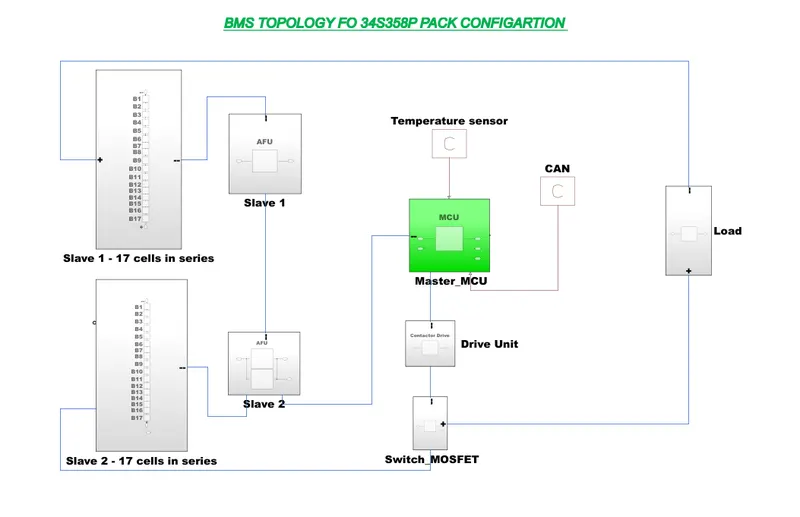
>> Above Model is For BMS Topology of 34s358P battery pack Configarationmodel
>>This Topology consistes a 2 numbers of slave of AFU units with each AFU units slave Consists a 17 numbers Of Cells connectd in series.
Conclusion :-
We can conclude from above calculations
The battery Pack configaration is 34S358P
Battry BMS Topology is "Master and Slave " Topology is is designed and explained thery regarding BMS topology.
--------------------------------------------------------------------------------------------------------------------------------------------
2)Build a 3S2P battery pack configuration with generic battery block using Matlab/Simulink.
Aim)The main aim is design a given battery pack configaration by using theMatlab/Simulink Tool.
Given data :-
Battery pack configartion = 3S2P
Procedure :-
Batteries in 3S2P configuration in Matlab/Simulink. That is 3 cells should be connected in series and 2 cells should be connected in parallel.
,total number of cells in battery pack = No. of cells in series * No. of cells in parallel
= 3 * 2 = 6 cells
Model Explanation:-
The voltage measurement block is connected across the battery pack to measure the battery pack voltage. The scope output used for the battery pack consists of SOC (State of Charge), Current and voltage. The controlled current signal is given as the load to the battery pack. The constant blockis determined with battery capacity and it is given to the controlled current block.
The parameter given inside the battery is given below:-
- Nominal voltage of a cell 7.2V
- Rated capacity of a cell 5.4Ah
- Maximum voltage of a cell 8.3V
There fore ,
Nominal voltage of the battery pack = no.of cell in series * nominal voltage of a cell
= 3 * 7.2v
= 21.6 V
Rated capacity of the battery pack = no.of cell in parallel* rated capacity of a cell
= 2 * 5.4Ah
= 10.8Ah
The model is for an 21.6V 7 with 10.8Ah battery capacity
Overall voltage of the battery pack = maximum voltage of the battery * no. of cells in series
= 8.3V * 3
= 25 v
Overall voltage = 25 V-
output Scope results :-
Voltage scope :-
Overall voltage of the battery pack = maximum voltage of the battery * no. of cells in series
= 8.3V * 3 = 25 V
Conclusion :-
The battery pack configuration(3S2P) with generic battery block using Matlab/Simulink is created.
---------------------------------------------------------------------------------------------------------------------------------------------
(The End)