|| Powertrain Of An Aircraft's Towing Vehicle ||
1.
The Total weights of an Aircraft are listed below:
|
Type |
MTOW [kg] |
MLW [tons] |
|
Antonov An-225 |
640,000 |
591.7 |
|
Scaled Composites Model 351 Stratolaunch |
589,670 |
|
|
Airbus A380-800 |
575,000 |
394 |
|
Boeing 747-8F |
447,700 |
346.091 |
|
Boeing 747-8 |
443,613 |
306.175 |
|
Boeing 747-400ER |
412,770 |
295.742 |
|
Antonov An-124-100M |
405,060 |
330 |
|
Boeing 747-400 |
396,900 |
295.742 |
|
Lockheed C-5 Galaxy |
381,000 |
288.417 |
|
Boeing 747-200 |
377,840 |
285.700 |
|
Boeing 747-300 |
377,840 |
260.320 |
|
Airbus A340-500 |
371,950 |
240 |
|
Airbus A340-600 |
367,400 |
256 |
|
Boeing 777-300ER |
351,800 |
251.29 |
|
Boeing 777F |
347,800 |
260.816 |
|
Boeing 777-200LR |
347,450 |
223.168 |
|
Boeing 747-100 |
340,200 |
265.300 |
|
Airbus A350-1000 |
308,000 |
233.5 |
|
Boeing 777-300 |
299,370 |
237.683 |
|
Boeing 777-200ER |
297,550 |
213.00 |
|
Airbus A340-300 |
276,700 |
190 |
|
McDonnell Douglas MD-11 |
273,300 |
185 |
|
Airbus A350-900 |
270,000 |
175 |
|
Ilyushin Il-96M |
270,000 |
195.04 |
|
McDonnell Douglas DC-10 |
256,280 |
183 |
|
Boeing 787-9 |
254,000 |
192.777 |
|
Boeing 787-10 |
254,000 |
201.849 |
|
Airbus A340-200 |
253,500 |
181 |
|
Ilyushin IL-96-300 |
250,000 |
175 |
|
Airbus A330-300 |
242,000 |
185 |
|
Airbus A330-200 |
242,000 |
180 |
|
Lockheed L-1011-500 |
231,300 |
166.92 |
|
Boeing 787-8 |
228,000 |
172.365 |
|
Lockheed L-1011-200 |
211,400 |
|
|
Ilyushin IL-86 |
208,000 |
175 |
|
Boeing 767-400ER |
204,000 |
158.758 |
|
Airbus A300-600R |
192,000 |
140 |
|
Boeing 767-300ER |
187,000 |
136.08 |
|
Concorde |
185,000 |
111.1 |
|
Airbus A300-600 |
163,000 |
138 |
|
Boeing 767-300 |
159,000 |
136.078 |
|
Airbus A310-300 |
157,000 |
124 |
|
Vickers VC10 |
152,000 |
151.9 |
|
Boeing 707-320B |
151,000 |
97.5 |
|
Boeing 707-320C |
151,000 |
112.1 |
|
Douglas DC-8-61 |
147,000 |
|
|
Airbus A310-200 |
142,000 |
123 |
|
Airbus A400M |
141,000 |
122 |
|
Douglas DC-8-32 |
140,000 |
|
|
Douglas DC-8-51 |
125,000 |
|
|
Boeing 757-300 |
124,000 |
101.6 |
|
Boeing 707-120B |
117,000 |
86.3 |
|
Boeing 757-200 |
116,000 |
89.9 |
|
Boeing 720B |
106,000 |
79.5 |
|
Boeing 720 |
104,000 |
79.5 |
|
Tupolev Tu-154M |
104,000 |
80 |
|
Tupolev Tu-204SM |
104,000 |
87.5 |
|
Convair 880 |
87,500 |
|
|
Boeing 737-900 |
85,000 |
66.36 |
|
Boeing 737-900ER |
85,000 |
71.35 |
|
Boeing 727-200 Advanced |
84,000 |
70.1 |
|
Airbus A321-100 |
83,000 |
77.8 |
|
Boeing 737-800 |
79,000 |
65.32 |
|
Boeing 727-200 |
78,000 |
68.1 |
|
McDonnell-Douglas MD-83 |
73,000 |
63.28 |
|
Boeing 727-100 |
72,500 |
62.4 |
|
Boeing 727-100C |
72,500 |
62.4 |
|
McDonnell-Douglas MD-90-30 |
71,000 |
64.41 |
|
de Havilland Comet 4 |
70,700 |
|
|
Boeing 737-700 |
70,000 |
58.06 |
|
Airbus A320-100 |
68,000 |
66 |
|
Boeing 737-400 |
68,000 |
54.9 |
|
de Havilland Comet 3 |
68,000 |
|
|
Boeing 377 |
67,000 |
|
|
Boeing 737-600 |
66,000 |
54.66 |
|
Airbus A220-300 |
65,000 |
57.61 |
|
Hawker Siddeley Trident 2E |
65,000 |
|
|
Airbus A319 |
64,000 |
62.5 |
|
Boeing 737-300 |
63,000 |
51.7 |
|
Boeing 737-500 |
60,000 |
49.9 |
|
Airbus A220-100 |
59,000 |
50.80 |
|
Airbus A318 |
59,000 |
57.5 |
|
Boeing 717-200HGW |
55,000 |
47.174 |
|
Douglas DC-7 |
55,000 |
|
|
de Havilland Comet 2 |
54,000 |
|
|
Boeing 717-200BGW |
50,000 |
46.265 |
|
de Havilland Comet 1 |
50,000 |
|
|
Douglas DC-6A |
48,600 |
|
|
Douglas DC-6B |
48,500 |
|
|
Embraer 190 |
48,000 |
43 |
|
Caravelle III |
46,000 |
|
|
Fokker 100 |
46,000 |
39.95 |
|
Douglas DC-6 |
44,000 |
|
|
Avro RJ-85 |
42,000 |
36.74 |
|
Handley Page Hermes |
39,000 |
|
|
Embraer 175 |
37,500 |
32.8 |
|
Bombardier CRJ900 |
36,500 |
33.345 |
|
Embraer 170 |
36,000 |
32.8 |
|
Bombardier CRJ700 |
33,000 |
30.39 |
|
Douglas DC-4 |
33,000 |
|
|
Vickers Viscount 800 |
30,400 |
|
|
Bombardier Q400 |
28,000 |
28.01 |
|
Bombardier CRJ200 |
23,000 |
21.319 |
|
ATR 72-600 |
22,800 |
22.35 |
|
Saab 2000 |
22,800 |
21.5 |
|
Embraer ERJ 145 |
22,000 |
19.3 |
|
ATR 42-500 |
18,600 |
18.3 |
|
Saab 340 |
13,150 |
12.930 |
|
Embraer 120 Brasilia |
11,500 |
11.25 |
|
BAe Jetstream 41 |
10,890 |
10.570 |
|
Learjet 75 |
9,752 |
8.709 |
|
Pilatus PC-24 |
8,300 |
7.665 |
|
Embraer Phenom 300 |
8,150 |
7.65 |
|
Beechcraft 1900D |
7,765 |
7.605 |
|
Cessna Citation CJ4 |
7,761 |
7.103 |
|
de Havilland Hercules |
7,000 |
|
|
Embraer Phenom 100 |
4,800 |
4.43 |
Where,
MTOW = Maximum take-off weight
MLW = Maximum landing weight
Determination Of The Weights:-
The wings, engine, fuselage, and tail, plus the payload and the fuel. Each part has a weight associated with it which the engineer can estimate, or calculate, using Newton's weight equation:
w = m * g
where w is the weight, m is the mass, and g is the gravitational constant which is 9.8 meters/square sec in metric units. The mass of an individual component can be calculated if we know the size of the component and its chemical composition. Every material (iron, plastic, aluminum, gasoline, etc.) has a unique density. Density r is defined to be the mass divided by the volume v:
r = m / v
If we can calculate the volume
m = r * v
The total weight W of the aircraft is simply the sum of the weight of all of the individual components.
W = w(fuselage) + w(wing) + w(engines) + w(payload) + w(fuel) + ...
2.
Yes, there is a difference between ground speed and the wind speed, And the difference is known as air speed.
To Understand it more clearly, let us understand each term. That is, Wind speed, Air speed, and ground speed.
One of the most confusing concepts for young scientists is the relative velocity between objects. Aerodynamic forces are generated by an object moving through a fluid (liquid or gas). A fixed object in a static fluid does not generate aerodynamic forces. Hot air balloons "lift" because of buoyancy forces and some aircraft like the Harrier use thrust to "lift" the vehicle, but these are not examples of aerodynamic lift. To generate lift, an object must move through the air, or air must move past the object. Aerodynamic lift depends on the square of the velocity between the object and the air. Now things get confusing because not only can the object be moved through the air, but the air itself can move. To properly define the relative velocity, it is necessary to pick a fixed reference point and measure velocities relative to the fixed point. In this slide, the reference point is fixed to the ground, but it could just as easily be fixed to the aircraft itself. It is important to understand the relationships of wind speed to ground speed and airspeed.
Wind Speed
For a reference point picked on the ground, the air moves relative to the reference point at the wind speed. Notice that the wind speed is a vector quantity and has both a magnitude and a direction. Direction is important. A 20 mph wind from the west is different from a 20 mph wind from the east. The wind has components in all three primary directions (north-south, east-west, and up-down). In this figure, we are considering only velocities along the aircraft's flight path. A positive velocity is defined to be in the direction of the aircraft's motion. We are neglecting cross winds, which occur perpendicular to the flight path but parallel to the ground, and updrafts and downdrafts, which occur perpendicular to the ground.
Ground Speed
For a reference point picked on the ground, the aircraft moves relative to the reference point at the ground speed. Ground speed is also a vector quantity so a comparison of the ground speed to the wind speed must be done according to rules for vector comparisions.
Airspeed
The important quantity in the generation of lift is the relative velocity between the object and the air, which is called the airspeed. Airspeed cannot be directly measured from a ground position, but must be computed from the ground speed and the wind speed. Airspeed is the vector difference between the ground speed and the wind speed.
Airspeed = Ground Speed - Wind Speed
On a perfectly still day, the airspeed is equal to the ground speed. But if the wind is blowing in the same direction that the aircraft is moving, the airspeed will be less than the ground speed.
To Visualize more precisely, Animation by NASA make it more clear. Below is the link.
https://www.grc.nasa.gov/www/k-12/airplane/Animation/airrel/anrelw.html
3.
It is not recommended to use aircraft engine power to move it on the ground at Airport due to the following three reasons:
1. Noise
2. Engine wear
3. Cost
1. Noise :
In aviation, pushback is an airport procedure during which an aircraft is pushed backwards away from an airport gate by an external power. Pushbacks are carried out by special, low-profile vehicles called pushback tractors or tugs.
Image 1: Pushback of an airplane by a pushback tractor or tugs
Although, many aircraft are capable of moving themselves backwards on the ground using reverse thrust (a procedure referred to as a powerback), the resulting jetblast or prop wash might cause damage to the terminal building or equipment. Engines close to the ground may also blow sand and debris forward and then suck them into the engine, causing damage to the engine. A pushback is therefore the preferred method to move the aircraft away from the gate.
PROCEDURE:
Pushbacks at busy aerodromes are usually subject to ground control clearance to facilitate ground movement on taxiways. Once clearance is obtained, the pilot will communicate with the tractor driver (or a ground handler walking alongside the aircraft in some cases) to start the pushback. To communicate, a headset may be connected near the nose gear.
Since the pilots cannot see what is behind the aircraft, steering is done by the pushback tractor driver and not by the pilots. Depending on the aircraft type and airline procedure, a bypass pin may be temporarily installed into the nose gear to disconnect it from the aircraft's normal steering mechanism.
Once the pushback is completed, the towbar is disconnected, and any bypass pin removed. The ground handler will show the bypass pin to the pilots to make it clear that it has been removed. The pushback is then complete, and the aircraft can taxi forward under its own power.
Airbus A380, pushback is shown in the Link
Link: https://upload.wikimedia.org/wikipedia/commons/6/6f/Airbus-A380-Pushback-001.ogv
5.
- Take-Off Power:
Takeoff is the phase of flight in which an aerospace vehicle leaves the ground and becomes airborne.
For aircraft that take off horizontally, this usually involves starting with a transition from moving along the ground on a runway. For balloons, helicopters and some specialized fixed-wing aircraft (VTOL aircraft such as the Harrier), no runway is needed. Takeoff is the opposite of landing.
The total energy of an aircraft flying in the atmosphere can be calculated using equation.
Taking an example of Boeing 737-300,
A Boeing 737-300 has a maximum takeoff weight of 5.65 × 10⁴ kg, a cruise altitude of h = 10,195 m, and cruise speed of 221 m/sec. Inserting these numbers into the above equation, we obtain 7.03 GJ for the energy at cruise conditions. [3] However, the engines mounted onto the wings of the plane are required to provide additional energy per time, power, in order to keep the aircraft flying at a constant altitude and speed. This extra power needed to overcome the drag acting on the airplane and is calculated using
P = (dh/dt) * m * g
where (dh/dt) is the decent speed required to keep the plane's speed constant if the engines fail. Assuming that a Boeing 737-300 has a similar glide ratio to a Boeing 747 of 17:1, a Boeing 737-300 has a descent speed of approximately (dh/dt)= (221m/sec)/17 = 13 m/sec. The power required to keep a Boeing 737-300 flying at a constant altitude and speed is 7.2 × 10⁶ watts. The rate of fuel burn necessary for the engines to produce enough power to keep the airplane flying can be calculated from the total power requirement. Assuming the efficiency of the engines adding thrust to the aircraft is roughly 30% and the specific gravity of jet fuel is about 0.82 kg per liter, a Boeing 737-300 burns approximately 0.665 liters per second. A Boeing 737-300 has a standard fuel capacity of 2.0104 × 10⁴ liters. Assuming that takeoff, climb, and landing burns approximately one third of the total fuel, and at cruise conditions with a fuel burn rate of 0.665 liters per second, a Boeing 737-300 can fly for approximately (2/3) × 8.4 hours= 5.6 hours at cruise conditions before running out of jet fuel.
- Tyre Design:
An aircraft tire or tyre is designed to withstand extremely heavy loads for short durations. The number of tires required for aircraft increases with the weight of the aircraft, as the weight of the airplane needs to be distributed more evenly. Aircraft tire tread patterns are designed to facilitate stability in high crosswind conditions, to channel water away to prevent hydroplaning, and for braking effect.
Aircraft tires also include fusible plugs (which are assembled on the inside of the wheels), designed to melt at a certain temperature. Tires often overheat if maximum braking is applied during an aborted takeoff or an emergency landing. The fuses provide a safer failure mode that prevents tire explosions by deflating in a controlled manner, thus minimizing damage to aircraft and objects in the surrounding environment.
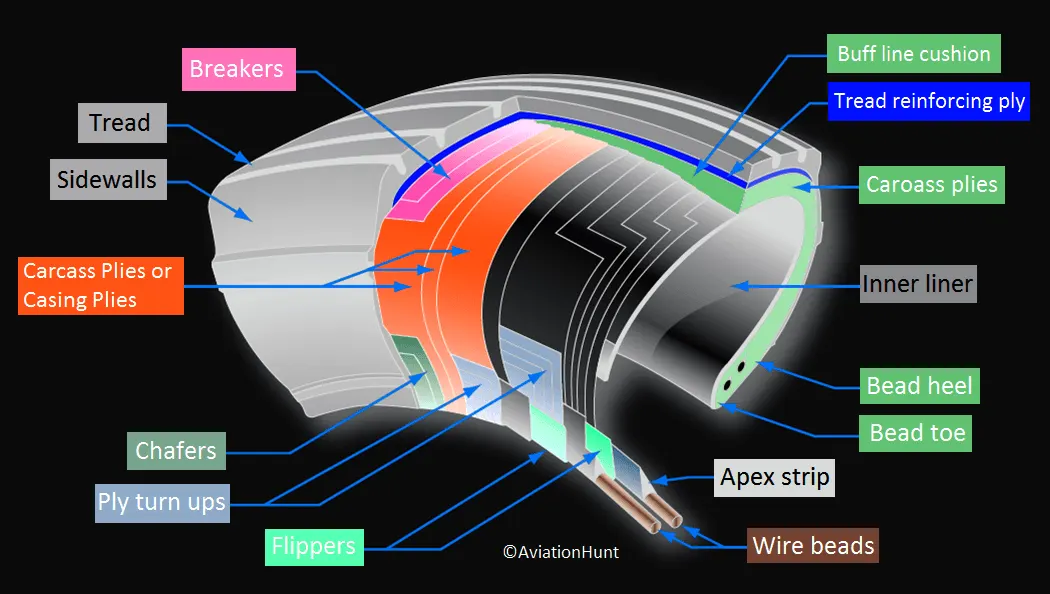
Diagram: Construction of an aircraft tire
Some technical aspects which should be taken care while designing the tyre:
Retreading – Retreading is methods of restoring a worn tyre by renewing the tread area or by renewing the tread area plus one or both sidewalls. Repairs are included in the tyre retreading process.
Load Rating – Load rating is the maximum permissible load at a specified inflation pressure.
Ply Rating – Ply Rating is used to identify the maximum recommended load rating and inflation pressure for a specified tyre. It is an index of tyre strength.
Speed Rating – The speed rating is the maximum takeoff speed to which the tyre has been tested.
Skid Depth – Skid depth is the distance between the tread surface and the deepest groove as measured in the mould.
- Rolling resistance:
Rolling resistance, sometimes called rolling friction or rolling drag, is the force resisting the motion when a body rolls on a surface. It is mainly caused by non-elastic effects; that is, not all the energy needed for deformation of the wheel, roadbed, etc., is recovered when the pressure is removed.
The "rolling resistance coefficient" is defined by the following equation:
F=μrr⋅N">F=μrr⋅NF=μrr⋅N
- where,
- F">FF is the rolling resistance force
- μrr">μrrμrris the dimensionless rolling resistance coefficient or coefficient of rolling friction (CRF), and
- N">NNis the normal force, the force perpendicular to the surface on which the wheel is rolling or the normal force (equal to W)
- Tyre Pressure:
Aircraft tires generally operate at high pressures, up to 200 psi (14 bar; 1,400 kPa) for airliners, and even higher for business jets. The main landing gear on the concrode was typically inflated to 232 psi (16.0 bar), whilst its tail bumper gear tires were as high as 294 psi (20.3 bar). The high pressure and weight load on the Concorde tyres were a significant factor in the loss of Airplanes.
- Braking Forces Acting During Landing:
In the initial landing phase, when the object is approaching the runway, there are aerodynamic forces and moments acting on it as well as the gravitational force. In this situation, the object is the aircraft with its own motion laws. But as soon as the object’s wheels touch the runway, there appears a new force acting on this object while other forces are changing. The wheel force of friction starts to act on the object; the aerodynamic forces start to decrease. The wheel friction force depends on the magnitude of aerodynamic lift (in respect to the weight of the object). The more time the object moves on the runway, the smaller the aerodynamic lift and the greater the wheel friction force. The aircraft in its kinematic behavior turns into a ground transport vehicle. The object’s longitudinal motion in the aircraft phase is described in accordance with Newton's law:
6.
The force to move an air plane on an absolute flat runway with no wind at constant low speed is equal to the rolling resistance between the plane and the tug.
The rolling resistance for the air plane can be calculated as:
Fr=μrr⋅mr⋅g">Fr=μrr⋅mr⋅gFr=μrr⋅mr⋅g
where
Fr = Force (N)
c = rolling resistance coefficient
mr = rolling mass (kg)
g = acceleration of gravity (9.81 m/s2)
Force required to pull an air plane at constant low speed
Assuming,
The mass of the AirPlane as 7000kg
Which is a very light jets on down to virtually all piston engined aircraft and single engined turboprops.
Rolling Resistance Coefficent = 0.02
Then,
F_r = 0.02*7000*9.81
F_r = 1374 N
This is the force that can be delivered by a pulling truck.
The friction force for the puller can be calculated to
Ff = μ W
= μ mf ag
where,
Ff = frictional force (N)
μ = friction coefficient
W = Weight (N)
mf = friction mass (kg)
taking, value of μ = 0.9
then,
m_f = (1374N) / (0.9 (9.81 m/s2))
m_f = 156 kg
With a more realistic bending angle 60o - the minimum vertical force or weight can be calculated as
W = tan(60o) * 1374
W= 2380 N
Then, the mass of the puller could be,
m_f1 = W/g
=2380/9.81
= 243 kg
Taking, radius of the wheel as 0.25m
Now, Calculating Torque (T) = F*R
then, T = 1374*0.25
T = 344 N-m
So,
Power(P) = F*V
Taking V = 6 kph (including load)
i.e., V = 1.66 m/s
then,
P = 1374*1.66
P = 2.3 Kw
7.
Fig. 1. Basic Powertrain of an EV
By, the powertrain diagram. We can say, that output of the converter/ controller is the input of the motor
According to the previous Solution, We got the power consumption of the towing vehicle as 2.3 Kw
We know that,
By Electric Power Equation,
By the equation for electric power:
- Vo⋅Io=η⋅Vi⋅Ii">Vo⋅Io=η⋅Vi⋅IiVo⋅Io=η⋅Vi⋅Ii
where,
Vo is the output voltage
Io is the output current
η is the power efficiency (ranging from 0 to 1)
Vi is the input voltage
Ii is the input current
Here,
Considering, DC input voltage,
Vi">ViVi = 36V
and, Pi=2.5">Pi=2.5Pi=2.5KW
then,
Pi=Vi⋅Ii">Pi=Vi⋅IiPi=Vi⋅Ii
250036=Ii">250036=Ii250036=Ii
Ii=70Amps.">Ii=70Amps.Ii=70Amps.
So, Efficiency of the Buck Converter will be,
ηb=PoPi">ηb=PoPiηb=PoPi
ηb=23002500">ηb=23002500ηb=23002500
ηb=0.92">ηb=0.92ηb=0.92
Now, From the Equation
Vo⋅70=0.92⋅36⋅70">Vo⋅70=0.92⋅36⋅70Vo⋅70=0.92⋅36⋅70 (Ii=Io">Ii=IoIi=Io)
Vo=33.12V">Vo=33.12VVo=33.12V
Now, For Duty Cycle,
We know That,
Duty cycle (D">DD) = VoVi">VoViVoVi
So,
D=3336=0.91">D=3336=0.91D=3336=0.91
So, Duty cycle will be operated in the range of
"0.1<D<0.91"