Optimization of Stiffener position on a Cyclone Separator Stand for Buckling using SOLIDWORKS.
Aim : To Optimize position of the Stiffner on a Cyclone Seperator Stand using SOLIDWORKS.
Introduction : A Cyclone seperator is a device which is used to remove particulate matter from flue gases. It is used for air pollution control. They are also called precleaners as they remove remove large pieces of particles. It consists of a main operating unit which is supported by stand. The stand has four long legs which can be subjected to buckling. Buckling is a bending phenomenon which occurs in objects having a large length compared to other dimensions of the body, when subjected to presure.
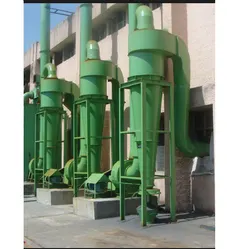
a Cyclone Seperator
Theory : A simulation is the process of immitating an operation and generating its results on a computer with exact same conditions that would be present in practical situations. This helps in avoiding many failures that would have occured practically after executing it .It also helps in post-manufacturing and testing stage.This simulation is carried on a cyclone seperator stand to analyse effect of buckling on the stand. It is done a software named Solidworks. The factor considered for optimization is the factor of safety of which is to be maximized. Buckling is governed by the following equation:
where, Pcr = Bucling Load
E = Modulus of Elasticity/ Young's Modulus
I = Moment of Inertia
L = Effective Lenght of the body
Case Setup :The operating part excluding the stand has been suppressed and the force exerted by it is considered. A new study named ' Buckling Test' for buckling is created from the Simulation tab.The cyclone seperator stand model is as follows:
I) Study: Buckling Test
Step 1: The required material, alloy steel is selected from the Part option present in the menu on left.
Step 2 : From the Fixtures option, select 'fixed geometry ' and then fix the faces highlited by red circles as shown in the figure below:
Step 3 : Apply the required force on the upper face of the stand from 'External Loads' . The force applied in this simulation is 150 KN.
Step 4 : The next step required is the Meshing. It can be done from the 'Mesh' option. A finer mesh is always preffered.
Step 5 : Now the simulation is Run to get the buckling amplitude contour as the result. The following figure shows the result generated:
II) Study : Optimization
Step 1: Using the Sketch Tab and Features Tab a stiffner is extruded in fixed form to the stand as shown :
Step 2: A new study named 'Optimization' is created for Design Study.
Step 3: Following parameters including for the optimization :
1. Distance between the stiffner and the uppermost face of the stand is included in the Variables section.
2. Buckling factor calculated from the 'Buckling Test' is included as the Constraint.
3. The deciding factor for optimization is set as Buckling Factor (to be Maximised) is included as the Goal.
The diagram below is obtained after completion of the above steps :
Step 4: After Running the Design Study, optimized result is shown :
Optimized case is highlited in the figure. Also the Seperator stand shows the optimized position.
Study Results :
The results box as shown in Solidworks:
From the table it can be seen that : The Stiffner distance from the topmost face of the stand is 1m to get the highest factor of safety of 51.433 .
Conclusion:
The below figure compares the cases before and after optimization:
It can be seen that there is a significant decrease in Red, Yellow and Green contoured sections present on the stand's legs and face after optimization. Also the amount of buckling in the later figure has decreased.
Hence, it can be concluded that the Optimization was successful in reducing buckling in the stand.