| Mesh a sheet metal component (Car_front_hood) using hypermesh
OBJECTIVE
AIM
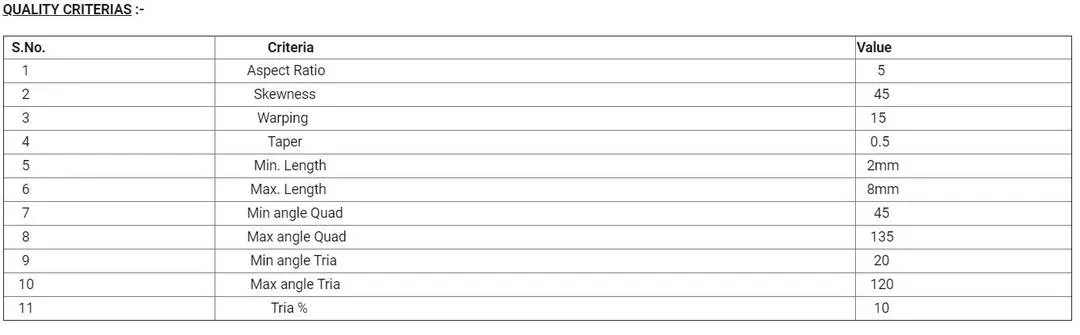
The aim of the challenge is to mesh up the given geometry in the given quality standards.
OBJECTIVE
- The geometry given is a sheet metal component .
- The given geometry is of uniform thickness
- The geometry is divided into 4 parts to mesh
- The seperated parts are extracted witha mid surface.
- Then the meshing for each part is done.
LATCH
- Latch is a part of inner component.
- Since it has uniform thickness auto mid surface extraction method is used.
- Initially the solids are deleted and the mesh is carried out on the surface.
- The approach of meshing is segregated ito smaller parts and it is pursued
OBSTACLES
The obstacles while meshing this parts is the fillet area and it is over comed by remeshing and meshing under line category
HINGE
- Hinge is a part of inner component.
- Since it has uniform thickness auto mid surface extraction method is used.
- Initially the solids are deleted and the mesh is carried out on the surface.
- The approach of meshing is segregated ito smaller parts and it is pursued
- The washer split option is not used.
- The concentrated areas are filled with even number of elements to mainatin athe mesh flow.
OBSTACLES
The obstacles while meshing this parts is the fillet area and it is over comed by remeshing and meshing under line category. The curved parts are held with lot of tria elements.
OUTER
- Outer part is flat component.
- Since it has uniform thickness auto mid surface extraction method is used.
- Initially the solids are deleted and the mesh is carried out on the surface.
- The component is masked initially.
- The half part is segregated into smaller parts to attain mesh flow.
- After the meshing the elements are reflected to attain a complete com[onent.
OBSTACLES
The obstacles while meshing this parts is the mesh flow and the trias and it is overcomed by adjusting the flow concentration.
INNER
- The inner part of the hood is a complex component.
- Since it has a uniform thickness auto mid surface extraction method is used.
- Initially, the solids are deleted and the mesh is carried out on the surface.
- Since the part is symmetrical half of the part is masked.
- The meshing process I pursued is from the inner region to the outer region.
- The meshing on the fillet is been a complex task.
OBSTACLES
The obstacles while meshing these parts is the fillet area and many inner coordinated areas the fillet regions are meshed by reducing the meshing to 4 which is a bit greater than the minimum element size.
CONCLUSION.
The hood consists of several parts and each parts are treated under different category to obtain optimum results, the trias where the major obstacles and the mesh flow, the fillet regions and the curved parts are the the major where areas where the min and max element size are often failing. The fillet regions is often meshed by reducing the element size.