MBD Simulation on IC Engine Valve Train
MBD Simulation on IC Engine Valve Train
Aim: To model and simulate IC Engine Valve Train.
Objectives:
1.Model the parts and assemble them in SolidWorks.
2.Run the simulation using the below parameters
3.Obtain the,
- Valve Lift
- The contact force between
- Cam and PushRod
- Pushrod and Rocker Arm
- Rocker Arm and Valve
4.Explain why the contact force between the Rocker arm and valve varies while measuring with respect to the X direction and measuring with respect to magnitude.
Solution:
- 3D Modelling of parts and assembly:
Fig. Cam, Push rod and Rocker arm
Fig. Valve and Valve seat
Assembly of IC Engine Valve Assembly:
Cam Lift Calculation:
In the video lecture dimension, R1=12.5 R2=5mm,
In case 1, 3.5=(L-12.5)+5, L= 11mm
In case 2, 6=(L-12.5)+5,L=13.5 mm
Setup of Motion Analysis:
- Motor is set to the cam axis at 1500 rpm
- Contacts have been established between all the parts which undergo movement.
- A spring of length 45mm is placed along the length of the valve body resting on the valve seat.
Results:
Case 1: Cam of Lift 3.5mm
Valve Lift
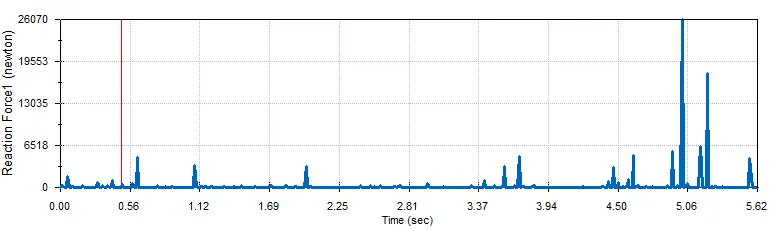
Contact Force Between Cam and Push rod
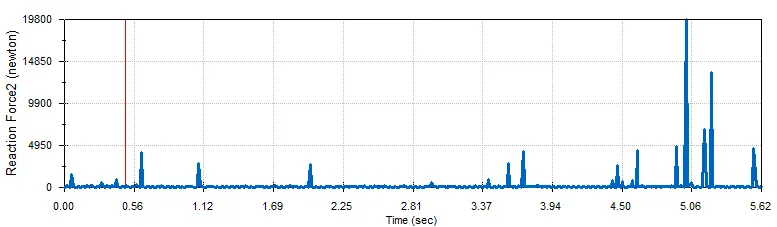
Contact Force Between Push rod and Rocker arm
Contact Force Between Rocker arm and Valve
Case 2: Cam of Lift 6mm
Valve Lift
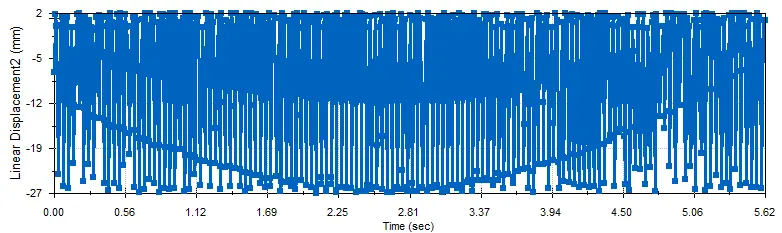
Contact Force Between Cam and Push rod
Contact Force Between Push rod and Rocker arm
Contact Force Between Rocker arm and Valve
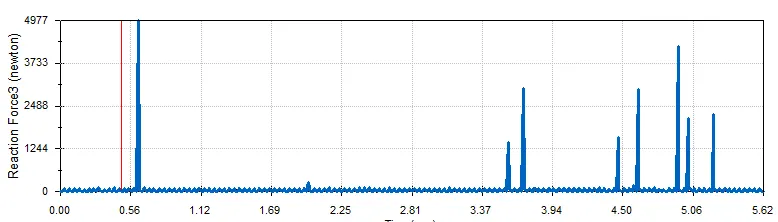
Why the contact force between the Rocker arm and valve varies while measuring with respect to the X direction and measuring with respect to magnitude?
The reason for difference in magnitude of force is due to the geometry of rocker arm. It has a curved shaped structure which slips away in x direction along with y movement. But compared to y movement where the total magnitude is taken into account, x direction magnitude will be less.
Inference:
It is clear that the contact forces exhibited between cam and pushrod is equivalent to the contact force between pushrod and rocker arm. This also holds true for the contact force between rocker arm and valve.
This shows that the contact forces are transmitted almost equally at negligible intervals of time. However the spring in the valve might induce a non proportionality due to its unpredictable behaviour at some circumstances.
Animation of Motion Analysis:
https://youtu.be/gdCjbpFN_X0