Literature review RANS derivation and analysis
The objective of the current study is to use the standard Navier-Stokes (NS) equations to derive the Reynolds Averaged Navier-Stokes Equations (RANS). The RANS equations are used to solve average turbulent flow by using mean values of the velocity. The RANS equations are derived by time-averaging the NS equations.
Before time-averaging, the instantaneous velocity is decomposed into its mean and fluctuating components, as shown in the figure below
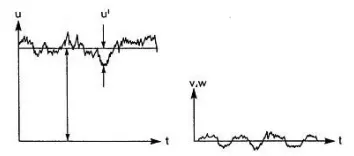
The instantaneous velocity `u` is represented as
`u=bar u + u', v=bar v + v', w=bar w + w' `______________________i
where `bar x` and `x'` refer to the averaged and fluctuating components of the velocity respectively.
The averaging process for velocity is carried out by taking the mean value at fixed point in space over a span of time such that the mean values are independent of the variation of time.
`bar u=1/(trianglet)int_(t_0)^(t_0+t_1)udt` ________________ii
The time-averaged values of the fluctuating components of velocity are assumed to be zero.
The process begins by initially averaging the continuity equations. Substituting Eqn. i in the continuity equations gives us
`(partial baru)/(partialx)+(partial u')/(partialx)+(partial barv)/(partialy)+(partial v')/(partialy)+(partial barw)/(partialz)+(partial w')/(partialz)=0` _____________iii
The time-averaged value of Eqn iii is given as
`bar((partial baru)/(partialx)+(partial u')/(partialx)+(partial barv)/(partialy)+(partial v')/(partialy)+(partial barw)/(partialz)+(partial w')/(partialz)=0`____________iv
The guidelines and rules adopted to carry out this transformation are listed out in Appendix A
According to the rules listed out in Appendix A, the average-derivatives of the fluctuating components of the velocity are also zero.
`(partial baru)/(partial x) + (partial barv)/(partial y) + (partial barw)/(partial z)`____________v
Transforming the x component of the advection term of the continuity equations gives
`u(partialu)/(partialx)+v(partialu)/(partialy)+w(partialu)/(partialz)=(partial(u^2))/(partial x)+(partial(uv))/(partial y)+(partial(uw))/(partial z)-u((partialu)/(partialx)+(partialv)/(partialy)+(partialw)/(partialz))`
However, since `(partialu)/(partialx)+(partialv)/(partialy)+(partialw)/(partialz)=0` , the above equation is written as
`u(partialu)/(partialx)+v(partialu)/(partialy)+w(partialu)/(partialz)=(partial(u^2))/(partial x)+(partial(uv))/(partial y)+(partial(uw))/(partial z)` _____vi
The values obtained in i are substituted into the Navier-Stokes equation to obtain the transformed form of the NS equations with a time-average:
`bar(rho{(partial(baru +u'))/(partialt)+(partial(baru +u')^2)/(partialt)+(partial(baru +u')(barv + v'))/(partialt)+(partial(baru +u')(barw + w'))/(partialt)})=bar(F_x-(partial(barp + p'))/(partialx)+mu((partial^2(baru + u'))/(partialx^2)+(partial^2(baru + u'))/(partialy^2)+(partial^2(baru + u'))/(partialz^2))`___________vii
Application of the rules from Appendix A reduces eqn vii to the following
`rho((partialbaru)/(partialt)+(partialbar(u.u))/(partialx)+(partialbar(u'.u)')/(partialx)+(partialbar(u.v))/(partialy)+(partialbar(u'.v'))/(partialy)+(partialbar(u.w))/(partialz)+(partialbar(u'.z'))/(partialz))=F_x-(partialbarp)/(partialx)+mu((partial^2baru)/(partialx^2)+(partial^2baru)/(partialy^2)+(partial^2baru)/(partialz^2)`______viii
However, we know that `(partial^2baru)/(partialx^2)+(partial^2baru)/(partialy^2)+(partial^2baru)/(partialz^2)=trianglebaru`
Further transformations reduce Eqn. viii to
`rho((partialbarw)/(partialt)+baru(partialbarw)/(partialx)+barv(partialbarw)/(partialy)+barw(partialbarw)/(partialz))=F_x-(partialbarp)/(partialz)+mutrianglebarw-rho((partialbar(u'w'))/(partialx)+(partialbar(v'w'))/(partialy)+(partialbar(w'w'))/(partialz))`_________ix
Writing ix in tensor form
`rho(Dbaru_i)/(Dt)=F_i-(partialbarp)/(partialx_i)+mutrianglebaru_i-rho((partialbar(u_iu_j))/(partialx_j))`_______x
where `(partialbar(u_iu_j))/(partialx_j)` refers to the Reynolds Stress
In order to simplify the expressions, time-averaged fields will not be denoted by a bar anymore. For instance, `u` refers to the time-averaged component of the velocity component in the direction of the x axis.
The last two terms of the RHS of Eqn. x are modified as shown below
`mutrianglebaru_i-rho((partialbar(u_iu_j))/(partialx_j))`
`=mupartial/(partialx_j)((partialu_i)/(partialx_j))-rhopartial/(partialx_j)(bar(u'_iu'_j))`
`=partial/(partialx_j)(mu(partialu_i)/(partialx_j)-rhobar(u'_iu'_j))`_______xi
The term in the brackets in Eqn xi. corresponds to the total shear stress:
`tau_(ij)=mu(partialu_i)/(partialx_j)-rhobar(u'_iu'_j)`_________xii
Upon comparison with the original NS equations, it is evident that besides the viscous component of the equation, an additional part has been added to the equation due to the time-averaging process and is the dominant part of the total shear stress. This term refers to the Reynolds stress or apparent turbulent shear stress.
Boussinesq in 1877 adopted the principle of eddy viscosity to the general time-averaged NS equations to obtain the RANS equations in tensor form, as shown below:
`rho((Du_i)/(Dt))=F_i-(partialp)/(partialx_i)+(partialtau_(ij))/(partialx_j)`_______xiii
where `tau_(ij)=mu(partialu_i)/(partialx_j)+rho(v_T((partialu_i)/(partialx_j)+(partialu_j)/(partialx_i))-2/3kdelta_(ij))`________xiv
Thus, the Reynolds-averaged Navier Stokes Equations are obtained.
Appendix A
`bar((partial baru)/(partialx))=1/(trianglet)int_(t_0)^(t_0+t_1)(partial u)/(partialx)dt=(partial)/(partial x)1/(trianglet)int_(t_0)^(t_0+t_1)udt=(partial baru)/(partial x)` _________A1
`bar((partial u')/(partial x))=1/(trianglet)int_(t_0)^(t_0+t_1)(partial u')/(partialx)dt=(partial)/(partial x)1/(trianglet)int_(t_0)^(t_0+t_1)u'dt=0` ____________A2
`bar(barf)=barf, bar(f+g)=barf+barg, bar(barf.g)=barf.barg, (bar(partialf))/(partials)=(partial barf)/(partial s), bar(int fds)=intbarfds`____________A3
However,
`bar(f.g)nebarf.barg`