Introduction to National Building Code and Steps in a Construction project
ASSIGNMENT NO 05
1.Why building codes or standards essential for the modelling /efficiency of drawing in Revit?
Ans :
- In order to provide safe, healthy and sustainable habitat, careful consideration needs to be paid to the building
construction activity. - Building codes provides set of guidance which should be followed while modelling the project.
- Building code is a set of norms that provides the guidelines to the construction of the building by following the
minimum standards. - Building codes provides the regulations which can be adopted for use by various department, municipal
administrations and public bodies. - It lays down a set of minimum provisions designed to protect the safety of the public with regard to structural
sufficiency, fire hazards and health aspects of buildings. - With the use of codes not only functional, aesthetic and safety aspects of buildings but also operational and
maintenance aspects can be ensured. - Building codes are expected to lead to safe and orderly development of buildings.
- Also, cost optimization has to be achieved through proper selection of materials, techniques, equipment
installations, etc - With the use of code the maximum benefit from the building and its services in terms of objectives such as
quality, timeliness and cost-effectiveness can be achieved. - Code covers the administrative provisions that should be followed to get administrative approval to ensure
safety of the structure. - Code also covers the development control rules and general building requirements; fire safety requirements;
stipulations regarding materials and structural design.
The code provides an integrated approach for utilization of appropriate knowledge and experience of qualified
professionals from concept through construction and completion stage of a building and indeed during entire
life cycle.
- Code covers the rules for design of electrical installations, lighting, air conditioning and heating, installation of
lifts; provisions for ventilation, acoustics and plumbing services, such as water supply, drainage, sanitation and
gas supply; measures to ensure safety of workers and public during construction; and rules for erection of signs
and outdoor display structures.
- Code, besides prescribing various provisions, also allows freedom of action to adopt appropriate practices and
provides for building planning, designing and construction for absorbing traditional practices as well as latest
developments in knowledge in the various disciplines as relevant to a building including computer aided. - The Code today also covers provisions relating to structural use of glass; escalators and moving walks;
information and communications enabled installations; solid waste management; landscape planning and design; and asset and facility management.
- Therefore, by following the building code guidelines the modelling efficiency of building is increased as
mentioned above.
2.From the National Building Code, list the groups that will be essential to you when you begin modeling in Autodesk Revit.
Ans
■ The national Building Code contains the following groups which are essential while modeling :-
GROUP A residential
GROUP B educational
GROUP C institutional
GROUP D assembly
GROUP E business
GROUP F mercantile
GROUP G industrial
GROUP H storage
GROUP I hazardous
3.List the five major steps that occur in project cycle. The steps should include from conceptualization of project to maintenance and final stage.
Answer :-
- The five major steps that occur in project cycle :-
- Project Initiation
- Project Planning
- Project Execution
- Project Monitoring and Controling
- Project Final Stage
1.Project Initiation :-
- Like with all things, the first step to the construction life cycle is merely to begin. It is usually not that simple as it
sounds. It is easy to come to a project with an idea but translating that idea into actionable items requires a
dedicated project team. The project will require input from each side. - We must create and evaluate the project inorder to determine if it is feasible and if it should be undertaken, at
the beginning of the project. - Here the project objective or need is identified, this can be a business problem or opportunity.
- A suitable response to the need is documented in a business case with recommended solution options.
- A feasibility study is conducted to examine whether each option clearly identifies the project objective and a
final recommended solution is determined. - Many questions related to the issues of feasibility i.e. can we do the project?" and justification like "should we do
the project?' are mentioned and faced. - When a solution is approved, a project is initiated to implement the approved solution.
- For this, a project manager is appointed.
- At this stage, the major deliverables and the participating work groups are identified.
- This is the time when the project team begins to take shape.
- Approval is then required by the project manager to move onto the detailed planning phase.
2.Project Planning :-
- The planning phase involves further development of the project in detail to meet the projects objective.
- The team identifies all of the work to be done.
- The projects tasks and resource requirements are identified, along with the strategy for producing them.
- In a broader sense identification of each activity as well as their resource allocation is also carried out.
- A project plan outlining the activities, tasks, dependencies, and timeframes is created.
- The project manager is the one who coordinates the preparation of a project budget by providing cost
estimates for the labor, equipment and materials costs. This is mainly carried out by project scheduling
software like MS project or PRIMAVERA. - This scheduling charts would help us to track the stages of the project as time passes.
- This is also referred to as "scope management'.
- The budget of the project already estimated is used to monitor and control cost expenditures during project
implementation. - Finaly, we require a document to show the quality plan, providing quality targets, assurance, and control
measures, along with an acceptance plan, listing the criteria to be met to gain customer acceptance. - At this point, the project would have been planned in detailand is ready to be executed.
3.Project Execution :-
- This is the implementation phase, where the project plan is put into motion and the work of the project is
performed practically on site. - It is essential to maintain control and communicate as needed during each implementation stages.
- Progress should be continuously monitored and appropriate adjustments are made and recorded as variances
from the original plan. - A project manager is the one who spends most of the time in this step.
- Throughout the project implementation, people carry out the tasks and progress information is being reported
through regular project team meetings. - The project manager uses this information to preserve control over the direction of the project by comparing
the progress reports with the project plan to measure the performance of the project activities. - If any deviation is found from the already defined plan then corrective measures are made.
- The first option of action should always be to bring the project back to the original plan.
- If that cannot happen then the team should record variations from the original plan and record that and
publish modifications to the plan. - Through this step, project sponsors and other key stakeholders are kept informed about the project's status as
per the agreed rate and format of communication. - The plan should be updated and avaiable on a regular basis.
- Status reports should always highlight the probable end point in terms of cost, schedule and quality of
deliverables. - Each project deliverable produced should be reviewed for quality and measured against the acceptance
criteria. - When deliverables have been produced and the customer has agreed on the final solution, the project is said
to be ready for closure. - 4..Monitoring and control-
* Some project management methodologies have a different phase here for monitoring and control.
* The construction manager monitors the budget, risk, insurance management, and scope using various
project management techniques.
One of the best tools for this stage is the KPI (Key Performance Indicator).
O Examples of KPIs are effort and cost tracking, project objectives, and deliverables.
O monitoring and control are sometimes combined with execution because they often occur at the same
time.
* As teams execute their project plan, they must constantly monitor their own progress.
5.Project closure-
* That is the last step in the long process of designing and completing a construction project.
O the project team has to overall contractual agreements and make sure that the project is free from any
type of legal burden.
o Teams close a project when they deliver the finished project to the customer, communicating completion
to stakeholders and releasing resources to other projects.
This vital step in the project management life cycle allows the team to evaluate and document the
project and move on to the next one, using previous project mistakes and successes to build stronger processes and more successful teams.
4.Give examples of different disciplines involved in construction of a project.
Answer :-
- Disciplines involved in construction project areas follows :-
Architecture
Civil Engineering
Structural Engineering
Geotechnicai Engineering
Earthquake Engineering
Electrical Engineering
Plumbing Engineering
Fire Protection Engineering
HVAC and Refrigeration Engineering
Environmental Engineering
Town Planner
Urban Designer
Landscape Architect
Interior Designer
Quantity Surveyor
Project/ Construction Manager
Construction : Managing the building of civil engineering systems from to include coordination between the
owner, contractor and designer.
- Finance and estimating : Operating in the business world to include accounting, financial contracts and
estimating the cost of activities. - Contract and bids : Demonstrating strong bidding practices and effective contract administration is integral to
acquiring the next job or project as a construction manager. - Geotechnical : Designing foundations and earthwork systems to support soil itself and transfer loads from
structures into the earth while limiting settlements.
- Management : Managing equipment, personnel and supplies to build more effectively, efficiently and
economically. - Structural : Designing systems of structural members used to support loads for a specified public function such
as bridges, buildings, dams and bell towers. - Surveying : Measuring physical features to include horizontal distances and elevation differences to determine
property lines, lay out buildings and produce maps. - Architect : Architects are responsible for visual appearance of the buildings and structures before final
structural design. - Civil engineer Civil engineers plan, design and manage large construction projects. This could include bridges,
buildings, transport links and other major structures. They use computer modelling software and data from
surveys, tests and maps to create project blueprints. These plans advise contractors on the best course of
action and help minimize environmental impact and risk. - Plumbing engineer : Plumbing engineer deal with the water supply system, drainage system, mode of
measurements, usage, and maintenance of plumbing and drainage work. - Electrical engineer Task of an electrical engineer is to design high voltage equipment such as wiring systems,
power distribution systems, generators and lighting systems etc
5.How are buildings classified ? Place the following buildings under each category
- Four unit apartments.
- School with capacity of 1000 students.
- A single unit shop.
- Multi story Shopping complex.
- Steel machine factory.
Answer :-
- The classification of buildings
- Residential Buildings
- Educational Buildings
- Institutional Buildings
- Assembly Buildings
- Business Buidings
- Mercantile Buildings
- Industrial Buildings
- Storage Buildings
- Mixed Land Use Buildings
Residential Buildings :-
- A building should be considered as a residential building, when more than half of the floor area is employed for
dwelling purposes. - Other buildings should be considered non-residential.
- A residential building is one that is designed and accordingly built for inhabitants to measure in and called
House. - Inhabitants can either be a family, single, a couple, roommates or maybe a group.
- A residential building basically has Bedroom, Living roomispace, Conveniences (as in Toilet and Bathroom),
Kitchen.
Educational Buildings :-
- These are buildings housing educational institutions such as schools or colleges which are affiliated and
recognized by an appropriate board, university or any similar affiliation authority. - The building should promote the aggregation of instructional, educational and recreation alactivities pertaining
to educational purposes. - Further, it is mandatory for the building to have proper residential facilities for essential staff who need to reside
within the campus. - Apart from this, the institution should also have a hostel exclusive to the institute either within its premises or
outside.
Institutional Buildings :-
- These types of buildings consist of buildings that are constructed by the government, semi-government
organizations or registered trusts for specific purposes. - Those specific purposes include Medical Treatment such as treatment of Physical or Mental Illness, Chidren's
Hospitals, Old age homes, Centers for the care of orphans or abandoned women, Auditoriums or complexes
meant to be used for cultural or allied activities, religious accommodation facilities such as Dharamshalas,
Jails, Correctional Facilities, Detention Centres, Juvenie Reformatories etc.
Assembly Buildings :-
- These are defined as buildings or parts of them which houses public gatherings congregated with the intent of
Amusement Recreation, Social, Religious, Patriotic, Civil, Travel or Other similar Buildings such as Movie houses,
Drama theatres, Drive-in theatres, Assembly halls, Club houses, Town halls, Auditoriums, Exhibition halls,
Museums, Mangalkaryalayas, Gymnasiums, Sports complexes, Restaurants, Boarding houses, Dance clubs,
Gymkhanas, Places of Worship, Bus stops, Taxi stands, Railway stations, Airports, Piers, etc. are categorized as Assembly Buidings.
Business Buildings :-
- If a building or a part of it is primarily used for keeping records of Business Transactions, Maintaining Accounts,
Book Keeping Purposes or Managing other types of records then it can be classified as a Business Building. - Buidings under this category include Offices, Banks, Court houses and other Professional Establishments Serving
the above mentioned purposes.
Mercantile Buildings :-
- In these types of buildings, either the entire buiding or a part of it is used for Housing Shops, Stores or
Showrooms where display and sale of wholesale goods, retail goods or merchandise is carried. - Such buildings should also accommodate Office, Storage and Service Facilities essential for the business which
should be located in the same buiding.
Industrial Buildings :-
- Buidings used to Manufacture, Assemble or Process Products or Materials are termed as Industrial Building.
- They include Manufacturing Units, Assembly Plants, Factories, Mills, Power Plants, Oil Refineries, Gas Plants, Dairy
plants, laboratories etc.
Storage Buildings :-
- If a Buiding or a part of it is used for the storage of Commodities, Goods, Merchandise etc., then it is categorised
as a Storage building. - They comprise buildings such as Warehouses, Cold Storages, Grain Storage Units, Barns, Stables, Freight Depot,
Transit Shed, Hangars, Truck Terminals, Public Garages etc.
Mixed Land Use Buildings
- These are buildings which are used for both Residential purposes as well as for carrying out Non-Residential
activities.
6) Distinguish the roles of Design team and Management team
Ans :
Role of design team
- In building projects, various aspects like form; space planning; aesthetics; fire and life safety; structural
adequacy; plumbing services; lighting and natural ventilation; electrical and allied installation need to be kept in view right at the concept stage.
- The project requiring such multi-disciplinary inputs need a coordinated approach among the professionals for
proper integration of various design inputs. - For this, and to take care of the complexities of multi-disciplinary requirements, a design team of professionals
from the required disciplines shall be constituted at the appropriate stage. - Here, it is desirable that the multi[1]disciplinary integration is initiated right from the concept stage.
- The team shall finalize the plan.
- The composition of the team shall depend on the nature, magnitude and complexities of the project.
- Design is an evolutionary and participatory process, where participation of the owner constitutes a very
important input at all stages, and the same shall be ensured by the design team. - To ensure proper implementation of the design, the design team, may be associated during the construction/
execution stage.
Role of management team
- The objective of project management or construction management is primarily to achieve accomplishment of
a project in accordance with the designs and specifications in a stipulated time and cost framework, etc, with a
degree of assurance prior to commencement and satisfaction on completion and commissioning. - For large projects, separate teams of experienced professionals from the required disciplines may be
constituted for project management (including planning and scheduling) and for construction management depending upon the complexities of the project.
- However, for smaller projects these teams may be combined.
- The teams shall be responsible for day-to-day execution, supervision, quality control, etc, and shall ensure
inter-disciplinary coordination during the construction stage. - The team shall be responsible to achieve satisfactory completion of the project in respect of all relevant project
management functions like cost, time, quality, safety, etc. - Some members of the design team may also be included in the project management team andlor associated
actively during the project execution stage.
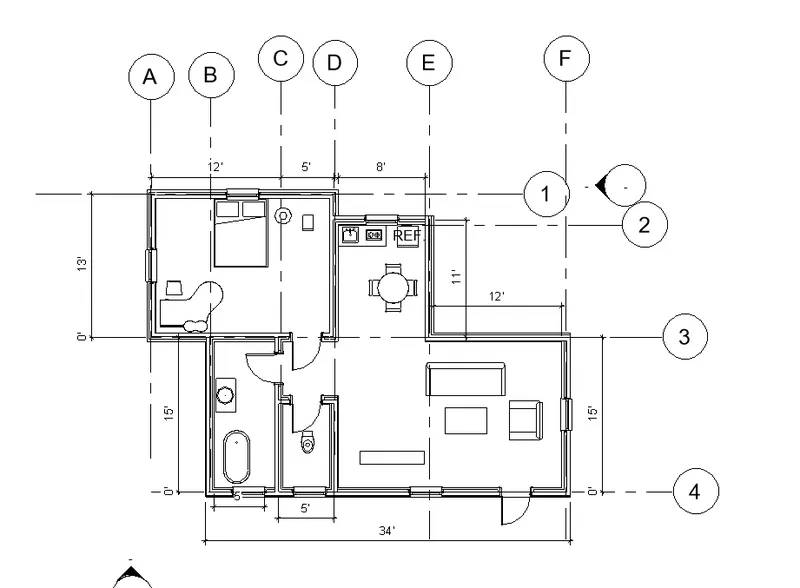
7. Refer to NBC, Identify the modeling requirements for the project ( from week 4).
- Height Limitations
- Area Limitations
- Room sizing
- Wall height
- Thickness based on fire life and safety
- Passageway requirements
Ans:
Height limitations
As per NBC 2016 C-2.5 (page 13)
The height of building shall not exceed 15 m. NOTES
1 For buildings up to the height of 15 m, there is no need to provide lifts.
2 Housing for the low-income group shall preferably be up to a maximum of two storeys.
3 Buildings for housing beyond 15 m in height should be resorted to in exceptional circumstances and it should be governed by provisions laid down in this Code
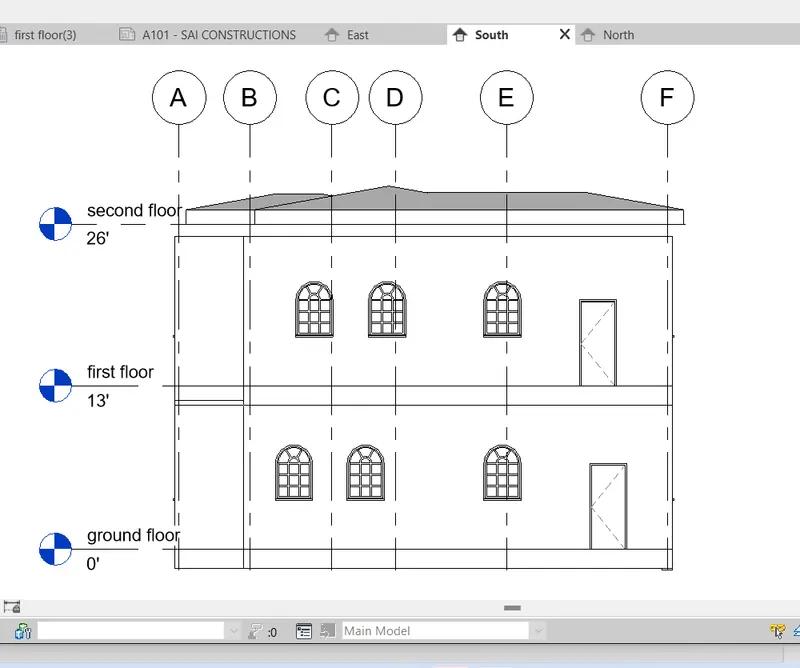
As per my model height of building is 6.9 rn which is less than that of specified in NBC i.e,. 15 m. therefore model follows the NBC guidelines.
Area limitation
As per NBC 2016 C-2.3 (page 137)
- The minimum plot size with ground coverage not exceeding 75 percent, shall not be less than 40 m2 in small
and medium town and not less than 30 m2 in metropolitan cities. - Plot sizes below 30 m2 but not less than 15 m2 may be permitted in case of cluster planning, however, in such
cases the ground coverage and FBI shall be 100 percent and 2 percent respectively.
as per NBC guidelines minimum plot size should not be less than 40 sq.m, in my model the plot size is 12 x 9 rn i.e., area is 108 sq.rn which is more than 40 sq. m hence safe.
Room sizing
As per 12 of national building code 2016 page 44
- The area of habitable room shall not be less than 9.5 m2 , where there is only one room with a minimum width
of 2.4 m. - Where there are two roams, one of these shall not be less than 9.5 m2 and the other not less than 7.5 m2, with a
minimum width of 2.1 m. - The area of a kitchen where separate dining area is provided, shall be not less than 5.0 m2 with a minimum
width of 1.8 m. - Where there is a separate store, the area of the kitchen may be reduced to 4.5 m2 A kitchen, which is intended
for use as a dining area also, shall hove a floor area of not less than 7.5 m2 with a minimum width of 2.1 m - The area of a bathroom shall not be less than 1.8 m with a minimum width of 1.2 m. The floor area of
water[l]closet shall be 1.1 m2 with a minimum width of 0.9 m. - If bath and water-closet are combined, its floor area shrill not be less than 2.8 m2 with ci minimum width
of 1.2 m
In my model the number of rooms in the building is 4 and the total area of the room is (22 + 13 + 38 + 9) sq. m = 82 sq. m which is greater than 40 sq. m hence ok.
Wall height
As per C-3.5 of national building code 2016 (page no 138)
- The minimum height of rooms/spaces shall be as follows:
- a) Habitable room : 2.6 rn
- b) Kitchen : 2.6 rn
- c) Bath/water-closet : 2.1 m
- d) Corridor : 2.1 m C-3.5.1
- In the case of sloping roofs, the average height of roof for habitable rooms shall be 2.6 m and the minimum
height at eaves shall be 2.0 m.
As per NBC the height of walls in the room is 3 m which is greater than minimum height requirement, hence ok.
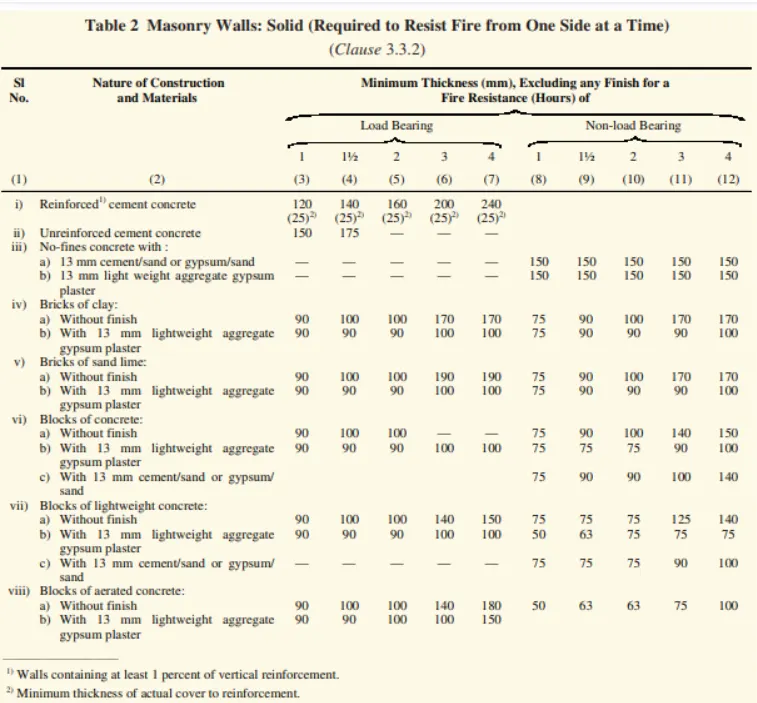
- Thickness based on fire life and safety
Thickness of wall based on fire life and safety as per NBC 2016 table no 2 clause 3.3.2 as shown below.
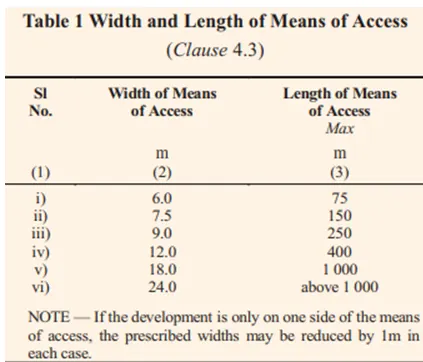
Passageway Requirements
- The approach to the buidings from Road/ Street/ Internal means of access shall be through the paved
pathway of a width not less than 1.5 m, provided its length is not more than 30. - In the case of special housing schemes for the low-income group and economically weaker section of society
developed up to two storey row/cluster housing scheme, the pedestrian pathway width shall be 3m. The
pedestrian pathway shall not serve more than S plots on each side of the pathway; the length of the pathway
shall be not more than 50 m. - The length of the main means of access shall be determined by the distance from the farthest plat (building) to
the public. - The length of the subsidiary accessway shall be measured from the point of its origin to the next wider road on
which it meets. - In existing built-up areas in the case of plots facing Street/ means of accessway less than 4.5 m in width, the
plot boundary shall be shifted to be away by 2.25 m from the central line of the street/means of accessway to
give rise to a new street/means of accessway of 4.5 m width.
8. We have identified requirements for modeling from question 7, Use these numbers from code book and verify the numbers used in modeling the unit from week 2 to week 4. If the numbers are not reasonable, use the numbers obtained from the code book to create a revision of the mode. This model resembles the actual modeling requirements for Project 1 of course work.
Ans :
The model created from week 2 to week 4 follows all the guidelines of NBC 2016, as shown below.
NBC Requirement Provided in model
Height (m) H < 15 m 6.9
Area (sq. m) A > 40 sq. m 100 sq. m
Room sizing
Habitable room A > 9.5 sq. m 10 sq. m
Habitable room A >9.5 SQ M 10 SQM
Kitchen room A > 4.5 SQ M 11 SQM
Combined bath and A > 2.8 SQM 5 SQM
water closet
Wall size (m) A> 2.6M 3M
Thickness based on fire A> 90MM 203MM
life and safety (mm)