Design of automotive Hood/Bonnet using _NX_CAD
Design of Automotive Hood/Bonnet
Hood/Bonnet:
Hood or Bonnet is a part of the automotive vehicle which gives the aesthetic look to the automobile and also helps as an enclosure to the various engine components and sensors and it is an airtight cover which protect the internal components. The bonnet system is an access panel to the engine compartment to enable maintenance of power train, drive belts, battery, fluid levels and lamp units. It is fundamentally a reinforced skin panel with many safety and quality requirements.
The design of the hood consist of the following parts:
- Internal hood structure
- Outside panel
- Engine body and hood hinge reinforcements
- Latch reinforcements
Bonnet is the front end of the moving vehicle hence the design of the Bonnet internal and outer panels involves both the aerodynamic and mechanical strength characteristics and during the hazardous accidental situation the first hitting part in the vehicle is it front end i.e. the Hood.
For the safety of pedestrians various countries follow different standards in designing of the font hood of the vehicle. Legislation for new vehicle registrations in Europe, the United States of America and Japan all include requirements for pedestrian safety. EuroNCAP (European New Car Assessment Program) and other independent vehicle assessment bodies have been instrumental in increasing public awareness of the effectiveness of design for pedestrian safety. Additionally, their test results are factored into the insurance ratings that are delivered for new vehicles. The objective of these measures is to reduce the number of road accident fatalities and the severity of injuries sustained by pedestrians involved in a collision with a vehicle in urban traffic. Impact frequency and seriousness of injury has been studied for many years, resulting in rating systems and improved design. One such study based on 246 passenger car / pedestrian collisions (Bosch Automotive Handbook 4th Edition 1998) clearly shows that the bonnet zone accounts for a substantial proportion of the risk associated with pedestrian safety.
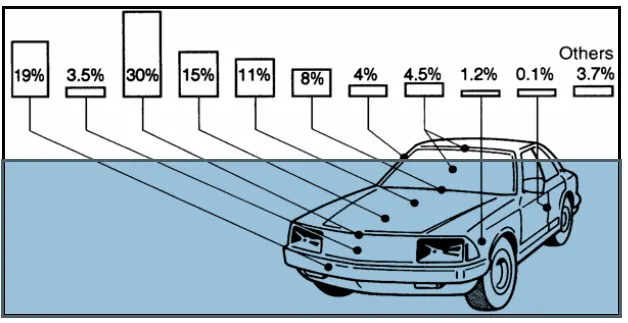
Design and Boundary conditions for Bonnet
Pedestrian impact energy is absorbed by a sequence of different mechanisms. In most cases, the leg of the pedestrian is first impacted by the bumper system (lower leg impact is a safety critical load case for the pedestrian that is entirely managed by the bumper system). Initial contact with the pedestrian is therefore at a point below the centre of gravity of the head and torso causing rotation. At relatively low velocity impacts (<= 40km/h) the tendency is for the head to impact the bonnet or the lower part of the windscreen
The height, weight and age of the pedestrian all play a role in the kinematics of the event and in his ability to survive. Most fatalities for the younger population are related to brain damage caused by head impact on the bonnet. For older people additional risks include rupture of arteries in the lower limbs and pelvis from bumper and bonnet leading edges.
All major insurance and regulating authorities have studied this topic in order to put in place a range of measures to reduce mortality rates and the severity of injury resulting from pedestrian impacts. These studies have produced test procedures and systems to rank and regulate vehicles for pedestrian safety
Evaluation of pedestrian safety for a bonnet must be carried out in the context of its surrounding elements:
- Vehicle styling, size (wrap around distance “WAD”) and under bonnet clearance to other elements (considered as hard points).
- Local bonnet stiffness is influenced by mounting point stiffness such as hinges, bump stops and latches.
- This is better understood by superimposing the kinematics of a dummy onto the test conditions
Mastic points:
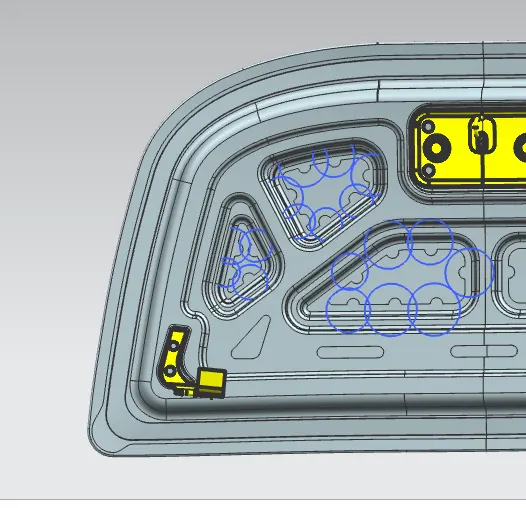
Overall bonnet stiffness is derived from the inner and outer panels and their local reinforcements and hinges. Considering the bonnet alone, the inner panel contributes most to the stiffness from its section properties. Both the outer and the inner panels are joined together with the help of Hemming process and airtight saeling gell is applied at the mastic points as shown in the picture.
Hemming:
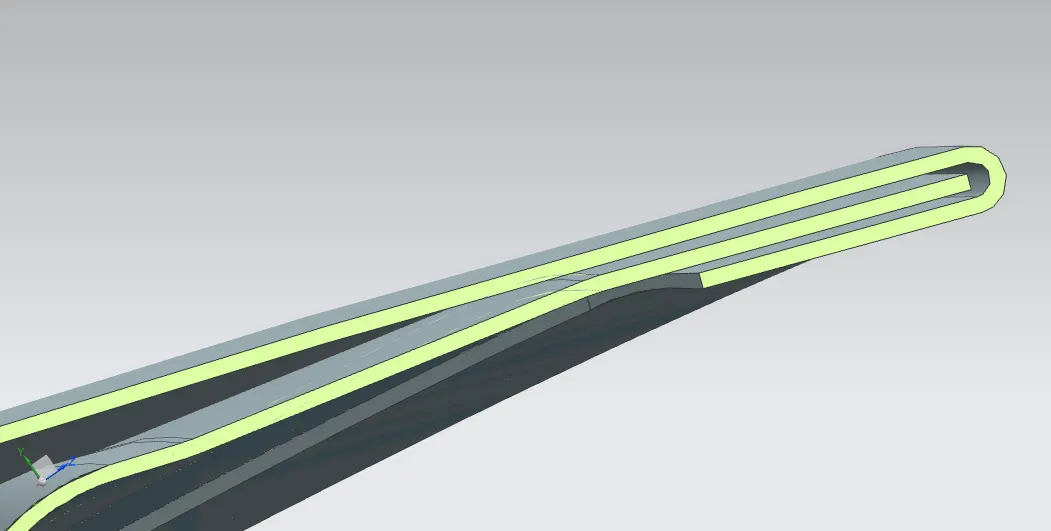
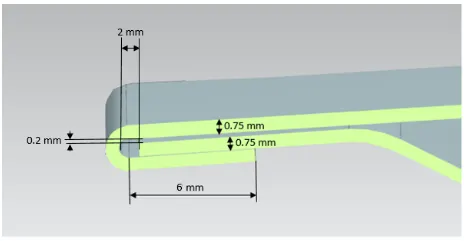
Hemming is a sheet metal forming process in which sheets are joined by bending it usually to 180°. Automotive body panels and automotive parts such as deck-lids, trunk-lids, doors, hoods and tailgates are formed by hemming process. Hemming is routinely carried out in aluminum and steel bonnet manufacture.
Emboss:
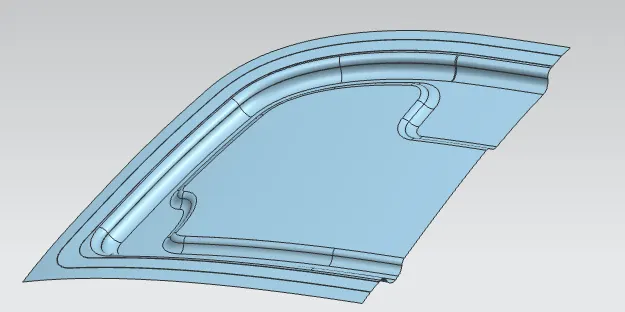
Sheet metal embossing is a stamping process for producing raised or sunken designs or relief in sheet metal. This process can be made by means of matched male and female roller dies, or by passing sheet or a strip of metal between rolls of the desired pattern. It is often combined with foil stamping to create a shiny, 3D effect.
Deep drawing:
Deep drawing is a sheet metal forming process in which a sheet metal blank is radially drawn into a forming die by the mechanical action of a punch. It is thus a shape transformation process with material retention. The process is considered "deep" drawing when the depth of the drawn part exceeds its diameter. This is achieved by redrawing the part through a series of dies. The flange region (sheet metal in the die shoulder area) experiences a radial drawing stress and a tangential compressive stress due to the material retention property. These compressive stresses (hoop stresses) result in flange wrinkles (wrinkles of the first order). Wrinkles can be prevented by using a blank holder, the function of which is to facilitate controlled material flow into the die radius.
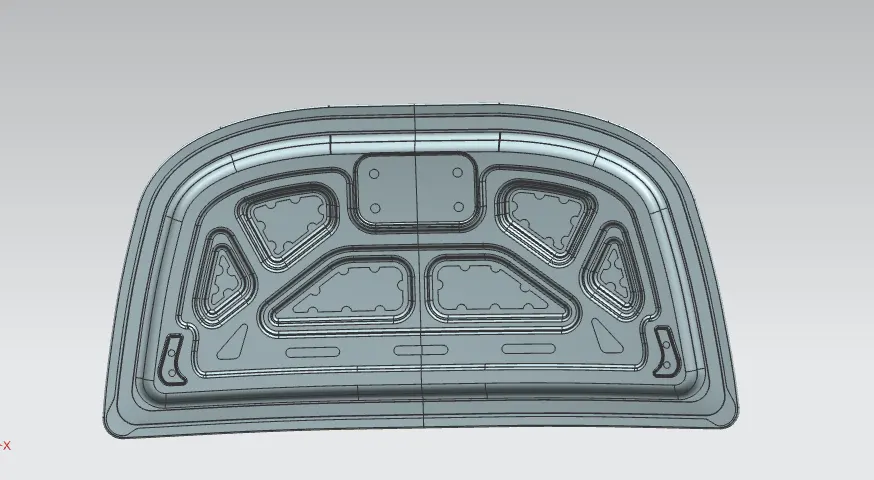
Besides this deep drawing the manufacturing of the hood involves various other manufacturing process like
- Blanking
- stretch forming
- trimming and punching
- deburring
- welding
- grinding
- painting
- baking
- polishing and waxing, and
- Coating.
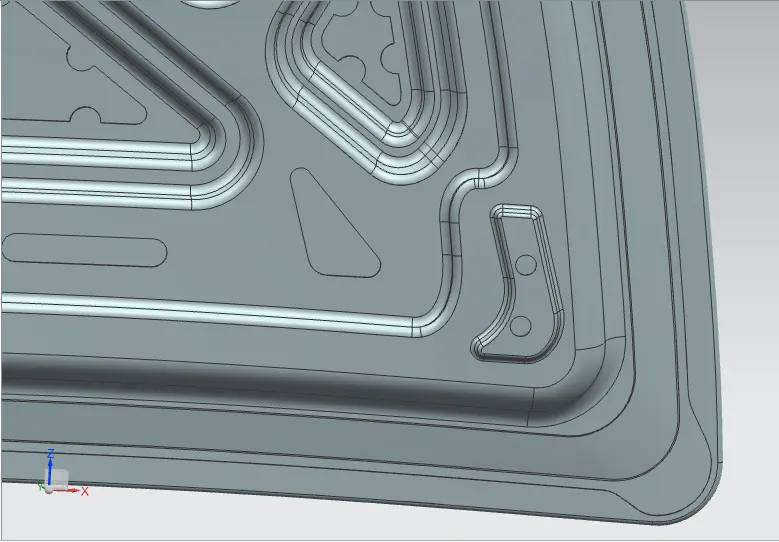
Inner and Outer pannel Assembly:
Draft analysis:
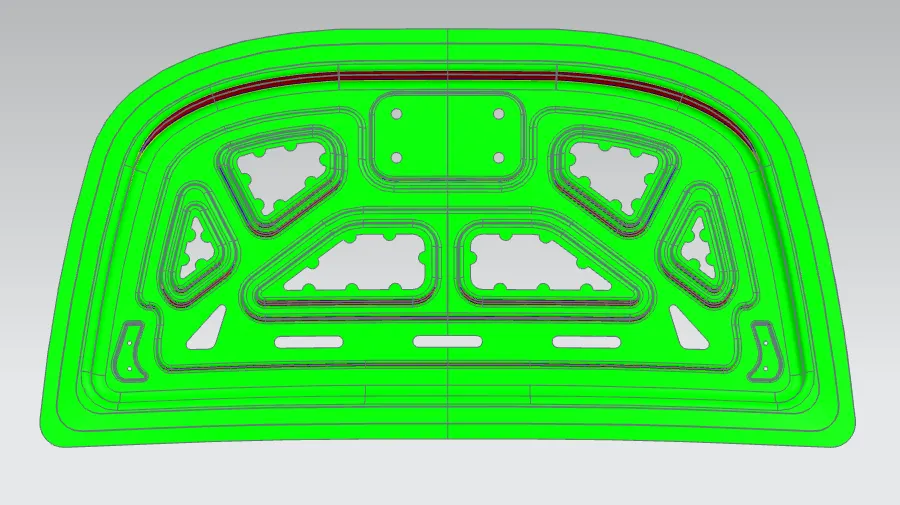
This task shows how to analyze the draft angle on a surface. The Draft Analysis command enables you to detect if the part you drafted will be easily removed.
This type of analysis is performed based on color ranges identifying zones on the analyzed element where the deviation from the draft direction at any point, corresponds to specified values.
These values are expressed in the unit as specified in Tools > Options > General > Parameters > Unit tab
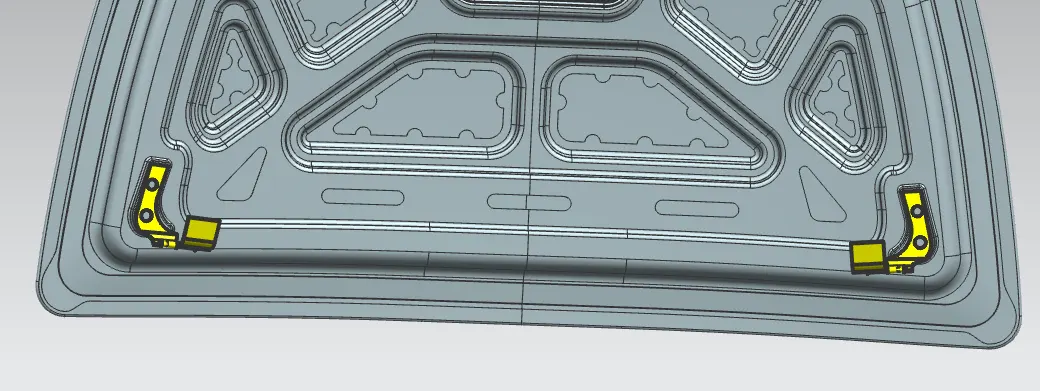
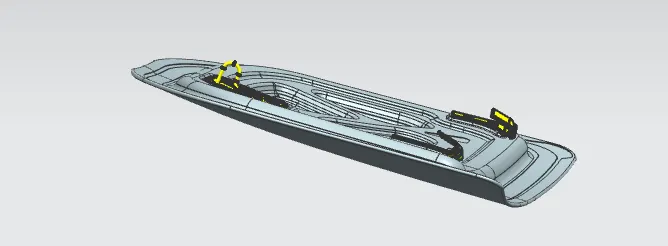
Hinge reinforcements:
Latch reinforcement:
it is used to kick the hoog pannes this reinforcemets gives strength to the sheet metal
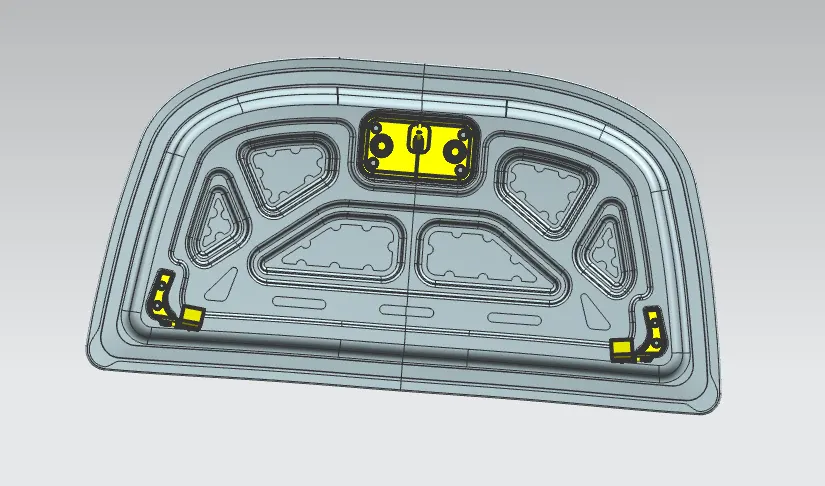
Thus the car Hood is designed using NX Cad 11
The link to obtain the design files for the hood from the google drive is provided below:
https://drive.google.com/file/d/1z5trHzK2dVSwNjXL-mU5dD4i1hUH0qaZ/view?usp=sharing