Hood design-Week 2
CAR HOOD CHALLENGE 3
AIM
1) To Design Hood outer panel, inner panel and the necessary reinforcements by following the Master section mentioned with the design parameter and to do assembly of Hood inner panel, outer panel, latch, hinge and the reinforcements
2) To provide a detailed report about the Hood Design which includes a detailed explanation about hood and its components, Latch trajectory, Mastic data, Emboss definitions, manufacturing process like deep drawing and hemming, and all the parameters followed in the design.
HOOD OR BONNET
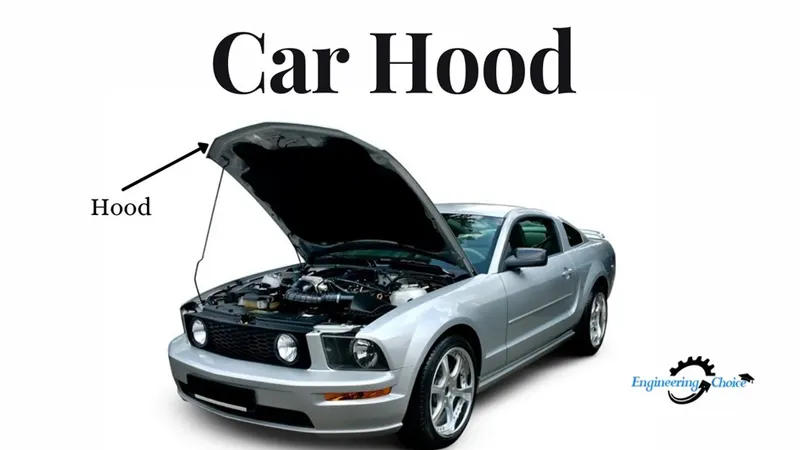
- A car hood, also referred to as a bonnet in some other countries, is the hinged cover that rests over the engineof a front-engine vehicle.
- Its purpose is to provide access to the engine for repair and maintenance.
- A concealed latch is typically used to hold down the hood. On vehicles with an aftermarket hood and on racecars, hood pins may be used to hold down the car hood.
- Hoods sometimes also contain a hood scoop, wiper jets, power bulge, and/or hood ornament.
- Car hoods are typically constructed from steel and sometimes from aluminum.
- Aftermarket car hoods may be constructed from various other materials, including carbon fiber, fiberglass, or dry carbon. The hood design may vary from one model to another.
- Hood is the most important and critical part of the car as it always exposed to the Frontal crash, Heat generated by the engine compartment, etc.
- It also gives easy access to the engine compartment which contains engine, battery and other components which are always needed to be inspected at regular intervals.
- Hood is the combination of the several components.
COMPONENTS OF HOOD:
Hood assembly consists of several components such as
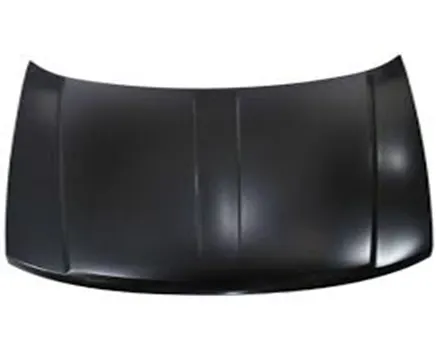
- Hood Outer Panel: It gives the complete aesthetic appearance of the hood.
- Hood inner panel: Inner Panel will be under the outer where it has embossing on the hood according to the force distribution and safety requirements.
- Latch and striker: Latch and striker are the locking mechanism of the hood to the engine compartment.
- Hinges: Hinges helps to connect the hood with the engine component where it helps to open the hood with Free -flowing direction.
- Hood Stay Rod (or) Supporting rod: It is the rod which is used to make the hood rest in one position and to make comfortable for the person to open the hood and look on the engine compartment.
- REINFORCEMENTS: Reinforcement helps to provide the strength for the parts like latch and striker, Hinges, etc.
DESIGN CONSIDERATIONS FOR CAR HOOD
Designing the car hood is the very important phase of the automotive designer where hood is exposed to Frontal crash, Vibration, etc. It is very much necessary to consider the safety of the pedestrian and the person who is riding the car and also while accessing the Hood. The design considerations that should be strictly followed are
- Head Clearance Zone
- NVH (Noise Vibration Harshness) CONSIDERATION
- Pedestrian safety
Head Clearance Zone:
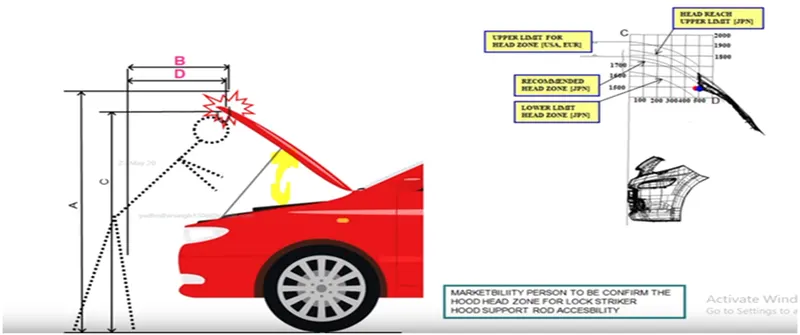
Head clearance zone is the clearance given to the hood such that when the hood is in fully open condition it does not hurt the head of the person that is standing next to the hood. This is controlled by the opening angle of the hood. the opening angle of the hood decided for the region the car is manufactured.
NVH (Noise Vibration Harness) Considerations:
Noise, vibration, and harshness (NVH), also known as noise and vibration (N&V), is the study and modification of the noise and vibration characteristics of vehicles, particularly cars and trucks. While noise and vibration can be readily measured, harshness is a subjective quality, and is measured either via jury evaluations, or with analytical tools that can provide results reflecting human subjective impressions.
Pedestrian Safety
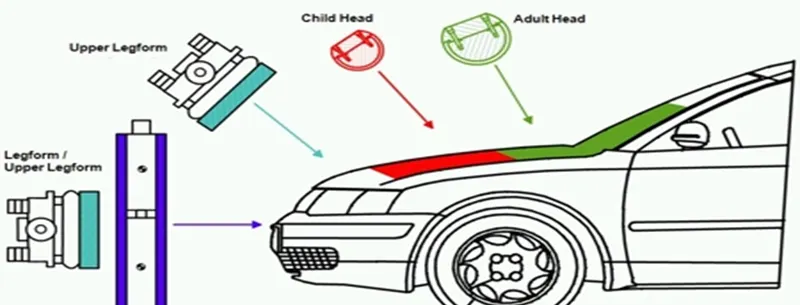
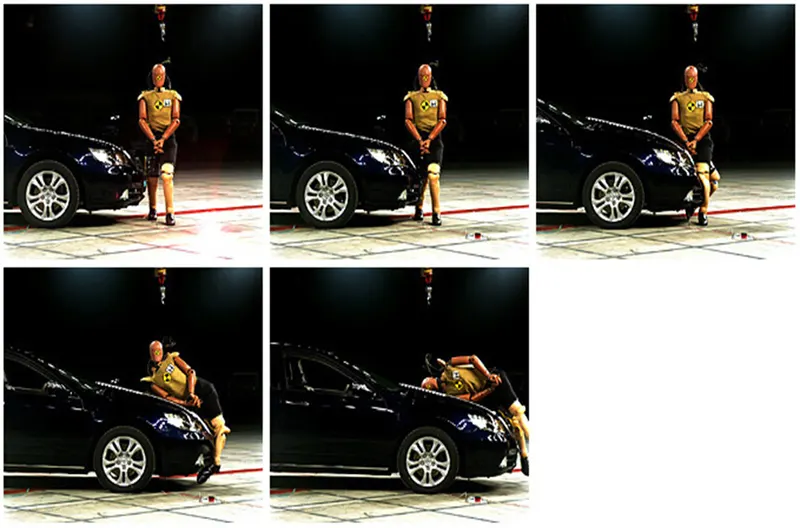
- This is one of the important and critical part that should be very much considered focussed in designing a hood. As the Pedestrains are at high risk and most vulnerable of traffic accidents.
- The major reason for the fatality of the pedestrain in traffic accident is due to the head injury resulting from the hard impact of the head against the stiffer hood or the ground.
- Most serious head injuries occur when there is insufficient clearance between the hood and the stiff underlying engine components.
- A gap of approximately 10 cm is usually enough to allow the pedestrian’s head to controlled deceleration and a significantly reduced risk of death.
- So, it becomes necessary to design the new inner hood panel which is less stiffer and pedestrian friendly.
- The head impact zone is identified correctly and it is to be made softer to reduce the impact force during accident.
DESIGN PARAMETERS
- Outer Panel Thickness = 0.75 mm
- Inner Panel Thickness = 0.75 mm
- Reinforcement Thickness = 1.5 mm
MASTER SKETCH
HEMMING DATA
FRONT RELIEF
REAR RELIEF
PROCEDURE TO CREATE COMPONENTS
HOOD INNER PANEL:
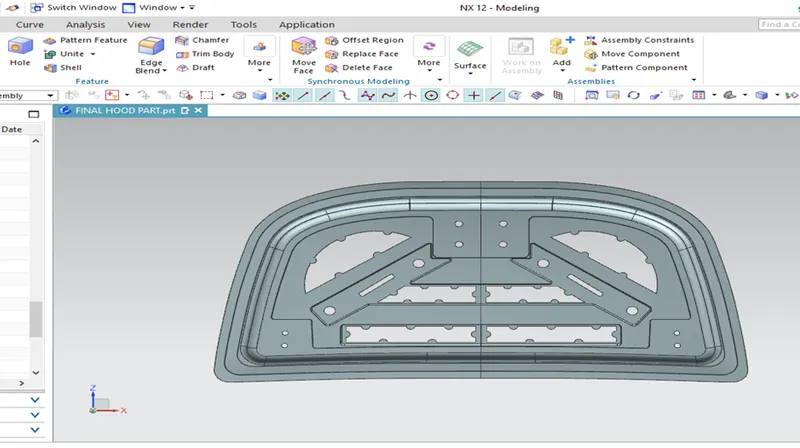
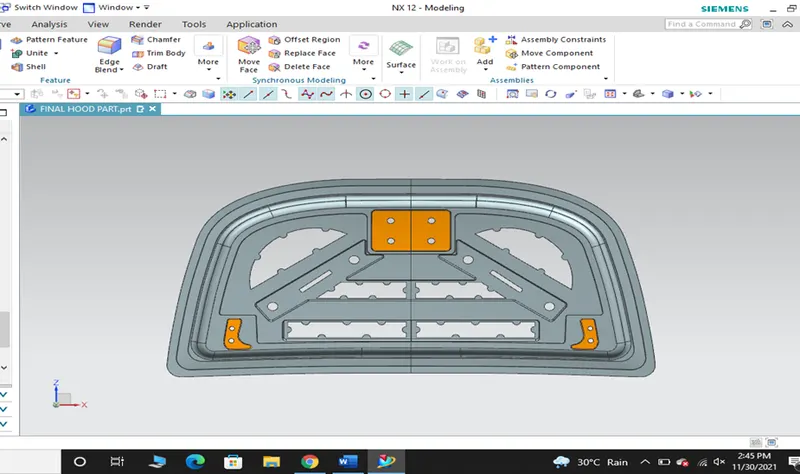
- Inner Panel is the part that gives strength and rigidity to the outer panel.
- The master section represents the initial emboss shape and size.
- After reviewing the master section, We provide embosses for the inner panel, latch and hinge elements after fixing the location.
REINFORCEMENT
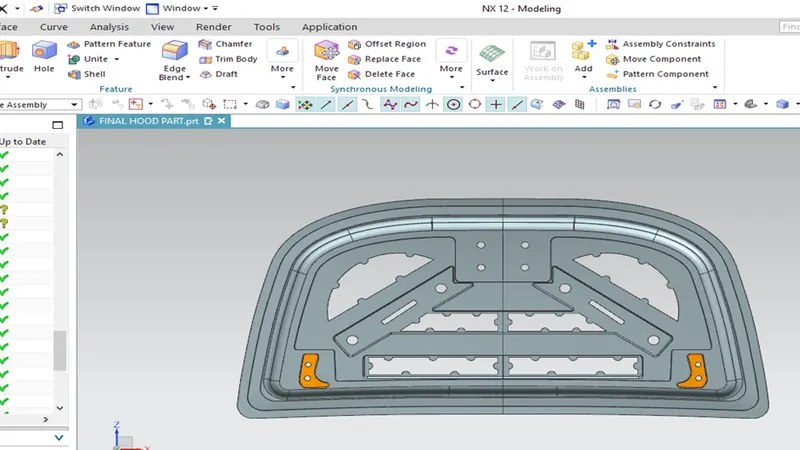
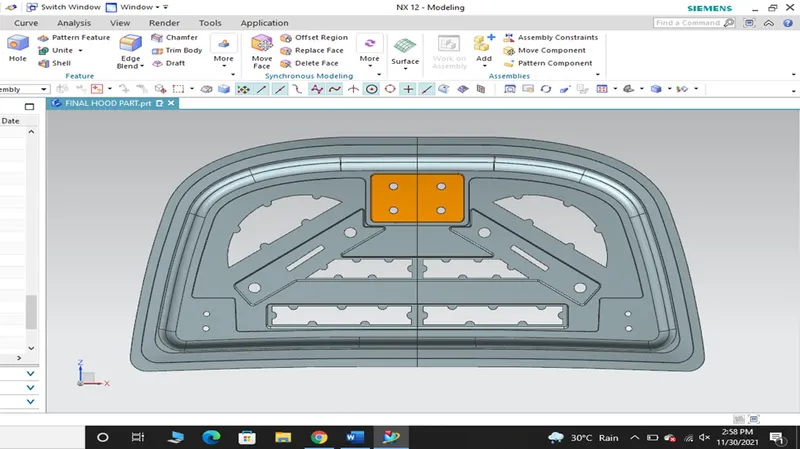
- Reinforcements are provided according to the design requirements.
- The give design requirements of hinge reinforcement is that the thickness should be of 1.5 mm.
- The reinforcements are provided to the hinges, latch and striker.
- The aim of providing reinforcements is to improve the strength of the part locally.
- The thickness of the reinforcements should be greater than the thickness of the hood panels (both inner and outer panel) and it may vary depending upon the requirements.
HINGE REINFOECMENT
LATCH AND STRIKER REINFORCEMENT
HOOD OUTER PANEL
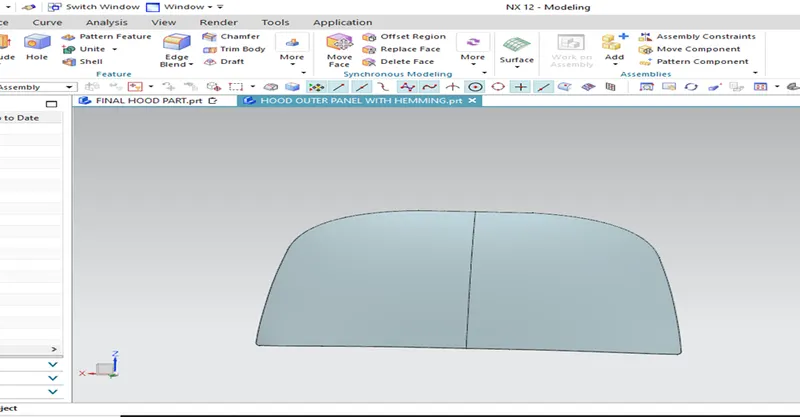
- Outer panel is the aesthetic part of a car.
- Styling team designs the aesthetic part of the outer panel and provides the skin for the same.
- The skin doesn’t have any features or the thickness of the part.
- So, the hood outer panel is designed with the required size, shape and position and also it should satisfy the safety norms.
- The outer panel is the important part in the hood, so designing the outer panel should be given more importance to pedestrian safety.
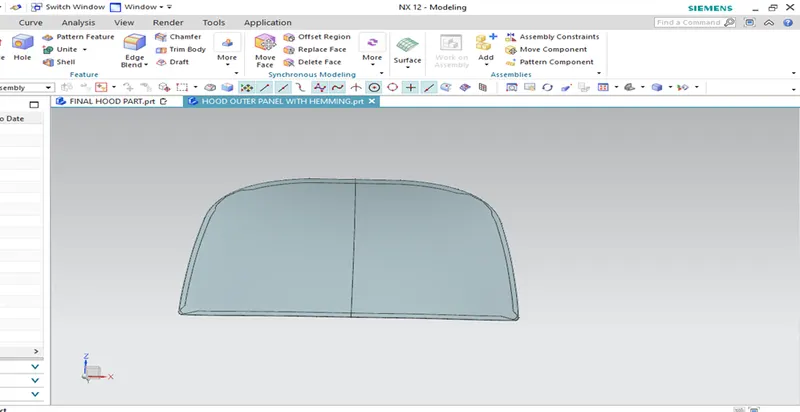
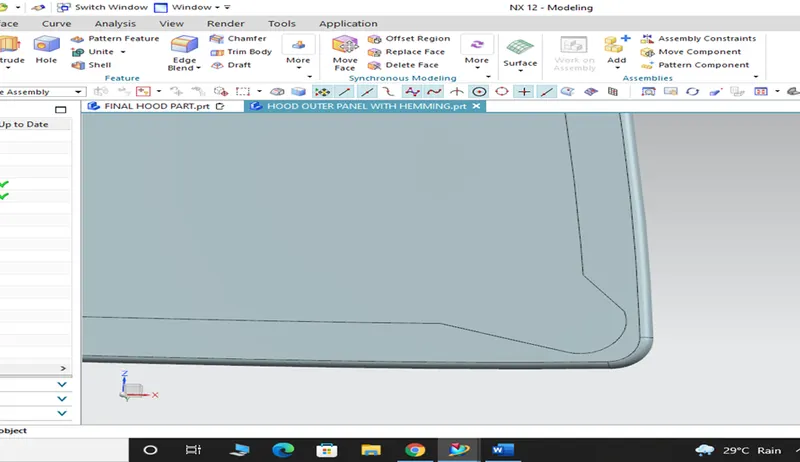
- The outer panel is attached with the inner panel using hemming.
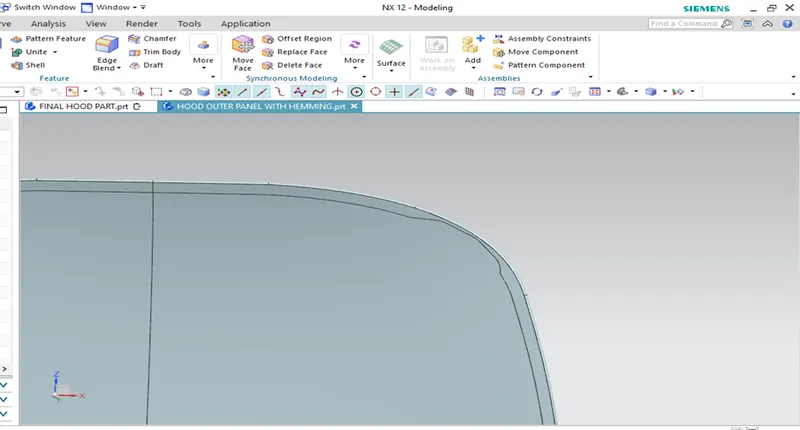
- The hemming flange is designed in the outer panel and it should wrap the inner panel and it should have reliefs for the hemming operation.
- Mastic sealants are also provided between outer panel and inner panel.
FRONT RELIEF
REAR RELIEF
LATCH TRAJECTORY
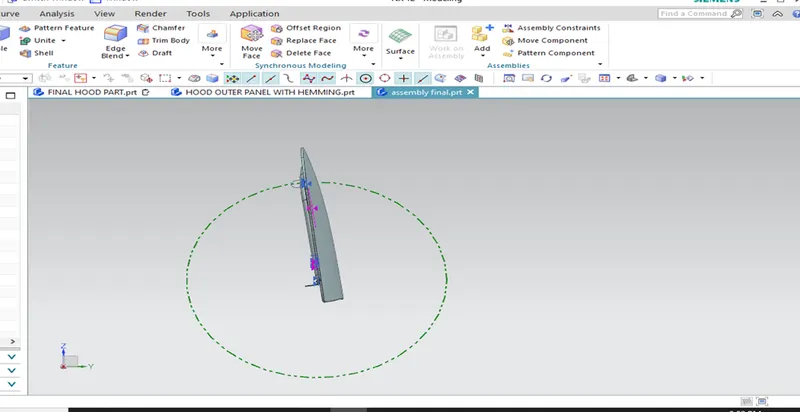
- Latch trajectory is given by the circle drawn from the hinge axis point.
- Hinge axis point is the center point of the hinge axis.
- Hinge is fixed tentatively and after fixing the hinge then the trajectory circle for the latch is drawn.
- The striker should be tangential to the latch trajectory for proper mating conditions.
EMBOSS:
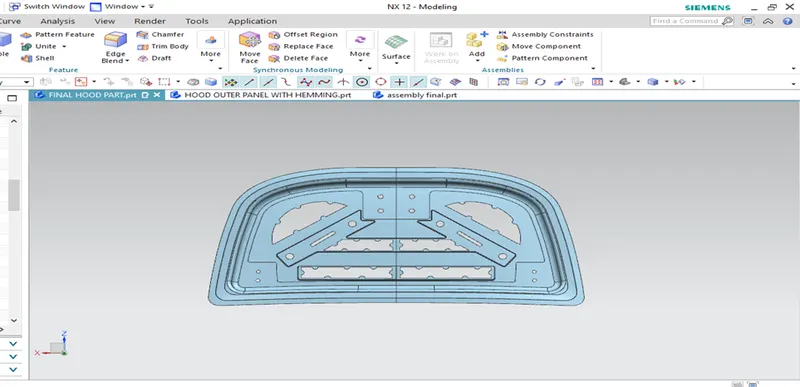
- Emboss is used to increase the stiffness of the part. Here, it is used to increase the stiffness of the inner panel.
- The embosses which should be created depends upon the shape, size and position of the part.
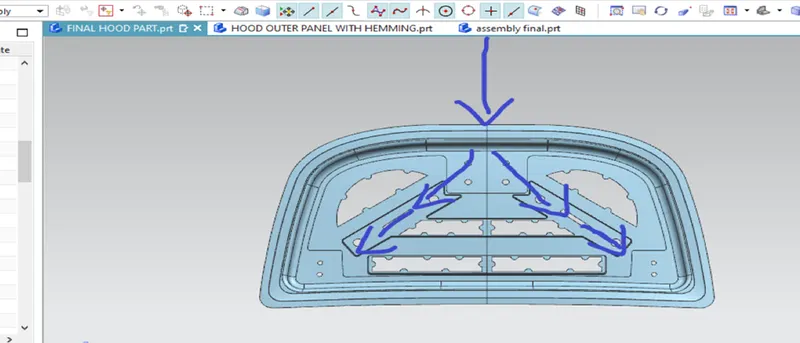
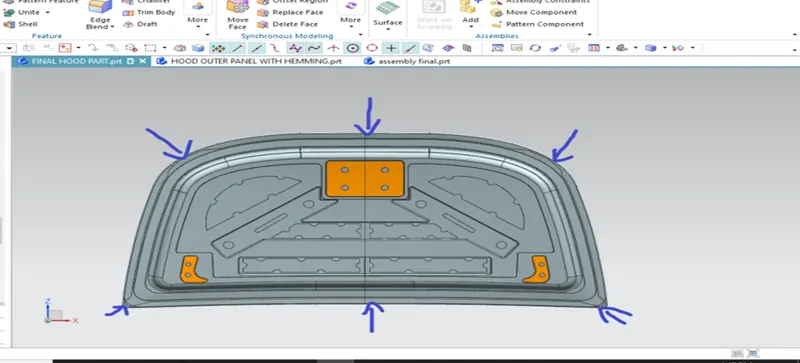
- Embosses are to created in such a way that while frontal collision, the force should be distributed away from the passengers.
- Taking that as a design consideration, here the embosses are designed in such a way that the force is directed away from the passengers (i.e. it is directed to either sides of the car).
- Embosses can be created using law extension also by trimming it with the surface.
- The below image shows the direction of the force after frontal collision and it is moving either side of the car.
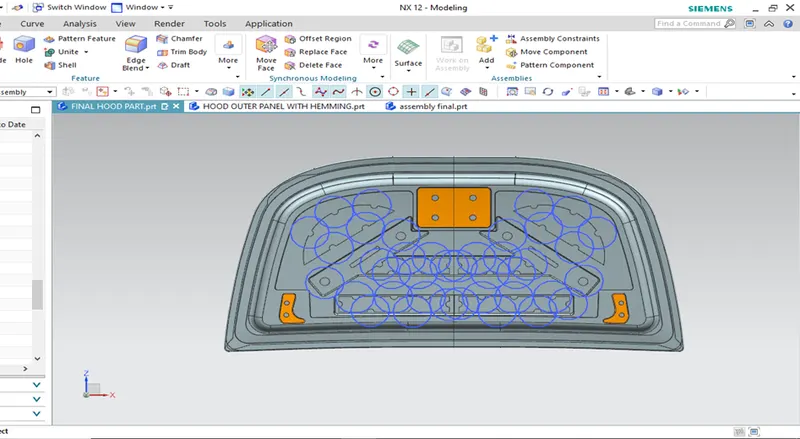
MASTIC SEALANT DATA
- Mastic is commonly used on construction projects as an adhesive and sealant. It is a popular choice where one surface needs to be adhered to another in a durable bond, or where the area needs to be protected.
- Hood commonly possess large surface area and hemming can only be provided through its boundary.
- Other joining techniques such as welding, riveting, etc. because they will leave marks on the hood panels.
- The Blue circle shown in the below image is the mastic sealant.
HEMMING
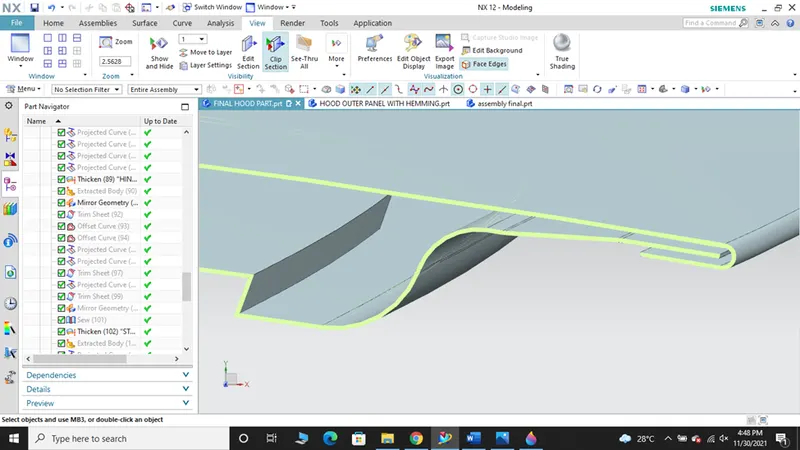
Hemming is a technology used by the automotive industry to join inner and outer closure panels together (hoods, doors, tailgates, etc.). It is the process of bending/folding the flange of the outer panel over the inner one.
- The accuracy of the operation affects significantly the appearance of the car’s outer surfaces and is therefore a critical factor in the final quality of a finished vehicle.
- In car production, hemming is used in assembly as a secondary operation after deep drawing, trimming and flanging operations to join two sheet metal parts together.
- Hemming can be done in the parts like hood, doors, trunk lids and fenders and it is important to provide reliefs in the corner to overcome the hemming drawbacks.
- There are two types of hemming operations such as Conventional die Hemming and Roll hemming.
Hemming is performed in order to:
- Achieve a better final geometry in the vehicle´s part
- Add resistance and rigidity to the part
- Allow a safe handling of the part
DEEP DRAWING
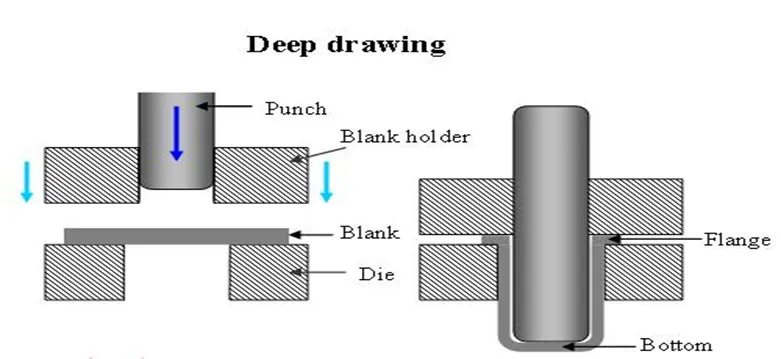
- Deep drawingis a sheet metal forming process in which a sheet metal blank is radially drawn into a forming die by the mechanical action of a punch.
- It is thus a shape transformation process with material retention. The process is considered "deep" drawing when the depth of the drawn part exceeds its diameter.
- This is achieved by redrawing the part through a series of dies. The flange region (sheet metal in the die shoulder area) experiences a radial drawing stress and a tangential compressive stress due to the material retention property.
- These compressive stresses (hoop stresses) result in flange wrinkles (wrinkles of the first order). Wrinkles can be prevented by using a blank holder, the function of which is to facilitate controlled material flow into the die radius.
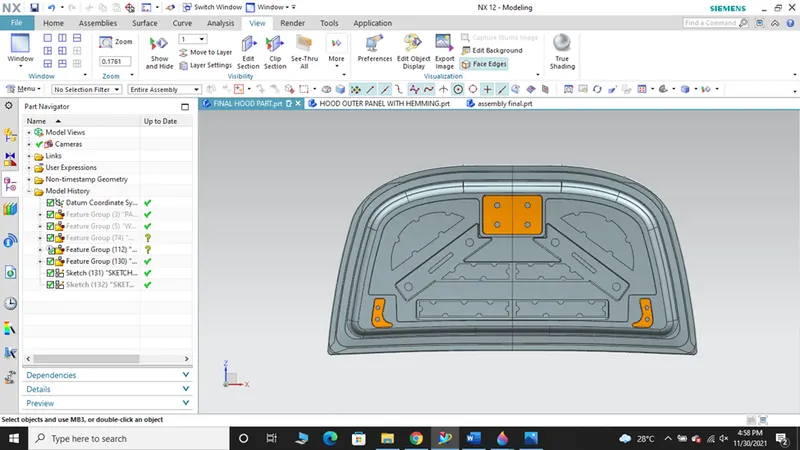
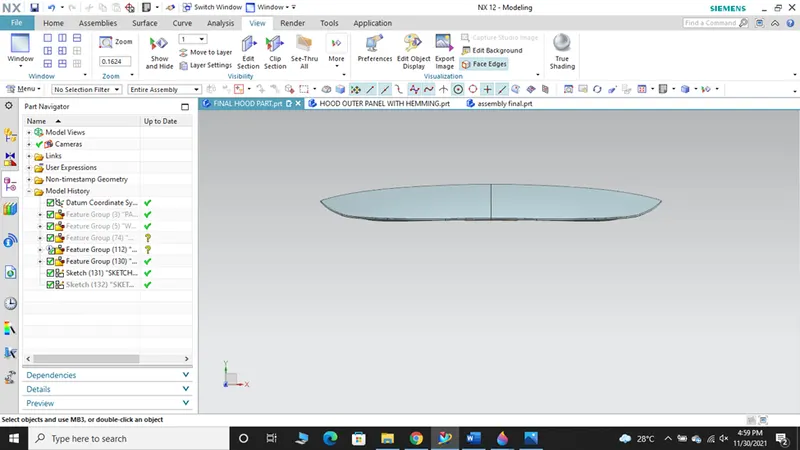
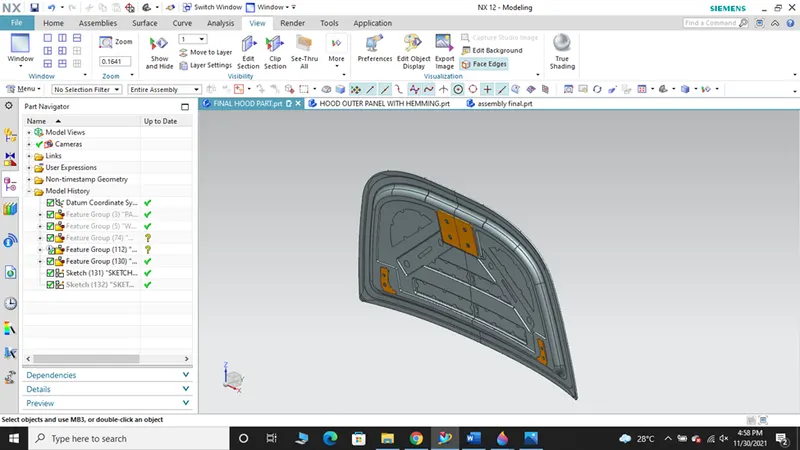
FINAL ASSEMBLY
FRONT VIEW
TOP VIEW
TRIMETRIC VIEW
RESULTS & CONCLUSION:
1) The Design Hood outer panel, inner panel and the necessary reinforcements by following the Master section mentioned with the design parameter and the assembly of Hood inner panel, outer panel, latch, hinge and the reinforcements are created and the detailed report about the hood design which includes a detailed explanation about hood and its components, Latch trajectory, Mastic data, Emboss definitions, manufacturing process like deep drawing and hemming, and all the parameters followed in the design has been submitted.
2) In this challenge of creating the car hood, I have gained the knowledge to design and develop the hood inner panel and outer panel with the help of master selection and the skin surface. I have also learnt about the assembly of inner hood panel and outer hood panel and the reinforcements like latch and striker and hinge assembly.