Hood design-Week 2
DESIGN OF HOOD BY USING NX CAD
Aim - Design and Modeling of Automotive hood design used in car which BIW part that intersect the Manufucturing and Functional requirment as per EURO NCAP standards.
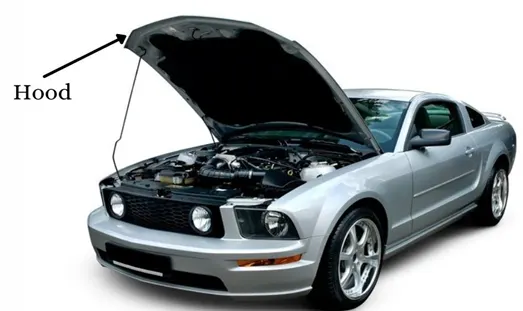
What is Hood in Automotive Industry?
- A hood in car is also called as Bonnet as per country standards which is Hinged cover that rest over the engine of front engine vehicle.
- Its purpose is to provide access to the engine for repair and maintainance.
- A latch is used to hold down the hood .
Purpose of Hood Design -
- Safety of Passangers and Padestrian Safety .
- Give an access of Maintance of Engine and Hardness of Engine.
- Cover all Engine , Radiator & and other components .
- Reduce air effect due to its aerodynamic shape of design,
- It can give enough time to passanger go out also around vahicle went far in any emergency.
Components of Hood-
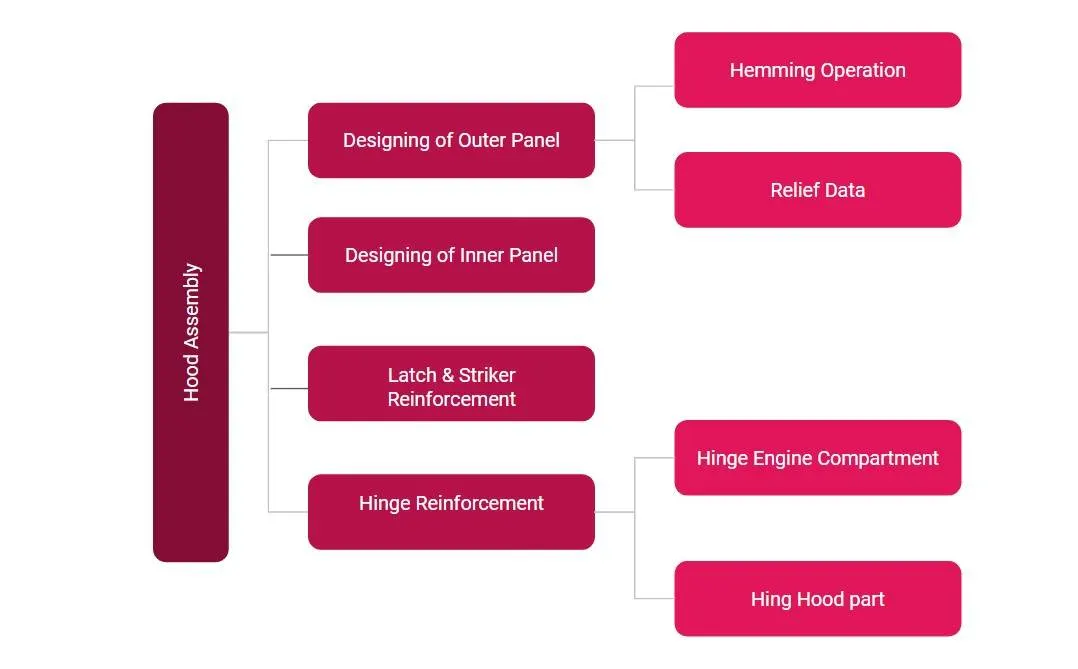
- Inner Panel
- Outer Panel
- Latch and Striker Rainforcement
- Hinge and its Rainforcement
- Stiffener Pad
Design Consideration -
- Pedestrian Safety
- Vehicle Quality
- Occupent Safety
- Manufucturing Factors
- Proper Styling
Manufucturing Requirment -
- No sharp corner
- Material requirment- Steel , Aluminium and fibers
- No Nagative draft
- Provide appropriate corner relief on the area of curvature
- Outer panel thickness - 0.75 mm
- Inner panel thickness - 0.75 mm
- Rainforcement thickness - 1.50 mm
Sheetmetal Operations -
- Blanking and Piercing
- Deep Drawing
- Embossing
- Hamming
- In Blanking and Piercing process Ram and Die used to give shape to sheet metal . In blanking punched out piece is used and in Piercing Punch our piece is scrap.
- Deep drawing of sheet metal is used to form workpiece in depth direction.It is a Plastic deformation in which a flat sheetmetal or plate is formed into a recessed three dimenssional part with a depth sereval times thickness of metal.
- Sheetmetal Embossing is stamping process . This process can be made by means of matched male and female roller dies or by passing sheet or by passing strip of Metal between rolls of the desired pattern.
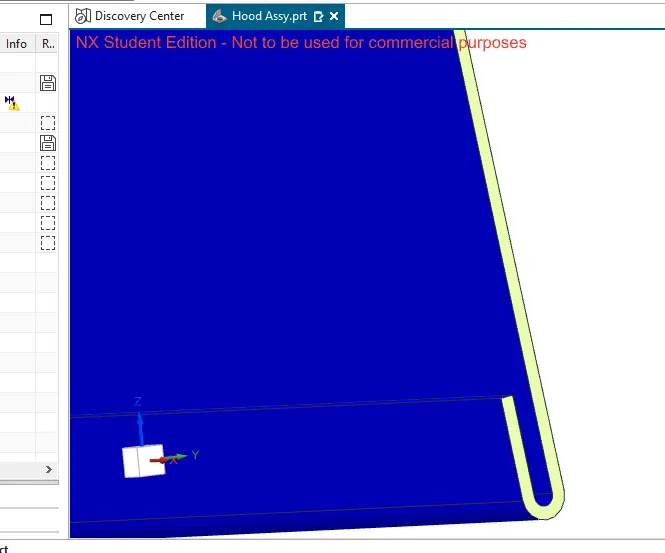
-Hemming is a sheet metal process in which sheets are joined by bending it to 180 degree. Automotive part such as Panels , Lids , door and hood are formed by the hemming process , in this process sheet is bent with the help of the inner and outer sheet.
Design Procedure-
Inner Panel-
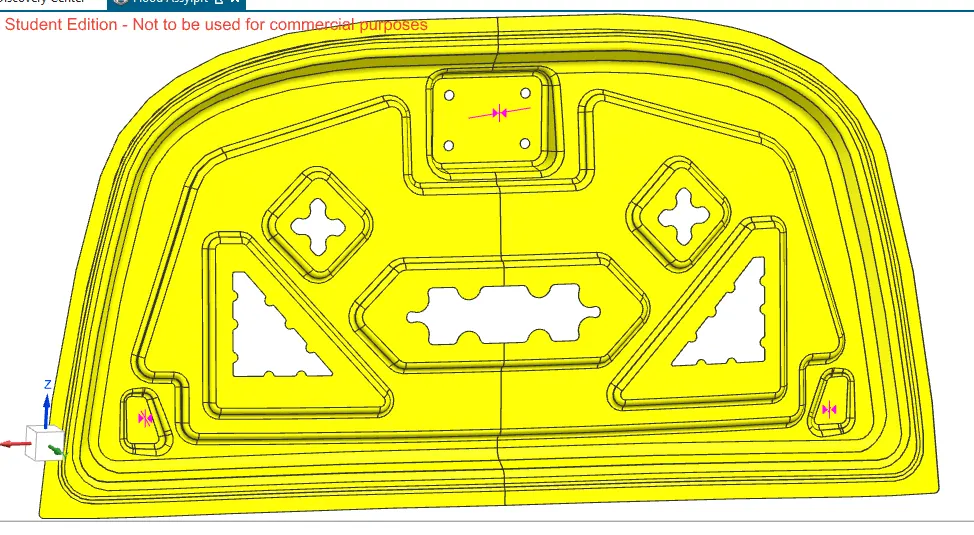
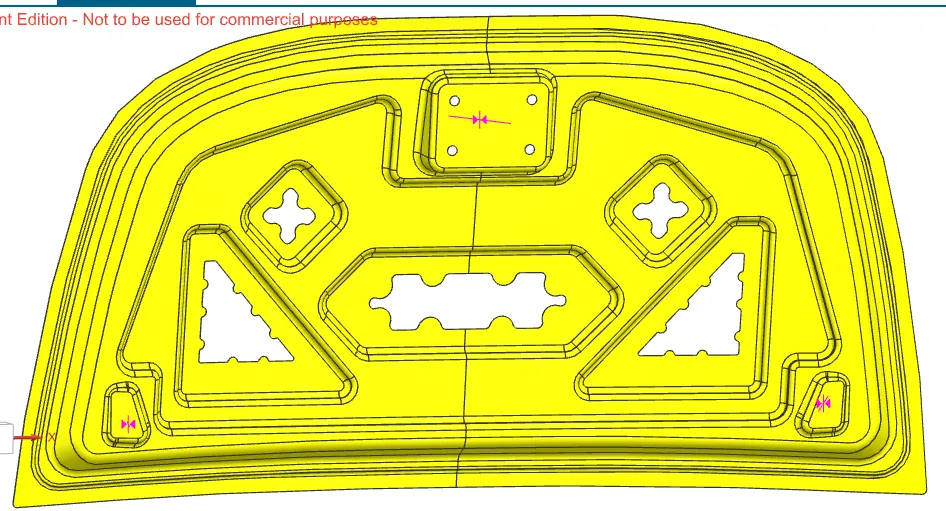
- Extract body from the given dumb solid body and start creating inner panel using that extracted one.
- Create a part file in Assembly named after '" Inner Panel" . Trim the half part as we will mirror it in the end.
- Create a offset surfaces as per skatch from Linked body.
- Use offset curve on face create curves on face using edges and trim off unwanted portion.
- Use through curves command by selecting appropriate surfaces which usually creates a body through multisection where the shape hange through each section .
- Create more one surface using offset surface and connect it with previous sueface using law extension and trim off the extended portion using trim and extend '
- Blend the faces of the sheets using face blend by giving appropriate dimensions.
- Now create a skatch by selecting a plane paralll to the panel surface and project the curves on the panel using projected curve.
- Create emboss to modify the body with face made by projecting a section along a vector by selecting embossed face as end face and projected curve as curve . Use edge blend to blend . Create more embosses as per design consideration , benchmarks and pedestrial safety.
- Hinge Emboss- Use wave geometry linker to extract the hinge face and use it as reference it as create sketch skatch for its positioning.
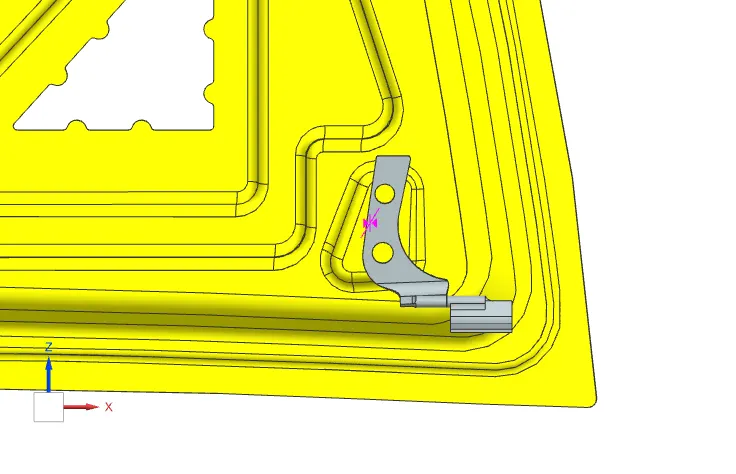
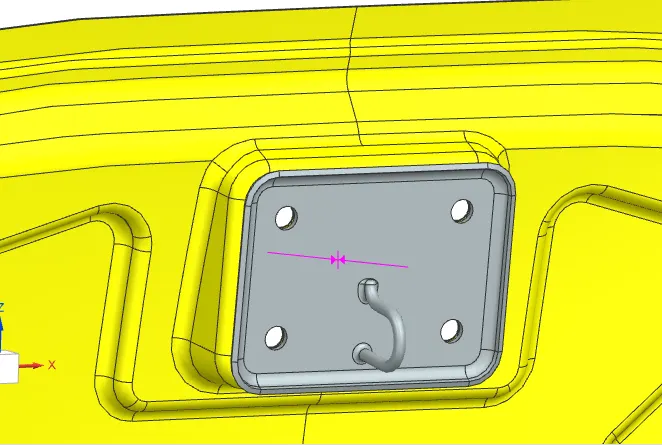
- Latch Emboss- This emboss is created once the trajectory of hood opening and Clossing finalized .
Thicken the part as per specific thickness value and make it to solid body.
Mastic Data-
- The main purpose of the outer panel is for aesthetic looks. Thus we cannot use bolts or welding this has to be done with the help of hemming and mastic sealants.
- Mastic sealents are elasric compound seems as rubber . It is placed between inner and outer panel . Initially it is paste prom but after furnase bath, it will gets harded thus joining the outer panel . Mastic sealents has the tendency to increase the strenght of the panel and has the influence of 80 mm diameter.
- Usually in designing these are created in inner panel using sketche and projecting them on panel . Later trimming of the sheet and blending it.
Hinge and Striker positioning-
- For proper opening and clossing of hood , the striker should be perpendicular to the trajectory of hood .For this , the hinge is assembled at its position.Once its placed , the hinge axis is drawn by coonecting sketch points created on hinge edges. Create datum plane using midpoint of hinge axis.
- Now sketch circle to in such a way thay helps in positioning latch.
- Now position the latch using above drawn circle which has to be perpendicular to the hood trajectory .
- Once postioned create a emboss on inner panel by ectracting the face of the latch .
Design of Outer Panel -
1. Hemming -
- Use offet curve on face to create curve along the faces by selecting above offset surface.
- Extend the sheet by selecting the above offset curve .
- Create one more surface at an offset of calculating thickness and gap between flanges on opposite direction bove surface .
- Offset the above created law extension as per requirment offset face.
- Now trim the extra surfaces which are not reuqired.
- Use face blend and select the top, rear and middle face to create hemming .
2. Relief Data-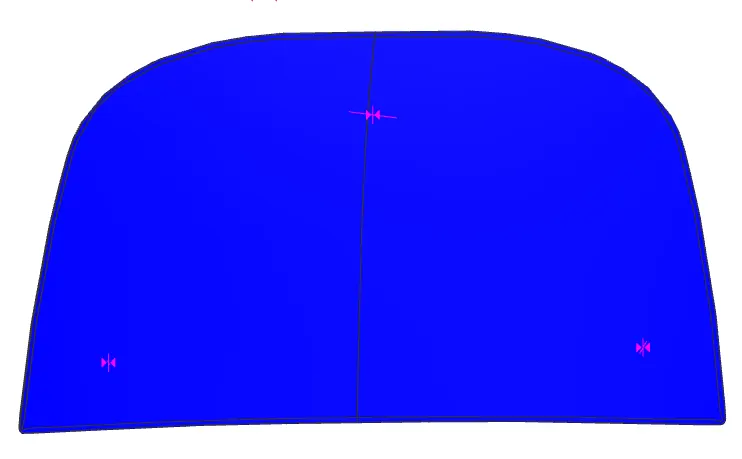
- Relief is provided onto the part or component in order to remove any stresses developed in a perticular area as sharp corners that take place during hemming process are carried out. Thus comers are rounded or chamfered.
- Created a skatch and project it on panel using project curve, Trim the extra portion using trim sheet by selecting projected sketch as boundry.
FINAL ASSEMBLY
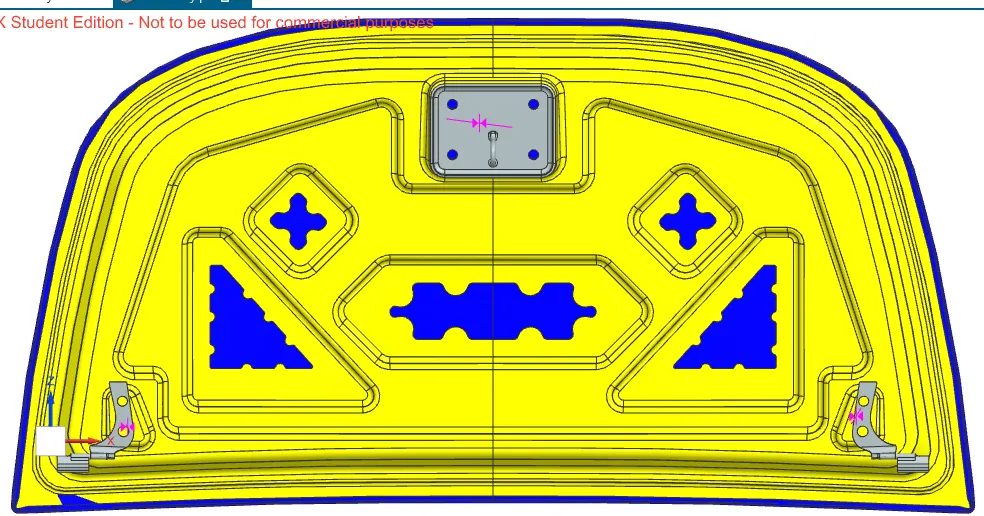
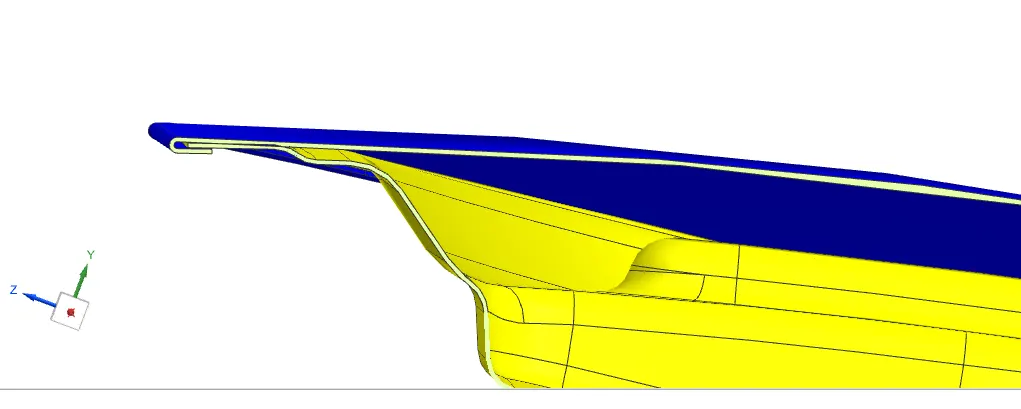
Draft Analysis-
Draft analysis is carried out to see that panel can be drawn or not. It also help to find the negative draft present in the component which can cause difficulty in manufucturabity.
CONCLUSION
Thus a hood is designed in a top - down approach where the intent comes from the top and moves down , which satisfies the industry's manufucturing requirements , functional as well as safety standerds as EURO NCAP standard.