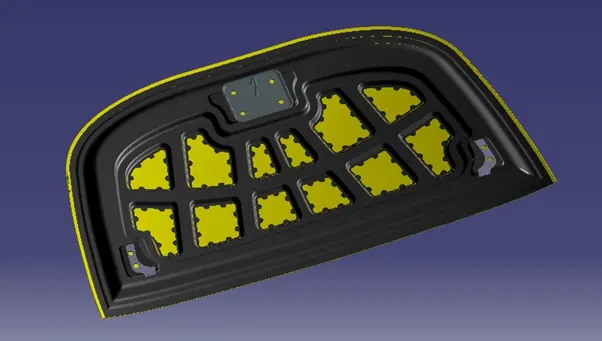
Automotive Hood design
Aim :-
To design a Hood outer panel, inner panel and the necessary reinforcements by the given Master section and design parameters.
Design:
Master section :-Master section is a predefined sketch which will be adaptable for different situations.
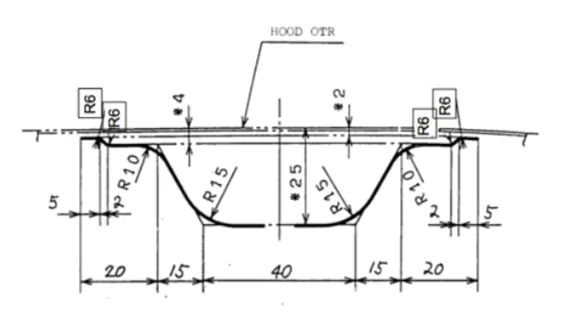
Master section
Four main parts of Hood assembly are as follows
- Outer Panel
- Inner Panel
- latch and striker system
- Hinge system
Hood Thickness Information
- Outer Panel Thickness = 0.75mm
- Inner Panel Thickness = 0.75mm
- Reinforcement Thickness = 1.5mm
Outer panel:
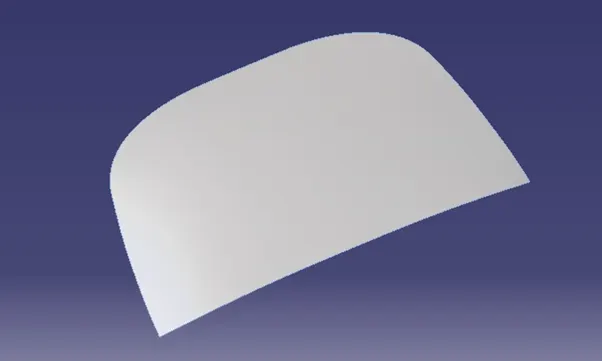
The style department provides us with the outer panel skin surface, ensuring that it has the appropriate aesthetic appearance and gaps. Additionally, the outer panel is designed with an aerodynamic shape to minimize air resistance. The shape of the outer panel serves as the foundation for designing the inner panel.
Inner panel:
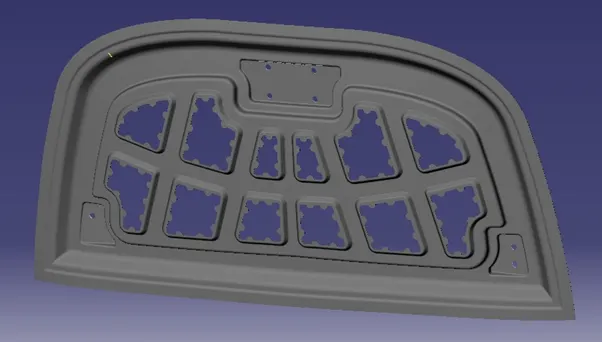
The hood inner panel is a crucial component in the design of a hood, providing structural support and strength to the outer panel. The outer and inner panels are usually joined together using a hemming operation at the edges, creating a secure and stable connection.
Latches and striker:
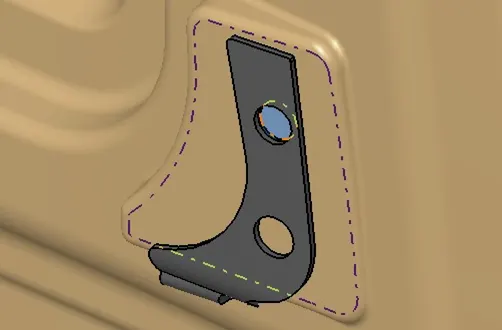
The hood latch system plays a critical role in attaching the hood assembly to the vehicle body. It must be designed in a way that allows it to quickly and automatically catch the striker of the hood upon closing and lock instantly. Once locked, the system must remain secure and only unlock when the operator initiates the unlocking process. Ensuring the reliability and effectiveness of the hood latch system is crucial for the safe and proper operation of the vehicle.
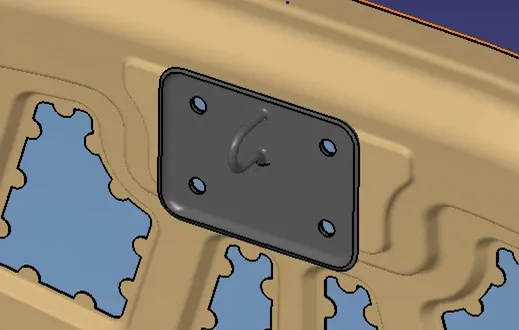
Latches:
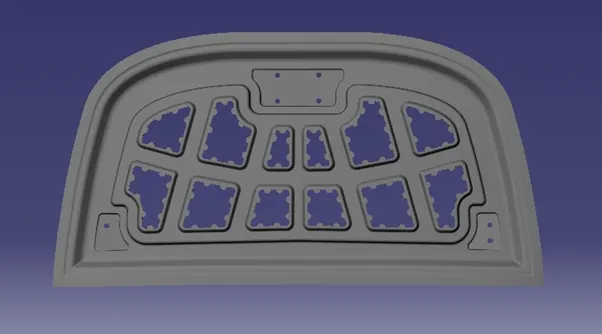
Emboss definition:
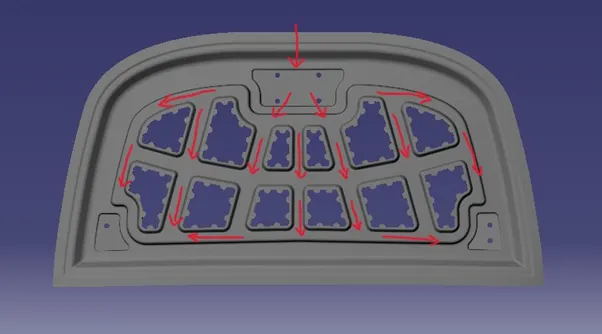
Embosses are incorporated into the design of the inner panel to enhance its strength. The shape and size of the embosses also play a critical role in determining the direction of force distribution during a collision. It is important to design the embosses in a way that directs the collision forces towards the outward side of the car, i.e., towards the hinge side. By doing so, the impact energy can be better absorbed and dissipated, minimizing damage to the vehicle and increasing occupant safety.
Force distribution: -
Mastic data:
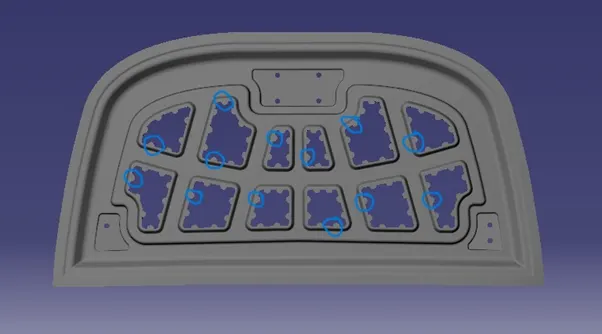
Mastic sealants are a type of elastic compound used to connect the outer and inner panels of a car hood at specific points. Unlike other joining processes like welding or riveting, mastic sealants are preferred in the region between the inner and outer panel to maintain the aesthetic design of the car. Moreover, they also help in improving the NVH (Noise, Vibration, and Harshness) characteristics of the vehicle. The mastic sealant points are typically effective within a circular region of 80mm diameter.
Manufacturing aspect:
One of the most critical design considerations for any component is its manufacturability. In the case of sheet metal, the component is typically manufactured using press tool dies. The press tool involves various cutting operations such as shearing and piercing, as well as forming operations such as bending, deep drawing, and hemming. The primary goal of the manufacturing aspect is to ensure that the hood assembly can be produced with the minimum number of operation sequences and process time, while maintaining the required quality standards. By optimizing the manufacturing process, the component can be produced efficiently, effectively, and at a lower cost.
Deep Drawing:
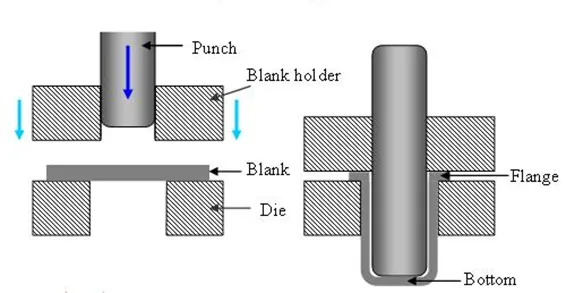
Deep drawing is a widely used forming process for manufacturing cup-like products from thin sheet metal. The process involves a punch with a round comer and a die with a large radius, and the punch-die clearance is slightly larger than the thickness of the sheet metal being drawn. As the punch is applied, the sheet metal is forced to flow radially and sink into the die cavity to form a cup. This process is ideal for creating complex-shaped components with a seamless effect and smooth, curved edges. Deep drawing is commonly used in the automotive industry to manufacture car body parts. In practice, the process may involve a combination of stretch and deep drawing to ensure that the sheet metal is stretched to its maximum potential without reaching its limits, such as splits or wrinkles.
Piercing: -
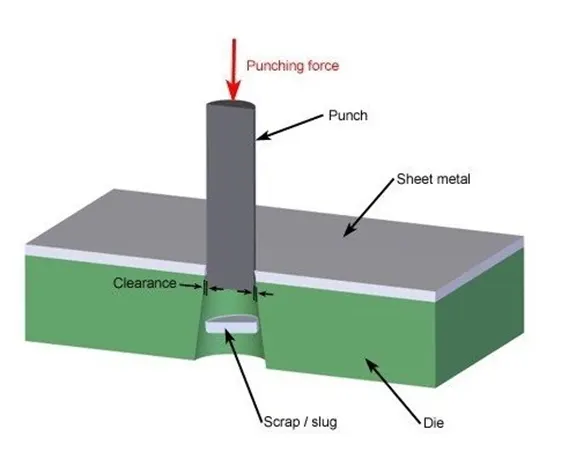
Piercing is a shearing process in which raw metal is pierced with a machining tool, resulting in the creation of a circular or other-shaped hole.
Hemming:
Hemming is a sheet metal forming process in which two sheets are joined by bending one sheet over the other, typically to a 180° angle. This process is widely used in the final stages of automobile production for aesthetic purposes, particularly in automotive body panels and parts like hoods and doors. Hemming involves rolling the edge of a sheet metal over and onto itself, creating an area of two layers that lie flush with each other. The process usually involves a three-step bending process consisting of flanging, pre-hemming, and final hemming. Hemming is an important assembly method for improving the appearance of automobile closures and ensuring proper fit and function.
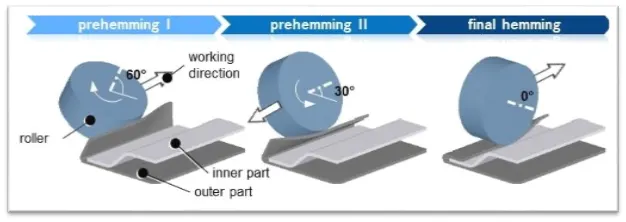
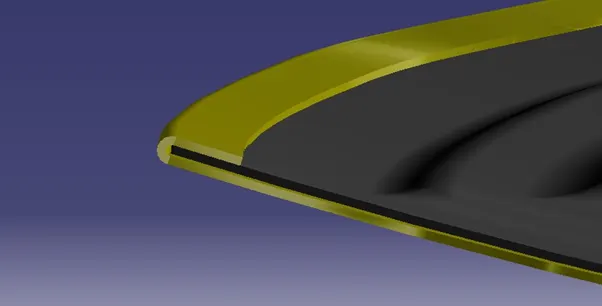
Hemming
Draft analysis:
Draft analysis is a process of evaluating the angles of a part's geometry and the direction of its features relative to its mold's parting line. This analysis helps identify any issues or potential problems that may arise during the manufacturing process. For example, if a part's angle is too steep, it may not be possible to eject it from the mold, resulting in a defective part.
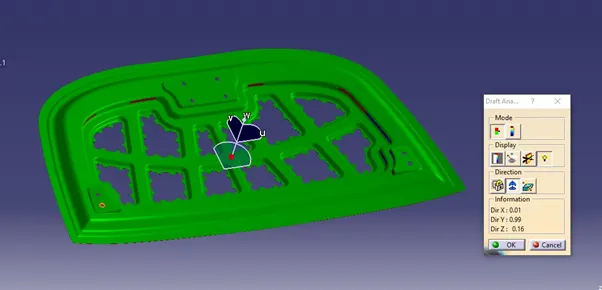
Draft analysis
Assembly:
The below picture shows the assembly of the Hood outer panel, inner panel, hinges and Stricker