Hood design-Week 2
Hood Design
A car hood, also referred to as a “bonnet” in some countries, is the hinged cover that rests over the engine bay of a front-engine vehicle. The car hood protects the engine and connected parts from the elements while providing easy access for repairs and maintenance. Car hoods are typically constructed from steel and sometimes from aluminum. Aftermarket car hoods may be constructed from various other materials, including carbon fiber, fiberglass, or dry carbon. A concealed latch is typically used to lock the hood in place while driving. A release for the mechanism can be accessed from the dash below the steering wheel. On race cars and vehicles with an aftermarket hood, exposed pins may be used to secure the car hood. Hoods sometimes contain a hood scoop or a power bulge to allow for greater engine capacity and airflow to increase the car’s performance output.
There are four the components of hood design.
- Hood outer panel or skin of the hood.
- Hood inner panel.
- Hinge assembly.
- Striker
Hood outer panel and inner panel
There are two types of body panels: (1) outer body panels, which include horizontal panels (hoods, deck lids, and roof) and vertical panels (door and quarter panels) and (2) inner body panels, such as wheelhouse and rear floor. Closure panels, such as hoods and deck lids, usually consist of an inner panel and an outer panel that are joined together along their perimeters by hemming.
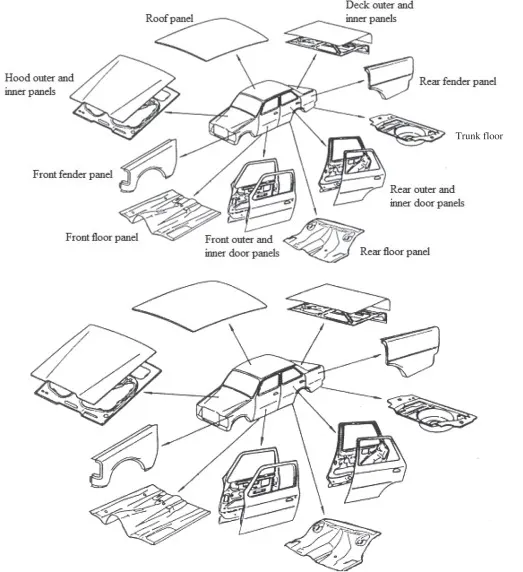
As with the body structure, the bending stiffness of body panels is the first major design consideration, since it controls the panel deflection under load. For a bending stiffness-critical design, the initial material selection is based on the material index E1/3/ρ. The bending stiffness can be increased by increasing the panel thickness. However, since increasing the panel thickness also increases weight, the bending stiffness of interior body panels is usually increased by adding stiffeners, reinforcements, curvature, intermediate supports, corrugation, ribs, etc. For outer body panels, stiffness increase is achieved through double curvatures, adding reinforcements on the nonvisible inner side of the panels, and in some cases, forming character lines along their lengths. It should be noted that the design of the reinforcements and stiffeners, their spacing as well as their layout pattern determine the degree of panel stiffness improvement and weight saving. There is also growing application of tailored parts in which two or more sheet blanks with different gage thickness, different material grades (e.g., high-strength steel and advanced high-strength steel) or both are joined by laser welding to make a full blank before manufacturing the final part either by stamping or roll forming. The tailored parts provide an opportunity to use the right thickness or the right material grade where it is needed instead of using the same thickness or the same material grade in the entire part. This also provides an opportunity to reduce the weight of body panels. Two other design requirements for outer body panels are resistance against oil canning and resistance against denting. Oil canning is a local elastic buckling phenomenon that is manifested by a sudden reversed curvature on the surface when the panel is pressed by hand. Since it is an elastic deformation, it does not leave any permanent depression in the panel. Resistance to oil canning requires high elastic modulus, but high yield strength is also desirable, since it delays the plastic deformation. Denting, on the other hand, is a permanent deformation and it occurs when the local stresses in the dented region exceed the yield strength of the material. Denting can occur in a number of ways; for example, by stone impact, low-speed accidents or an unintentional bump by the opening of a door of a closely parked neighboring car. . In general, dynamic yield strength of steels increases with increasing strain rate, whereas dynamic yield strength of aluminium alloy is not much affected by strain rate. It should be noted that the polymer matrix composite panels will not dent in the way steel or aluminum panels dent. Instead, under low impact conditions, there will be local damages. Some of these damages may be visible on the surface; but there may also be subsurface damages, such as delamination or internal cracks, that can only be detected using nondestructive testing. These local damages may not pose any immediate structural problems, but they may have to be repaired to reduce their spread over time. The damage repairing methods for composites are different from the dent repairing methods used for steel panels and are not yet fully developed.
Hinge assembly
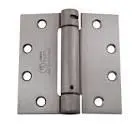
It is a jointed or flexible device on which a door, lid, or other swinging part turns a flexible ligamentous joint. Hinges are mechanical bearings that are used to connect two swinging objects or points to one another and give them the freedom to move relative to each other. Hinges have limited movement, allowing the joint to move only at one angle and restrict the other movements of swinging parts.
Striker

Door strikers are hooks or bolts that latch up the doors on a vehicle. The striker is designed to create a tight fit between the door and the seal on the cab. The striker plate is made of hardened metal that prevents wear when the door is open and shut many times each day.
Latch Trajectory
The striker is placed 90 degree such that it is tangent to the circle.
Mastic Data
Mastic is used for stomach and intestinal ulcers, breathing problems, muscle aches, and bacterial and fungal infections. It is also used to improve blood circulation. Some people apply mastic directly to the skin for cuts and as an insect repellent. In dentistry, mastic resin is used as a material for fillings.
Emboss Definitions
It is to raise the surface of into bosses. Especially to ornament with raised work,to raise in relief from a surface and adorn, embellish.
Manufacturing process like Deep-Drawing and Hemming
The term deep drawing refers specifically to the depth of the item that is created, which is equal to or greater than its diameter. The deep drawing process involves a single metal blank and forming it into a 3D round, square, or rectangular shape called a case or enclosure. Hemming and seaming are two similar metalworking processes in which a sheet metal edge is rolled over onto itself. Hemming is the process in which the edge is rolled flush to itself, while a seam joins the edges of two materials. Design Parameters . means the operation, performance, duty-rate and redundancy of the “equipment” as initially designed and installed or as improved during the term of the Agreement. The four project parameters: time, cost, quantity and quality
Time
Your project deadline is bound to be one of your most important parameters. What is the finish time and why? There may well be a relationship between the budget and the deadline, in that you may have to work within a particular financial year or account to a funder for money spent over a particular period. As well as your final deadline, there are certain to be a number of critical time points that need to be taken into account. We go into these in more detail in our project management course but it is important to be clear, right from the start, that in order to achieve the final deadline, several other ‘mini-deadlines’ will have to be met.
Cost
You may have to draw up the project budget, or it may have been set by others. You will certainly be responsible for ensuring that the budget is not overspent and that income (if appropriate) is raised according to plan. You may need to ensure that the phasing of income and expenditure is achieved successfully so that you have enough money for the project’s needs in plenty of time. How much leeway do you have, as Project Manager, in moving the project spend from one cost heading to another? If you are overcommitted on your print budget but have some left over in the training cost centre, can you rob Peter to pay Paul?
It is important to be clear:
- How much income you must raise to fund the project, if any?
- How much you can spend and on what?
- How much income the project is intended to generate?
- Must you raise the income before you start to spend or not?
- How much discretion do you have about changing the details of the budget – for example, moving money from ‘post’ to ‘stationery’ if that’s what you think is needed?
In large organisations, especially in the public sector, it is common for Project Managers to be very vague about the budget for their project. "Finance deals with all of that" is a phrase we often hear at the Centre. However, it is unlikely that financial considerations will not affect your project at all and it is wise, as well as good practice, to get as clear a picture as you can of all the income and expenditure constraints involved with your project.
Quantity
Some projects have no quantity parameters at all; others are very focused on quantity. For example, if the project aim is to design a leaflet informing people about services, then the quantity of leaflets produced is not one of the most important parameters. You need to produce enough for your needs, but the main factors to be monitored will be the quality of the information given, its appropriateness to the audience, the cost involved and the print deadline if any. However, in the example of employment training for young people, quantity is a key factor. Funders and other stakeholders will have set clear standards for the number of young people receiving the training and the numbers successfully placed in work.
Quality
Finally, you need to be aware of the quality parameters involved in the project. Quality standards may be imposed from outside, as in the case of residential care, or they may need to be devised internally and fleshed out in the planning stage of the project. In doing this, you need to be able to answer the question "Is this good enough?" Quality factors apply to inputs (the raw materials for the project), to outputs (what the project produces), to outcomes (the results of the project), and to processes (the means used to achieve the outputs). So in the example of the employment training project, there will be quality factors in the training materials (the inputs), in the delivery of the training (the process), in the number of young people successfully ‘passing’ the training (the outputs), and in the kind of work the young people achieve at the end of the project (the outcomes). The four different project parameters are sometimes shown as four perfectly balanced forces. Unfortunately, such a situation never exists. There will always be one or two parameters that matter more than the others. In brain surgery, for example, quality of process and outcomes matters far more than cost and deadline. It is very important to establish with your line manager and other stakeholders what the most important parameters are. For instance, in the production of an annual report, one organisation will want a full colour glossy report to support its fundraising and publicity. Quality will be a key feature, quantity will be important and budget will be less important if there is a good end result. Another, perhaps smaller, organisation will be happy with a few photocopied stapled sheets in black and white that meet the statutory requirements and that don’t give stakeholders the impression of money ‘wasted’ on inessentials.