Function Plotting and Suspension System Comparison
Objective
The objective on this project is
- Plotting the function y(x) = (x-1) * (x-3)^2 * (x-9)^2 using Simulink blocks,
- Running the example “Suspension System Comparison” on Simulink, assess the models and their results respectively
1. Function Plotting:
y(x) = (x-1) * (x-3)^2 * (x-9)^2
The block diagram of the function is given below
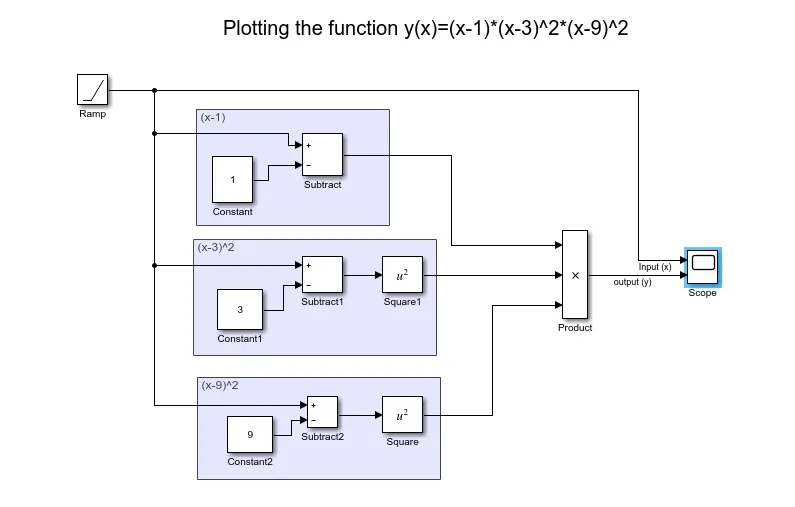
The blocks used for plotting the function includes:
1. Ramp Input
2. Constant
3. Substract
4. Square
5. Product
6. Scope
The ramp input parameters proided were slope=1, start time= 0, initial input=0. The Stop time provided was 10 sec.
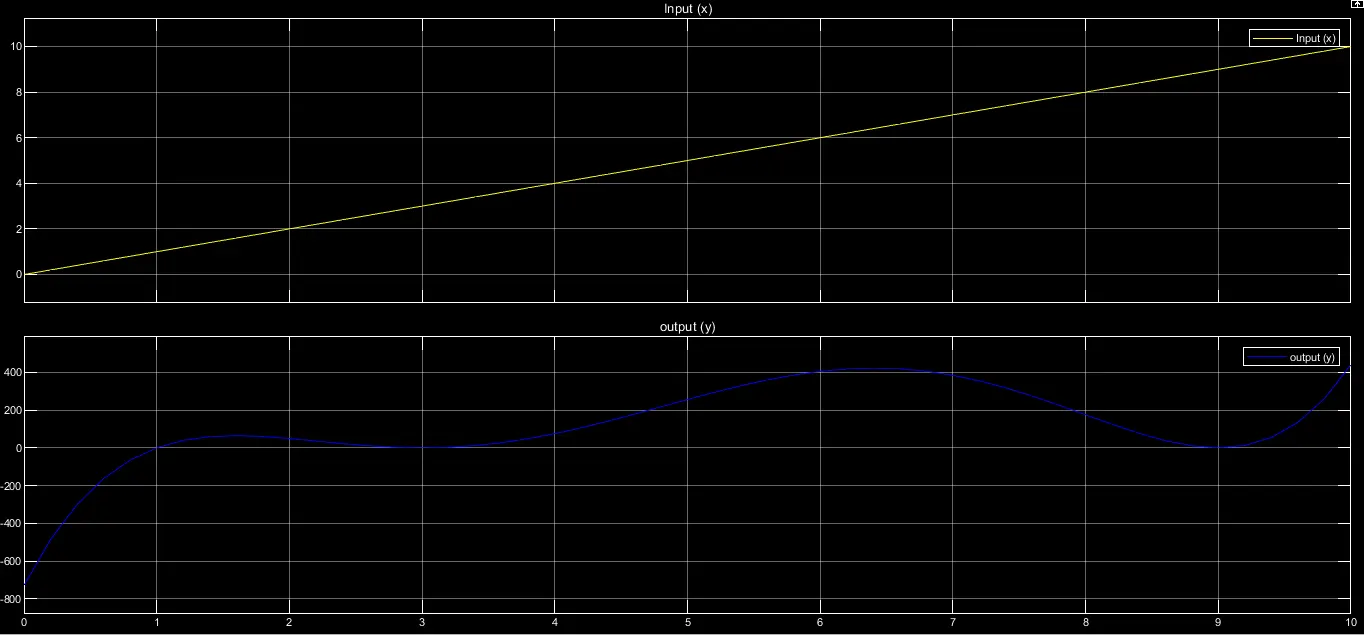
Two connection to the scope were made so as to display the input and output on the same scope in the layout as shown below
Output:
2. Suspension System Comparison
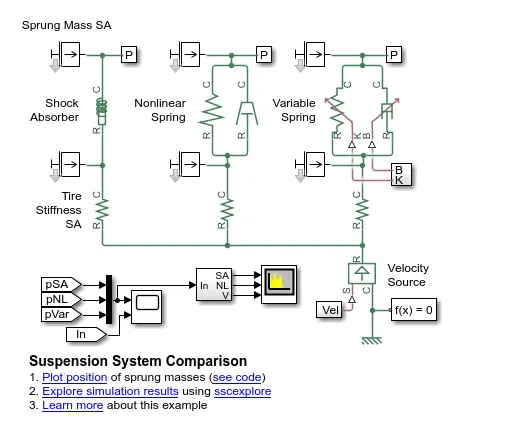
Objective: The objective of this simulation is to compare the results of three different sets of suspension configuration based on spring and damper which are excited by similar oscillating velocity source.
- The first setup of shock absorber block including linear stiffness and damping
- The second setup of shock absorber uses nonlinear translational spring and nonlinear translational damper which is specified with symmetric polynomials
- the third setup uses a variable translational spring and a variable translational damper, i.e., the spring constant is varied during the simulation and the damping coefficient adjusts to achieve critical damping
Optional friction and hard stops were not used in the testbed
Similarities:
- The oscillating velocity source is similar in all the three setups
- The values of sprung mass (350kg) and unsprung mass (50kg) is same
- Tire stiffness is same (spring rate=2e5) across all three setups
Differences:
- The spring and damping parameters are different in each case i.e., in the first case translational shock absorber is used, in the second case nonlinear translational spring and nonlinear translational damper & in the third case variable translational spring and a variable translational damper
The model of the suspension system is given below
How Ocillating Velocity Source is Created:
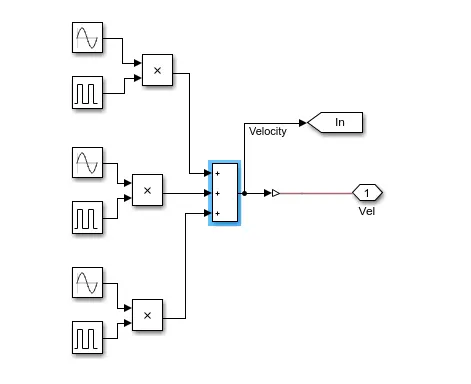
The oscillating velocity source is created using the sin wave and pulse generator blocks. The output of these blocks are multiplied to generate the velocity signal. For the testing, the suspension systems were to be subjected to oscillating velocity of different frequecies, so a two additional set of sin wave and pulse generator blocks were added to the subsystem and added using an addition block to obtain the required velocity input. The frequencies of the sin wave blocks provided were 3rad/sec, 15 rad/sec and 75 rad/sec respectively, and the time period for each oscillation were given as 20 sec, with a time delay of 20sec between each oscllation to generate the input velocity signal as shown in fig 1.
Velocity Source Subsystem Model
Output:
Fig 1: Sprung Mass Position & Input Velocity
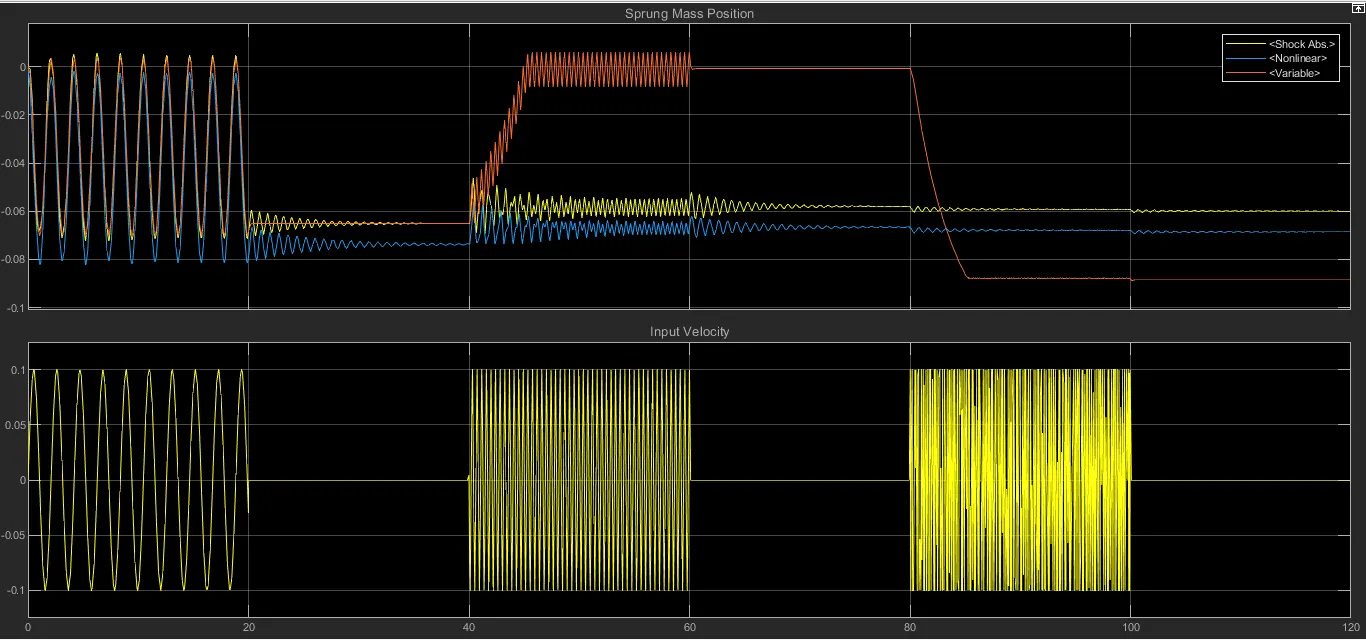
The plot above shows the position of the sprung masses in the individual suspension setups that are subjected the same test.
Observation: when the source generates oscillating velocity of frequency 3 rad/sec during 0-20sec, all position of the sprung mass is almost similar in all the three cases. During the second pulse from 40-60sec when the frenquency was 15 rad/sec, the third setup's oscillation of the sprung mass was minimal where as shock absorber and non linear spring-damper setup experienced high vibrations. In the third pulse from time 80-100 sec, the oscillating frequency of 75 rad/sec was provided to all the three setups;the variable translational spring damper setup adjusted the sprung mass position at around -0.9m with minimal vibration, where as the linear spring damper and shock absorber setup adjusted to sprung mass to around -0.6m and -0.7m respectively, but there were comparatively more viration in these two systems as compared to variable translational spring damper system
Fig 2: Power Spectral Density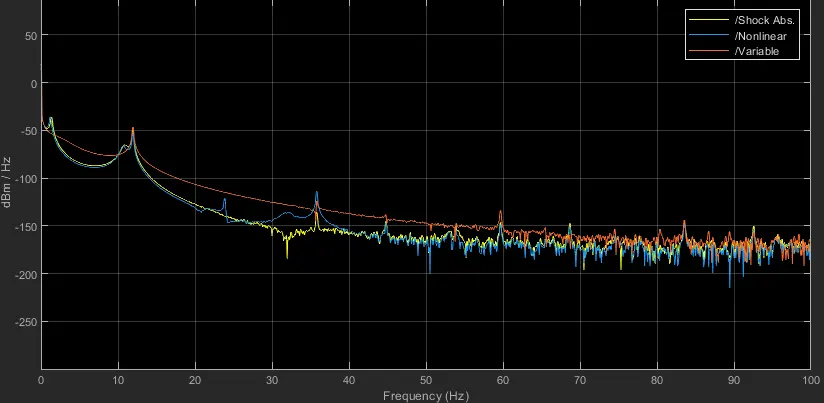
The plot above shows the power spectral density in the three different suspension setups