Flow over a cylinder
AIM :
To simulate the transient state flow over a cylinder.
OBJECTIVES:
- Calculate the Reynolds number for the baseline simulation and Run the baseline simulation.
- Conduct transient flow simulation for an increasing Reynolds number by a factor of 20%, 40%, and 100% of the baseline Reynolds number.
- Create animation for pressure – velocity for all the three condition of Reynolds number.
INTRODUCTION :
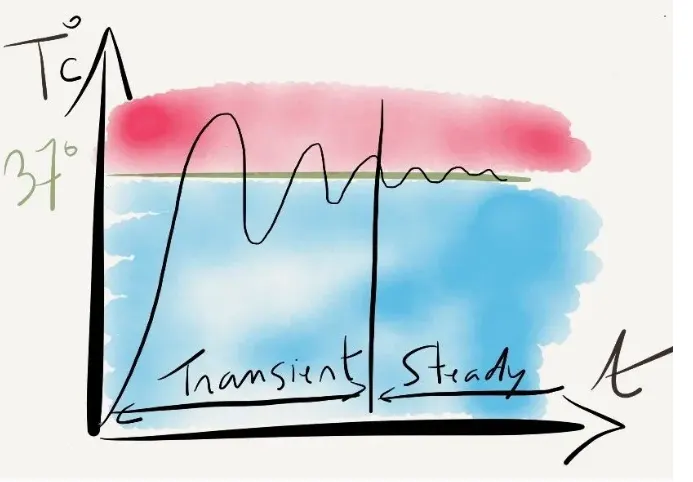
In general, nearly every process or system has both a steady state and a transient state. Also, a steady state establishes after a specific time in your system. However, a transient state is essentially the time between the beginning of the event and the steady state.
PROCEDURE :
- Geometry Modelling of the cylinder -
Prepare the cylinder for simulation of following dimensions
Cylinder diameter = 0.04 m
Cylinder length = 0.05 m
- Flow Simulation Setup -
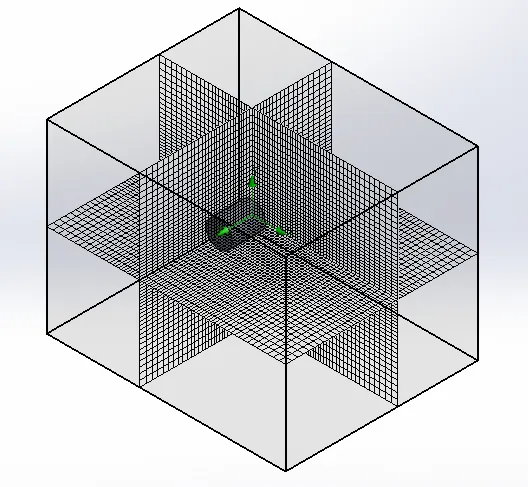
The characteristics of fluid flowing inside the pipe is given below,
Fluid: Air
Dynamic Viscosity: 0.00001825 N.S/m2
Density: 1.225 kg/m
Type of Flow : Laminar and Turbulant,
Wall Conditions : Adiabatic with 0 micro-meter roughness,
- Calculation-
Formula for Reynolds number: Re = rho*V*D/mu
Where,
Re = Reynolds number
V = Flow velocity
D = Diameter
rho = density
mu = dynamic viscosity
Assumption:
Surface of cylinder is smooth and roughness is considered zero.
Effect of temperature are not considered in study.
Re = (1.225 ×10 ×0.04)/0.00001825
Case 1 : Re = 26849.3
Similarly, Reynolds number at 20, 40 and 100% we get the following results as
Case 2 : At 120% = Re = 32414.55
Case 3 : At 140% = Re = 37817
Case 4 : At 200% = Re = 54024.26
- Result :
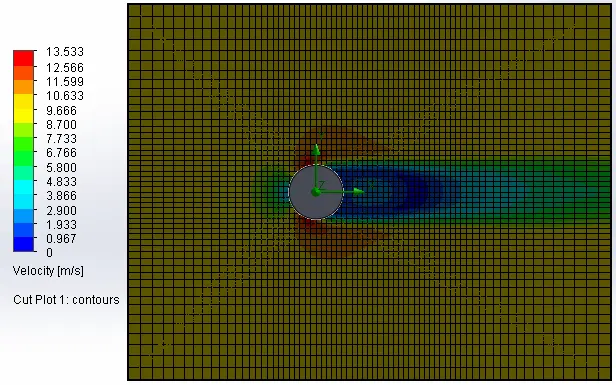
Case 1 : Velocity distribution over cylinder for velocity 10m/s -
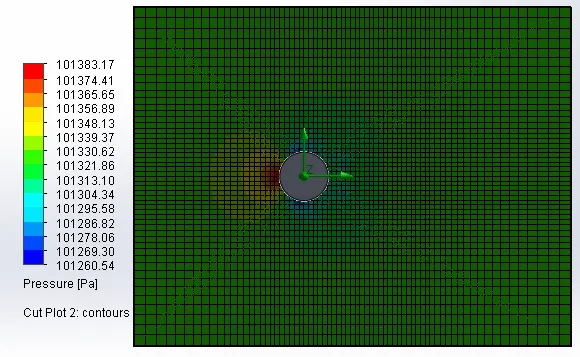
Pressure distribution over cylinder for velocity 10m/s -
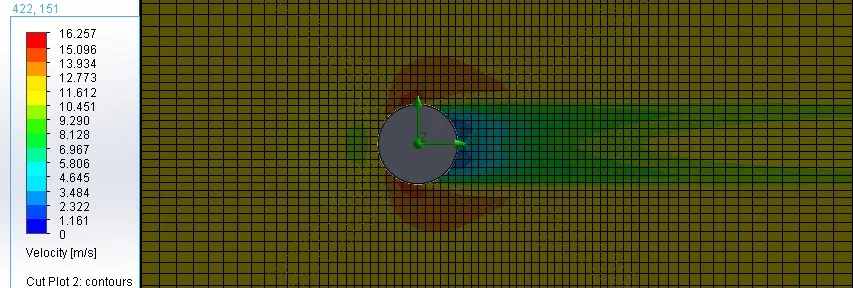
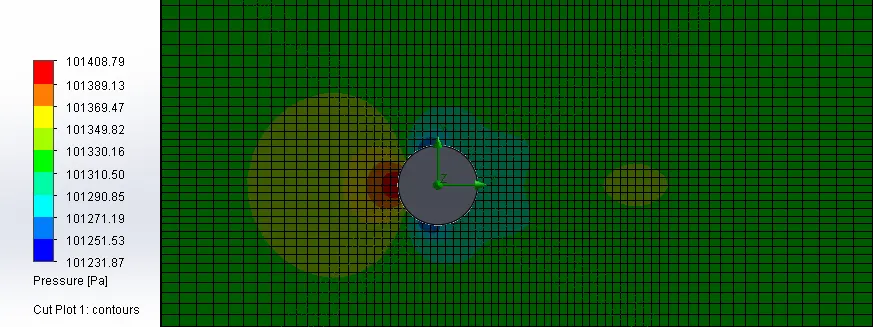
Case 2 : For Re = 120% of 26849.3 =32219.1
Velocity distribution over cylinder for velocity 12m/s -
Pressure distribution over cylinder for velocity 12m/s -
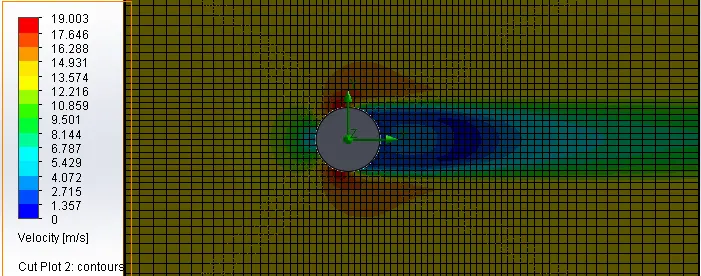
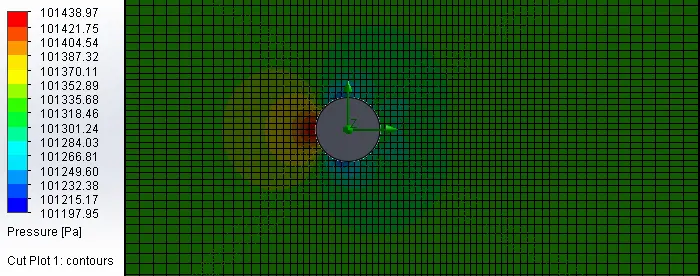
Case 3 : For Re = 140% of 26849.3 =37589.02
Velocity distribution over cylinder for velocity 14m/s -
Pressure distribution over cylinder for velocity 14m/s -
Case 4 :For Re = 200% of 26849.3 =53698.6
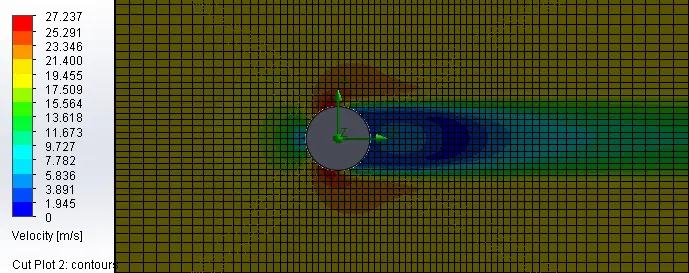
Velocity distribution over cylinder for velocity 20m/s -
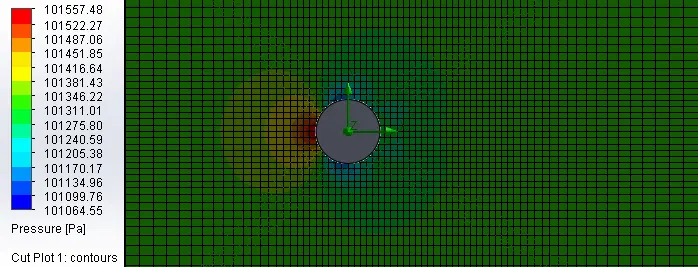
Pressure distribution over cylinder for velocity 20 m/s -
Conclusion :
- It is intelligible that increasing Re no increases the velocity of fluid.
- It is observed that the high pressure is created on the surface facing the inlet velocity.
- As velocity strikes the front face of cylinder, there is slight drop in the velocity and gradually increases over the cylinder.
- Vortex Formation takes place at the side of the cylinder which is opposite to velocity flow.
- Thiers no much of pressure change as compared to velocity change by Re no.
Animation videos:
https://drive.google.com/drive/folders/1VTdo9DeRZ_Q_jr1tts5vMsbJ_loP_nAR?usp=sharing