Flow over a cylinder
PROJECT TITLE:
- To simulate flow over a cylinder
- To run a baseline simulation and then to calculate the Reynolds number which then is increased by a factor of 20%, 40%, and 100%
- To create animations for pressure-velocity for all the three Reynolds numbers.
THEORY AND INTRODCTION
Reynold's number is an important dimensionless quantity in fluid mechanics used to help predict flow patterns in different fluid flow situations. At low Reynolds numbers, flows tend to be dominated by laminar (sheet-like) flow, while at high Reynolds numbers turbulence results from differences in the fluid's speed and direction, which may sometimes intersect or even move counter to the overall direction of the flow (eddy currents). These eddy currents begin to churn the flow, using up energy in the process, which for liquids increases the chances of cavitation. The Reynolds number has wide applications, ranging from liquid flow in a pipe to the passage of air over an aircraft wing. It is used to predict the transition from laminar to turbulent flow
A vortex street around a cylinder. This can occur around cylinders and spheres, for any fluid, cylinder size and fluid speed, provided that it has a Reynolds number between roughly 40 and 1000.
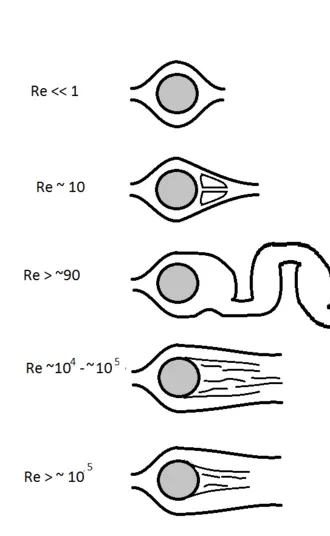 CHART 1
Qualitative behaviors of fluid flow over a cylinder depends to a large extent on Reynolds number; similar flow patterns often appear when the shape and Reynolds number is matched, although other parameters like surface roughness have a big effect.
REYNOLDS NUMBER is defined as

where:
- ρ is the density of the fluid (SI units: kg/m3)
- u is the flow speed (m/s)
- D is the diameter of the tube (m)
- μ is the dynamic viscosity of the fluid (Pa·s or N·s/m2 or kg/(m·s))
- ν is the kinematic viscosity of the fluid (m2/s).
initial setup :
CALCULATIONS:
VELOCITY 1: 10m/sec reynolds number : 27071
velocity profile
animation video :
https://drive.google.com/file/d/1zbkVpvTmpK_7WSxEGRRdubyi_rri-jDd/view?usp=sharing
case 2 : velocity 20m/sec reynolds number 32486(20 percent change in reynolds number )
animation video :
https://drive.google.com/file/d/1MEg75lAVQDMeAaHP76L-ku9MJqe91RMo/view?usp=sharing
case 3 velocity 40m/sec reynolds number :37900
animation video :
https://drive.google.com/file/d/10HhpHnHwWBxJl1ZfDLcI4X73HbM8at1L/view?usp=sharing
case 4 velocity 100m/sec reynolds number :54140
animation video :https://drive.google.com/file/d/14z8k4ItJ1a8iPFBiDzsRrM8NP7mc9xxN/view?usp=sharing
pressure region present aront the cylinder
at 10 m/sec
pressure contour at 100m/sec
CONCLUSION AND OBSERVATIONS
- From the above plots, we observe that when airstrikes the cylinder due to very high reynolds number it follows a situation as shown in figure 4 of chart 1 that can be seen from the pattern formed
- as the reynolds number is increased the velocity is also increased linearly
- maximum pressure region can be observed at the front of the cylinder and as the velocity increases the pressure value also increases
- a low pressure region can be observed behind the cylinder which cause the drag and vortices formation at low speeds at high spped there is just no time for vortices to form.