Final Project: Design of an Electric Vehicle
Introduction to HEV Using Matlab & Simulink
Final Project: Design of an Electric Vehicle
Aim:
To create a MATLAB model for the electric car which uses a battery and a DC motor. Build using suitable blocks from the powertrain blockset.
Need For A Mathematical Model & Simulation:
- Mathematical models are most suitable for initial experiments.
- Getting ideas before the actual design is accomplished.
- Challenges and limitations of a concept or design are better realized in simulation.
- Mathematical model helps in estimating the performance and driving range of a vehicle.
Theory:
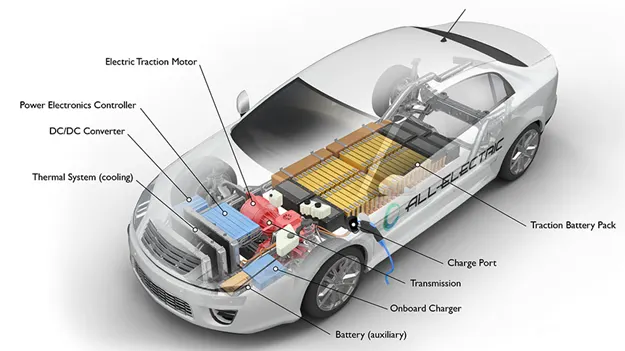
An electric vehicle is nothing but a vehicle that uses one or more motors using energy stored in rechargeable battery packs. These are eco friendly and has higher efficiency compared to ICE cars. An EV can offer 69-72% efficient when counted against required energy to recharge. They use electric motors for propulsion. The most common types of motors used are PMSM and three phase induction motor.
Block Diagram Of EV Model:
Drive Cycle:
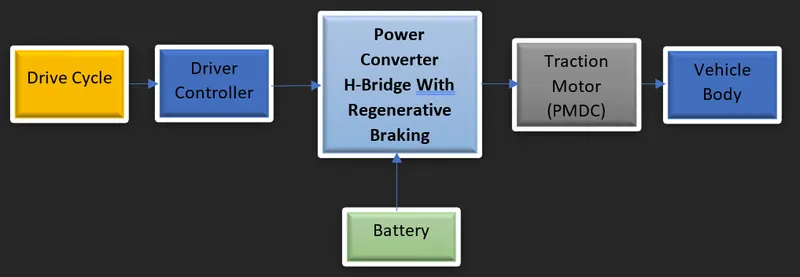
Drive cycle source has been used for providing drive cycle data, drive cycle source is a block from powertrain blockset provides different drive cycle data having time and velocity arrays.
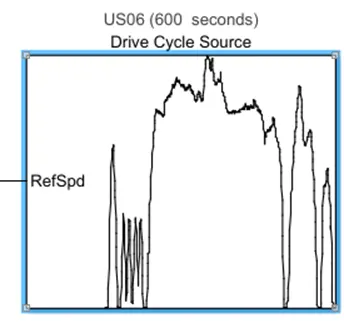
These drive cycle data are the real time examples of vehicle driving data for a particular time, these drive cycles are considered for analyzing performance parameters of vehicle model under simulation
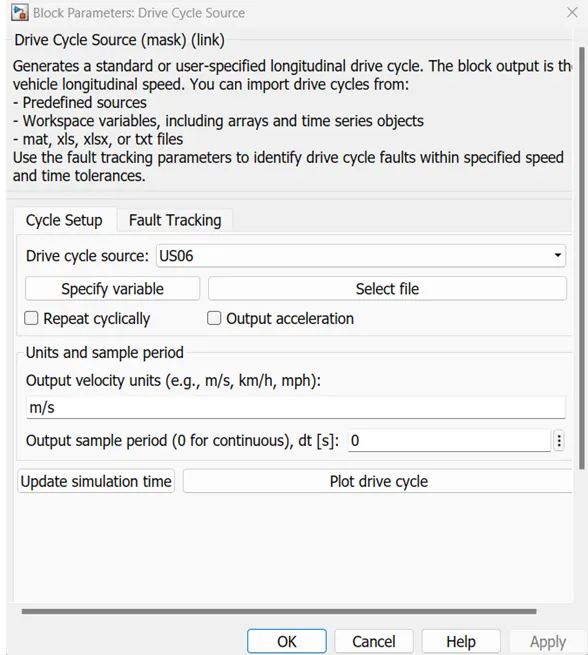
Drive cycles can be selected from the drop down menu named in different codes or a custom drive cycle data can also be added by a excel sheet.
Driver Controller:
Longitudinal driver block is a parametric speed tracking controller for generating acceleration and braking commands using reference and feedback velocities received from drive cycle source and vehicle velocity as feedback.
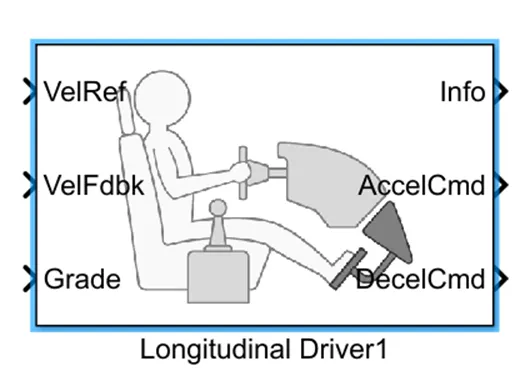
The controller may be a PI type or scheduled PI or predictive type, the gradeability can also be applied as input to the driver controller.
Power Converter:
Power converter consists of H-bridge and a PWM controller, which is fed from a DC supply. The controller signal provides PWM signals to the gate circuit of the power converter, these signals are depended on the drivers acceleration command received.
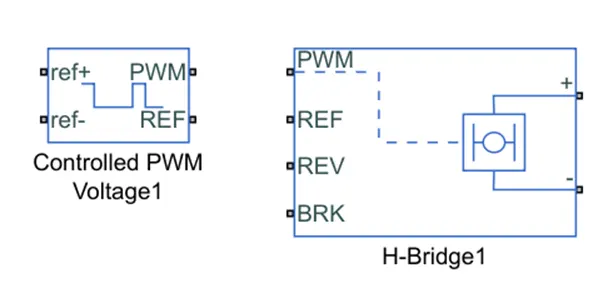
H_bridge is the motor drive which is driven by controlled PWM source, the behaviour is depended on the PWM mode which is either PWM or Average mode.
Motor:
DC motor is used as energy converter, DC motor block from the powertrain blockset suits for this project, this block represents the electrical torque characteristics of DC motor.
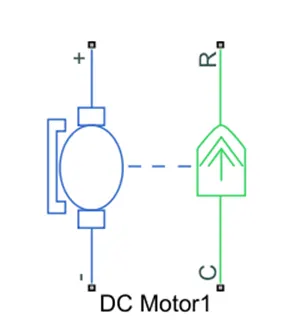
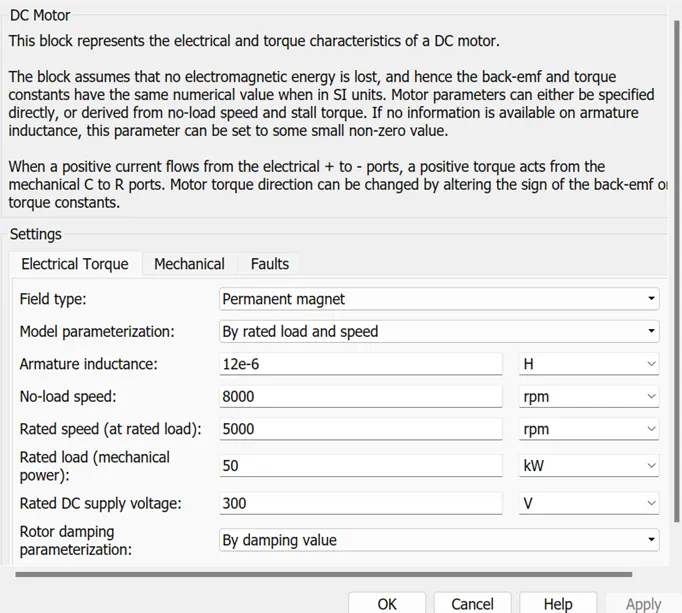
This block parameterization is done by speed and torque characteristics of the dc motor, different electrical, mechanical and fault conditions can be altered as user requirement.
Vehicle Body:
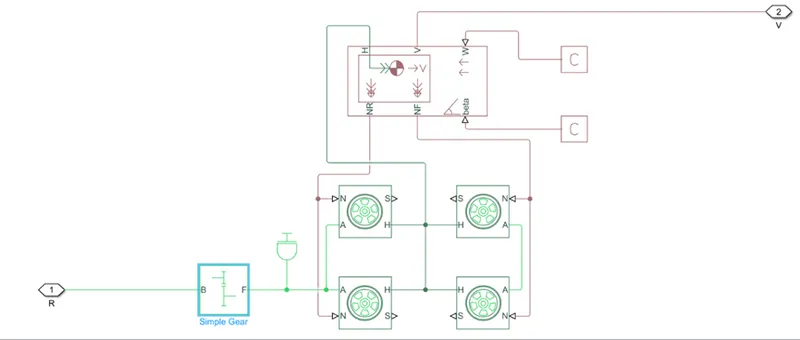
Vehicle body block along with tyres and gear system are build using the blocks shown above, the connections between vehicle body and tyres are made as per the instructions, the torque input is given to the gear system and then applied at the rear wheels of the system, the vehicle speed is observed from the V port of the vehicle body.
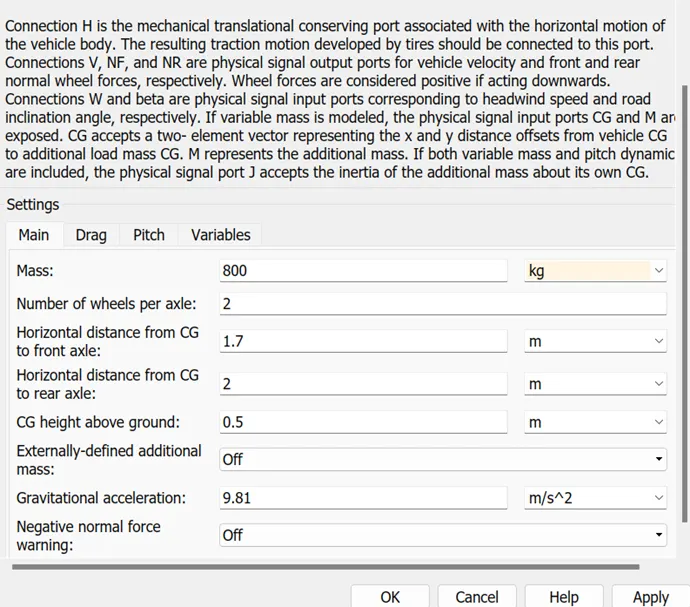
Vehicle body parameters are considered as shown above.
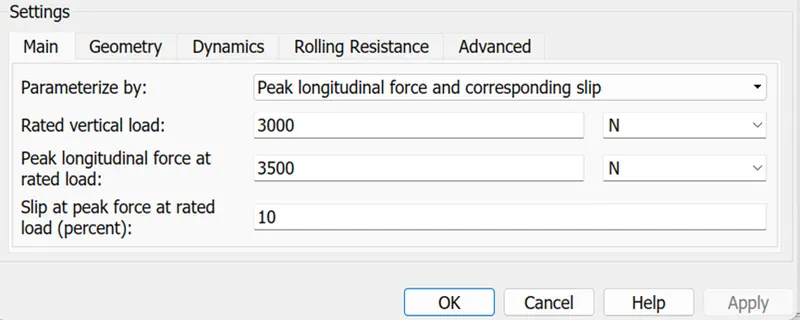
Tire magic formula block is parameterized with load and longitudinal force at rated load and slip, all other settings are made with assumptions.
Battery:
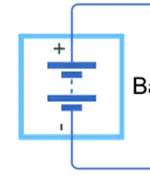
A generic battery or a normal battery from electrical energy sources makes the work done for the modelling of EV, the nominal voltage and the capacity of the battery are the important parameters which should match the motor selected and the drive cycle obtained.
A separate SOC subsystem is needed if a normal battery model is used, the SOC is compared with the time and distance covered by vehicle for applied drive cycle.
Controlled Voltage Source:
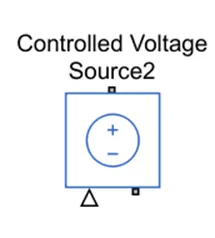
This block represents a ideal voltage source which supplies voltage irrespective of current flowing through it, the output voltage is controlled by a physical signal applied, in this case two physical signals from driver controller (I.e acceleration & braking commands) blocks are controlling the output voltage of the block.
Current sensor:
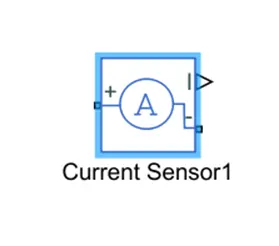
This block converts the measured current any electrical branch into equivalent physical signal, mainly used for current measurement at required branch of network.
MATLAB Model Of Electric Car:
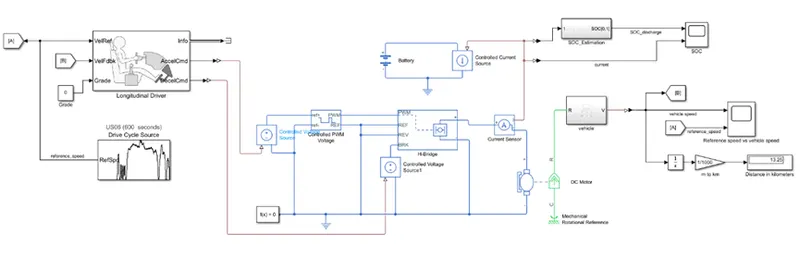
Many parameters were assumed and some environmental inputs are not considered for easy simulation, the power flow starts from battery to motor and then converted power transferred to the wheels of the vehicle control commands are handled by the longitudinal driver block and the power converter and controller supplies the input to the motor as per the driver acceleration and braking commands.
Simulation Results:
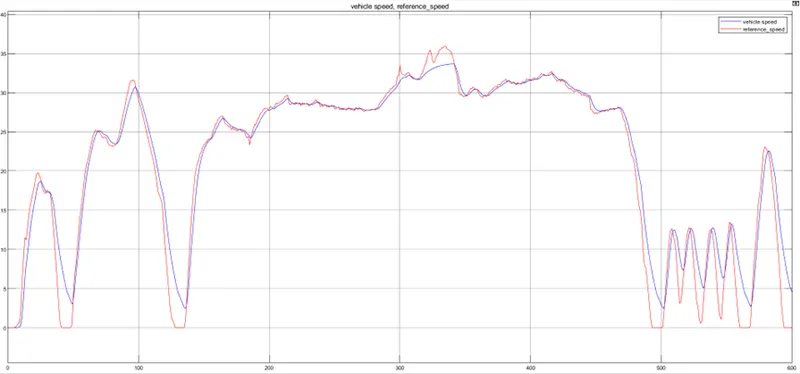
A provision is made in the model to compare the reference speed and vehicle speed. The plot shown is the result for the applied drive cycle US06 which is of total distance 12.8 kms in 600 seconds of time, it can be seen that the vehicle model tried to keep up with the applied drive cycle and gave the expected result, from my analysis during sudden braking the vehicle is not responding as quick as the drive cycle input, hence there is a need for improvement in braking.
Battery SOC & Current:
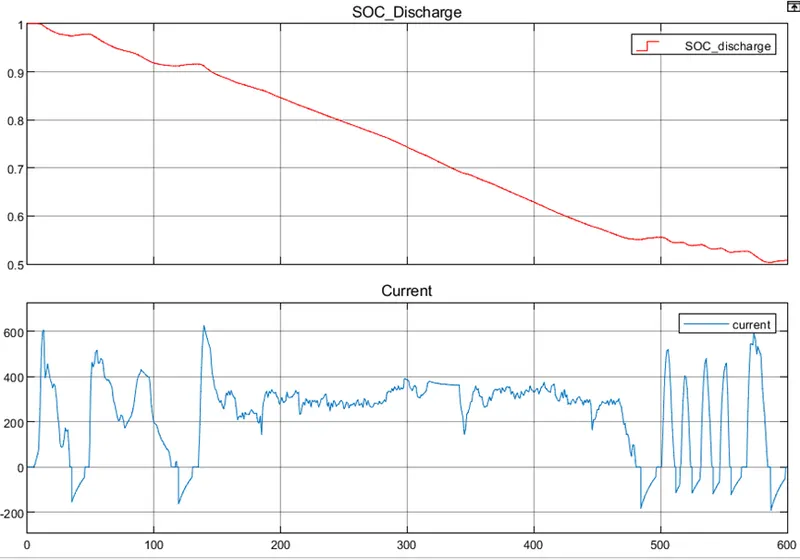
The initial SOC of the battery model is 1, for a run of one US06 cycle which is approximately 13kms there is a drop of 50% charge, and the current drawn from the battery according to the drive cycle inputs are also shown over the simulation period.
Conclusion:
The model developed using limited inputs and assumptions gave the results as expected, to observe the maximum drive range of the vehicle multiple drive cycles needed to be applied, and also more the parameters involved the more the model accuracy will get better and near to reality, the different dynamics of the vehicle are not considered to stick to simple construction. Losses that occur due to environmental conditions and losses in motor and other mechanical systems are not taken into considerations so that the vehicles traces similar velocity as reference velocity from drive cycle data.