Fender Design - Wheel Arch Challenge
AIM: To calculate the wheel arch gap at required points and check whether the car passes through the european standards
INTRODUCTION:
Wheel Arch is the semi-circular part of the fender positioned above the wheel of the vehicle. The design of Wheel arch of a fender should be such that it must shield wheels and protect both passengers' compartment and pedestrians from projection of water, mud and stones. The wheel Arch area of the fender is usually designed as a cover or sheild over the tyre along its perimeter to stop any debris or stones, dirt, sand, snow etc. from getting thrown into the vehicle/ BIW area as well as outside the vehicle and onto other vehicles or pedestrians on the road. For the vehicle to has its use permit in different countries, the wheel arch of fenders must be compliant with the standards and regulations set by the respective countries.
TYPES OF WHEEL ARCH REGULATIONS:
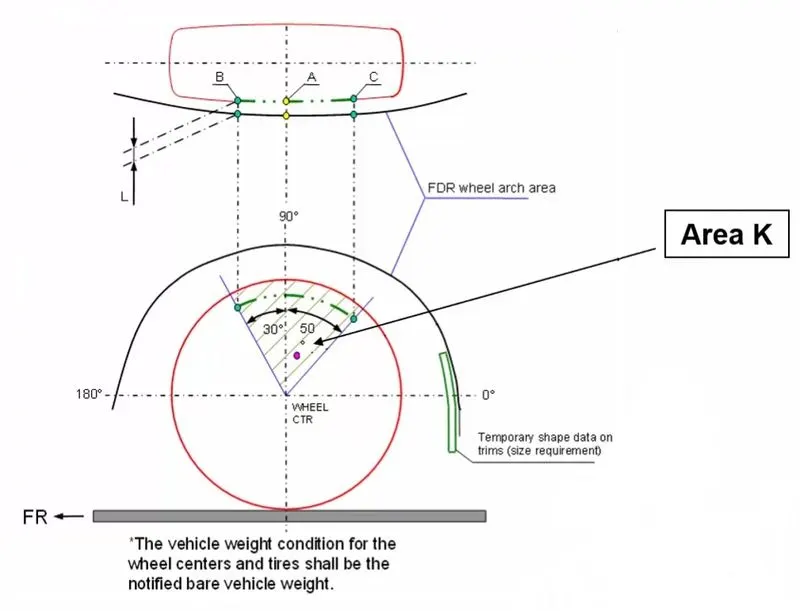
- JAPAN REGULATIONS:
- Measure clearance L of tire ,hub, cap & fender in three different positions within area K and produce clearance check chart to validate.
- Clearance must be greater than 5 mm in all the three positions.
- Wheel guard reqmt: The value of a shall be more than 5 mim at a line 30" forward and 50 rearward from the central vertical axis of axis of wheel.
- EUROPEAN REGULATIONS:
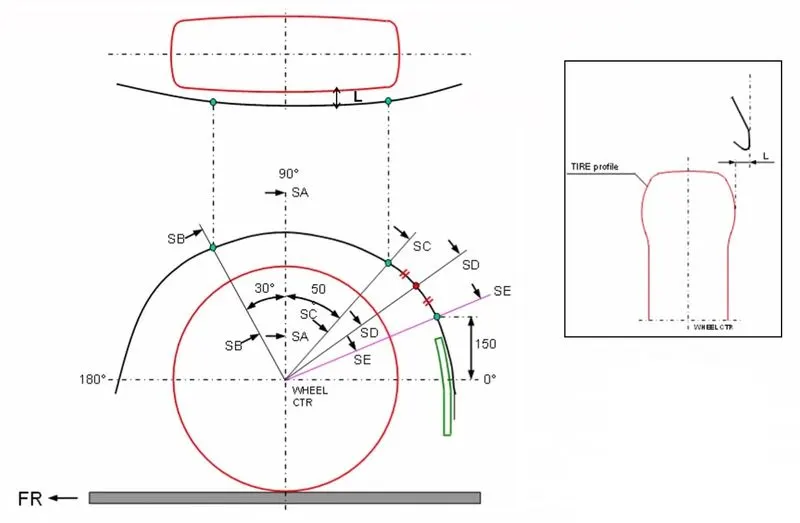
- Measure CL L at sections SA-SA SB-SB SC-SC SD-SD SE-SE and produce CL check chart to validate.
- At all five sections the CL L value should be greater than 10 mm to satisfy the European regulations.
- Wheel guard regmt: The value of 'a shall be more than 5 mm at a line 30* forward and 50* rearward from the central vertical axis of axis of wheel.
- US REGULATIONS:
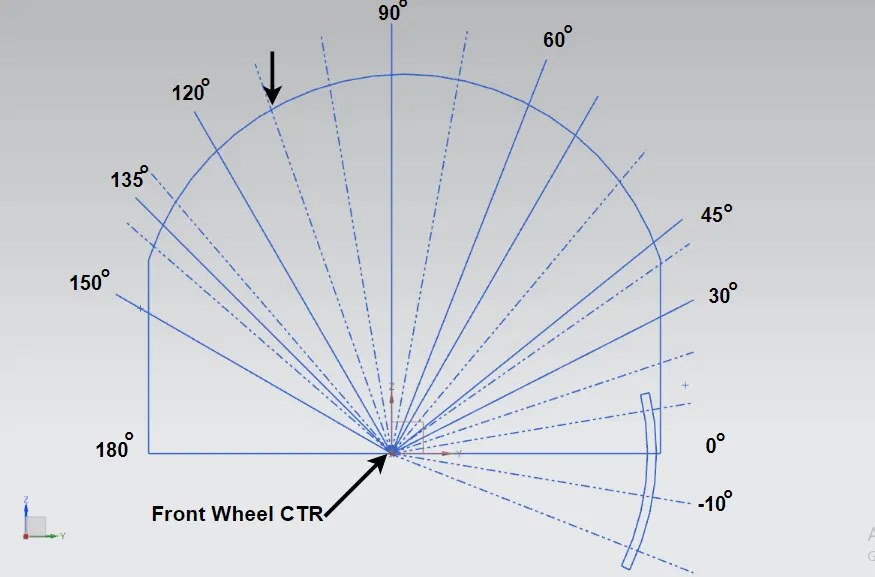
- Make clearance check details on all positions from -100* to 100* & make the clearance check table.
- All values should be greater than 5 mm to satisfy the regulations. The value of 'a' shall be more than 5 mm at a line 30* forward and 50*.
- rearward from the central vertical axis of axis of wheel.
EUROPEAN METHOD:
The European regulation requires a pre determined clearance or a minimum distance of 10mm. to be maintained between the Fender (Front Quarter Panel) and the respective tyre at particular points(5 points/Sections to be exact) along the tyre profile as shown below:
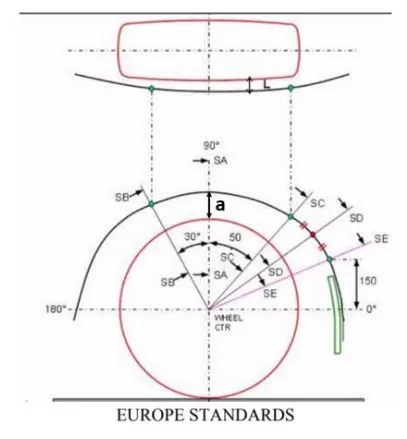
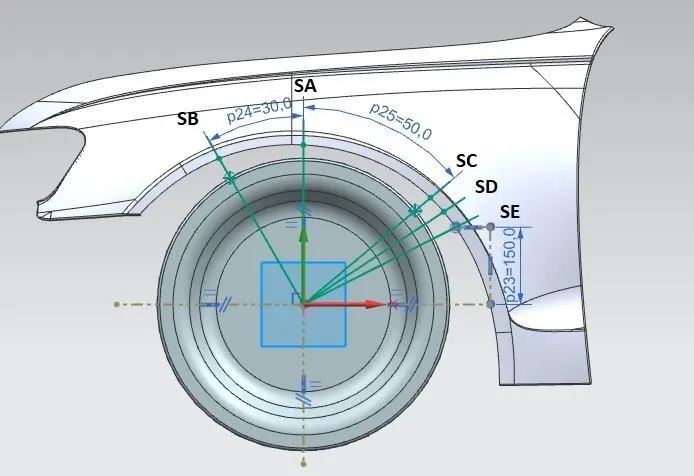
- A horizontal and vertical Axis is drawn from the centre of the wheel.
- The vertical axis intersection point is labelled as SA.
- Similar references are drawn at 30 degree to the left and 50 degree to the right of the section SA and are named SB and SC respectively.
- A line of 150mm is drawn perpendicular to the horizontal axis and the normal from that point on the fender gives us SE.
- The midpoint of the arc cut by the sections SC and SE results in a new section SD.
- The value of 'L' at each section and the value of 'a' are found out to determine whether the fender satisfies the European standards as shown below.
MEASUREMENTS:
- The clearance value 'L' was measured and found to be as follows:
-
Section
Required Clearance (mm)
Measured Clearance ‘L’ (mm)
Remarks
SB
10
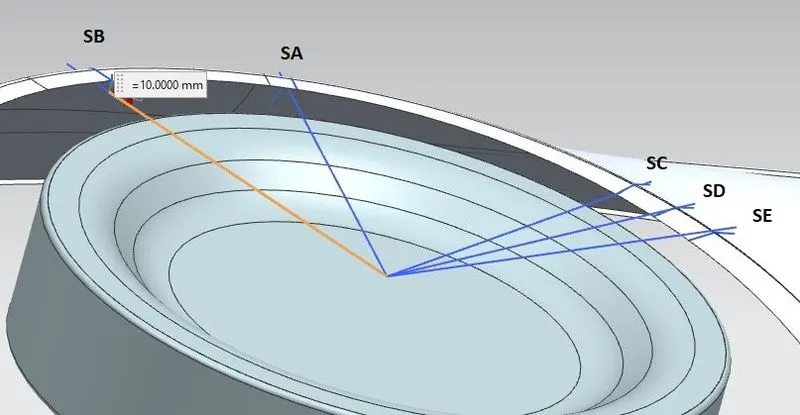
10
Pass
SA
10
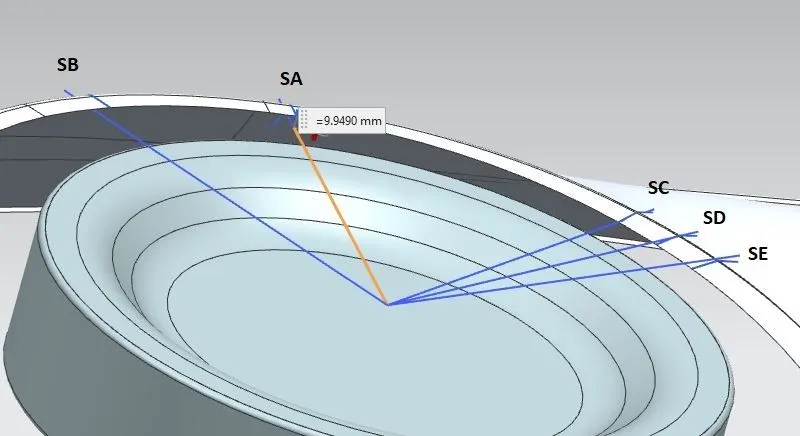
9.95
Fail
SC
10
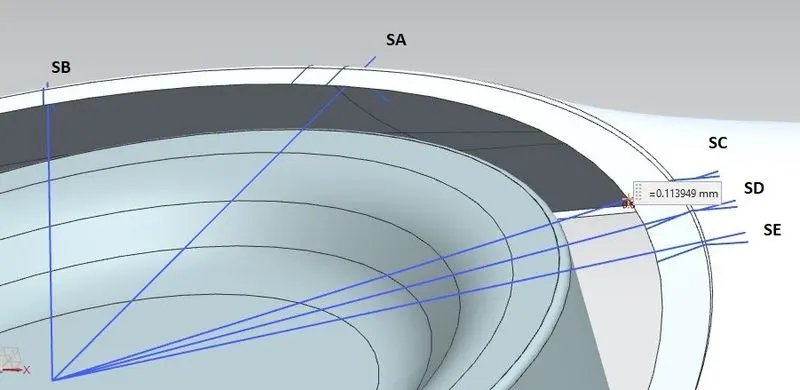
0.12
Fail
SD
10
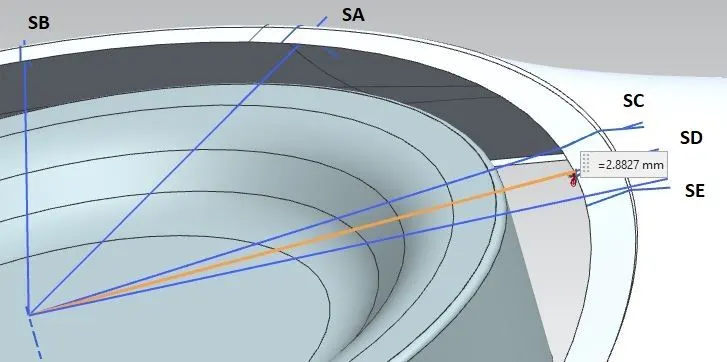
2.88
Fail
SE
10
5.98
Fail
'L' Value at Section SA:
'L' Value at Section SB:
'L' Value at Section SC:
'L' Value at Section SD:
'L' Value at Section SE:
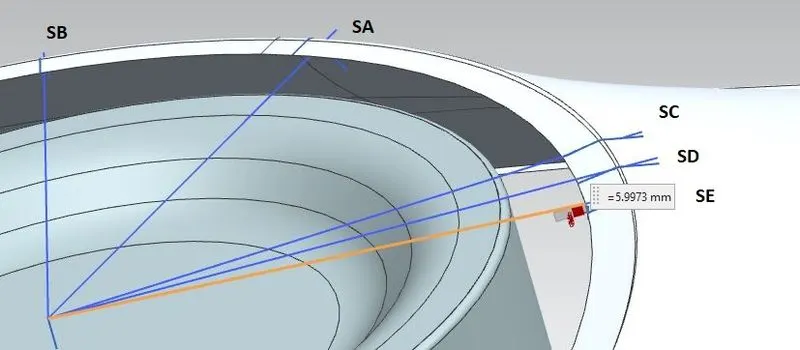
As per the European standards, the value of 'L' should be greater than 10mm. But at Section SB, the value of L is equal to 10mm and at other sections the value of 'L' is less than 10mm. So, it does not satisfy the condition L > 10mm to meet the European standards in any of the sections.
Wheel Guard Requirement:
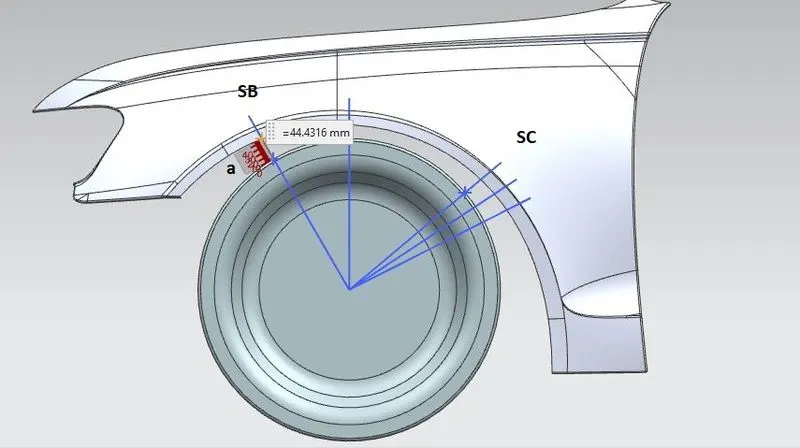
Value of 'a' at SB:
Value of 'a' at SC:
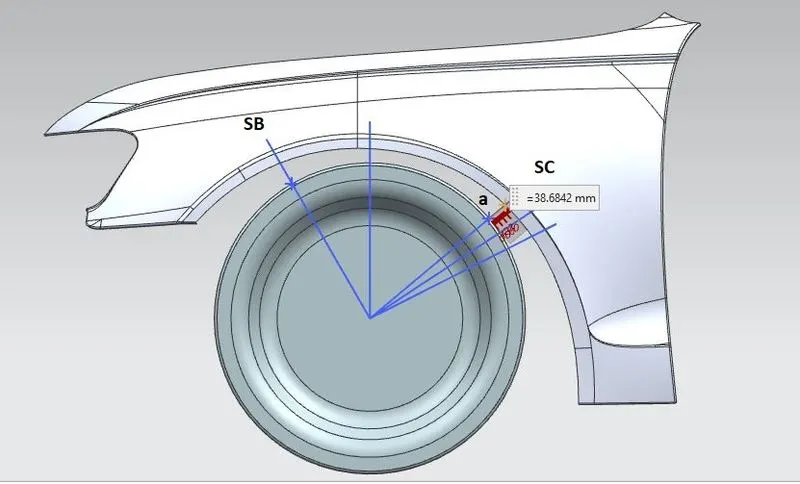
The value of 'a' at the sections SB and SC are greater than 5mm. So, it satisfies the criteria for wheel guard requirement.
CONCLUSION:
From the above results, we can conclude that the given fender does not pass the European standards for wheel arch area.