Fender Design - Wheel Arch Challenge
Fender Design - Wheel Arch Challenge
AIM:-
Calculate the Wheel Arch gap at required points and check whether the car passes the European standard.
Fender
Fender is a part of an automobile, motorcycle or other vehicle body that frames a wheel well (the fender underside). Its primary purpose is to prevent sand, mud, rocks, liquids, and other road spray from being thrown into the air by the rotating tire. Fenders are typically rigid and can be damaged by contact with the road surface.
The main purpose of fenders on cars is that they shield the wheels and they protect the passengers, the pedestrians, and the other vehicles from stones, mud, liquid, and other debris that can fly in the air because of the speeding rotating wheels while the car is running.
Wheel Arch
- It is a curved part of the Fender positioned right above the Wheel.
- The Wheel Arch is designed such that it protects both the pedestrian and car cabin from mud, water rocks and other road spray
- Different countries have different wheel arch regulations in place, and the wheel arch design has to comply with them to be deemed usable in that country.
- For avoiding design alterations of the same vehicle to meet the different regulations in different countries, the maximum values of the concerned regulation parameters are taken into consideration for design purpose.
- MATERIAL USED:-
The most commonly used wheel well are of plastic material. In the olden days, the inner fender or wheel well was made of sheet metal. If the vehicle with metal inner fenders is used there is a good chance that winter salt and moisture have caused them to develop some rust in hard-to-spot areas. Improper repairs after an accident can also accelerate corrosion here as well.
FENDER SAFETY:-
- The fender is a part of the car, it is also used a protect the side of the engine compartment.
- Pedestrian safety is also considered while designing a wheel arch in a fender since the debris in the wheel shouldn't hit them in the motion of the car.
- Fender is also reduced pedestrian injury when there is a pedestrian-vehicle crash and prevents the throwing up of debris nearby vehicles
TYPES OF FENDER:
The type of fender is based upon the area covered
- Full fender type
- Half fender type.
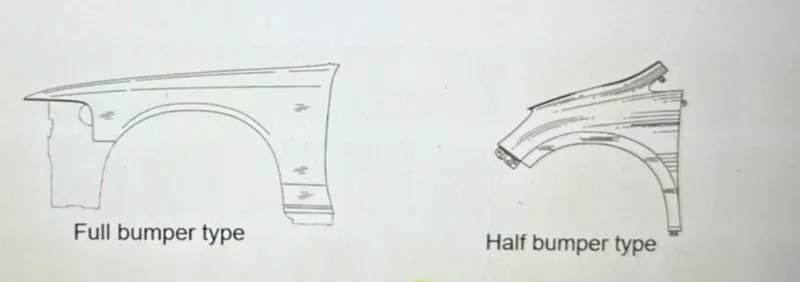
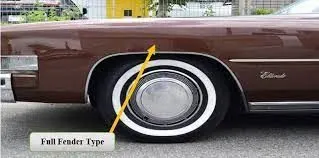
Full fender type
The full fender type is the traditional type of fender where more material consumption is observed. This type is used in the old designs of automobiles where it increases the overall weight and thus reduces performance. The maintenance is also relatively more due to more surface.
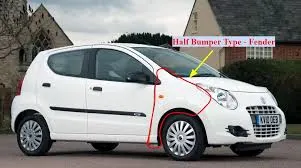
Half fender type
Half fender type is a modern design where less material consumption is observed, so productivity increases by reducing the size of the blank and thus providing more performance. The maintenance is also relatively low compared to the full bumper type.
Fender Wheel Arch Regulations
Japan Regulations
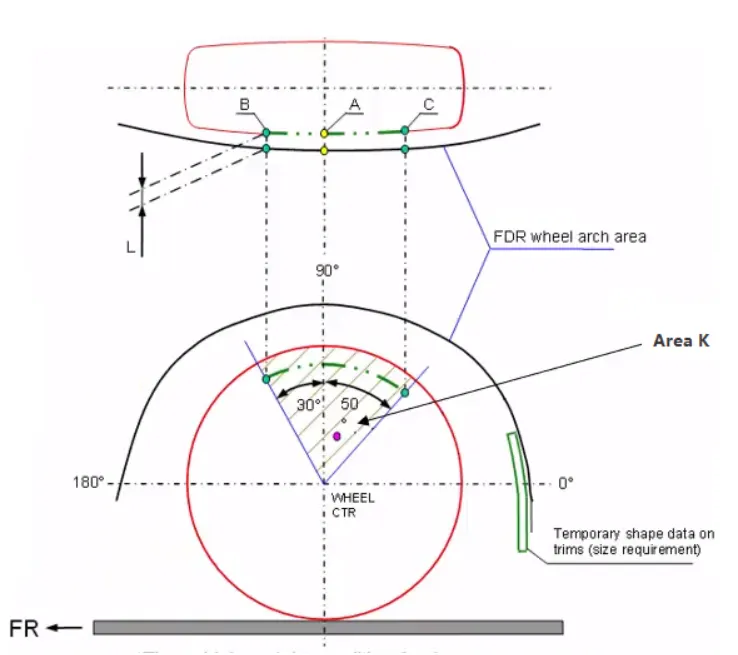
- The clearance ‘L’ for tire, hub, cap and fender is to be measured within area K and create clearance check chart to validate
- The value of L should be greater than 5mm at all positions
- Wheel guard requirement: The value of ‘a’ should be more than 5mm at line 30° forward and 50° rearwards from the central vertical axis of the wheel
European Regulations
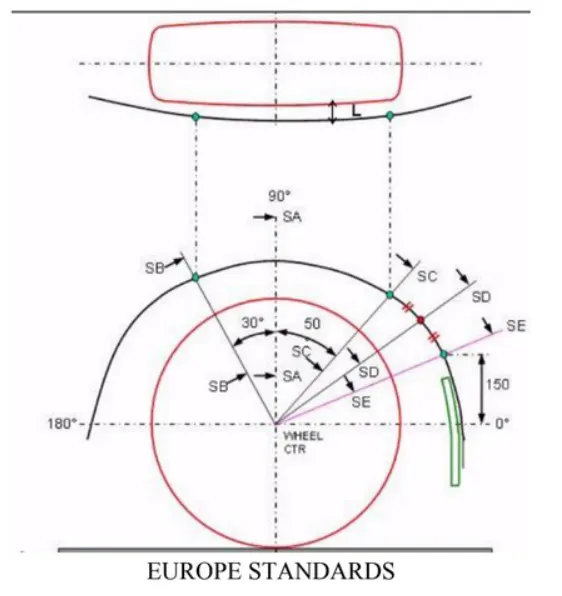
- The Clearance ‘L’ should be measured at sections SA-SA, SB-SB, SC-SC, SD-SD and SE-SE and create clearance check chart to validate
- At all the five sections the value of L should be greater than 10mm to satisfy the European Regulations
- Wheel guard requirement: The value of ‘a’ should be more than 5mm at line 30° forward and 50° rearwards from the central vertical axis of the wheel
US Regulations
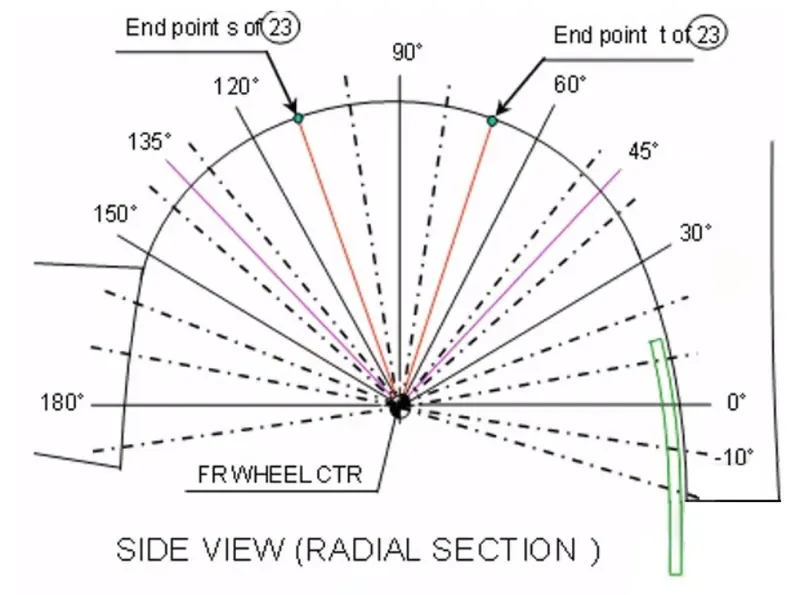
- Clearance ‘L’ is to be checked at all positions from -100° to 100° and create clearance check chart to validate
- The value of L should be greater than 5mm to satisfy the regulations
- Wheel guard requirement: The value of ‘a’ should be more than 5mm at line 30° forward and 50° rearwards from the central vertical axis of the wheel
Calculation of wheel arch area according to European Regulations
For calculation of clearance between Wheel Arch and Wheel we have to create a sketch on the outer most face of the wheel. The procedure of which is given below.
- A Datum Plane is created at the outermost face of the wheel
- The sketch is created on the new Datum Plane
- A Horizontal line is drawn across the centre of the wheel
- A perpendicular line SA is dropped at the centre of the wheel
- Two lines SB and SC are created at 30° forward of SA and 50° rearward of SA respectively
- A point is created 150mm vertically above the centre line
- A line SE is drawn from the wheel centre and passes from the point created
- Another line SD is drawn from the centre of the wheel and in the middle of lines SC and SE
Sketch
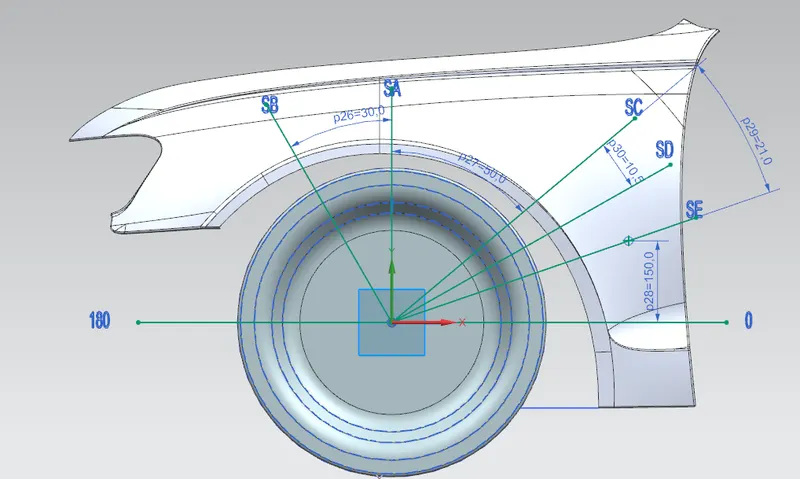
Obtaining the clearance L at the designated 5 points
The clearance distance 'L' is calculated at points SA-SA, SB-SB, SC-SC, SD-SD and SE-SE, which should be greater than or equal to 10mm
i.) Clearance 'L' at SA-SA
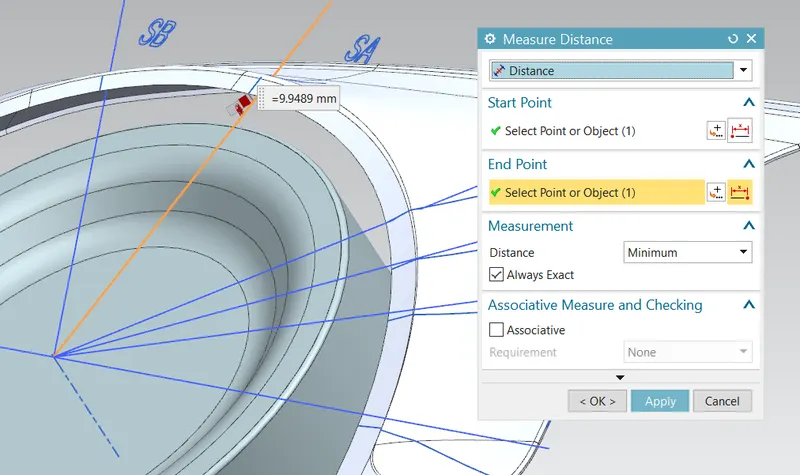
L = 9.95mm
ii.) Clearance 'L' at SB-SB
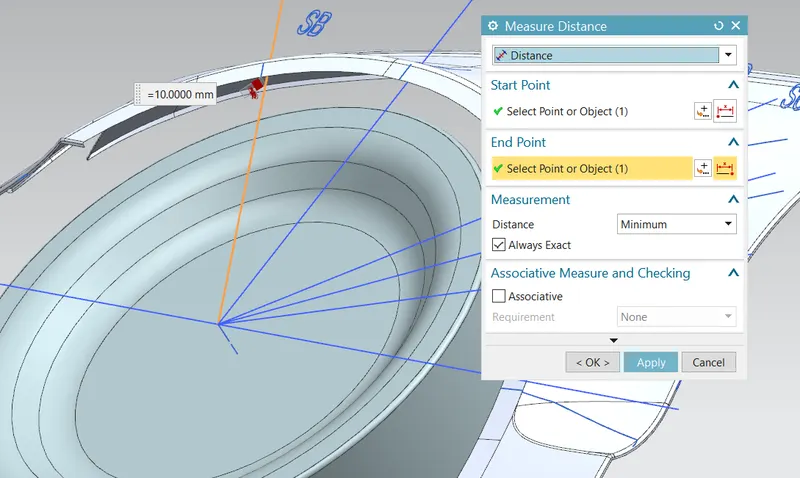
L = 10.00mm
iii.) Clearance 'L' at SC-SC
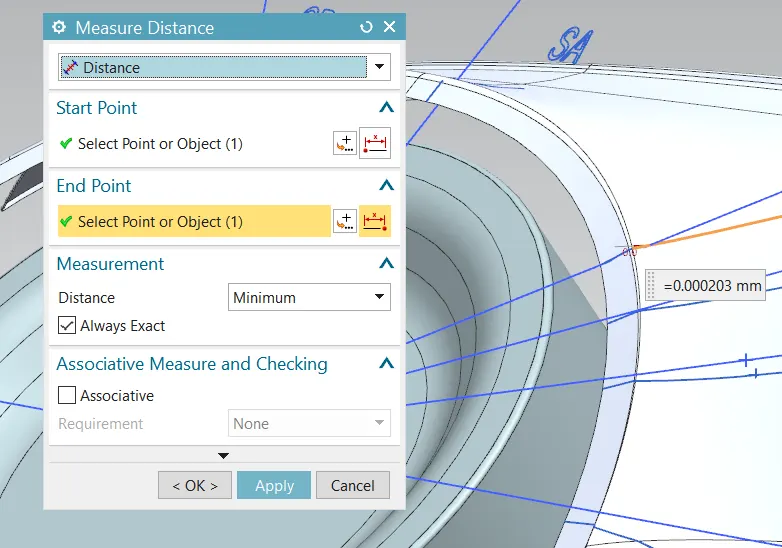
L = 0.00mm
iv.) Clearance 'L' at SD-SD
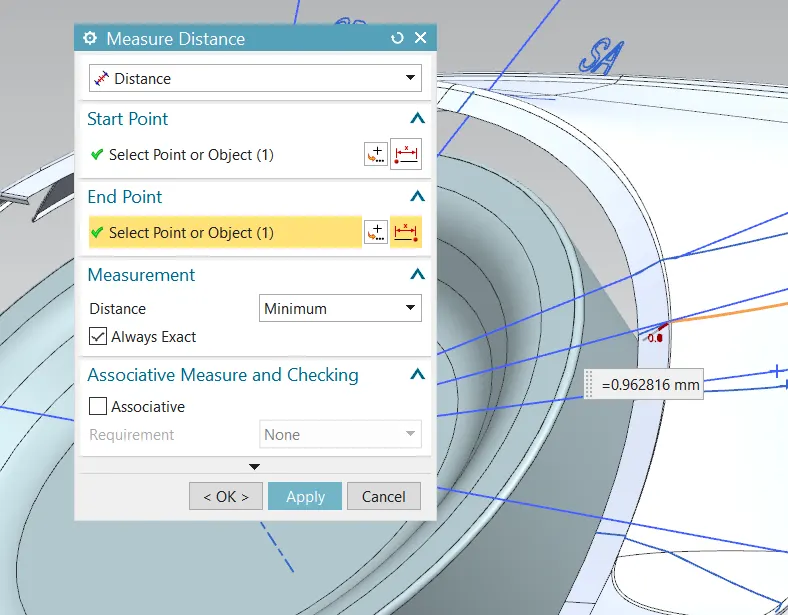
L = -0.96mm
v.) Clearance 'L' at SA-SA
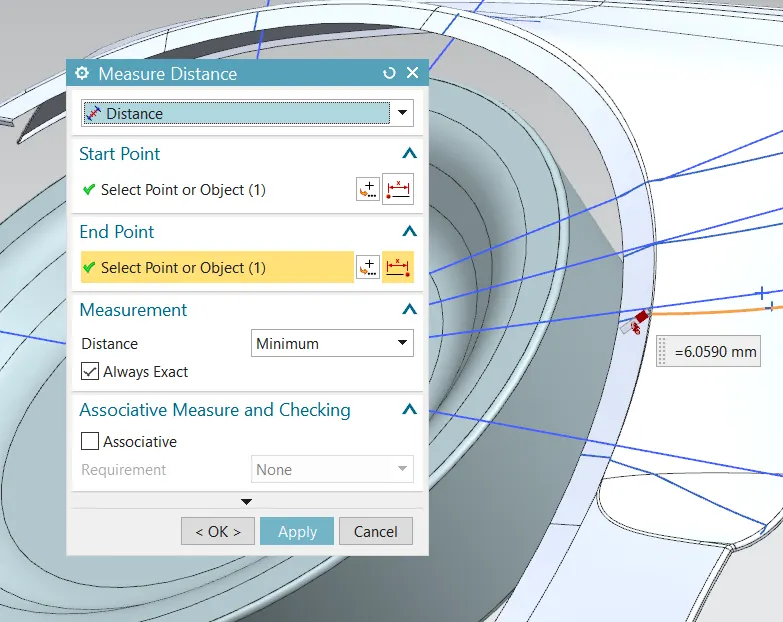
L = -6.06mm
Measuring the clearance vlaue'a' for Wheel Guard Requirement
i.) Clearance 'a' at 30° line SB
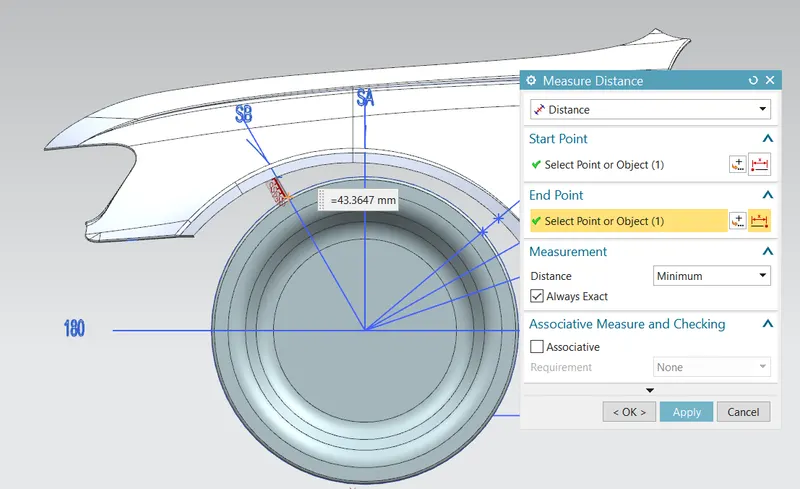
a = 43.36mm
ii.) Clearance 'a' at 50° line SC
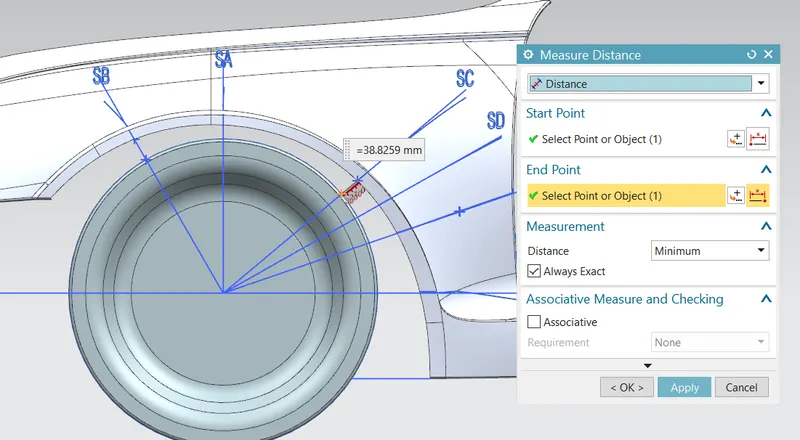
a= 38.25mm
Conclusion
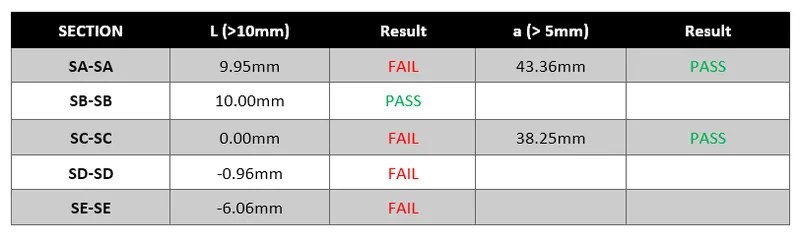
From the above results we can conclude that the Fender does not pass the European Regulations, as the minimum clearance L between the Fennder Wheel Arch and Wheel for vehicle and pedestrian safety is 10mm and this design does not meet the requirement.