Fender Design
Fender Design
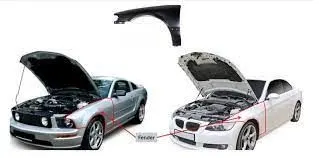
Fender is the American English term for the part of an automobile, motorcycle or other vehicle body that frames a wheel well (the fender underside). Its primary purpose is to prevent sand, mud, rocks, liquids, and other road spray from being thrown into the air by the rotating tire. Fenders are typically rigid and can be damaged by contact with the road surface. Sticky materials, such as mud, may adhere to the smooth outer tire surface, while smooth loose objects, such as stones, can become temporarily embedded in the tread grooves as the tire rolls over the ground. These materials can be ejected from the surface of the tire at high velocity as the tire imparts kinetic energy to the attached objects. For a vehicle moving forward, the top of the tire is rotating upward and forward, and can throw objects into the air at other vehicles or pedestrians in front of the vehicle. In British English, the fender is called the wing. (This may refer to either the front or rear fenders. However, in modern unibody vehicles, rear fenders may also be called quater panel.) The equivalent component of a bicycle or motorcycle, or the "cycle wing" style of wing fitted to vintage cars, or over tires on lorries which is not integral with the bodywork, is called a mudguard in Britain, as it guards other road users – and in the case of a bicycle or motorcycle, the rider as well – from mud, and spray, thrown up by the wheels. In modern Indian and Sri Lankan English usage, the wing is called a mudguard. However, the term mudguard appears to have been in use in the U.S. at one point. The American author E.B. White, in his October 1940 Harper's essay "Motor Cars", refers to "...mudguards, or 'fenders' as the younger generation calls them." In the United State, a minor car accident is often called a "fender bender".
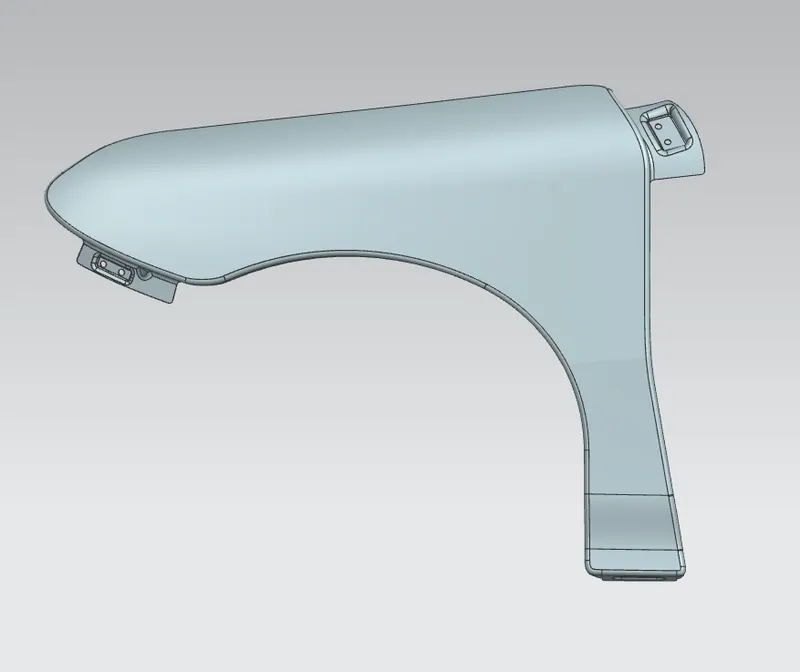
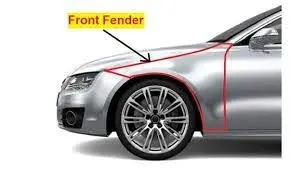
There are two types of Fenders
- Full Bumper type
- Half Bumper type
Full bumper type is the traditional type of fender where more material consumption is observed. This type is used in the old designs of automobiles where it increases the overall weight and thus reduces performance. The maintenance also relatively more due to more surface.
Half bumper type is the modern design where less material consumption is observed, so productivity increases by reducing the size of the blank and thus providing more performance. The maintenance also relatively low compared to the full bumper type.
Different mounts for fender
Body Mount
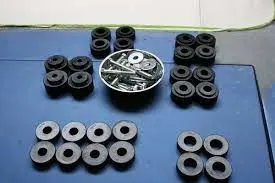
Body Mount means a device insulating and/or securing the vehicle floor from and to the motor vehicle frame. Body mounts are an integral component of a body on frame vehicle.
Drip Mount
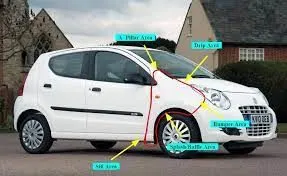
This region is mounted below the hood inner panel which needs to be in flush when the hood is in closed condition and also there should be very less gaps. The drip area is either spot welded or in some cases bolted down via self-tapping screws.
A pillar Mount
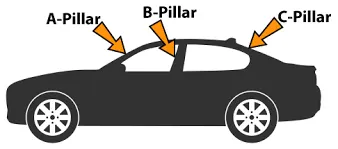
A mount or support in the form of a pillar for a gun in a fortification.
Cowl Mount
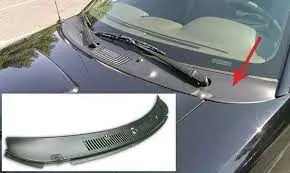
A cowling is the removable covering of a vehicle's engine, most often found on automobiles, motorcycles, airplanes, and on outboard boat motors. On airplanes, cowlings are used to reduce drag and to cool the engine. On boats, cowlings are a cover for an outboard motor.
Manufacturing Process for Fender
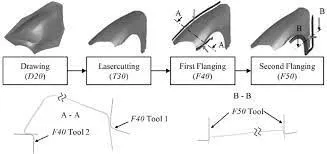
The invention discloses a manufacturing process for a car fender. The manufacturing process includes the following steps that firstly, unfolding and shearing are carried out on a plate, wherein a proper cold roll specification is selected at first, a cold roll is unfolded, and then the unfolded cold roll is sheared to an iron plate of the corresponding size according to production material specifications; secondly, oil pressing and punching are carried out, wherein the iron plate is extended at first, then side shearing and punching are conducted on the iron plate, folding and shaping are carried out on the iron plate, and finally reshaping is carried out on the iron plate; thirdly, small first parts of the fender are machined, wherein first of all, the iron plate is punched to a needed outer contour blank, then the iron plate completing the outer contour blank is further shaped, and the iron plate is punched at last; fourthly, installation and welding of a metal plate are conducted. The manufacturing process for the car fender is simple and high in production efficiency; a body of the fender and the small parts can be separately machined, so waiting time is shortened; working efficiency of production is improved.
Design Parameters of Fender
Height of fender can be minimum 80mm for child and adult (94mm,WAD 1700MAX, this +14 for increase in inertial force due to accident) impact. Parting will minimum 5 not more than 50mm from SRL ( a reference line on HOOD side, a point on fender makes from a line of 45 degree from ground level ).
Design constructions of Fender
Different car parts are manufactured in different ways. Metal parts are made using a metal forming process. Without automotive metal forming, modern cars would not look as they do. Sheet metal can be worked hot or cold. The basic processes are below: Metal forming is an ancient skill. Before the industrial revolution, blacksmiths worked metal into the required shapes using hammers and heat. Today, the same job is done on a vast scale using specialist machines. A blank piece of sheet metal is the starting point for many car parts. This metal is then reshaped, stamped, cut, and molded into the part needed. Presses are used to shape metal into curves. The right amount of pressure is needed or the metal won’t retain the desired shape. Stamping presses are used to make car parts such as hub caps. Here, the metal is literally stamped into a specific shape using a die. Drawing metal involves using a die to shape the metal. Sheet metal is pressed against a die using a hydraulic press or punch. Lubricant is used to minimize the possibility of wrinkles. Forging is also used to produce the same effect.