Exhaust Port Challenge
AIM : To perform a Conjuate heat transfer analysis for an exhaust port and caluclating the values of Heat transfer co-efficient
SIMULATION-SETUP :
- Case setup : ANSYS (FLUENT)
- Simulation editor : ANSYS FLUENT
- Post-processor : CFD POST
THEORY :
The Conjugate Heat Transfer (CHT) analysis type allows for the simulation of heat transfer between solid and fluid domains by exchanging thermal energy at the interfaces between them. Typical applications of this analysis type exist as, but are not limited to, the simulation of heat exchangers, cooling of electronic equipment, and general-purpose cooling and heating systems.
As we all know that the heat transfer in solid is mainly due to – CONDUCTON, where the heat is transferred by the tight bound molecules inside the solid.
Whereas fluids transfers the heat through CONVECTION, where the heat is transferred by freely movable gaseous or fluid molecules through air or any other medium
Heat Transfer by Solids and Fluids
Heat Transfer in a Solid
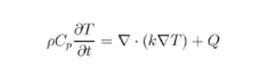
In most cases, heat transfer in solids, if only due to conduction, is described by Fourier’s law defining the conductive heat flux, q, proportional to the temperature gradient: .
For a time-dependent problem, the temperature field in an immobile solid verifies the following form of the heat equation:
Heat Transfer in a Fluid
Due to the fluid motion, three contributions to the heat equation are included:
- The transport of fluid implies that there is energy transport too, which appears in the heat equation as the convective contribution. Depending on the thermal properties on the fluid and on the flow regime, either the convective or the conductive heat transfer can dominate.
- The viscous effects of the fluid flow produce fluid heating. This term is often neglected, nevertheless, its contribution is noticeable for fast flow in viscous fluids.
- As soon as a fluid density is temperature-dependent, a pressure work term contributes to the heat equation. This accounts for the well-known effect, for example, compressing air produces heat.
Accounting for these contributions, in addition to conduction, results in the following transient heat equation for the temperature field in a fluid:

- Where is CHT Analysis is used ?
CHT analysis is used in simulation of heat exchangers, engine equipments, cooling of electronic equipment and general purpose heating and cooling systems.
- Why is CHT Analysis used ?
CHT analysis provides temperature distribution in solid and liquid interface. It also provides velocity and pressure distribution of the liquid inside the solid.
GEOMETRY
When performing a Conjugate Heat Transfer analysis, additional CAD requirements have to be taken into account. These include:
- The necessity for the model to contain multiple regions with at least one each assigned as solid and fluid domains. In case your raw geometry doesn’t include the fluid domain yet, consider using the fluid volume extraction tool.
- The necessity to properly define interfaces between contacting regions is to share the neccessary information like thermal energy and heat transfer rate.
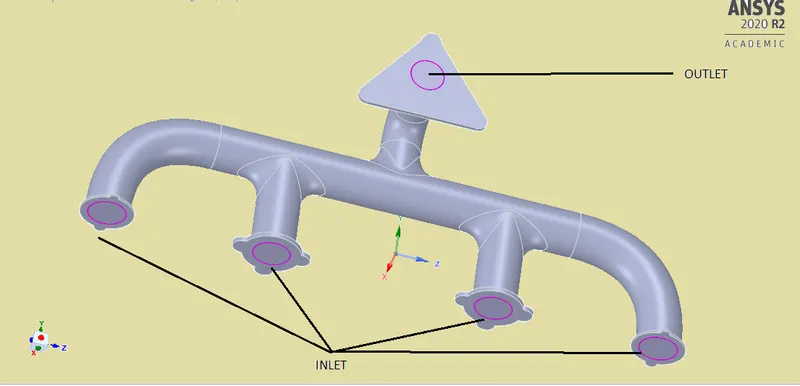
- BOUNDARY CONDITION AND TURBULENCE MODELLING :
Solver type - Pressure Based steady state solver
Viscous model - K-Epsilon standard with Energy equation ON.
Material - Fluid : Air; Solid : Aluminium
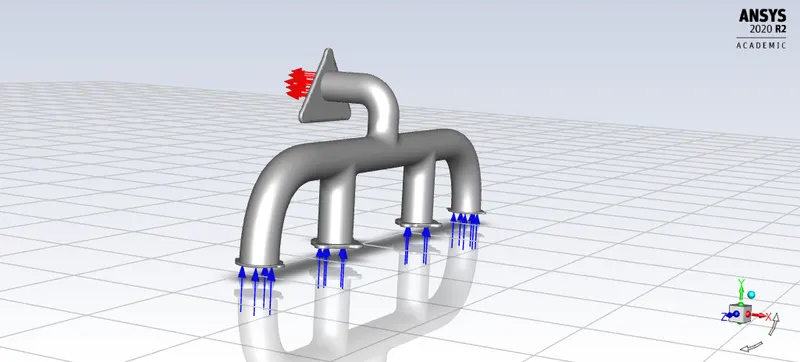
Inlet BC - Velocity = 5 m/s; Temperature = 700K
Outer Wall - Thermal Conditions = Convection; Heat Transfer Coefficient = 20 W/m^2K; Free Stream Temperature = 300K.
MESHING :
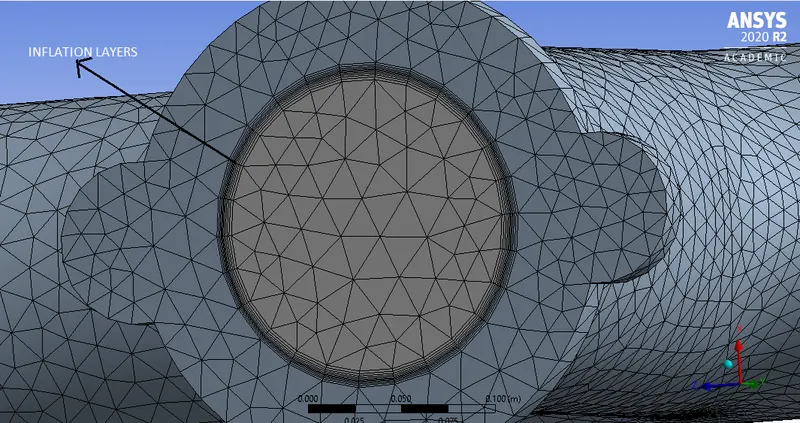
- Case I : Element size - 25mm Body sizing - 20mm Inflation layers - 5 Total number of elements- 343831 or 0.34 million cells
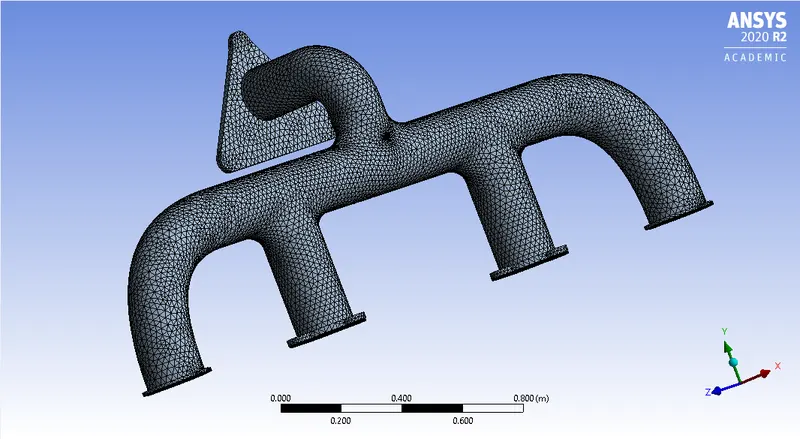
Inflation layers :
Adding inflation layer is very important to get a better accurate simulation results, which makes the region of confrontal mesh much more accurate for
simulation,
SIMULATION RESULTS :
1) TEMPERATURE CONTOURS :
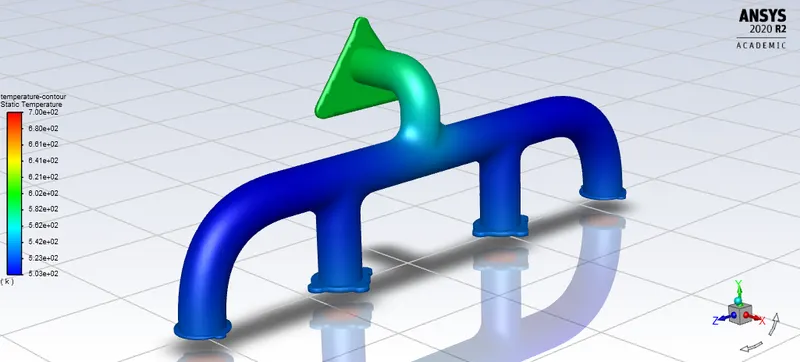
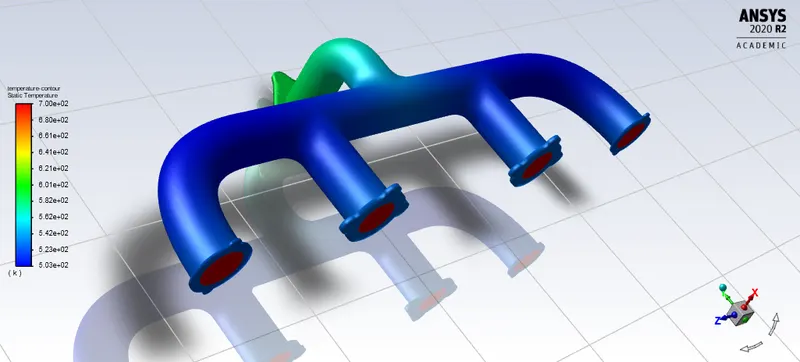
CALCULATION OF OUTLET TEMPERATURE
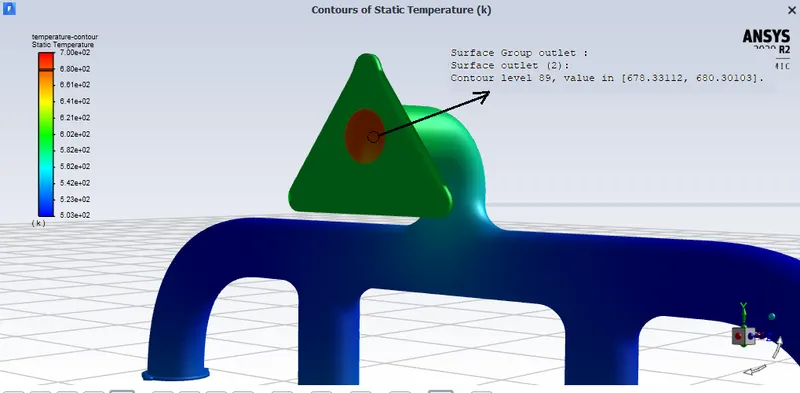
The temperature of the exhaust gases (air) was converged to be around 680K. The temperature drop of 20K is due to the fact of convection or may be conduction, the
way in which the heat gets escaped.
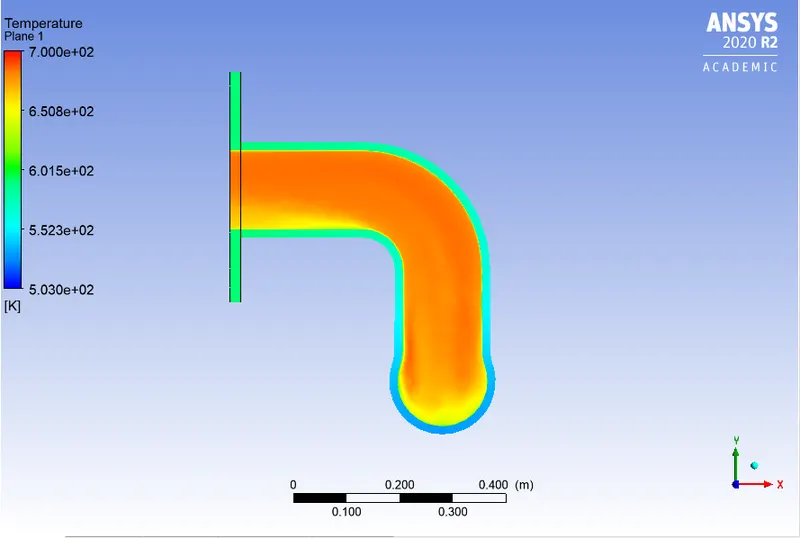
Above figure shows the temperature contour in the outlet port region.
2) Velocity
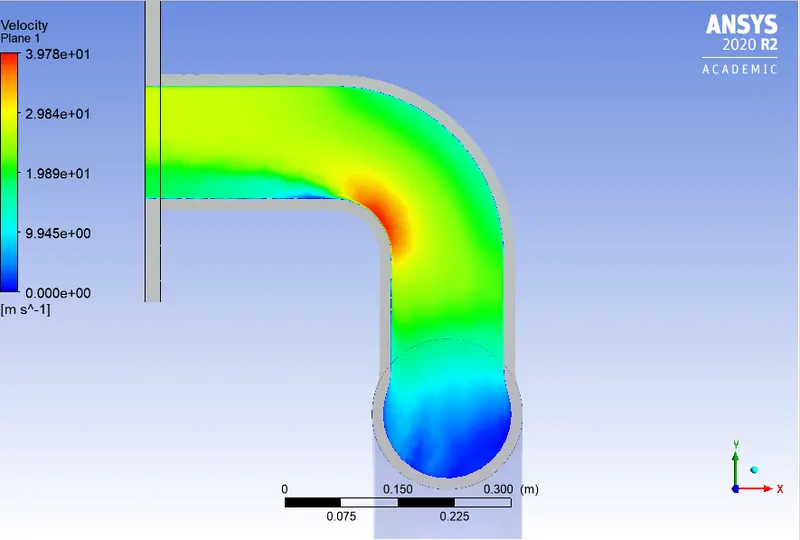
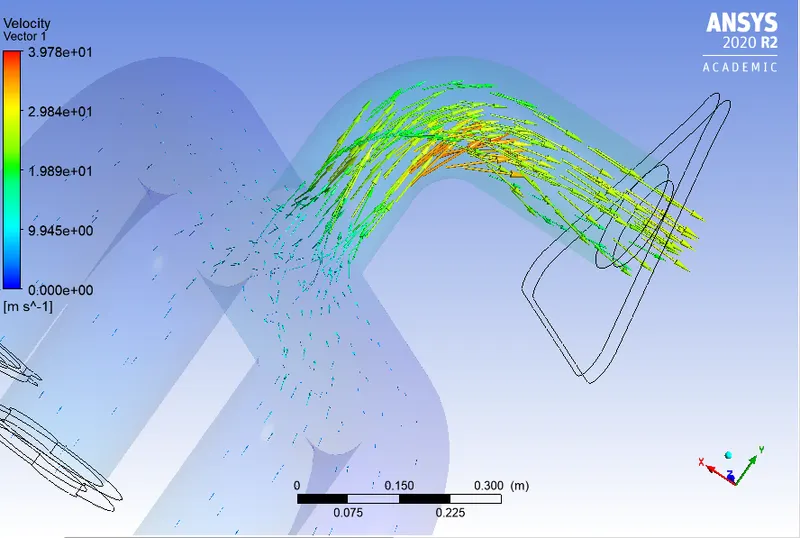
Above figure shows the velocity contour in the outlet port region. The velocity is found to be maximum near the wall ie,,, about 40 m/s and this is the
region where Heat transfer coefficient (HTC) will be maximum.
3) WHTC (Wall heat transfer coefficient)
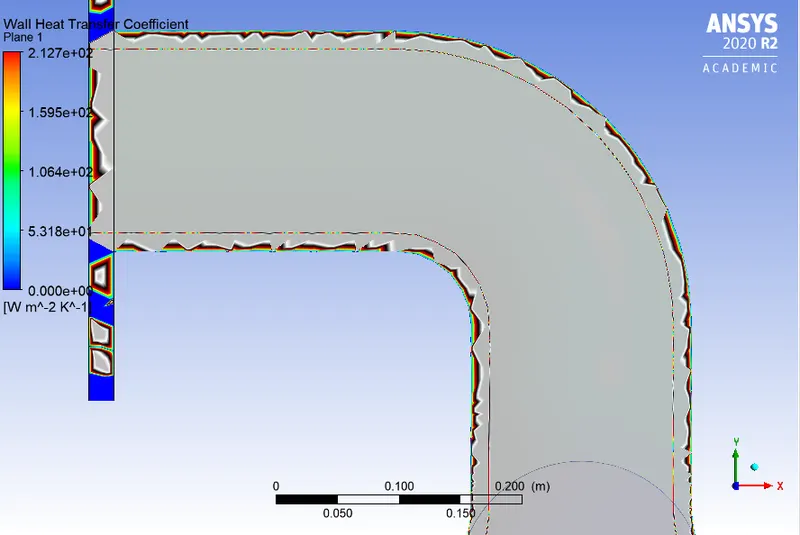
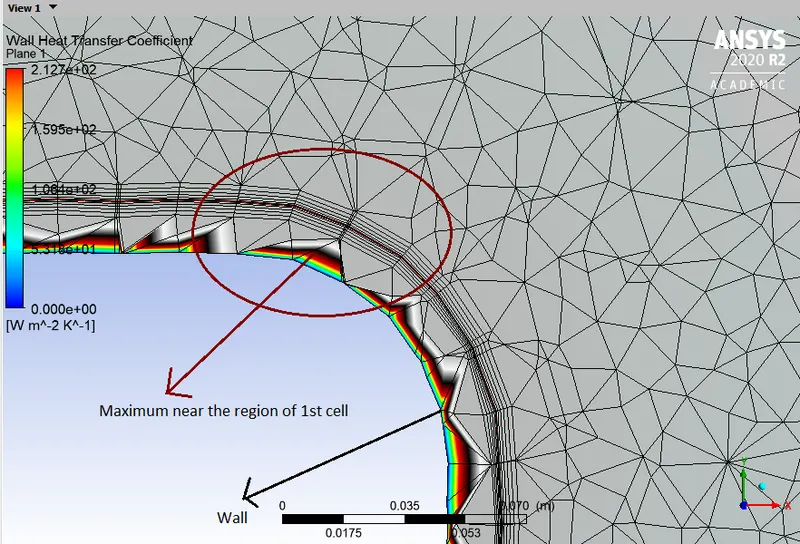
The value of WHTC is maximum where the velocity is maximum ie,,, near the walls and this can be observed in the region attatched to first cell only.
4) Depiction of Flow behaviour
Streamline
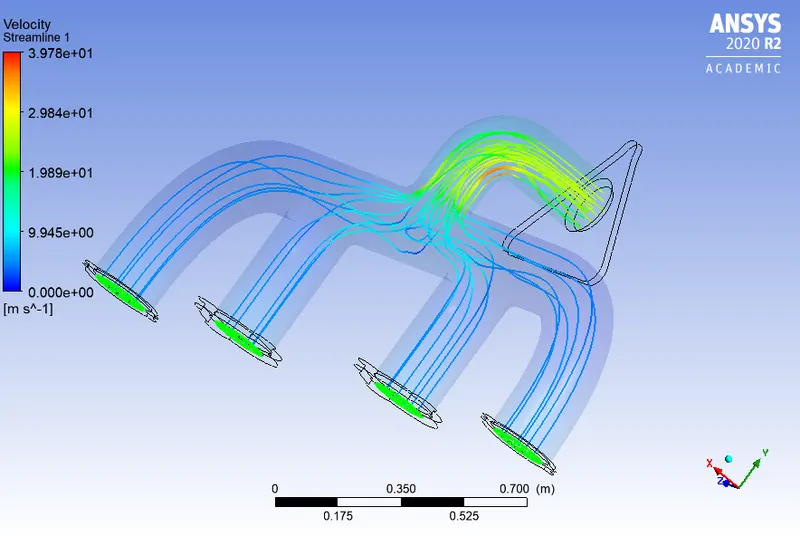
Above figure depicts the flow behviour along with the magnitude of velocity in the stream lines. The value of velocity increases at the point where all the flow particles coming from 4 inlets meets. This is because of conservation of mass ie,, continuity equation where the flow particles from diffrent direction meets and adds up increasing their velocity as they are flowing in one
direction.
Vector Plot :
ANIMATION OF FLOW BEHAVIOUR :
- Results and Conclusion :
Parameters Case 1
Max. wall temperature(K) 680.733
Max. Velocity(m/s) 40.13
Wall HTC (W/m^2K) 221.75
- Verification of HTC
Heat transfer coefficient can be verified by using Nusselt number.
Nusselt Number is given by Nu = Re.Pr where, Re - Reynolds Number and Pr - Prandtl Number
Re increases with increase in velocity which in turn will increase Nusselt number.
also, Nu = Convective heat transfer / Conductive heat transfer = h/k/L
Meaning when velocity increases, convective heat transfer will also increase.
- Accuracy of HTC depends upon :
- Number of elements and element size of the mesh.
- Inflation layers.
- Selection of right viscous model.
- Selection of material and its properties.