EV Drivetrain
Objective:
1. Understand various types of power converter circuits are employed in electric and hybrid electric vehicle.
2.To determine steady speed of EV with duty cycle 70 %.
Introduction:
1.Different ypes of power converter circuits are employed in electric and hybrid electric vehicle.
Ans:
General configuration of ev is as shown in figure:
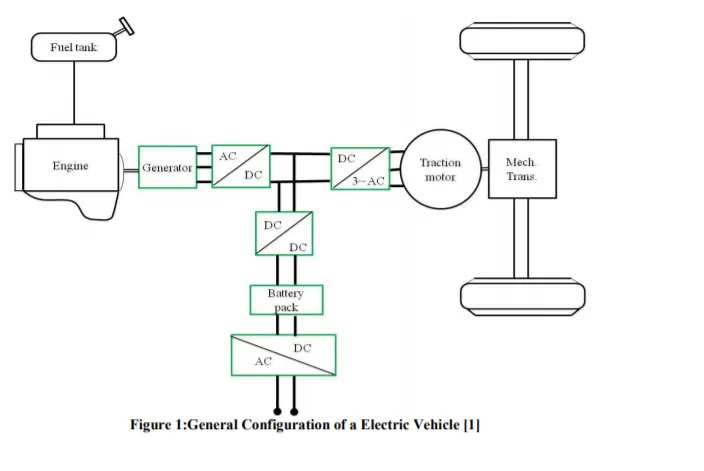
The main components of an Electric Vehicle are DC-AC inverter, DC-DC converter, battery, and electric motor.
Usually AC motors are used in HEVs or EVs for traction and they are fed by inverter and this inverter is fed by DC-DC converter
DC-DC converter:
The most commonly DC-DC converters used in an HEV or an EV are:
Unidirectional Converters:
They cater to various onboard loads such as sensors, controls, entertainment, utility and safety equipment.
Bidirectional Converters:
They are used in places where battery charging and regenerative braking is required. The power flow in a bi-directional converter is usually from a low voltage end such as battery or a supercapacitor to a high voltage side and is referred to as boost operation. During regenerative braking, the power flows back to the low voltage bus to recharge the batteries know as buck mode operation.
Buck Converter: The buck converter is step down converter and produces a lower average output voltage than the dc input voltage.
Boost converter: The output voltage is always greater than the input voltage.
Buck-Boost converter: The output voltage can be either higher or lower than the input voltage
DC-AC converters:
An inverter is a device that converts DC power from the battery to AC power used in an electric vehicle motor. The inverter can change the speed at which the motor rotates by adjusting the frequency of the alternating current. It plays a significant role in capturing energy from regenerative braking and feeding it back to the battery.
2. An Electric Vehicle's powertrain with 72V battery pack in shown in the diagram below. The duty ratio for acceleration operation is 'd1' and for the braking operation the duty ratio is 'd2'.
What is EV steady state speed if duty cycle is 70%?
Ans:
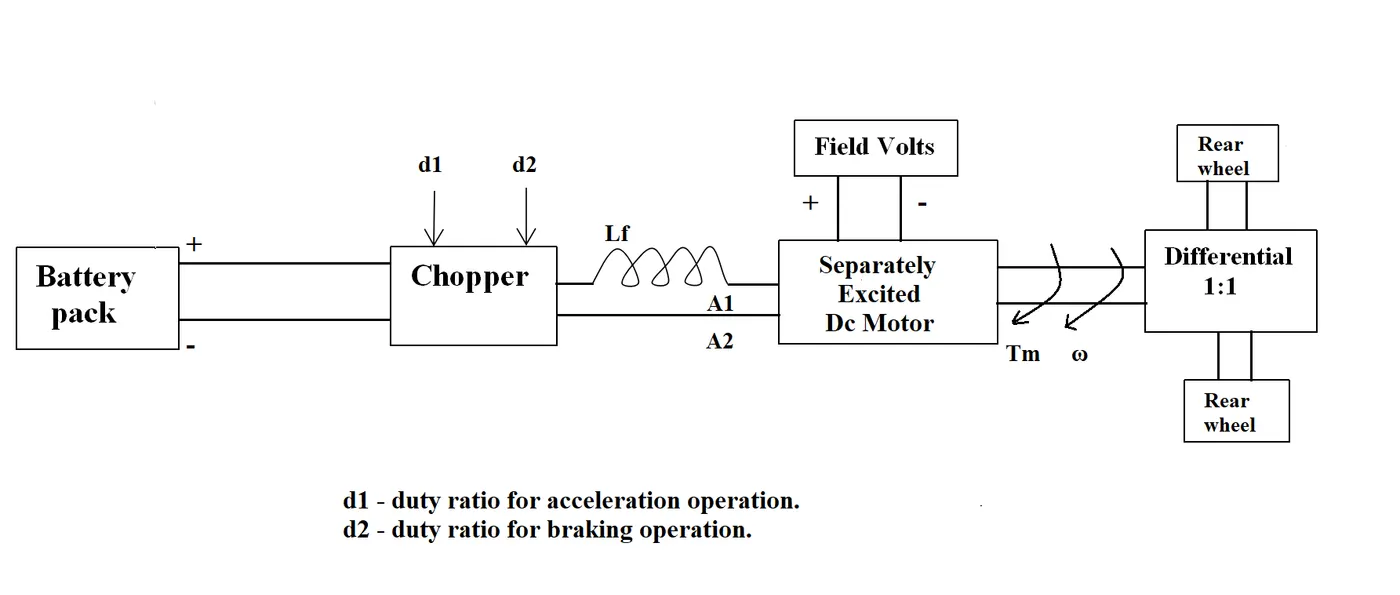
Given:
Motor and Controller Parameters:
Rated Armature voltage= 72 V
Rated armature current= 400 A
Ra= 0.5Ω, KΦ= 0.7 Volt second
Chopper Switching frequency= 400 Hz
The vehicle speed-torque characteristics are given by the below equation
 ....eq (1)
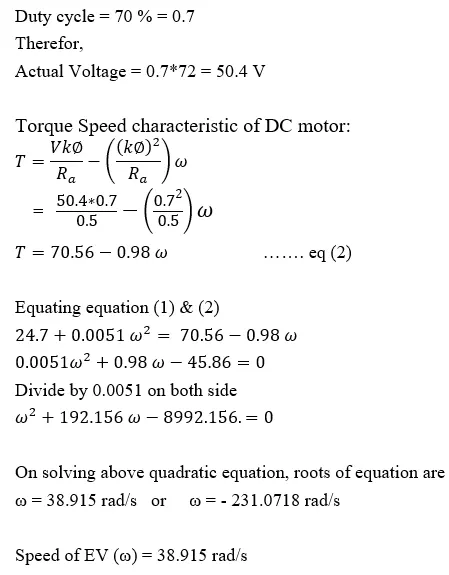
Solution:
Induction Versus DC Brushless Motors
In this world of gas-powered vehicles, engines are not all alike. here is no one best engine type, rather there are different types of engines to suit personal requirements, such as price and performance. This is also true for electric vehicle drives. In case of electric vehicle drive some element may be obsolete in nearby future or may get stability.
Comparison, Advantage and Disadvantage:
Author emphasis on electric motors and how do they work. He mentioned that main difference between 3 phase induction motor and the DC brushless motor is their rotor.
He liked induction motor as it has no magnets, the motor has the ability to start under load. No inverter is needed. With induction, as machine size grows, losses do not necessarily grow. Thus, induction drives may be the favoured approach where high-performance is desired. He mentioned drawbacks of induction motors like they cannot operate on DC, also when operated from utility power, they have limited starting torque and somewhat limited running peak torque capabilities as Shaft speed is proportionate to line frequency.
He mentioned some advantages of dc brushless drive like much less rotor heat is generated, DC brushless drive can also operate at unity power factor.
Conclusion:
When it comes to hybrid or plug in hybrid vehicle market dc brushless motor will dominate. However, Induction motor drive will always dominate for high performance and pure electrics. So, author have not mentioned who is clear winner among two rather he emphasis on advantage and disadvantages of one drive over another.