Design of backdoor
Introduction:
The back door is a door at the rear end of the car which enables entry to the boot space of car. This door is commonly hinged at the top. This door is operated by gas stay which reduces the effort required to open or close the door. In some high-end luxury cars, this door is operated by an electric motor resulting in its one switch control for open and close. This door also comes as side-mounted door in some cars. While designing this door various considerations are taken in account as it carries tail lights, wiper motors, etc.
Objective: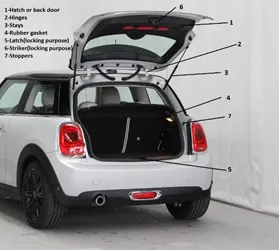
The aim of the project is to design parts of back door and create final assembly as per design requirements.
Design methodology:
To design the back door, the Styling surface is received as input from the styling team. This surface will be used as a reference to create all components. This design will be created using a top-down approach. First reference surfaces are imported in assembly, and then all components are created inside the assembly. Back door consists of following components:
Inner panel
Outer panel
Hinge reinforcement
Gas stay reinforcement
Latch striker reinforcement
Inner panel:
This is the component which provides strength to the back door and all the accessories are mounted on this panel. Various embosses are provided on its surface for strength. Also, cut-outs are provided for mounting of accessories. Inner panel is attached with outer panels by hemming and mastic sealants. The thickness of the inner panel is considered as 0.75mm.
Outer panel:
The outer panel is a styling surface of the Back door that covers the inner panel and all mountings of accessories. The outer panel should provide aesthetic look to the back door and cover the inner panel neatly. Outer panel is divided in two parts as upper and lower part. These parts are attached to inner panel by hemming at around the edges and mastic sealants. Then lower and upper part is joined using spot welding. Thickness of these panels is also considered as 0.75mm. Hemming and relief at the corner.
Reinforcements:
There are 6 reinforcements in this assembly. Hinge reinforcement LH and RH, Gas stay reinforcement LH and RH, Wiper motor reinforcement and Latch striker reinforcement. To attach hinges, gas stay and other mountings, we create holes in the surface of inner panel. This decreases the strength of the panel locally. To compensate the loss of strength, reinforcements are provided. This provides strength locally. Thickness of these reinforcements is considered as 1.5mm. For proper opening and closing of door, the door should follow a specific trajectory. The striker should be perpendicular to the path. To get the trajectory, a circle is drawn by considering hinge axis as centre point. This circle is the path that striker should follow.
Conclusion:
All the components of the back door are created in assembly using top-down approach by using the outer styling surface as a reference.