Design of backdoor
OBJECTIVE:
i) From the given styling surface, develop a back door using appropriate design methodologies.
ii) The objective of this project is to design a BIW Back Door of a car with an Inner Panel, Outer Panel, and Reinforcements for the Hinges, Gas stay, Wiper Motor, and Latch by following the engineering standards.
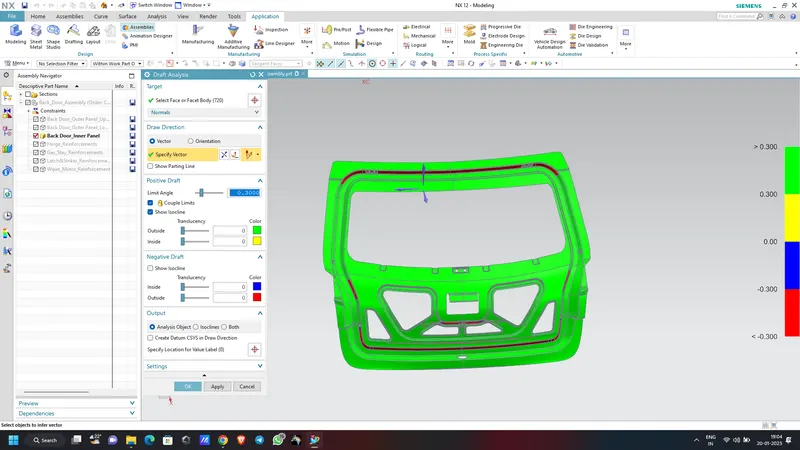
iii) The Inner Panel must be subjected to Draft Analysis for verifying whether it satisfies the Deep Drawing requirements for the tooling direction created in the design.
INTRODUCTION:
The Back Door of a car is the rearmost part of the vehicle which gives access to the trunk space of the vehicle. The rear door also supports the reinforcements and added weights of the Wiper Motor, Gas Stay, Tail Lamp, and Latch and Striker.
The Backdoor/tailgate is one of the closure commodities in BIW . The backdoor has a lot of components inside and is designed to incorporate them easily. It affects the rear visibility and luggage area.
The material used for door manufacturing depends on the budget and performance of the vehicle. Mostly Aluminium and Steel will be used whereas low-budget vehicles use Steel which makes the manufacturing process easy and cost-efficient since it follows the Stamping of Mouds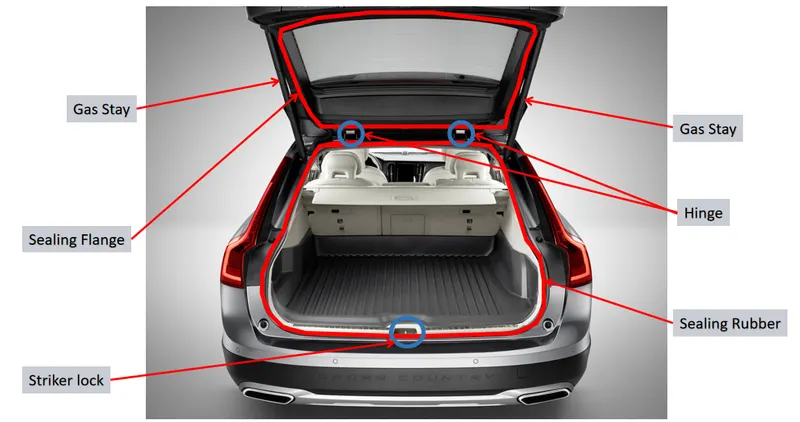
Functions of the Backdoor:
- It protects the occupants and luggage from getting damaged.
- It houses assembly of tail lamps, wiper motor and other components.
- It serves as entry and exit point for luggage/passengers.
- It houses windshield glass which helps in rear visibility.
- Parking sensors, rear view camera are mounted on it.
Types of Backdoor
- Top mounted
These type of back doors are used in a station wagon, pickup truck and some other sports utility vehicles. Today’s modern cars use top mounted tailgating systems which are both powered and also gas stay supported. These tailgates provide greater rear visibility compared to other types.
- Side mounted
It is generally used in van type MPVs, SUVs, pickup truck vehicles. These side mounted door/barn doors are a lot easier compared to top mounted ones. These doors are generally small in size and can be easily accessed. These doors are more convenient for the goods handlers carrying lengthy objects, long pipes where one door is kept open. It also saves accidental head impacts. It is a lot easier to load /unload things in vehicles having side-mounted doors.
- Bottom mounted
Bottom type or split type backdoor system is used in estate type cars, pickup trucks and some luxury SUVs. These are most convenient type of backdoor in which the bottom split is used as a support or even as a table for the touring people.
Materials Selection:
The selection of material plays a major role in determining the overall weight of the back door. The common materials used are Steel & Aluminum. The density of Steel is higher than Aluminum thus adding more weight to the door. The material used in the manufacturing of the backdoor depends upon the budget of the car, most low cost vehicles use steel as it is cheaper compared to Aluminium. Another aspect to be noted is that, if casted Aluminum parts are used instead of deep drawn steel parts there is no need of reinforcements and the overall weight of the car is reduced by approximately 5-10kg thus increasing the performance of the vehicle. Also the draft angle for casted parts is around 3 degrees while for deep drawn parts is around 7-10 degrees which helps in increasing the luggage/ cabin space.
Major Parts and Reinforcements:
The backdoor consists of the following basic components:
- Backdoor Outer Panel (Upper)
- Backdoor Outer Panel (Lower)
- Backdoor Inner Panel
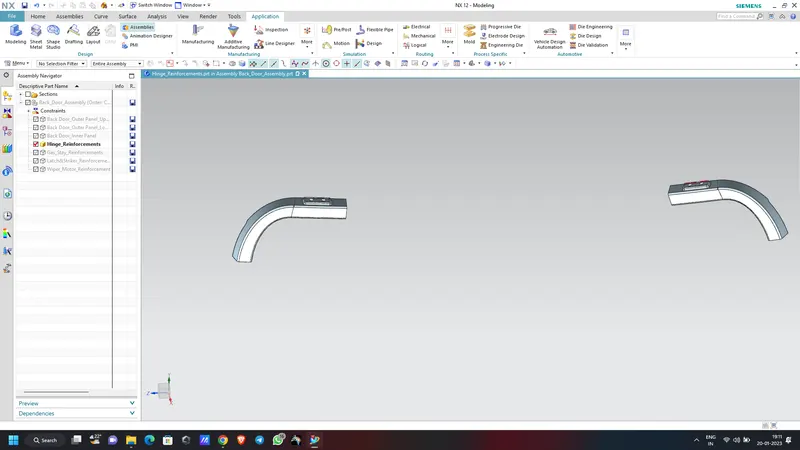
- Hinge Reinforcements (LH & RH)
- Gas-Stay Reinforcements (LH & RH)
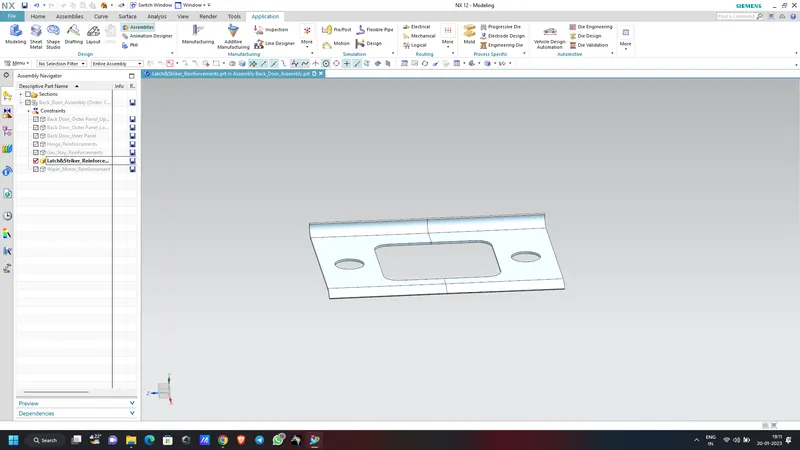
- Latch and Striker Reinforcement
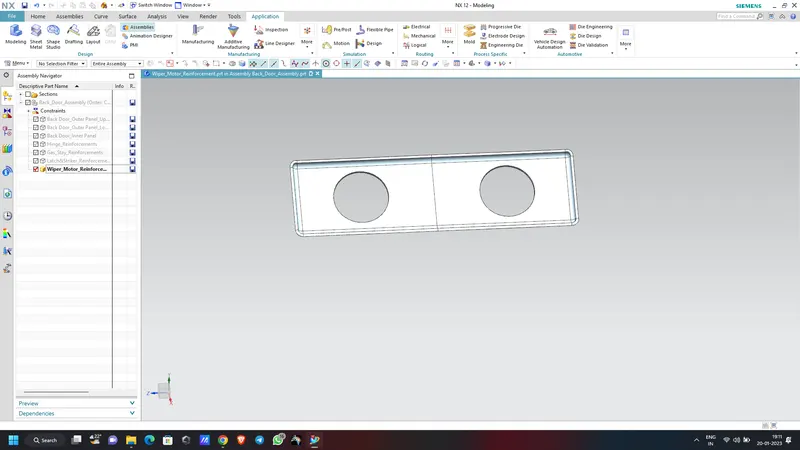
- Wiper motor Reinforcement
TAILGATE:
Tailgate is a door at the back of a truck or car, that is hinged at the bottom so that it open downwards.
DESIGN INTENT
The intent of the project is to design a Body In White Back Door of the vehicle considering the engineering standards and manufacturing requirements which satisfies the Deep Drawing Process.
DESIGN METHODOLOGY:
DESIGN OF BACKDOOR OUTER PANEL:
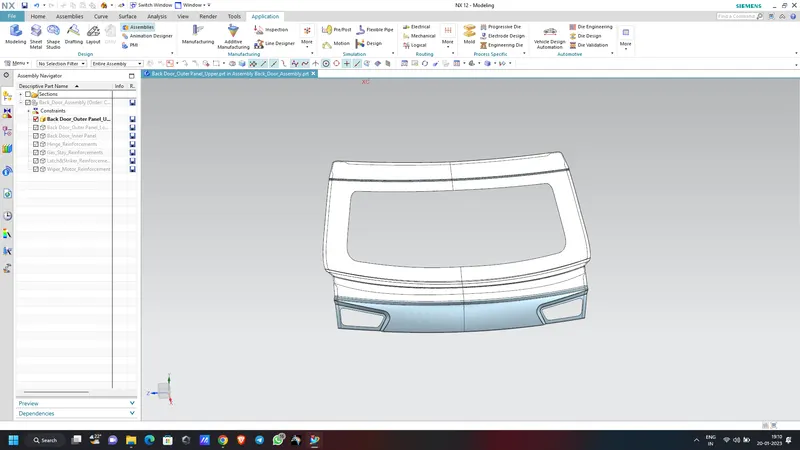
The Outer Panel is the styling surface of the back door. Other components of the backdoor are designed with reference to the outer panel. It acts as the outer cover and deals with the aesthetics of the car.
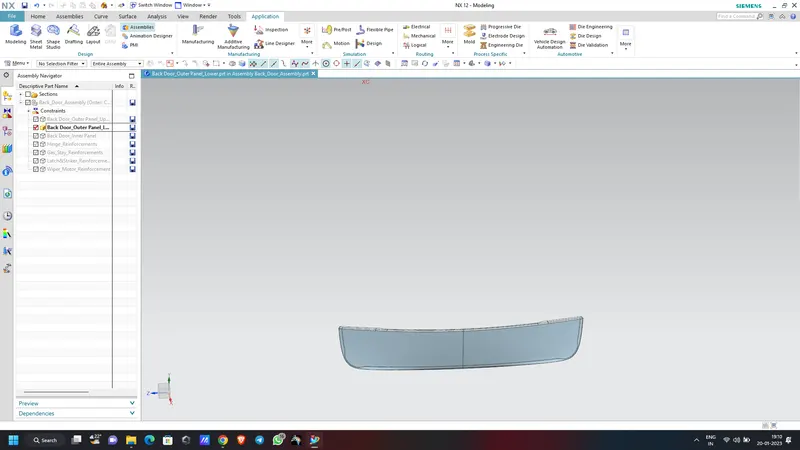
In this design outer panel is divided into two parts
- Outer Upper Panel
- Outer Lower Panel
 Outer Upper Panel:
The Outer Upper Panel Extracted from a styling surface.
The panel is altered for the required design with the surface tools of NX CAD
The thickness provided for the outer panel is 0.75 mm
Hemming is provided with the corner relief.
fig. Outer Upper Panel
Outer Lower Panel:
The Outer Upper Panel Extracted from a styling surface.
The panel is altered for the required design with the surface tools of NX CAD
The thickness provided for the outer panel is 0.75 mm
Hemming is provided with the corner relief.
Tooling Direction:
- Before starting to design the inner panel of the back door the tooling direction for Deep Drawing purpose should be created.
- Then the styling surface needs to be checked and analyzed since it might have irregularities, hence it must be fixed first.
- Then the back door was designed using the top-down approach.
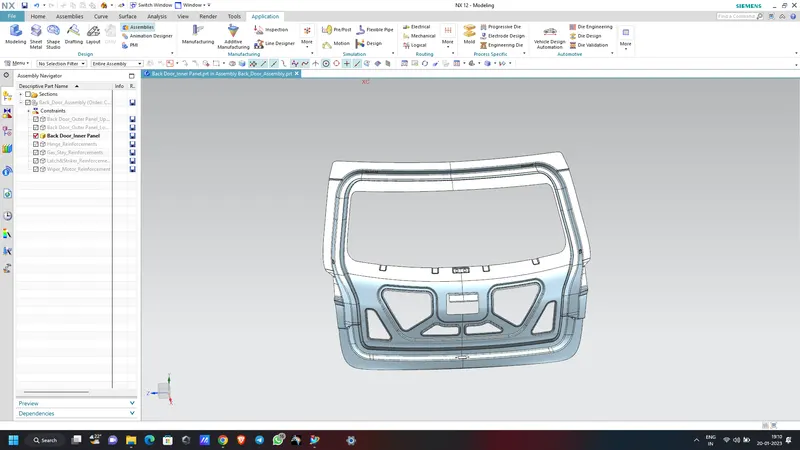
DESIGN OF BACKDOOR INNER PANEL:
The Inner Panel Extracted from a styling surface.
The panel is altered for the required design with the surface tools of NX CAD
The thickness provided for the outer panel is 0.75 mm
- After creating the tooling direction the design of the inner panel will begin where we will first develop an effective sealing flange by checking all the boundaries and by following the shape of the inner panel design.
- By creating multiple flanges and by using surface modeling techniques the concept design of the inner panel was created.
- After the concept of the inner panel is developed, then the child components like a hinge, latch, gas-stay locations, and their reinforcements must be designed. Which completes the overall design of the tailgate.
- The embosses were created in ‘V-Shape or Y-Shape’ so that if the vehicle undergoes the crash then the force dissipates over it which reduces the damage transferred to the trunk space.
MASTIC SEALANT:
The mastic sealant is used to fix the inner panel with the outer panel which increases the NVH factor and stiffness of the back door.
HINGE, GAS STAY & WIPER MOTOR EMBOSS:
The Orange circle denotes the hinge emboss which was created using the datum plane and emboss feature in NX. It was also designed in a way that the emboss should have a flat surface for assembling the hinges using it.
The violet circle denotes the gas stay emboss which was created using the surface of the connecting flange.
The yellow circle denotes the Wiper motor emboss which was created using the surface of the connecting flange.
LATCH AND STRIKER EMBOSS:
The Latch and Striker emboss were designed by creating a trajectory that follows the opening and closing of the back door with respect to the hinge axis.
STRIKER POSITION:
The position of the hinge should be perpendicular to the latch when the latch and striker meets. The circle is drawn from the center of the hinge axis to find the path of the striker and positioned perpendicular to the path.
draft analysis:
-
While designing a component a design engineer must make sure that the component can produced by any means of manufacturing methods with least amount of time, material, manpower and power. So that we can reduce the overall cost of car.
-
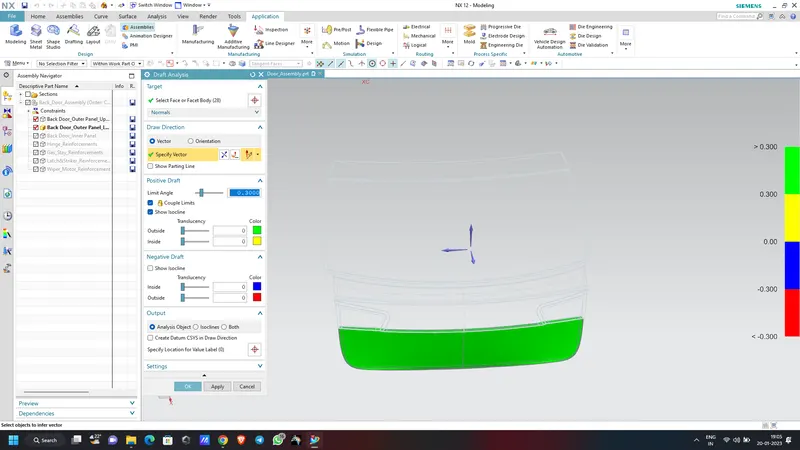
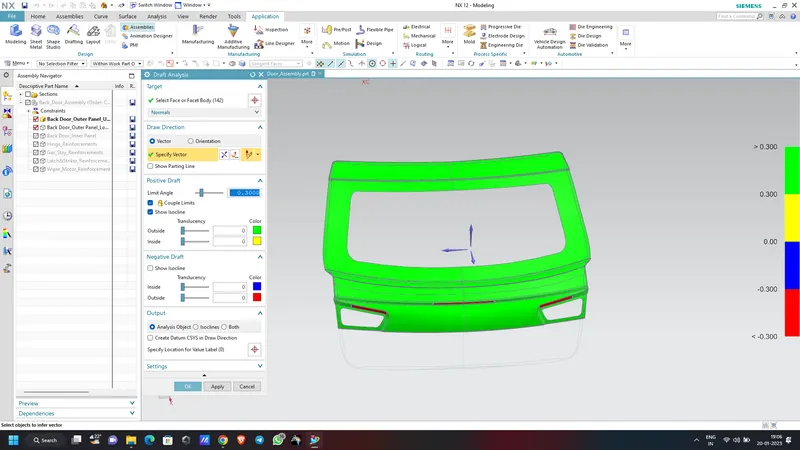
When the Back Door is considered it is manufactured by deep drawing at most of the time Deep drawing is the process where the single sheet of metal is place over a die which has the desired shape of the final output and the sheet is pressed against it with a tool. For the tool to come out from the part usually pressing relief of 5° to 9° will be provided during modelling itself.
-
In NX draft analysis can be done after modelling so that we can verify whether the product is manufactured by pressing or not. One side of the surface is highlighted by green and other side by Red colour means that the model can be manufactured. Result of the draft analysis is shown in the figure below.
- CONCLUSION:
-
Thus the Back door was designed and developed from the given styling surface with essential Reinforcements and Emboss. To satisfies the manufacturing requirements Draft analysis was also done on the Inner Panel.
-