BODY IN WHITE BACK DOOR DESIGN FOR PASSENGER CAR
OBJECTIVE
The objective of this challenge is to design BIW Tail gate (back door) of passenger Car through UG NX 12.0. The report constitutes about Positioning of Latch and Striker , Wiper Motor, Tail Light Mounting, Gas Stay Reinforcements with suitable emboss definitions and Hemming Flanges
BACK DOOR
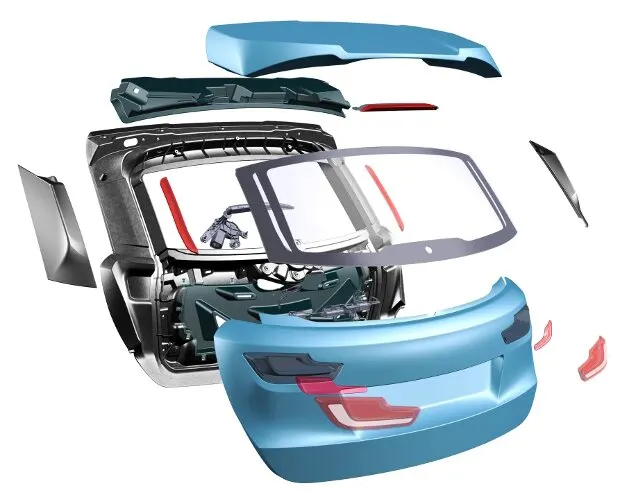
Backdoor or Tailgate is an exterior Body in White Component that covers the Rear Trunk Space and houses vital rear mounting components like Gas Stay, Wiper , Tail Light, Hinge for opening and closing and holds design considerations like Rear Visibility, Sealing Flange, Rear Windshield Mounting and Crash Resistance.
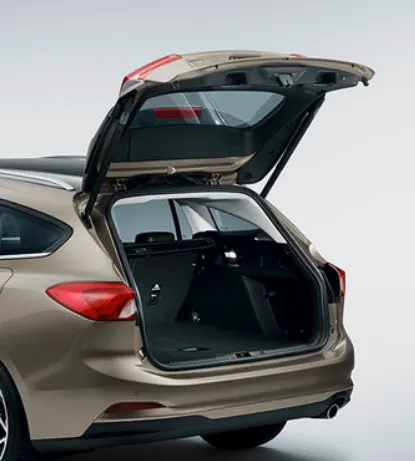
The Back Door is usually attached to the Rear Bow Roof Rail and Opening and Closing Situations are carried by Gas Stay /Power Lifter Mountings.
- The Tail Gate Design has
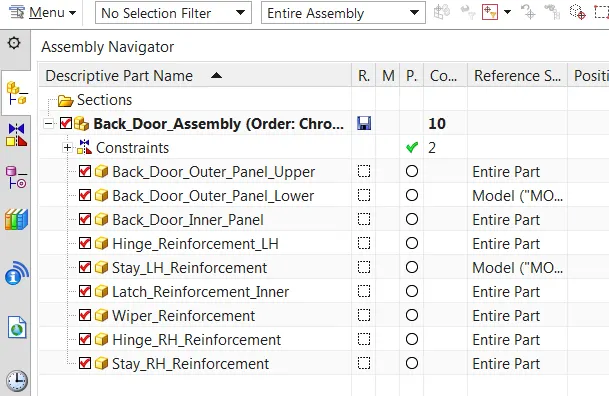
- Tail Gate Outer Panel Upper
- Tail Gate Outer Panel Lower
- Tail Gate Inner Panel
- Sealing Flange Development
- Reinforcement Mountings
DESIGN METHODOLOGY
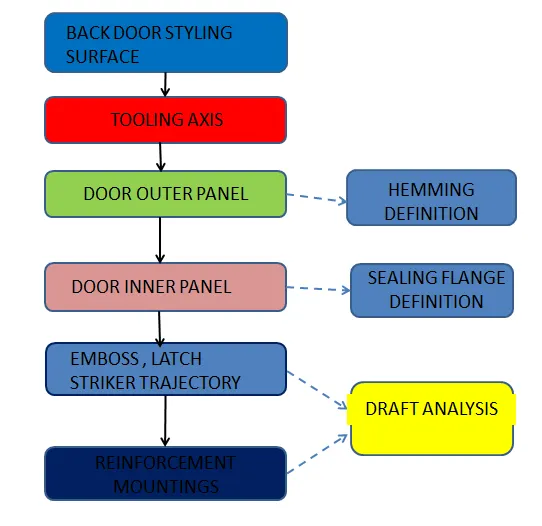
A Top Down Design Approach is used where an Assembly file is created in NX and all working parts are created with suitable feature groups
DESIGN CONSIDERATIONS
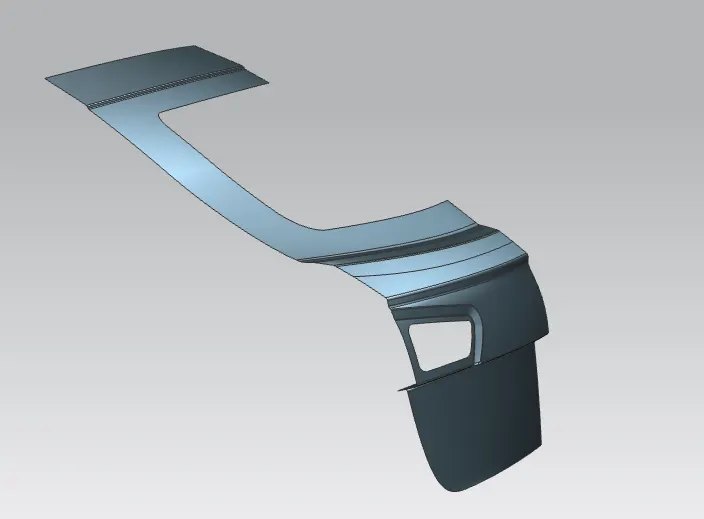
- The Styling surface is checked for Surface integrity and irregularities are developed and saved for further Surface Developments.
- To improve the Luggage Compartment the Panel is drawn thinner with considerable space for all the mounting parts and wire harness.
MATERIAL PREFERENCE
The inner panel is made out of Steel which is manufactured through deep drawn process hence reinforcements are essential to compensate the strength. At times Aluminum panel are used for casting outer panel which significantly reduces the weight and thickness can be varied along the panel without the requirement of reinforcement mountings.
Although with added advantages of Aluminum, Steel Drawn parts are used which is much cheaper than the former.
LOAD CASE ANALYSIS
Bend Test
Torsion Test
Abuse cases
Dent test
Assembly Load Cases
Endurance test
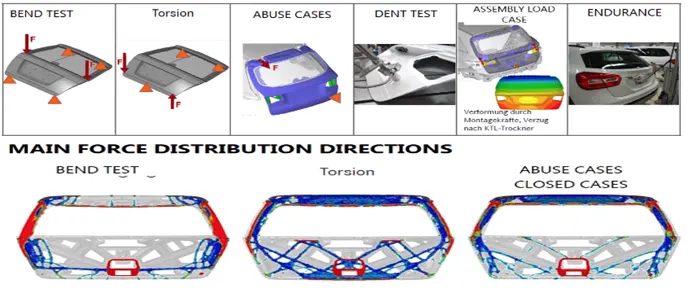
Force Distribution under various load simulations [Source: Skill Lync (1)]
Based on these test the effects of Gas Stay positioning or Power spindle is calculated.
TOOLING DIRECTION
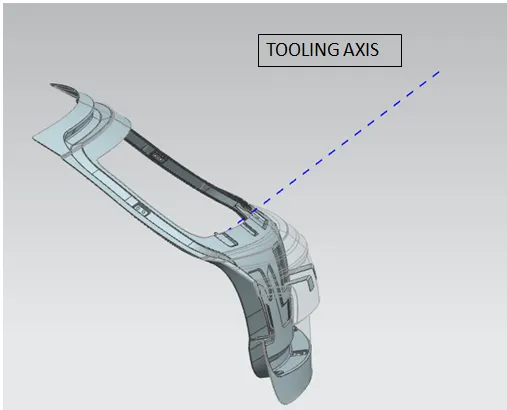
Based on the Styling surface the foremost step is definition of tooling direction for Deep Drawn Steel process and all downstream metal operations are based on Tooling Axis.
LATCH & STRIKER TRAJECTORY
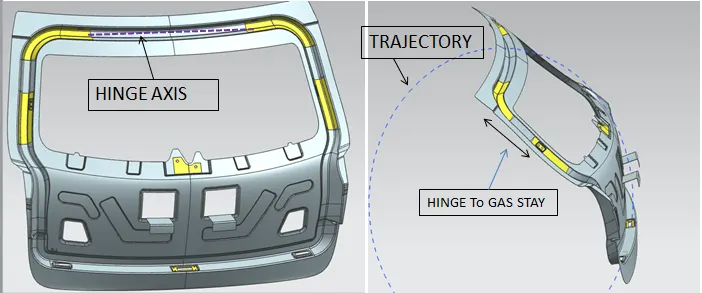
To define the opening and Closing Trajectory, the hinge and Latch are positioned based on the Hinge axis and Trajectory. The Circle drawn should perpendicular to the Latch’s Striker to satisfy the condition. Based on the Rotation trajectory the Hinge Axis, Latch Striker and predefined Gas Stay are correlated for smooth kinematics of door opening and closing.
Based on the type of Gas Stay, Door Weight and Kinematics the distance between the Gas Stay and Hinge axis is 60-90mm and an angle of 85-90.
EMBOSS DEFINITION
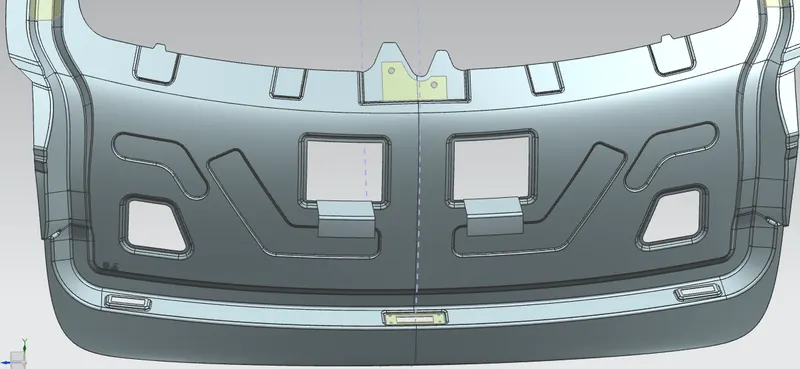
Based on the Load Simulations the Force acts in Y and hence emboss are defined on the inner panel to dissipate the force outwards caused due to slamming of door and Crash situations.
Emboss are defined and drafted along the tooling direction for feasible manufacturing and imparts strength to the panel without the need for increase in thickness.
HEMMING
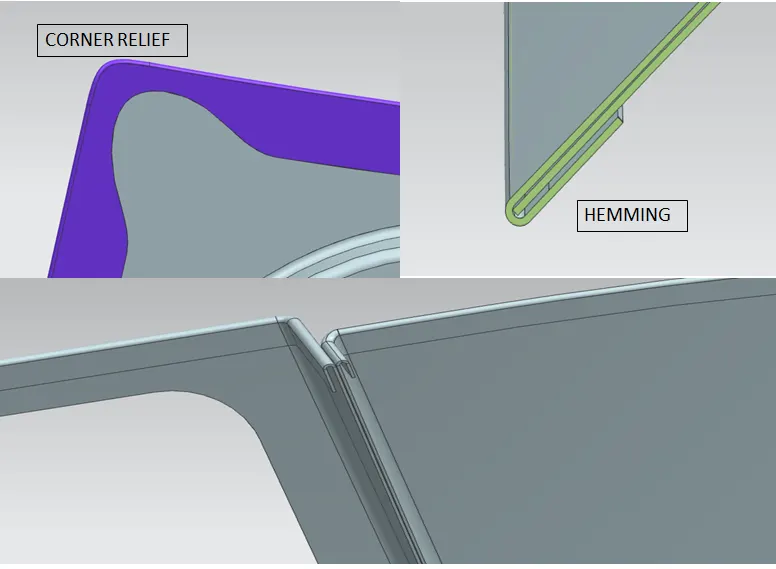
Hemming is a sheet metal joining process of inner and outer panel by eradicating the spot welded areas which affects the aesthetics of outer panel. It is also a safety requirement for door handling along the edges and suitable relaxations are provided along the corners to avoid stress concentration
MASTIC INFLUENCE
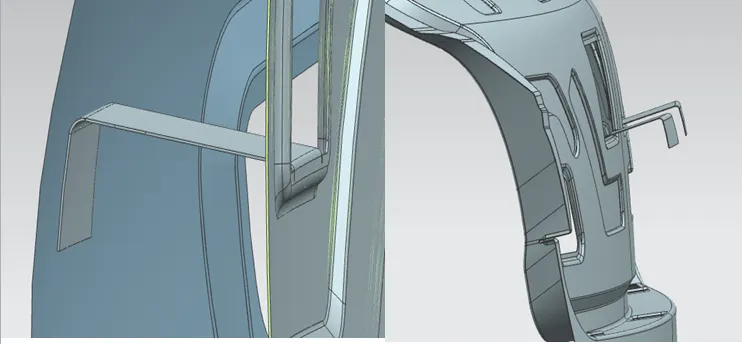
Apart from Hemming the Outer and inner panel are joined using mastic influence points to avoid the rattle noise and improve the NVH and Trim part mounting points are provided which are usually snap fits.
REINFORCEMENTS
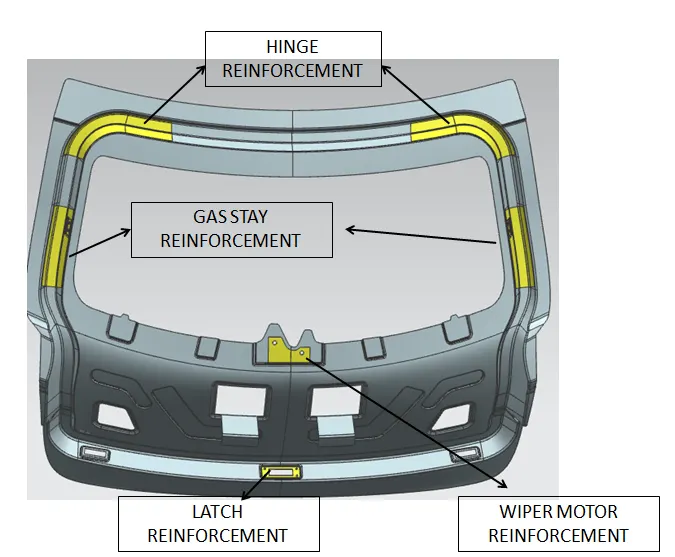
Reinforcement structures are provided to compensate the loss of strength on the embossed section of mouting points.
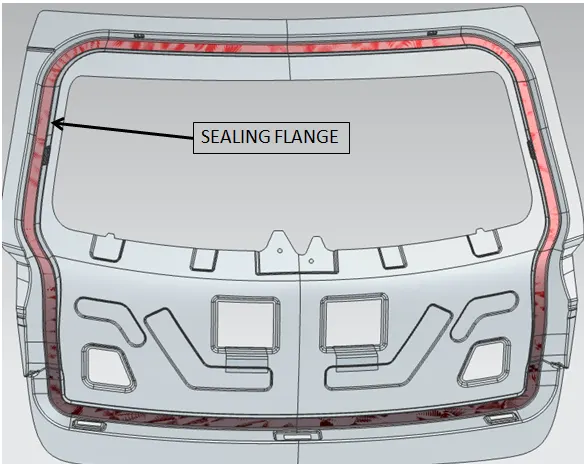
SEALING FLANGE
The Sealing Flange section shown forms an integral part as it contacts with Roof, Body Side Door and Rear Lower Panel.
DRAFT ANALYSIS
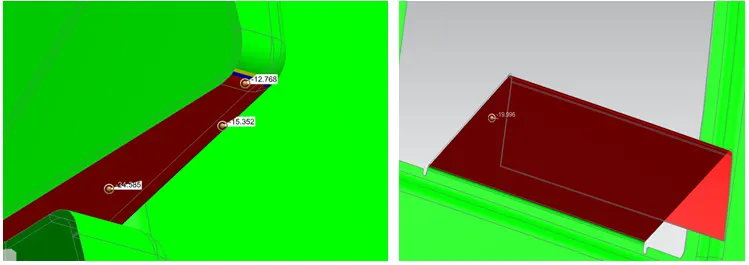
The Draft Analysis shows that the drafted section of inner panel are above 5 degree and are feasible for deep drawn process.
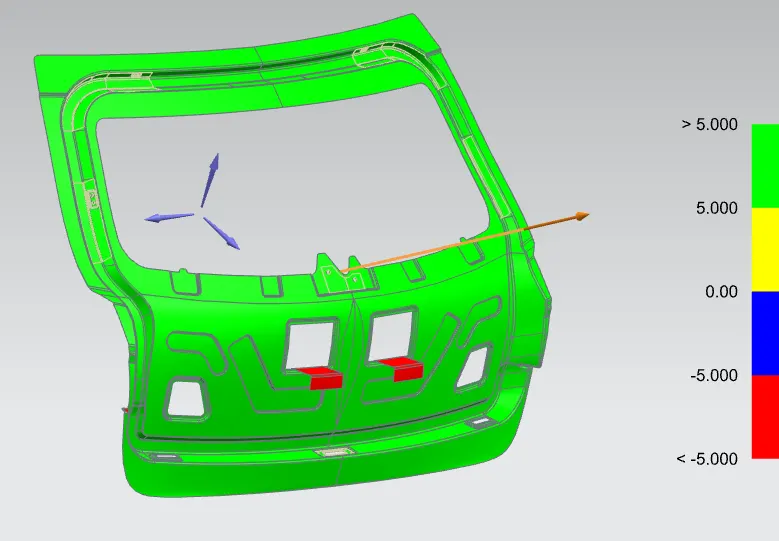
The Mastic Influence section and Connecting Flange needs seperate tooling direction
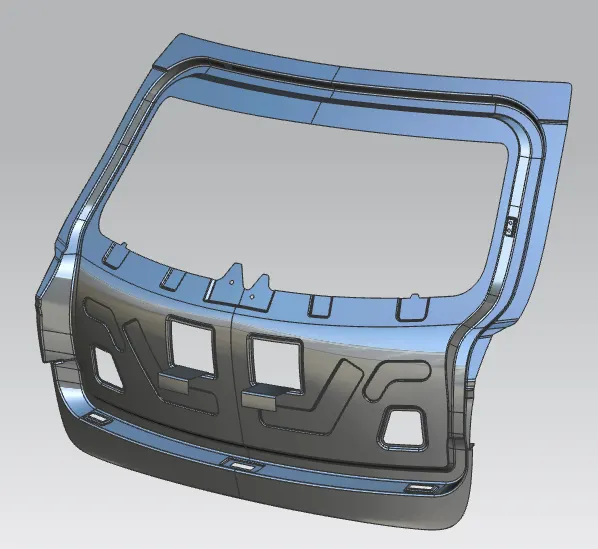
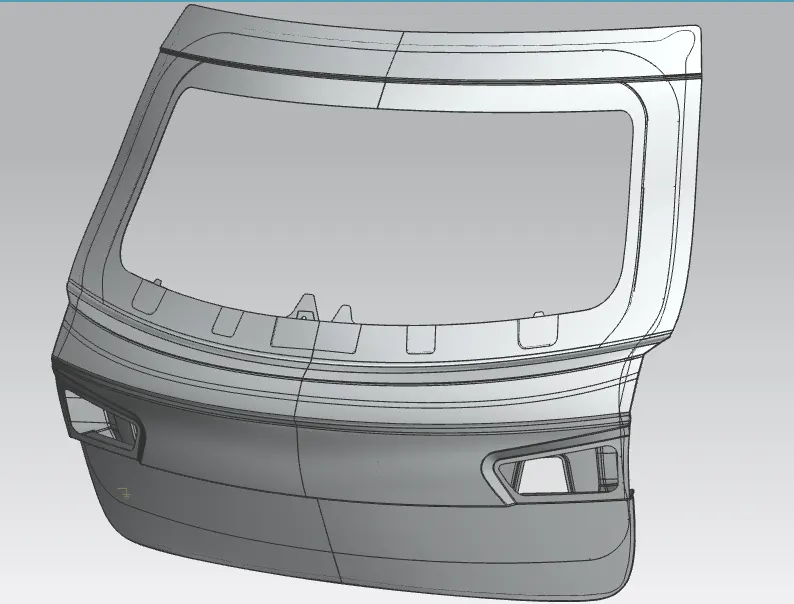
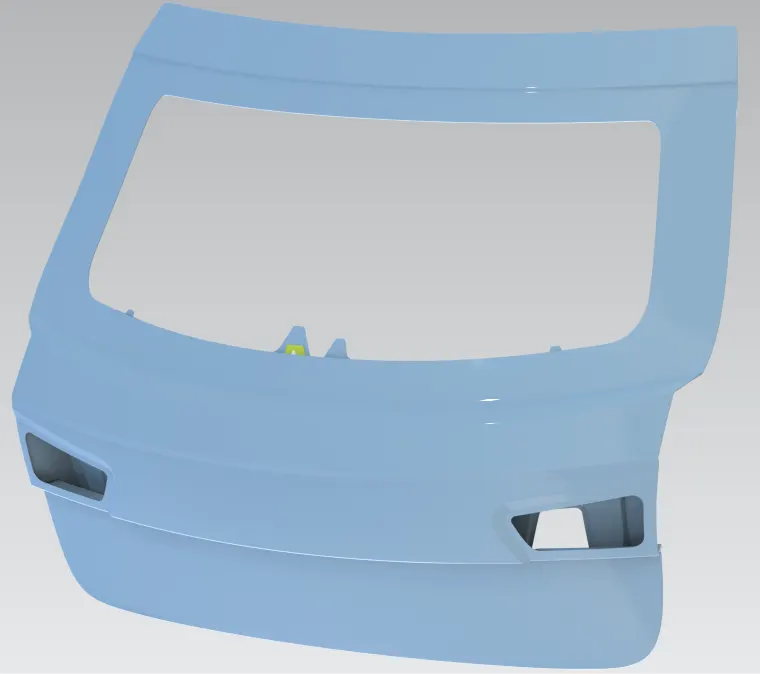
RENDERED IMAGES
CONCLUSION
Thus using the provided styling surface back door is designed with appropriate design methodologies and provided the necessary reinforcements and embosses.
REFERENCES
1)Skill-Lync. 2020 Automotive Sheet Metal Design . [online] Available at: <https://skill-lync.com/> [Accessed 16 November 2020].
2) Ngai, A. and Arnold, M., 2020. ANALYSIS OF A PRESSED COMPOSITE AUTOMOTIVE TAILGATE USING ANSA & Μeta. [online] Semanticscholar.org. Available at: <https://www.semanticscholar.org/paper/ANALYSIS-OF-A-PRESSED-COMPOSITE-AUTOMOTIVE-TAILGATE-Ngai-Arnold/b003edb901e49af1d3b4f79a0c3d25ca443a16ae> [Accessed 16 November 2020].