Design of backdoor
BACK DOOR DESIGN (BIW) USING SIEMEN NX
OBJECTIVE
The main objective of this project is to learn the Basics of the BIW (Body in white) through designing the Back Door "also referred to as Tail Gate of a car by considering all the Protocols and Standards of BIW Design
INTRODUCTION
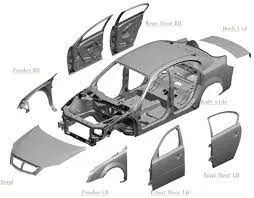
What is BIW?
Body in white (BIW) is the stage in automobile manufacturing in which a car body's frame has been joined together, that is before painting and before the motor, chassis sub-assemblies, or trim (glass, door locks/handles, seats, upholstery, electronics, etc.) have been integrated into the structure. Assembly involves different techniques such as welding (spot, MIG/MAG), riveting, clinching, bonding and laser brazing, Body in white refers to the stage in automotive manufacturing when a car's sheet metal components are welded together which include
- Hood
- Trunk lid
- Roof
- Front and rear fender
- Sidewall
- Side Doors
- TailGate (Back Door)
The term BIW derives from manufacturing practices before steel unibody monocoques-when automobile bodies were made by outside firms on a separate chassis with an engine, suspension, and fenders attached The manufacturers built or purchased wooden bodies (with thin, nonstructural metal sheets on the outside) to bolt onto the frame. The bodies were painted white prior to the final color.
A folk etymology for "body in white" is the appearance of a car body after it is dipped into a white bath of primer (undercoat paint)-despite the primer's actual gray color. BIW could also refer to when car bodywork would be made of timber - all timber products, furniture, etc. are considered to be "in the white" when at the stage of raw timber before finishing or varnishing.
In-car design, the "body in white" phase is where the final contours of the car body are worked out, in preparation for the ordering of the expensive production stamping die. Extensive computer simulations of crash-worthiness, manufacturability, and automotive aerodynamics are required before a clay model from the design studio can be converted into a body in white ready for production.
What is a Tail Gate (Back Door)?
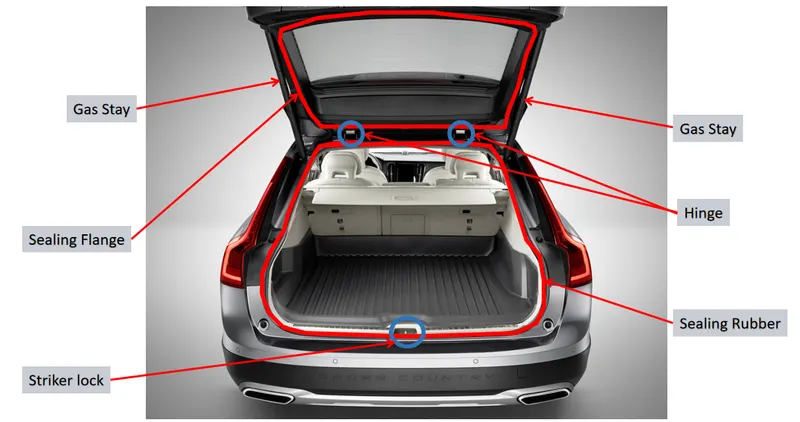
The Tailgate or the Back door of a car is the Door at the rear end of the car, which provides access to the luggage compartment. In most of cars, these back doors are operated with the help of gas stay which in turn reduces the effort required to lift open the door. Some luxury cars have a powered backdoor that is driven by an electric motor. This kind of system is also called a powered trunk lid system. The Back door is also responsible for dissipating the force created while rear collisions, away from coming inside the car.
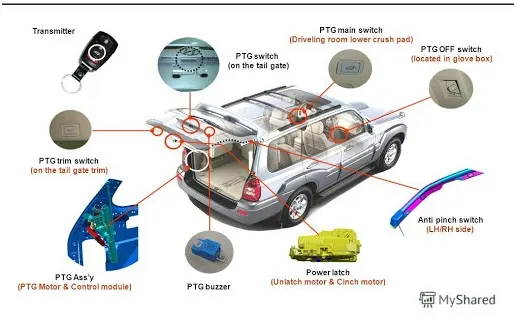
The Back Door of a car is the rearmost part of the vehicle which gives access to the trunk space of the vehicle. The rear door also supports the reinforcements and added weights of the Wiper Motor, Gas Stay, Tail Lamp, and Latch and Striker. The back door is usually made of an inner panel and 2 or 3 separate inner panels joined together by hemming or spot welding wherever necessary. The material used for door manufacturing depends on the budget and performance of the vehicle. Mostly Aluminium and Steel will be used whereas low-budget vehicle uses Steel which makes the manufacturing process easy and cost-efficient since it follows the Stamping of Moulds. But Aluminium was used for high-budget cars since it increases the manufacturing cost since the Aluminium parts will be mostly die-casted hence it has a variable thickness which reduces the requirement of reinforcements but improves the performance of the car rapidly since Aluminium is not heavy as steel.
DESCRIPTION
In this project, we are going to create the Assembly of a Back Door using previously given Styling surface (outer panel surface) as the reference. The software used here to model the Tailgate is Siemens NX
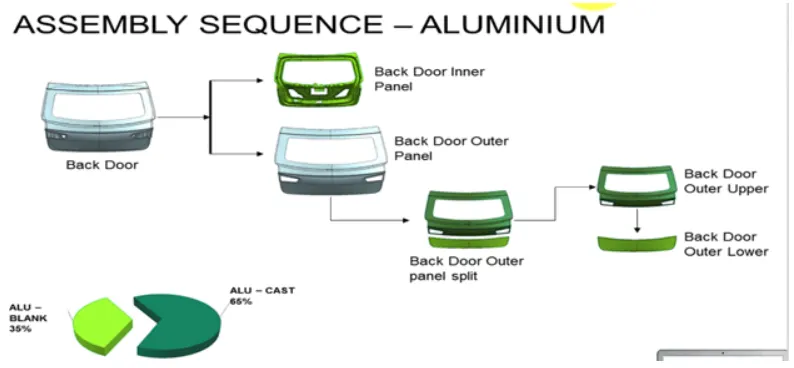
The assembly of the Back Door consists of various components such as the Outer panel Upper. Outer panel Lower. Inner panel. Hinges, gas stay Latch, and the Reinforcements. Here we are mainly dealing with the design of the inner panel.
For creating a Tailgate, there are several Factors and standards a Design engineer should consider Some of them are below
DESIGN CONSIDERATION OF A BACKDOOR:
- Functional Requirement of Hinge and gas stay
- Rear visibility criteria Luggage volume
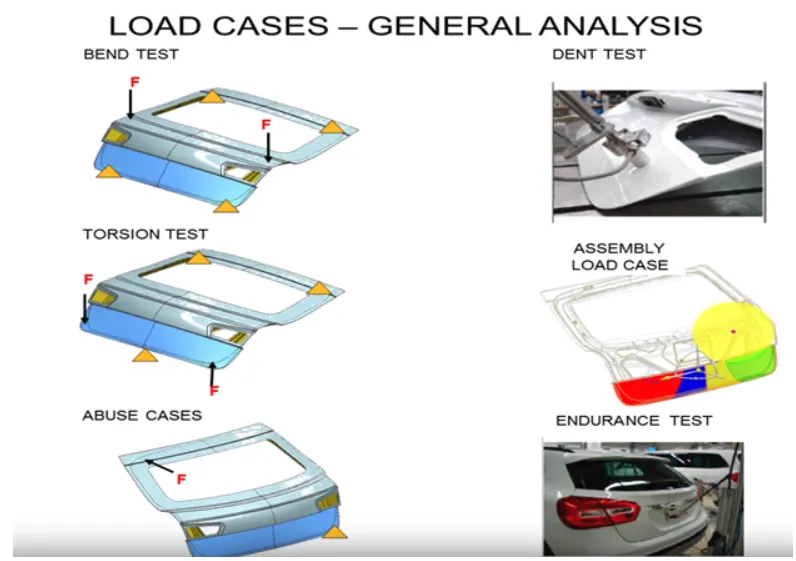
- Crash Analysis.Bend Test, Dent Test, Torsion Test & Endurance Test
- Rear Crash Regulation Gap and flushness Requirements
- Material selection
- Stiffness and strength and weight of the part
- Hinge position
- Latch position
- Distance from the outer panel to mastic points Should be maintained in between 4-6 mm
- Drawability (Minimum 7 degrees open)
- Hemming parameters
- Material selection
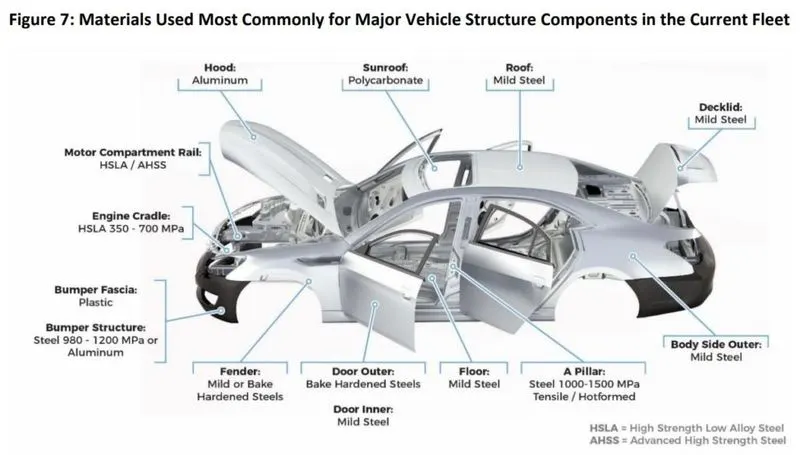
Tailgate BIW is expected to possess a number of significant properties. It must have high tensile strength as well as high stiffness-bending, torsional, static, and dynamic. It must also provide good quality safety both to the car body and to its occupants against crashes of all kinds front, rear, side, or even roll over, meeting the Federal Motor Vehicle Safety Standard No. 208. It should also be able to protect occupants from noise, vibration, and/or harshness (NVH) by absorbing or reducing these conditions. Also, it should be easy to weld and form, as well as be highly paintable and easy to design. It should provide a good surface finish that is smooth, and should also be corrosion resistant. Improvement of fuel economy also necessitates the use of lightweight materials in BIW, as it constitutes a significant share of a car's weight, in addition, given environmental concerns in recent times, it is also expected to be recyclable. Given such extensive requirements, only steel and aluminum have been used for making BiW; the former is preferred for its high strength and low cost, while the latter is preferred for its lower density that helps reduce car weight
- Stiffness strength and weight of the part
As the Back door protects the passengers from rear collisions, it should have enough strength and stiffness Stiffness strength and weight of the part depend upon major two factors. The first is the material selection which is discussed above and the second one is the Design of the part.
A Design engineer can easily increase and reduce the stiffness of the part through his or her designs. The methods of increasing stiffness and
strength of the parts is adding Embosses in the models.
Embossing
Sheet metal embossing is a stamping process for producing raised or sunken designs or relief in sheet metal. This process can be made by means of matched male and female roller dies or by passing sheet or a strip of metal between rolls of the desired pattern Adding embosses to a sheet metal part, drastically increase the strength of the party
- Rear visibility criteria
These criteria deal with the visibility of passengers backward through the rear windshield glass.it mainly depends upon the Wind glass area Here in this case as we already have a styling surface wind already included in the windshield area we need not worry about the Rear visibility criteria
- Hinge position
Hinges are the part that helps to open the Back Door to the luggage space. One part of the hinge is connected to the inner panel of the Back Door while the other is connected with the Roof
There are a few things to consider while the positioning of hinges i
The surface where the hinges are to be mounted must be flat in order to keep the hinge tightly in touch with the inner panel, otherwise, it leads to loosening of the nuts and bolts resulting in NVH (Noise Vibration and Harshness)
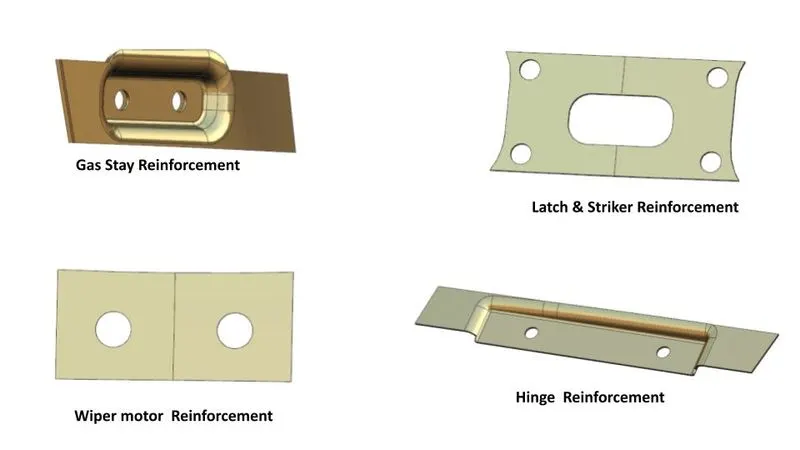
Reinforcements must be provided on both hinges. Because in sheet metals adding another solid body or a sheet body on it will result in decreasing the strength of the part. To overcome this problem Reinforcements are used
The central line or the axis of each hinge must be colinear
- Latch position
Placing a Latch/striker is one of the major factors to take care of As a Latch/striker is a separate body and itself a reinforcement, there is no need to add extra reinforcements. But like in hinges it’s compulsory to have a flat surface to mount it.
The striker in the Body and the Latch in the back door must be normal to a trajectory path to have a smooth locking and unlocking.
- Distance from the outer panel to mastic points
The Mastic sealant or the Mastic point is an elastic compound that behaves like rubber. The mastic points are defined on the hood inner panel where the hood can easily deform. They help the hood outer panel to come back to its original shape after it gets deformed The distance from mastic points to the outer panel must be 2-8 mm
- Hemming parameters
Hemming is a sheet metal forming process in which sheets are joined by bending it usually to 180°. Automotive body panels and automotive parts such as deck-lids, trunk-lids, doors, hoods, and tailgates are formed by the hemming process.
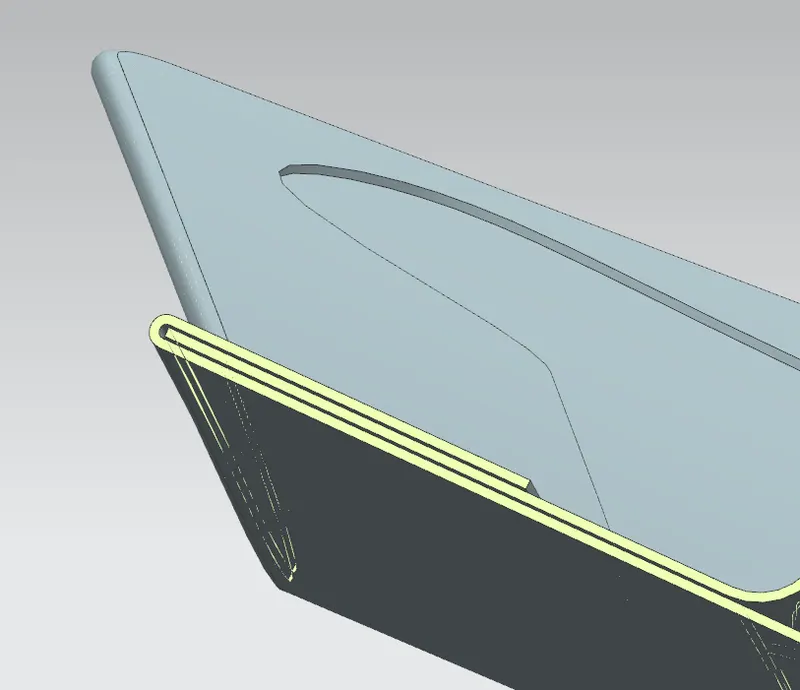
While hemming the gap between two sheet metals must be in between 2 to .5 mm and the distance bend of the outer sheet metal to the edge of the inner sheet metal must be 2 mm.
- Drawability (Draft Analysis)
To understand what is draw ability, first, we should know what is deep drawing
Deep drawing
Deep drawing is a sheet metal forming process in which a sheet metal blank is radially drawn into a forming die by the mechanical action of a punch. It is thus a shape transformation process with material retention. The process is considered 'deep drawing when the depth of the drawn part exceeds its diameter. This is achieved by redrawing the part through a series of dies. The flange region (sheet metal in the die shoulder area) experiences radial drawing stress and tangential compressive stress due to the material retention property. These compressive stresses (hoop stresses) result in flange wrinkles (wrinkles of the first order). Wrinkles can be prevented by using a blank holder, the function of which is to facilitate controlled material flow into the die radius. The feasibility of this deep drawing is called Draw ability.
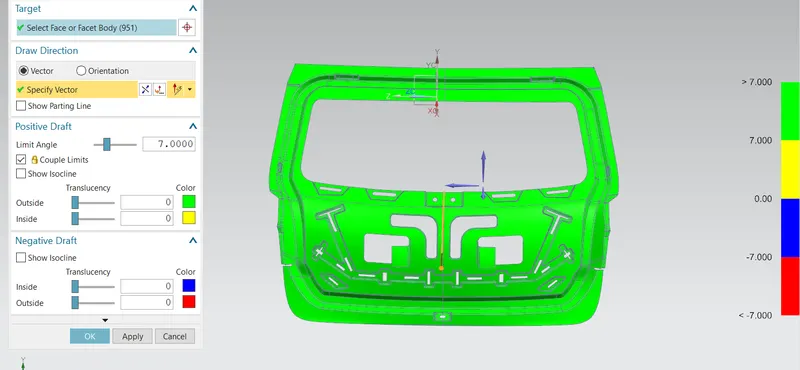
Draft analysis in Siemen NX is one of the tools used to study the deep drawing feasibility easily through checking draft angle in the various faces The Designer should Define a tooling direction in order to check the draft angles
- Holes (to drain the primer from the cavities)
On the inner side of the Tailgate, we can see several holes in the hood. Every hole in it has its purposes. Apart from the holes for the fasteners, these holes allow e-coating, surface prep, and primer to drain from the cavities in between the tailgate skin and tailgate skeleton after the chassis is dipped into these during production.
Components to Design
Here in this project, we are not creating the hinges as well as the latches., only we are creating Back Door outer panel Back Door inner panel Reinforcements for Hinge, Gas stay, and Viper mount
So in this case we need to assume the hinge position and hinge axis appropriately.
Back Door outer panel design methodology
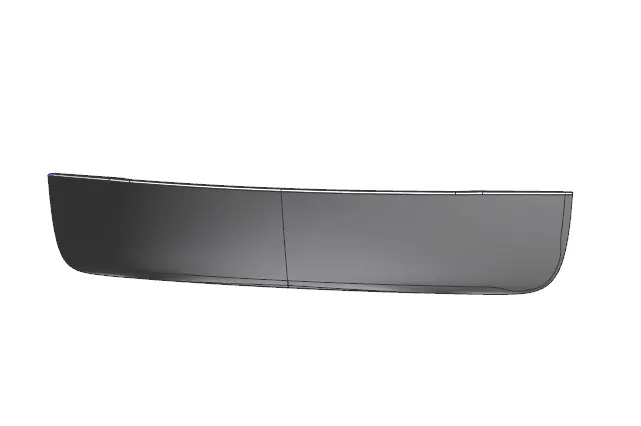
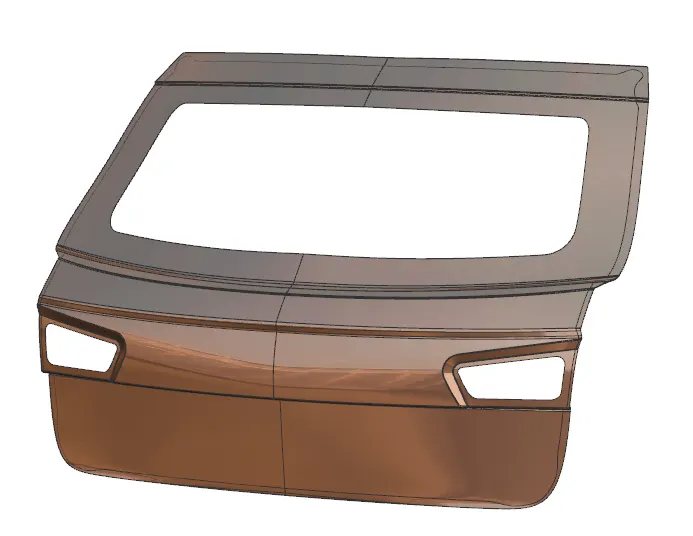
As we have the styling surface as the reference we need not to work more on the outer panel only need to create the hem flanges after the creation of the inner panel. Here the outer panel of the tailgate consists of two parts which are the Outer panel upper and the Outer panel lower. These two components are joined using the Laser Brazing method
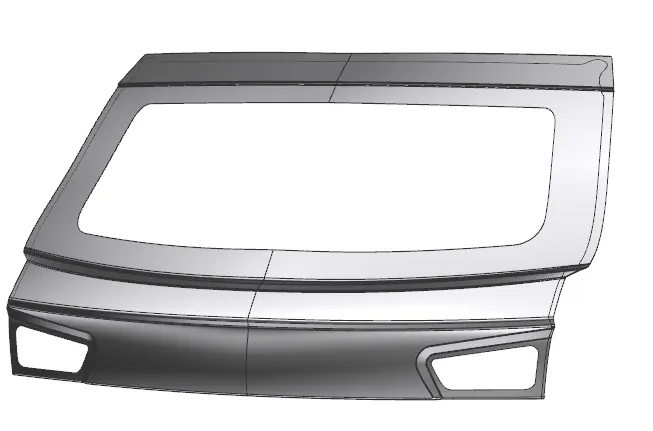
Laser Brazing
Here the outer panel of the tailgate consists of two parts which are the Outer panel upper and the Outer panel lower. These two components are joined using the Laser Brazing method
Joining methods, in which the brazing solder is melted with the help of an industrial laser, have been used mainly in the mass production of vehicle bodies. There, laser beam brazing is mostly used for joining galvanized metal sheets or lightweight components made of aluminum, but also for other brazing materials. Laser automobile brazing is usually realized with a brazing optic that is integrated into a robot. The laser beam is guided along the joint where it melts the brazing solder-e.g. a copper-silicon-wire- and in so doing connects the components. The success of the brazing process is based on whether the firmness is similar to the welding seams and the high esthetic quality of the joints: brazing seams that were generated with lasers are known for their sealed, smooth and clean structures. This is visually attractive and reduces post-processing to a minimum. Car body construction, for example, can often be lacquered immediately after cleaning.
Back Door inner panel design methodology
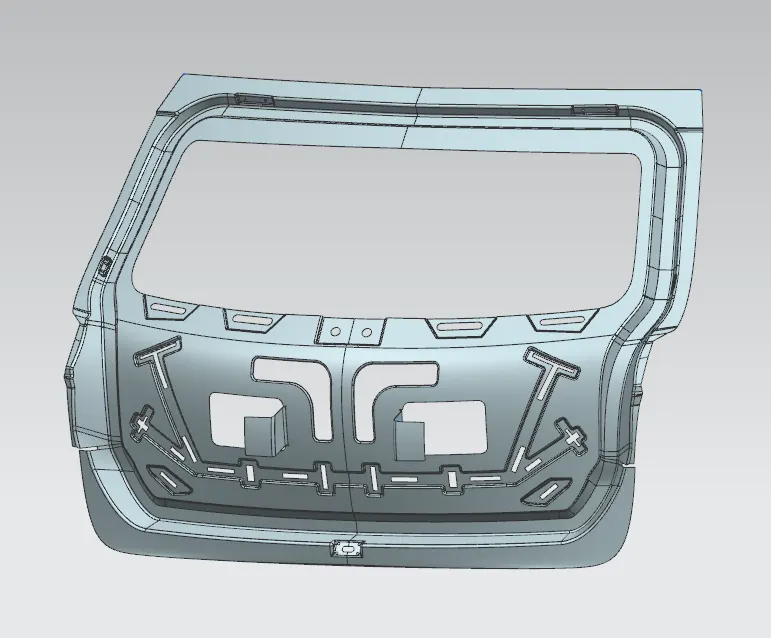
The inner panel is the part that gives enough strength to the outer panel as well as is the part where the viper, latch, hinge, and gas stays are mounted along with the Reinforcements.
The first thing I have created is the sealing flange of the Tailgate
Sealing Flange
The sealing flange is the part of the tailgate where it touches and presses the rubber gasket on the Body's side outer in order to avoid the entering of water into the luggage area.
curves.
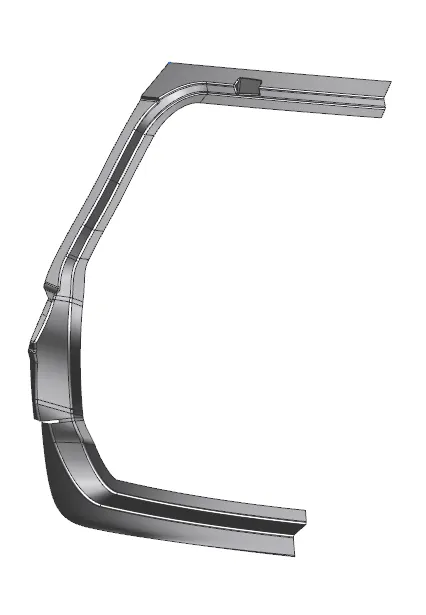
The sealing flange is created by offsetting the outer panel to the required distance and also by creating some studio surfaces guided by some bridge curves
Embosses For Hinge. viper mount and Gas stays
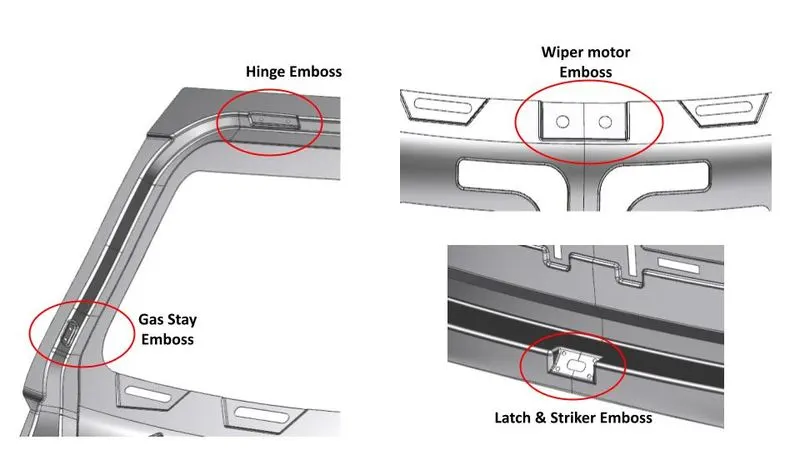
I have made one emboss for the Hinge in the appropriate position and another one emboss for the Gas stay mount. Also, I have made a flat surface on the embosses as the hinge and the gas stay need to be mounted on it.
Flanges for the mastic
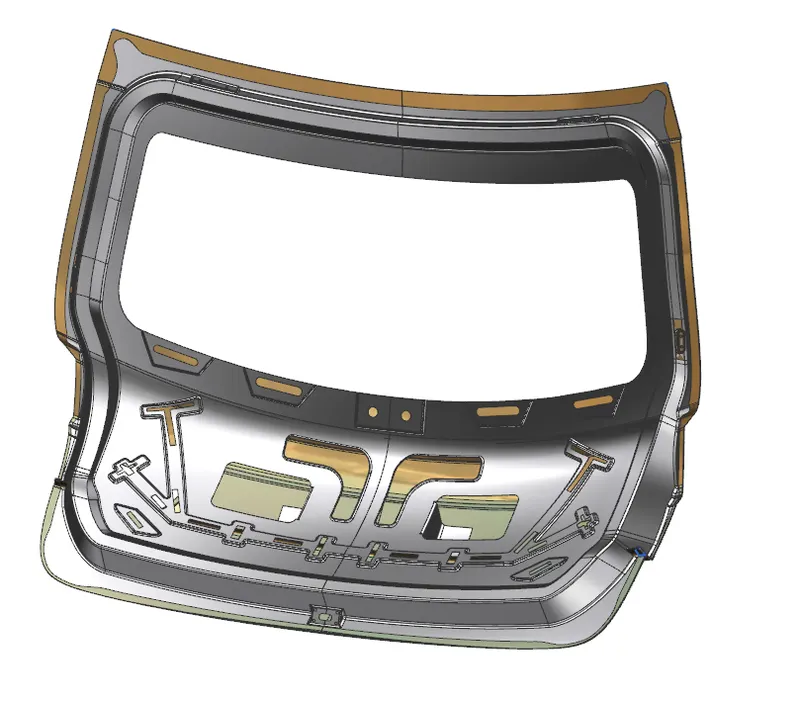
Apart from the hemming, the outer panel of the tailgate must be supported using some flanges from the inner panel and some mastics on it. So I have created some cutouts and created some flanges from the edge of the cutouts for creating the mastic points as shown in the figure. The distance from the mastic point to the outer panel is maintained at 5 mm
Embosses for Dissipation of collision force and Cutouts for weight reduction
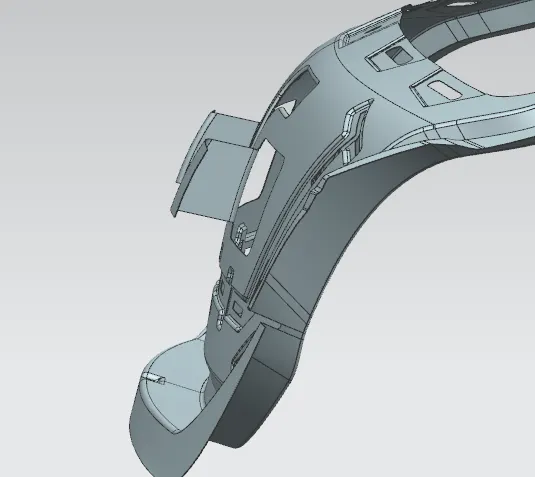
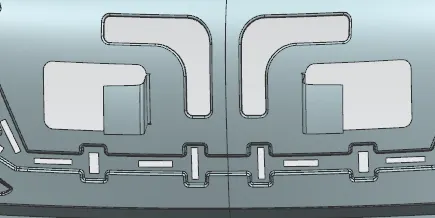
To dissipate collision force getting inside the car, Some embosses are made and directed towards the sides of the tailgate as shown in the figure
From the embossed surfaces, some materials are removed in order to reduce the weight of the part.
The embossed are created in such a way that when there is an impact on the tailgate the force is distributed along the sides tailgate flowing towards the hinge to minimize the impact.
Latch positioning
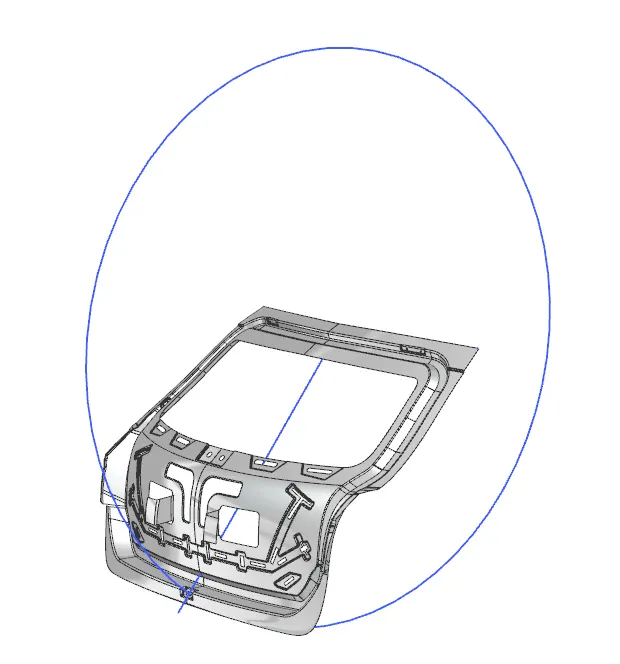
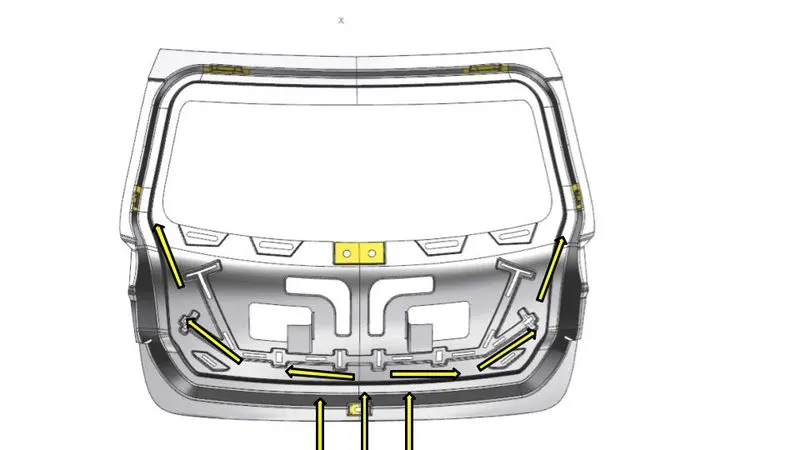
Latch positioning is one of the critical operations in the designing of the inner panel. For positioning the latch, first, a line is drawn from the axis of one hinge to the axis of the other hinge. After that, a trajectory circle is drawn from the center of that line as it crosses the surface where the latch is placed. And then make the latch axis tangent to the trajectory circle.
Here as i don't have the Hinges as well as the Latch, I am drawing a line from the emboss of the hinge to the other from that line I have drawn a circle and an emboss is created for the Latch where the circle crosses the inner panel.
Draft Analysis
I have created a line for the tooling direction and after draft analysis, There are some embosses with the negative draft. But in this case, it's negligible as all the embossing cannot be deep drawn in a single stretch.
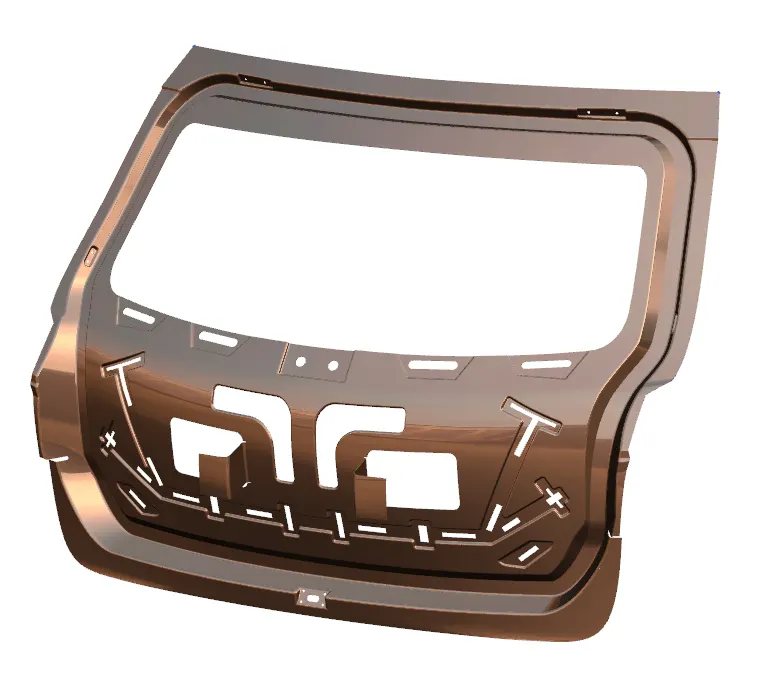
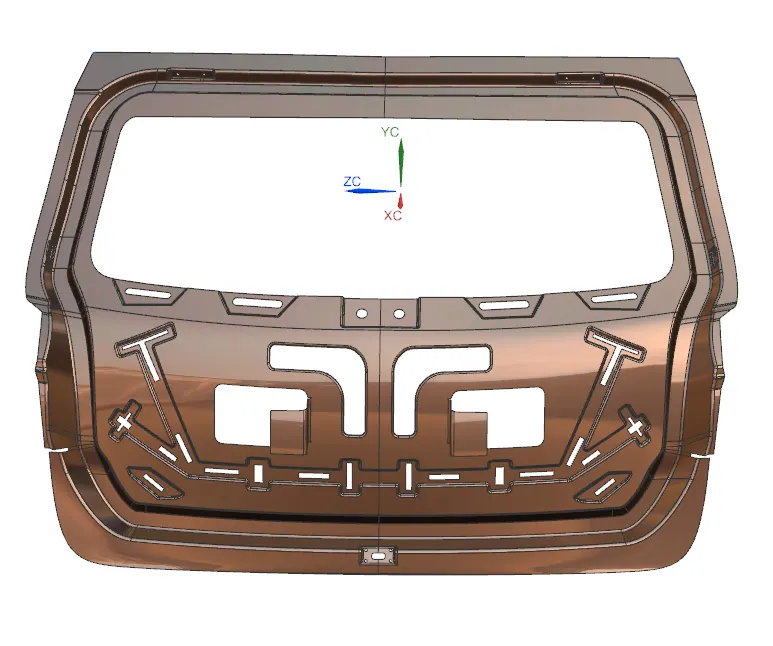
Back Door inner panel design views
Reinforcements
Reinforcements are used in the areas of sheet metal where other components are attached. The reinforcements compensate Reduced strength of the sheet metal while another component is added to it.
Complete Tail Gate design views
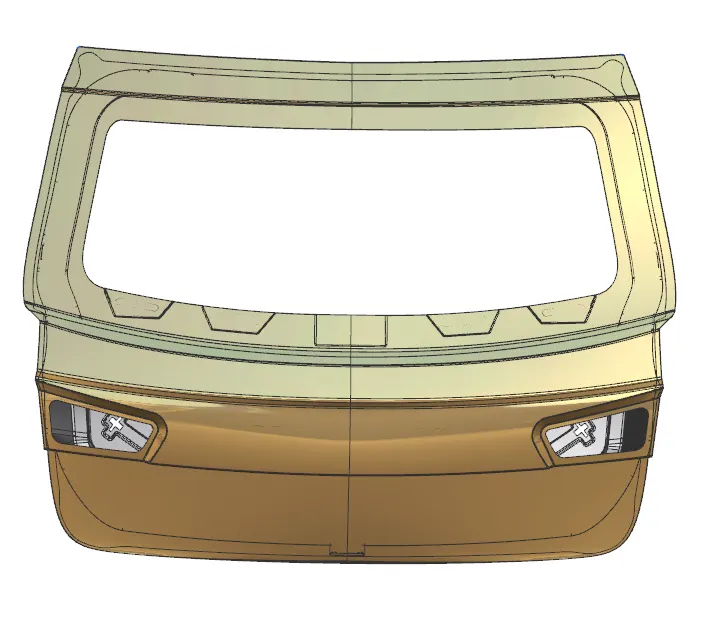
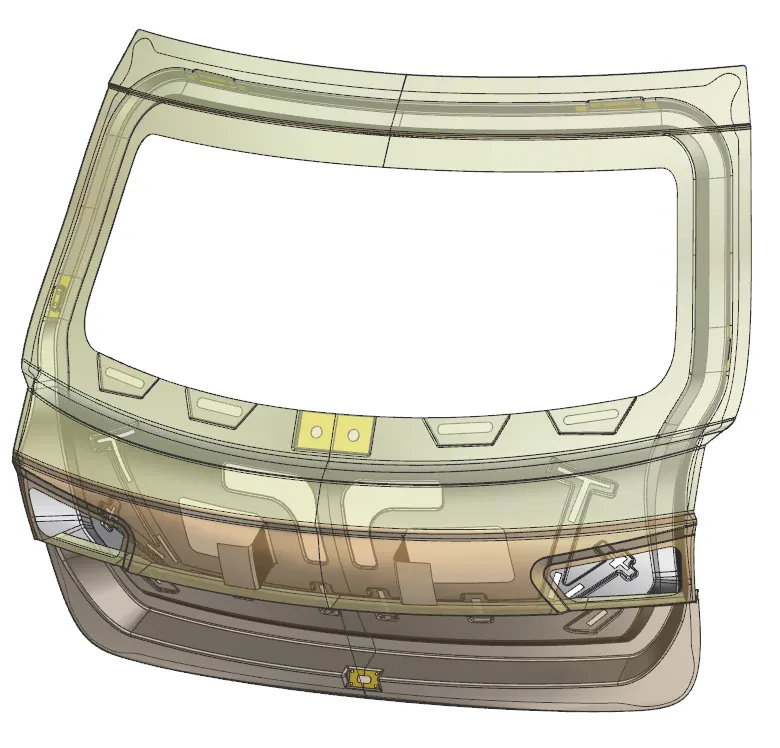
CONCLUSION:
Thus the Body In the White Back Door of a car was designed following the engineering standards and also the deep drawing requirements were satisfied.