Design of backdoor
The purpose of this report is to provide a comprehensive overview of the design methodologies and components developed for the back door of the Body in White (BIW) in automotive manufacturing. The back door serves as a crucial component in BIW, providing access for maintenance, assembly, and ensuring safety standards are met.
The back door serves as an essential component of buildings, providing access while also contributing to security, functionality, and aesthetics. This report outlines the design methodologies employed and the components developed as part of the back door design process.
Based on the requirements analysis, multiple conceptual designs were generated. These designs were evaluated against criteria such as functionality, ease of use, manufacturability, and compliance with safety regulations.
The frame structure forms the backbone of the back door assembly, providing structural support and rigidity. It was designed to withstand various loads and stresses encountered during operation.
High-quality hinges and latches were developed to facilitate smooth opening and closing of the back door. Special attention was paid to ensure robustness and reliability, especially in demanding environments.
Sealants and gaskets were incorporated into the design to prevent water ingress, dust accumulation, and ensure airtight sealing when the back door is closed. These components were selected for their compatibility with automotive-grade materials and resistance to environmental factors.
The design of the back door for BIW involved a systematic approach encompassing requirement analysis, conceptual design, CAD modeling, simulation, prototyping, and testing.
Utilize the Face Blend tool in NX to smooth transitions between different surfaces of the backdoor, ensuring a seamless appearance. Adjust blend parameters to achieve the desired curvature and continuity with surrounding geometry.
Next, employ the Bridge Curve tool to create connections between disparate surfaces or edges, facilitating the creation of smooth transitions and eliminating sharp edges or discontinuities that could compromise the concealment of the backdoor.
To enhance the complexity and discretion of the backdoor design, leverage the Curve on Surface tool in NX. This allows you to create curves directly on existing surfaces, enabling the creation of intricate patterns, contours, or features that blend seamlessly with the surrounding geometry.
Conducting a comprehensive draft analysis is essential to validate the functionality and concealment of the backdoor design.
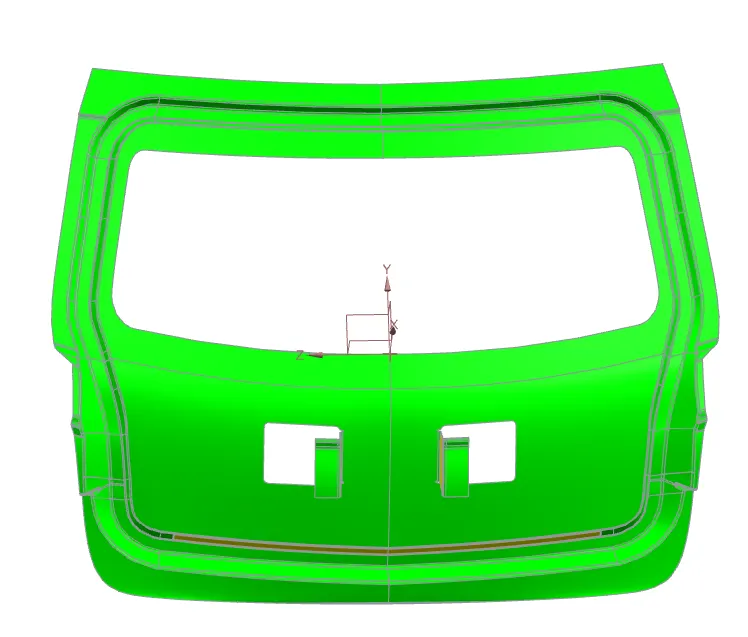
|
Draft analysis from tooling direction |