Design of backdoor
Aim: The aim of this project is to design a sheet metal panel for the backdoor, based on the provided skin data, while considering all the relevant design rules and guidelines.
Abstract: The backdoor, also known as the tailgate, serves the primary function of covering the rear end of a car. However, it also incorporates additional functionalities such as ensuring rear visibility and accommodating boot space. Designing this component requires careful consideration of factors like the rear roof rail's master section, the sealant flange, and its contact with the car's side body.
Theory: To begin the backdoor design process, it is essential to determine the type of backdoor required, as this determines the hinge axis around which the backdoor will open and close. The three types of backdoors are top-mounted, side-mounted, and bottom-mounted. The hinge axis will be positioned accordingly, aligned with the tailgate mounting point. This initial step helps determine the placement of the latch and striker mechanisms.
Types of back door:
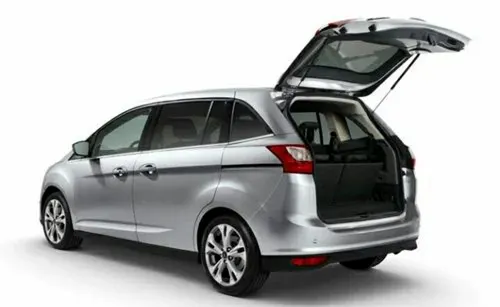
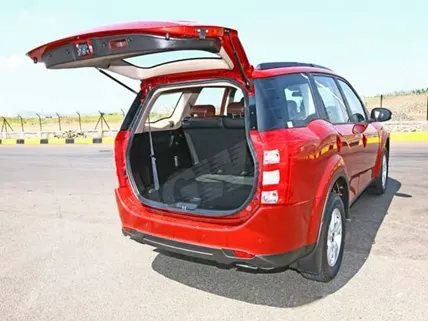
1)Top-Mounted:
Top-mounted back doors are commonly found in station wagons, pickup trucks, and certain sport utility vehicles. In modern cars, these tailgates are often equipped with power-operated mechanisms and gas stay supports. The top-mounted design offers enhanced rear visibility compared to side-mounted or barn-style doors that may have center pillars obstructing the view.
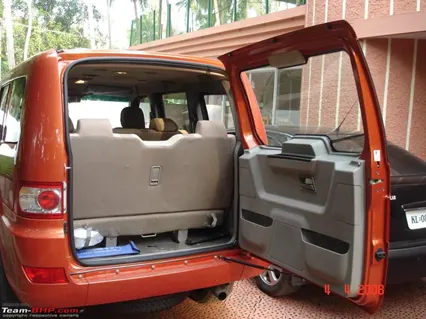
Side-Mounted Doors:
Side-mounted doors, also known as barn doors, are commonly used in van-type MPVs, SUVs, and pickup trucks. Unlike top-mounted doors, side-mounted doors offer easier accessibility. They are typically smaller in size and can be conveniently accessed for loading and unloading purposes.
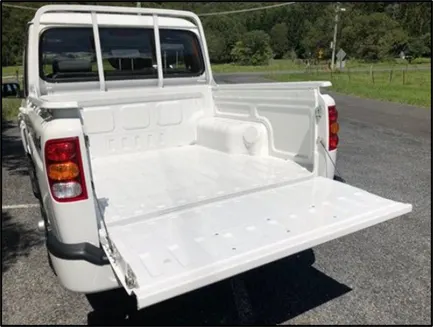
Bottom-Mounted Back Door:
Bottom-mounted or split-type backdoor systems are commonly found in estate cars, pickup trucks, and certain luxury SUVs. These backdoors offer exceptional convenience, as the bottom split can serve as a support or even function as a table for occupants during their travels. This design provides additional versatility and utility for users.
Materials Selection:
The choice of material for the backdoor plays a significant role in determining its overall weight. The two common materials used are steel and aluminum. Steel has a higher density compared to aluminum, resulting in a heavier door. The material selection depends on the car's budget, with lower-cost vehicles typically utilizing steel due to its affordability. However, it is worth noting that using cast aluminum parts instead of deep-drawn steel parts eliminates the need for reinforcements and reduces the overall weight of the car by approximately 5-10kg, thereby improving the vehicle's performance. Additionally, casted parts have a draft angle of around 3 degrees, while deep-drawn parts require a draft angle of 7-10 degrees, contributing to increased luggage/cabin space.
Components to create:
- Outer Upper panel
- Outer Inner Panel
- Inner Panel
- Hinge Reinforcements (LH and RH)
- Gas Stay Reinforcements (LH and Rh)
- Latch Reinforcement
Design Procedure:
The design procedure for the backdoor assembly involves several steps and considerations:
- Styling Surface Clean-up: Before creating the CAD model, it is crucial to check the given styling surface for any discontinuities or inconsistencies. The surface continuity is examined to ensure that the distance between the surfaces is within the acceptable tolerance limit (usually less than 0.0001 mm).
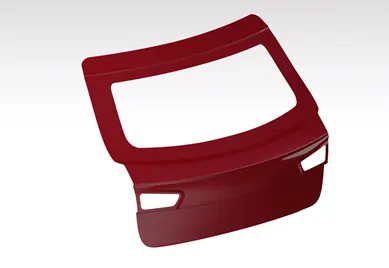
- Outer Panel: The outer panel serves as the outer styling skin surface of the backdoor. It is coated with multistage coatings that provide properties such as scratch resistance and rust prevention. The outer panel is wrapped around the inner panel using a hemming process.
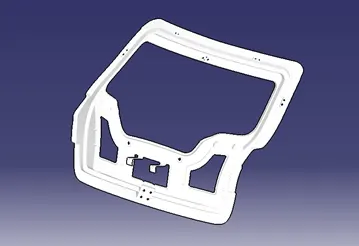
- Inner Panel: The inner panel is a vital component of the backdoor assembly. It provides structural strength and assists in dissipating external forces through strategically placed embosses. The inner panel also facilitates the mounting of various accessories, including hinges, wiper motor, gas stay, latch, and striker.
- Casting or Deep Drawing: The inner panel can be produced either through casting or deep drawing processes, depending on the material used. Aluminum parts are often casted, while steel inner panels are typically manufactured using the deep drawing process. In the case of deep drawing, a specific tooling direction is required to achieve the desired shape and dimensions of the panel.
- Corner Relief:
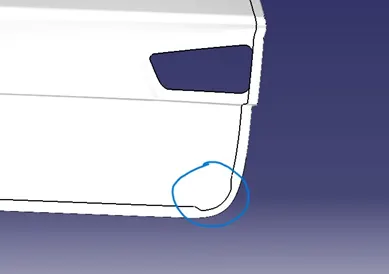
During the hemming process, the use of multiple rollers can result in vibrations and stress concentrations at certain locations, particularly at the corners. These conditions can affect the design intent of the panel, as the desired outcome is for the panel to spring back to its original formation once the roller is removed. However, corners often do not behave in the same manner, and the panel may not return to its intended shape.
Design considerations:
- Rear visibility
- Boot space & accessibility
- Sealing Flange
- Support structures like hinges and gas stays.
- Mounts for wiper motor, tail lamps and other wiring loops
- Rear crash regulations
- Joining techniques such as hemming, spot welding etc.
- Gap and flush requirements
Inputs for designing of backdoor:
- Outer Panel - 0.75 mm
- Inner Panel - 0.75 mm
- Reinforcements - 1.5 mm
Class A surface:
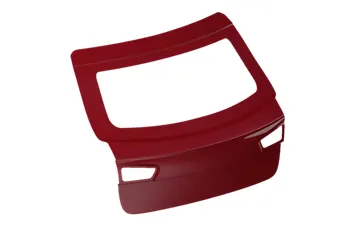
Creation of tooling axis:
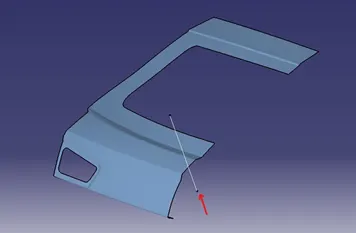
First, we need to create the Tooling direction for the Deep drawing operation. It shows that all the operations like embossing are done by considering this vector direction and it will help in manufacturing the part,
Design of inner panel:
Then we will be creating the Back door inner panel flange by offsetting the outer surface at a distance considering the sheet thickness and thickening direction.
Then created the connecting flange to join the inner panel and sealing flange.
Then for the windshield panel mounting, the windshield panel is created and joined with a sealing flange.
Offset the class A surface downward direction. To perform Hemming, offset the present surface to 0.95mm (inner Surface Thickness- 0.75mm, Inner panel thickness- 0.75 gap between Outer and Inner panel – 0.2mm, Hemming area bent region- 0.75mm, the gap between hem and Inner panel- 0.2mm)
Use the parallel curve option to 10mm to create the surface.
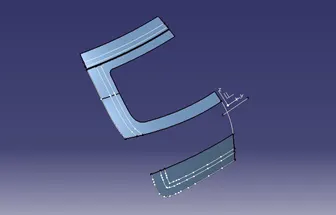
- Using the sweep command sweep the parallel curve with the tooling direction.
Using the split command split the offset surface.
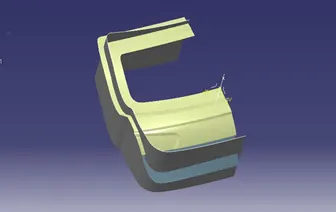
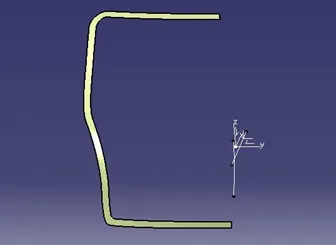
- Now, use the offset of 1.7 to trim the sweep and creating a surface.
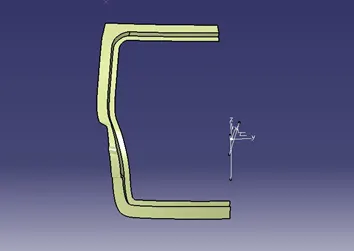
- After creating the boundary surface of the inner surface, extract the windshield area and extract it.
- Now create a sweep inside with an angle of 25 degrees and trim it with windshield extract.
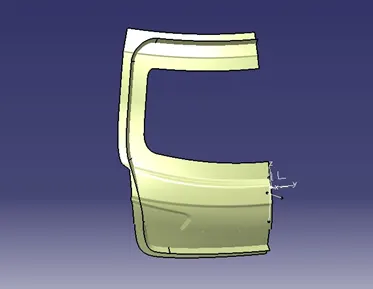
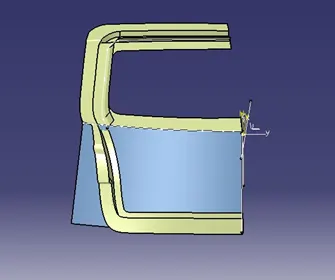
The inner panel base surface is complete. The next step is creating the embosses, Gas stay mount, Hinges mount, Sticker mount, creating mastic data and wiper motor mount
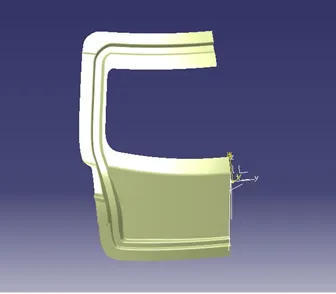
Hinges support mount:
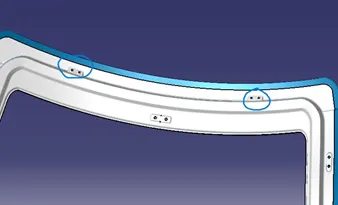
Gas stay mount:
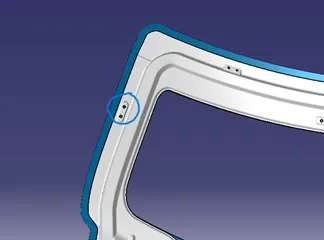
Wiper motor mount:
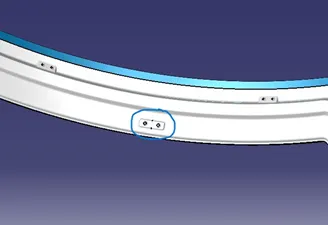
Embosses:
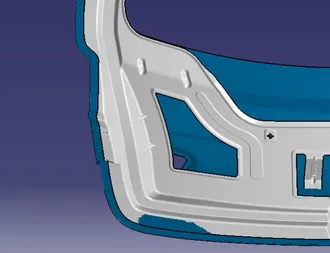
Mastic data region:
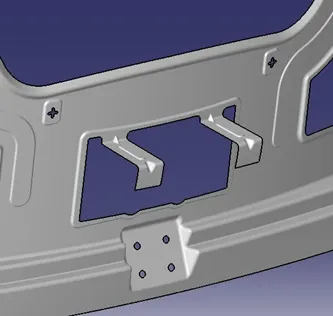
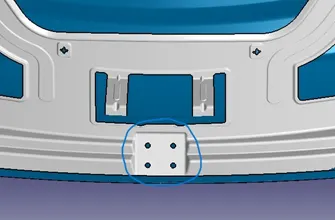
Sticker mount:
Hemming and corner relief:
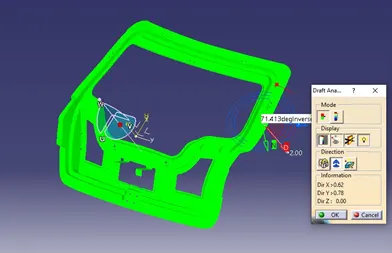
Draft analysis:
Outer panel:
Inner panel:
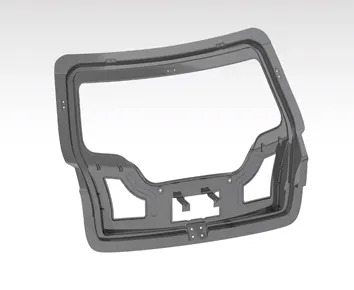
Assembly of the outer panel and inner panel:
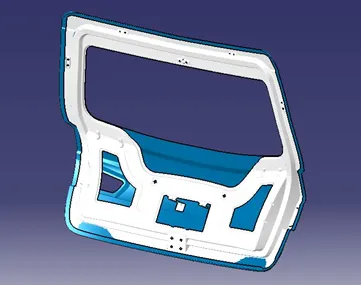
CONCLUSION:
The back door’s outer and inner panels were designed with the help of the styling surface along the tooling direction.
Draft analysis was performed on the inner panel and All the reinforcements were designed and placed at appropriate positions.