Design of backdoor
Design of backdoor
Definition
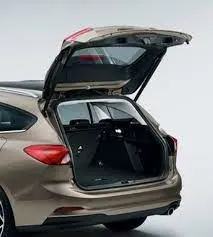
Rear Door means a door or door system on the back end of a motor vehicle (e.g. a rear hatchback or tailgate) through which passengers can enter or depart the vehicle or cargo can be loaded or unloaded.
Design methodologies
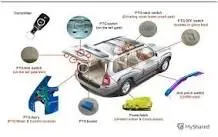
The trunk or luggage compartment is most often at the rear of the vehicle. Early designs had an exterior rack on the rear of the vehicle to attach luggages trunk .Later designs integrated the storage area into the vehicle's body, and eventually became more streamlined. The main storage compartment is normally provided at the end of the vehicle opposite to which the engine is located. Some mid-engined or electric cars have luggage compartments both in the front and in the rear. Examples include the Porsche 914 and Boxster as well as Toyota MR2. The mid-engined Fiat X 1/9 also has two storage compartments, although the rear one is small, easily accessible, and practically cuboid in shape.Rear engined cars like Volkswagon Beetle or Porsche 911 have the trunk in front of the passenger compartment. The Volkswagon type 3 featured a rear engine design that allowed for a shallow conventional trunk in the rear as well as space in the front for luggage.Sometimes during the design life of the vehicle the lid may be restyled to increase the size or improve the practicality and usefulness of the trunk's shape. Examples of this include the Beetle redesign to the 1970s 'Super Beetle' and the pre-war and 1950s post war Citroen Traction Avant. The door or opening of a cargo area may be hinged at the top, side, or bottom.If the door is hinged at the bottom it is called a tailgate, particularly in the United States. They are used on station wagons and pickup trucks, as well as on some sport utility vehicle (SUV). Traditional drop-down station wagon and pickup tailgates can also serve as a mount for a workbench.Traditional U.S. station wagons included a roll-down window retracting into the tailgate to load small items or to allow the tailgate to be opened down on its bottom-mounted hinges. Because of the potential for carbon-monoxide fumes, the tailgate window on station wagons should be closed whenever the engine is running.Two-way station wagon tailgates may be hinged at the side and the bottom so they can be opened sideways like a regular door, or drop downwards as load platform extenders. They are designed with special handle(s) for opening in the selected direction on special hinges after the window is lowered.A three-way design that was also used by Ford allows for the tailgate to be opened like a door with the window up.General Motors developed a clam shell style "disappearing" design where the rear window rolls up into the roof and the tailgate slides down and beneath the load floor.If the door is hinged at the top it is termed a hatch, and is used on a hatchback. A bottom opening door is now common on SUVs.
Components of backdoor design
1. Inner panel
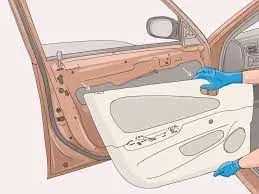
A backdoor is usually made up of 1 inner panel and 2 or 3 outer panels joined together by hemming and spot welding wherever necessary. The material used for backdoor varies as per the price range of the vehicle. Most of the low cost vehicles use steel as it is cheaper and use parts that are stamped using moulds.
2. Outer panel
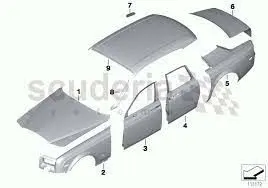
A "door skin" is the outer metal layer only. A "door shell" includes both the outer skin and the door frame, and is shipped preassembled with the skin already welded and bonded to the door frame. Door frames will also include the metal window surround, unless the vehicle uses "frameless windows".
3. Hinge reinforcement
Hinge reinforcement (10), for a motor vehicle door hinge, has a shape corresponding to the shape of the hinge bracket (6) and is able to be joined to the hinge bracket. The first end (11) of the reinforcement (10) facing the hinge pin (5) is provided with a fork-like shape so that it can be placed against the hinge pin (5) from below the bracket onto the hinge pin between the bearing arms (9) of the bracket, and on its side facing the bracket a cam (12) engages a recess (13) of the hinge bracket (6) to prevent the hinge reinforcement (10) from falling out. The second end (14) of the reinforcement is connected to the hinge bracket (6) by a fastening element.
4. Latch and striker reinforcement
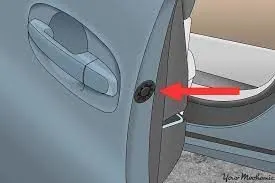
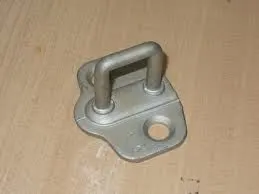
Door strikers are hooks or bolts that latch up the doors on a vehicle. The striker is designed to create a tight fit between the door and the seal on the cab. The striker plate is made of hardened metal that prevents wear when the door is open and shut many times each day. The door striker pin typically is a hardened steel pin or bolt that sticks out from the end or edge of the door itself. As the door of the vehicle closes, the striker pin mates with the door striker plate.
5. Gas stay reinforcement
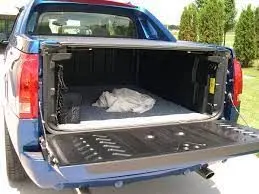
A tailgate is a door at the back of a truck or car, that is hinged at the bottom so that it opens downwards. He let down the tailgate so the dog could jump out. 2. verb. If you tailgate someone, you drive very closely behind them.
6. Wiper motor reinforcement
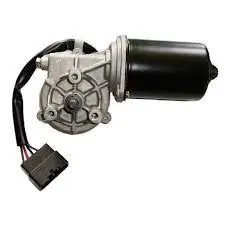
The wiper motor is the motor used to make the wipers work and keep the car windshield clean. It is the component that powers the windshield wipers. They are a part of the wiper system and is considered a car safety component.
MANUFACTURING OF BACKDOOR DESIGN
Backdoor are one of the type of door of the vehicle which are located next to the passanger seat which provides access to the luggage compartment. The invention discloses a manufacturing process for an automobile door panel. The manufacturing process comprises the following steps: (1) carrying out injection moulding on a door panel framework; (2) coating handrails; (3) welding the door panel framework and an insert panel, and welding sound absorption cotton; and (4) assembling a door panel assembly, wherein an automatic welding machine with hot rivet welding and ultrasonic welding functions is used in the step (3). The manufacturing process disclosed by the invention has the beneficial effects that the automatic welding machine with the hot rivet welding and ultrasonic welding functions is used, the welding of the door panel framework and the insert panel, and the welding of the sound absorption cotton are integrated to be finished in a working procedure, thus shortening the manufacturing working hours, increasing the working efficiency, and achieving good welding quality; because the procedure of bonding the sound absorption cotton by an adhesive is avoided, thus avoiding the volatilization of the adhesive, reducing harm to human body and air, and achieving good environment friendliness