Design of backdoor
BACK DOOR CHALLENGE:
Inroduction:
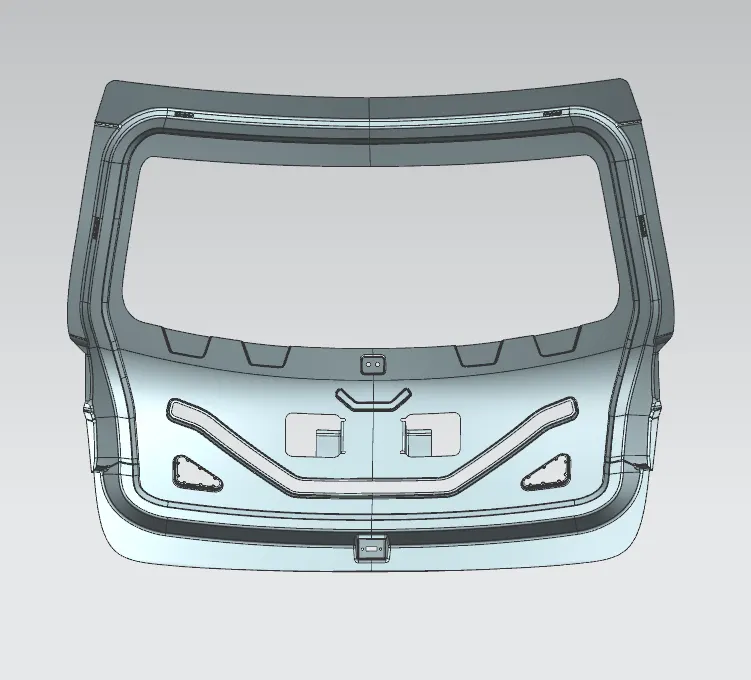
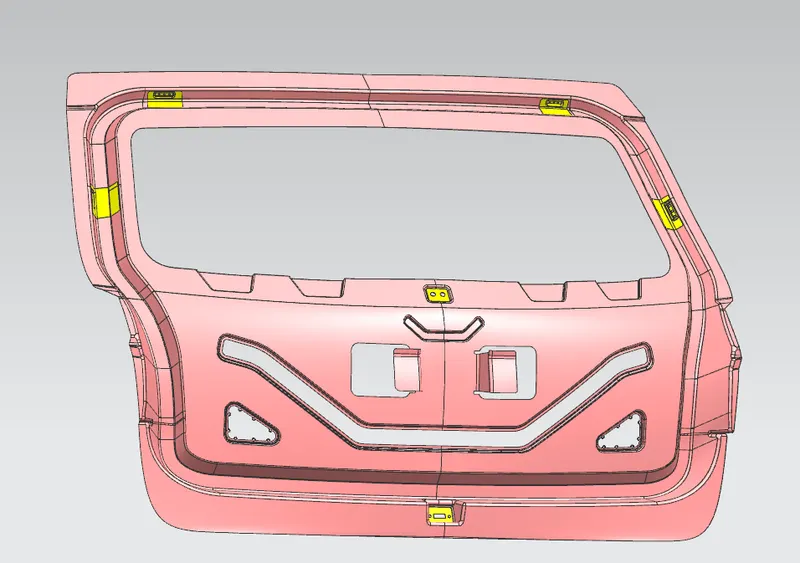
Here I have designed a back door for a hatchback where the hinge at roof level .Similar to the hood and side doors back door is a swinging/closure commodity in a car.It consists of an outer and inner pannel.It is a very critical component because of pedestrain safety luggaging space. It also cosists of latch and striker motor,wiper motor.
Both steel and aluminium are used in manufacturing the back door .Aluminium backdoors are lighter in weight and has lesser number of components as it has varying thickness it does not required reinforcements but steel backdoor is deep drawn with uniform thickness,added reinforcement,and therefore it is heavier than aluminium backdoor.Since steel cost is less when compared to aluminium steel is mostly prefered.
Major parts:
Outer Panel :
The outer pannel is the styling surface of the back door.It is the source of design of other parts of the back door.Primarily the inner pannel.It acts as the outer cover and deals with the aesthetic of the car .
Inner pannel:
Inner pannel provides strength to the back door.It’s thickness is about 0.75mm.The inner pannel has reinforcement and embosses to provided strength to the back door.There are many cases where where the inner pannel is subjected to stress due to frequent opening and slamming.The inner pannel consists of latch and striker actuator,Wiper motor actuators,Trim mounting,Hing and gast stay embosses,V-emboss,Latch etc and therefore the necessary cut outs are provided.Various reinforcement are also spot welded to the inner pannel.
Hinge reinforcement:
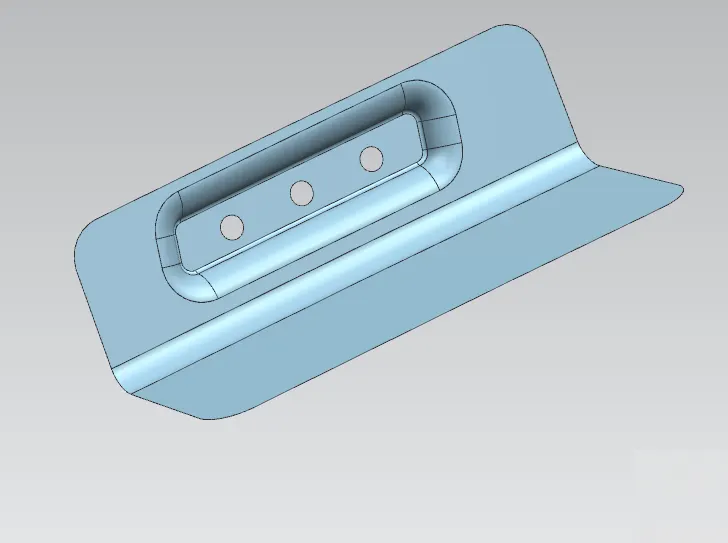
Hinge enables the opening and closing of the back door.One end of the hinge is fixed on the backdoor and the other end on the roof on both sides.Hinge can be placed outside or inside the backdoor.The position of the hinges are determined by the mid point of axis of the hinges called as hing axis point,Which should be alined with latch and strikes through the the trajactory of the back door opening and closing.If the striker is exactly perpendicular to thr trajectory then the hing can be fixed accordingy on the inner pannel.
Latch and striker reinforcement:
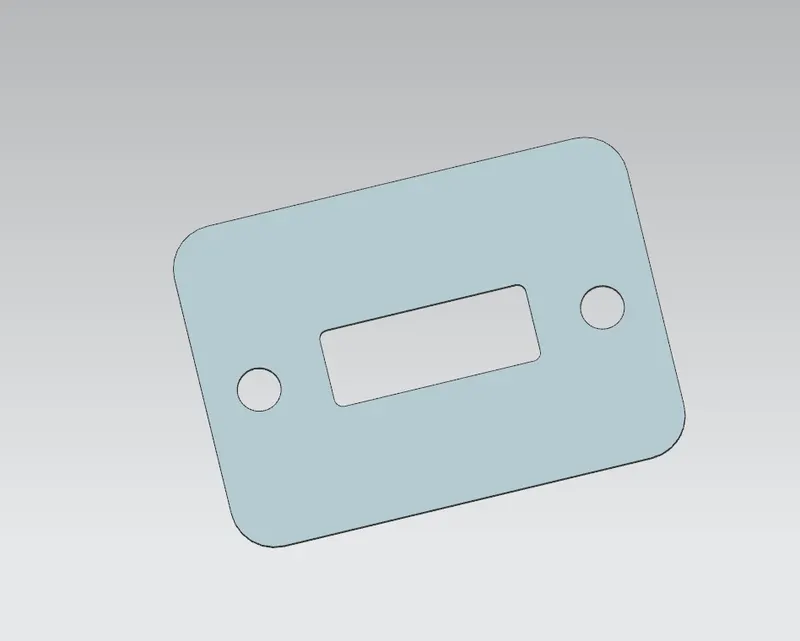
The latch and striker forms the locking mechanism of the backdoor with the car.Due to regular opening ,closing and over slamming of the back door there is stress developed in the latch and the striker area.Further during a rear collision this area this area will be the first point of contact.To componsate this reinforcement is added in this area.
Wiper motor reinforcement:
The wiper motor reinforcement is used for strengthening the
Gas stay reinforcement:
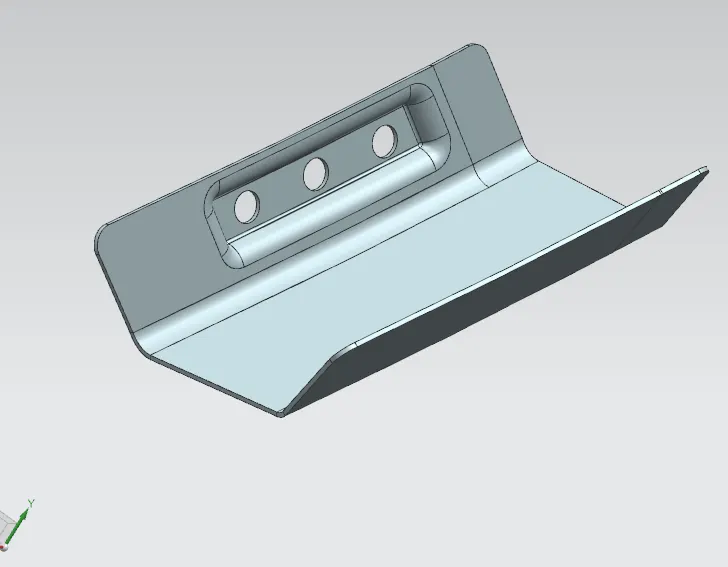
Gas stay is a device used for supporting the back door in its open position.Gas stay requires no man power and is engaged into support position automatically as the back door opens.One end of the gas stay is fixed on the backdoor and the other end on the body side body side or on the back door stationary area .Embossing is provided at the gas stay mounting area to compensate for the functional holes punched.
Hemming :
Hemming is a forming operation in which the edges of the sheet are folded or folded over another part in order to achieve a tight fit. Normally hemming operations are used to connect parts together, to improve the appearance of a part and to reinforce part edges.
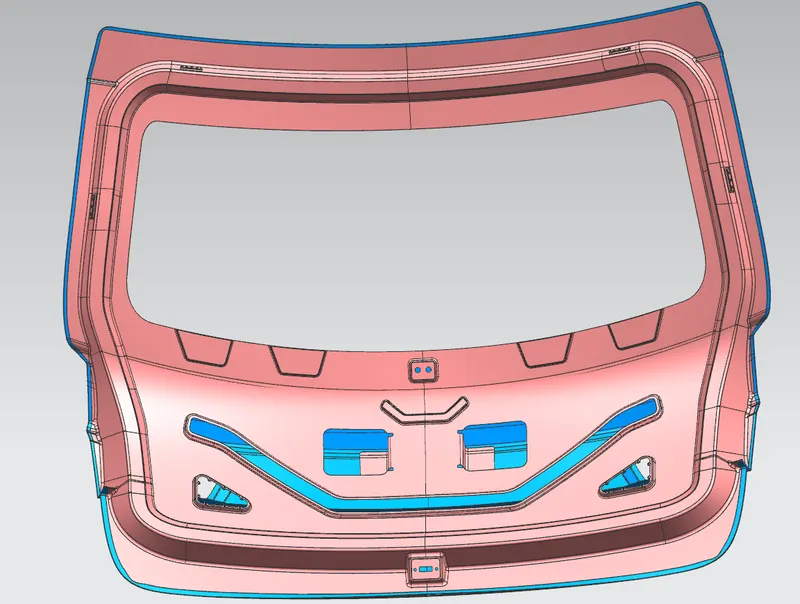
There is a 0.2mm gap between the two pannels and 1-2mm clearance between the edge of the inner pannel.This space is provided for the sealent to ooze out and to spread properly between the pannels after the hemming process.
Relief:
The corner relief is given to the sheet metal inorder to prevent deformation during unbend operation.

Emboss:
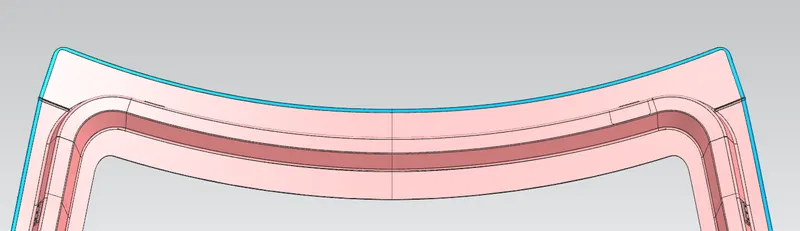
An embossing is a metal forming process in which a high pressure is applied on a die to make a imprint on the working surface.The imprint can be raised or sunked. In this process it is assumed that the metal thickness remains the same while embossing.
Throughout the inner panel we provide different embosses.We can increase the stiffness of the inner panel through these embosses.The shape and size of the embosses also determines the direction of the force distribution resulted from frontal collision.The force should be always distributed away from the passengers.
Draft analysis:
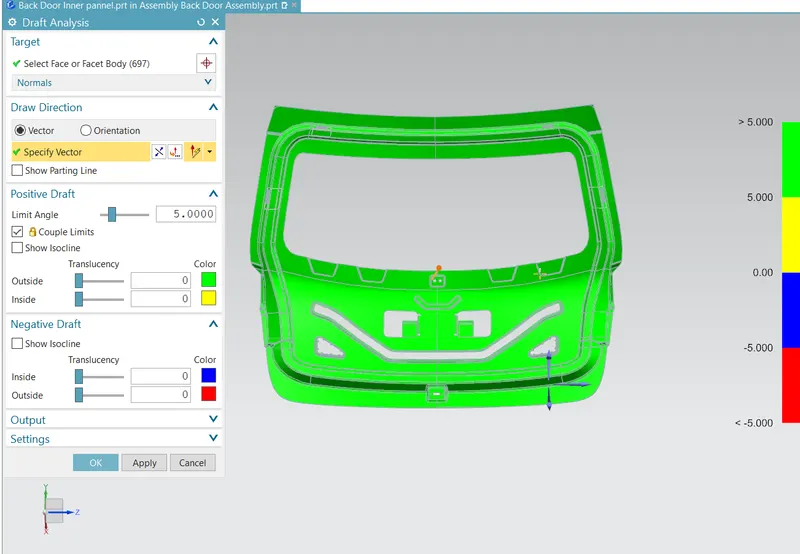
Draft analysis helps to verify wheather the product will be easily removed from the tool.When designing a product then need to be angled slightly so that the tool can be pulled away from object easily without deforming or damaging .This angle is called as draft angle.
Conclusion:
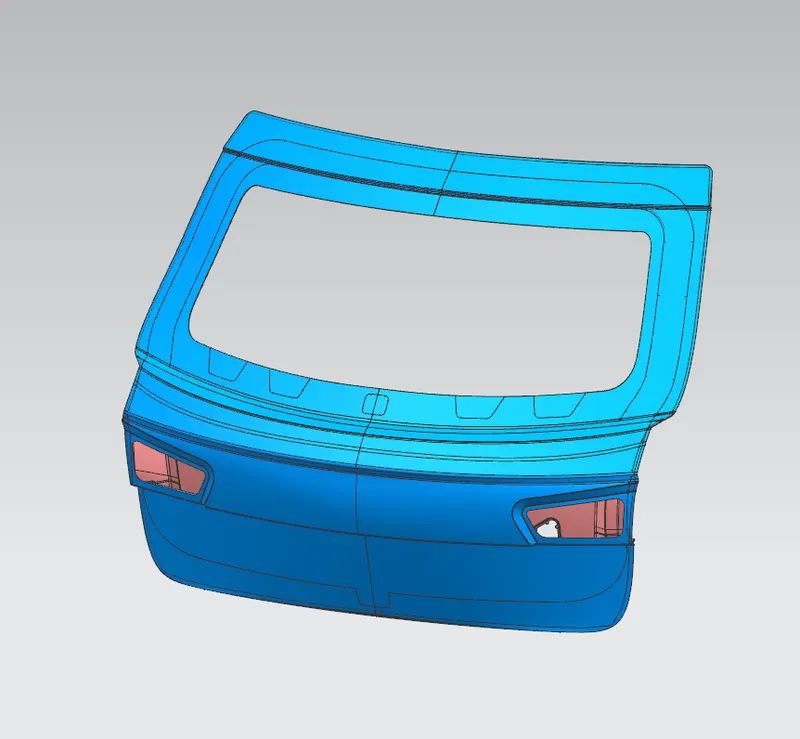
Thus the back door is designed from the given styling surface with necessary reinforcement and emboss.