Comparison of HEV and eV
- The mapped model is one type where the data points are pre assigned and lookup tables.
- The engine or motor torque required is sensed and the motoor engine block generates the required torque output just as required simply without considering the real time motor engine, parameters.
- The output values are stored for the corresponding given input values the engine motor and generator.
- The accuracy of this type is not that high but the simulation will be done in much less time as it does not run by real time parameters.
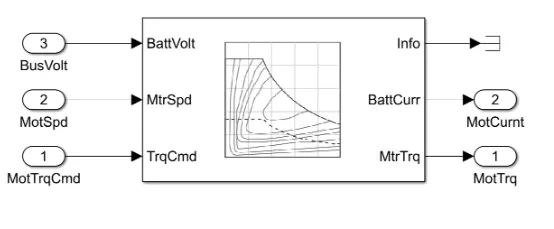
Dynamic model
- The dynamic model in other hand uses the combination of the outputs from various subsystems to generate the output.
- It runs by real time simulation where the required put from the drive cycle is taken and for that individiual real time simulation gets performed and summing all the results of the subsystems gives the output for the simulation.
- As per the drive cycle requirments the initial Bus voltage, current is given alonng with the vehicle feedback so that it runs the actual simulation at that particular moment throught the drive cycle particuciarmament throat the drive cycle.
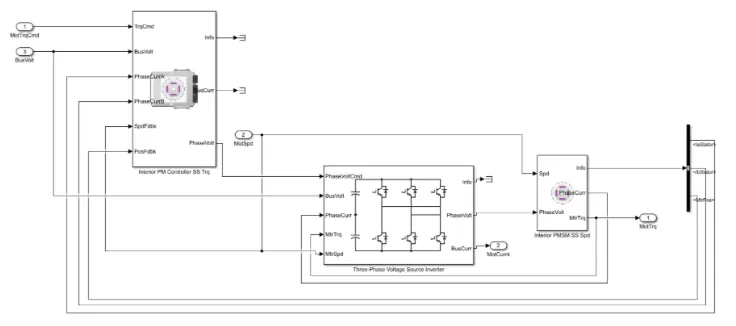
1. Open the powertrain module blockset for the required vehicle.
2. Click on passenger car vehicle block and select electric plant or engine.
3. Right click on Engine Excitari generator based on vehicle model and select variant.
4. Under variant scroll to label model active choice and choose manped or dynamic for the required calculation.
___________________________________________________________________________________________________________
2. How does the model calculate miles per gallon? Which factors are considered to model fuel flow?
Answer:
Miles per galon(MGP)
Mpg stands for miles per gallon, and is used to show how far your car is able to travel for every gallon (or 4.55 litres) of fuel it uses. As an example, if you own a car that can return 50mpg and its fuel tank only has one gallon of petrol or diesel in it, you should be able to drive 50 miles before the car runs out of fuel.
The powertrain blockset has a model that calculates the mgp for all kinds of vehicles.
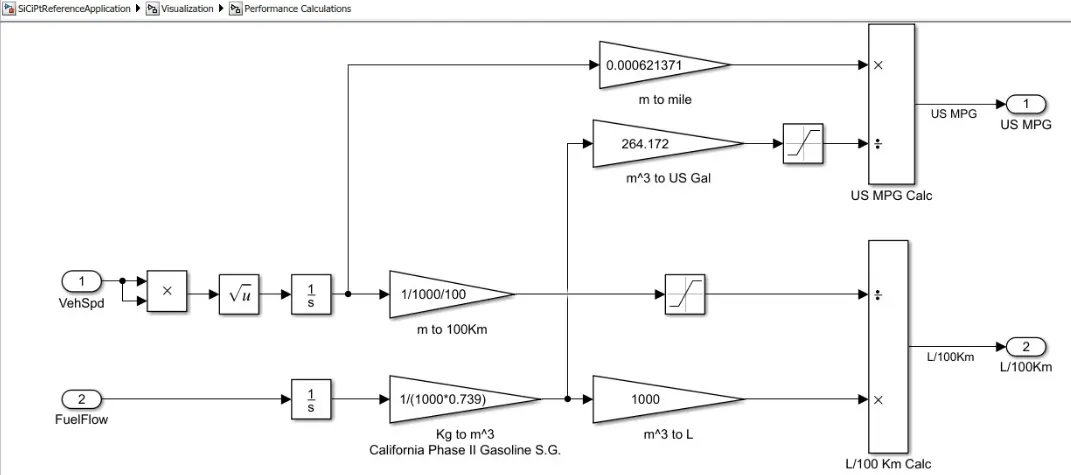
For Conventional vehicles
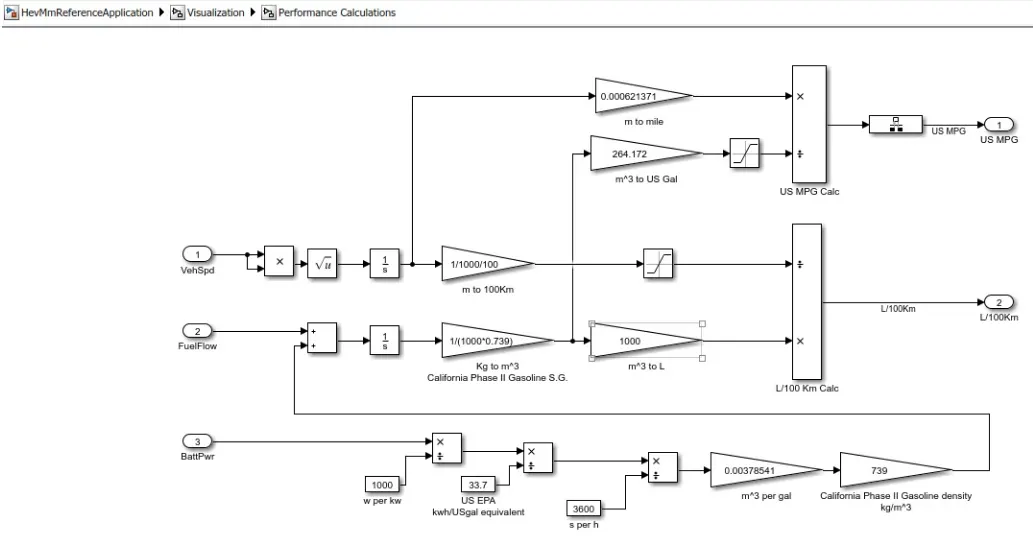
For Hybrid Electric vehicles
For Electric vehicles
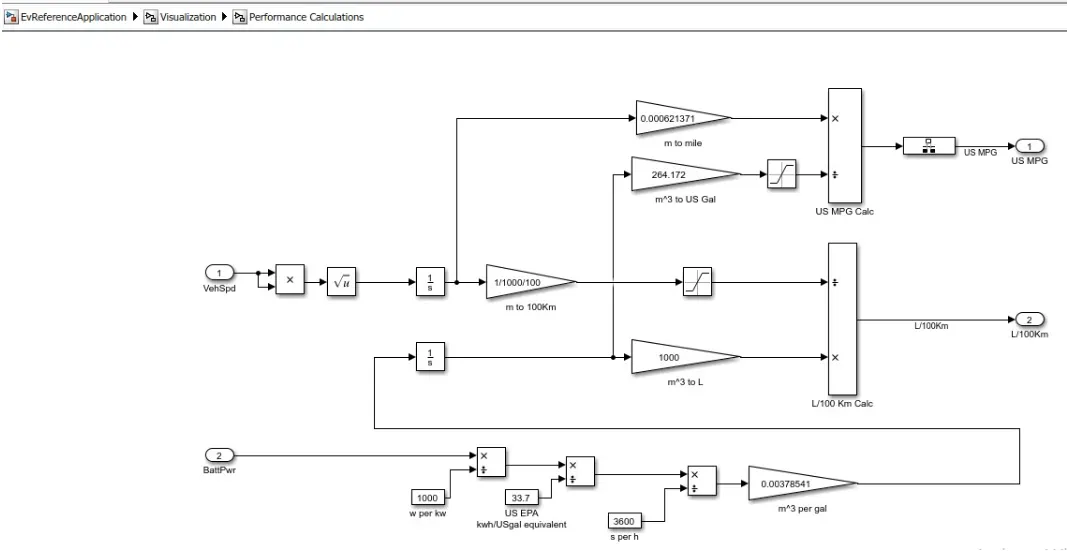
The model takes an input of vehicle speed, fuel flow and battery power to calculate fuel consumption and the equivalent battery consumption to calculate the mgp.
Calculating miles per gallon
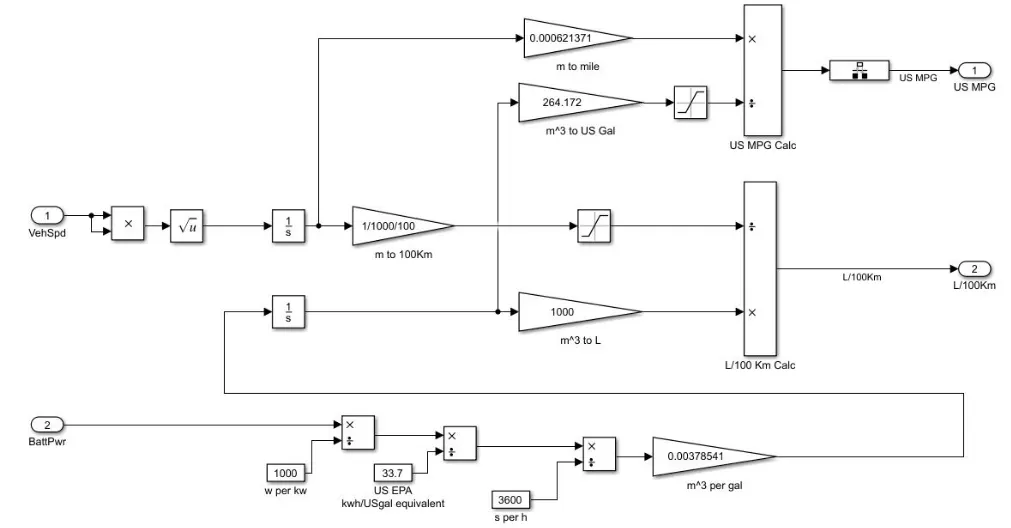
The inputs from the vehicle speed and the distance are taken into calculation and it is converted to miles by multiplying with 0.000621371.
Then the inputs from the fuel flow taken in m^3 and are converted into equivalent US gallons by multiplying with 264.172.
Then the miles covered and equivalent US gallon are further divided and the result are gathered in mile per gallon.\
Factors to consider to model fuel flow
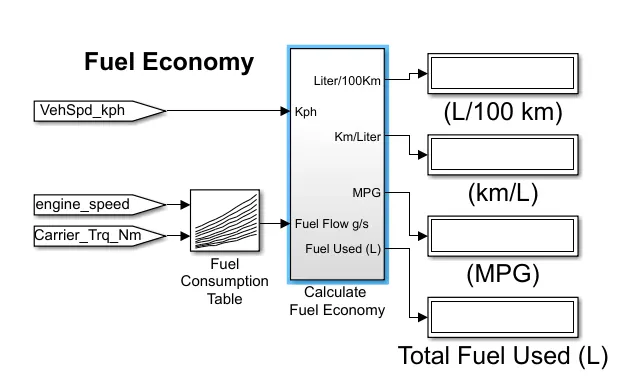
1. Fuel economy
The fuel economy of an automobile relates distance traveled by a vehicle and the amount of fuel consumed. Consumption can be expressed in terms of volume of fuel to travel a distance, or the distance travelled per unit volume of fuel consumed. Since fuel consumption of vehicles is a significant factor in air pollution, and since importation of motor fuel can be a large part of a nation's foreign trade, many countries impose requirements for fuel economy. Different methods are used to approximate the actual performance of the vehicle. The energy in fuel is required to overcome various losses (wind resistance, tire drag, and others) encountered while propelling the vehicle, and in providing power to vehicle systems such as ignition or air conditioning. Various strategies can be employed to reduce losses at each of the conversions between the chemical energy in the fuel and the kinetic energy of the vehicle. Driver behavior can affect fuel economy; maneuvers such as sudden acceleration and heavy braking waste energy.
Electric cars do not directly burn fuel, and so do not have fuel economy per se, but equivalence measures, such as miles per gallon gasoline equivalent have been created to attempt to compare them.
Factors affecting fuel economy
Weight
A vehicle’s weight influences how much energy it needs to move, which, of course, can require more or less fuel, depending on the case. Not only does a compact weigh much less than a truck or an SUV, its size also means it can afford to have a smaller engine that doesn’t have to work as hard to move the vehicle forward. Between two vehicles of the same size, the materials from which components are created usually determine which vehicle weighs less.
Displacement
The volume of air that the engine consumes in a single revolution is known as displacement. To understand how this affects fuel economy, just picture an engine throttling along. The more air that needs to be pushed while the engine is in movement, the more energy the engine requires. This measure is usually expressed in liters. The higher the number, the more fuel the engine burns while it’s in movement.
Aerodynamic efficiency
Throughout the years, the word “Aerodynamic” has been used as a marketing buzzword. But what is aerodynamic efficiency, and how does it affect fuel economy? Well, it’s simple. Air, like liquid, offers resistance when you move. Curves and a well-designed shape can minimize this resistance, also known as drag. On the other hand, a vehicle that’s fairly tall and possesses few curves, like a truck, will use more fuel to move through the air. If a vehicle’s exterior seems strange, it’s possible that it was simply designed with the goal of reducing drag as much as possible.
Mechanical resistance
Aerodynamic efficiency is one thing, but what about mechanical resistance? For carmakers and professionals with auto mechanic training, designing or tuning-up vehicles is full of these types of challenges. If reducing drag to a minimum by tweaking the vehicle’s shape is difficult, reducing mechanical resistance is quite a complicated affair. Mechanical resistance refers to the amount of energy required by the vehicle to move all the different pieces in the drivetrain. The transmission, wheel bearings, axels and multiple other components all contribute when a car is in motion. All of these systems can be refined to minimize the amount of power each individual piece needs to move. For example, a manual transmission will generally produce less resistance than an automatic model.
2. Fuel consumption
The amount of fuel a vehicle uses to travel a particular distance at a particular speed.
________________________________________________________________________________________________________________________
3. Run the HEV ReferenceApplication with WOT drive cycle. Change the grade and wind velocity in the environment block. Comment on the results.
Answer:
Hybrid Electric Vehicles (HEV)
Hybrid electric vehicles (HEVs) combine the benefits of gasoline engines and electric motors and can be configured to meet different objectives such as improved fuel economy, increased power, or additional auxiliary power for electronic devices and power tools.
HEVs run on fuel alone and do not plug in to an electrical outlet to recharge the battery.
The Toyota Prius is the most widely driven HEV, with over 2 million cumulative units sold as of 2010.
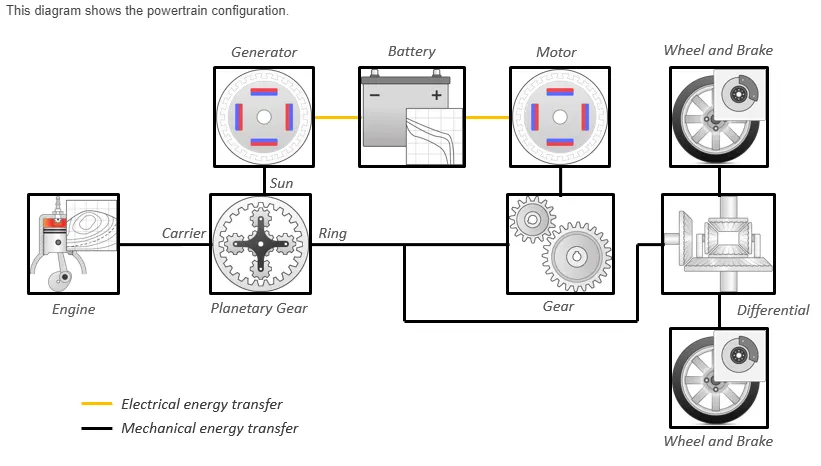
Simulation model
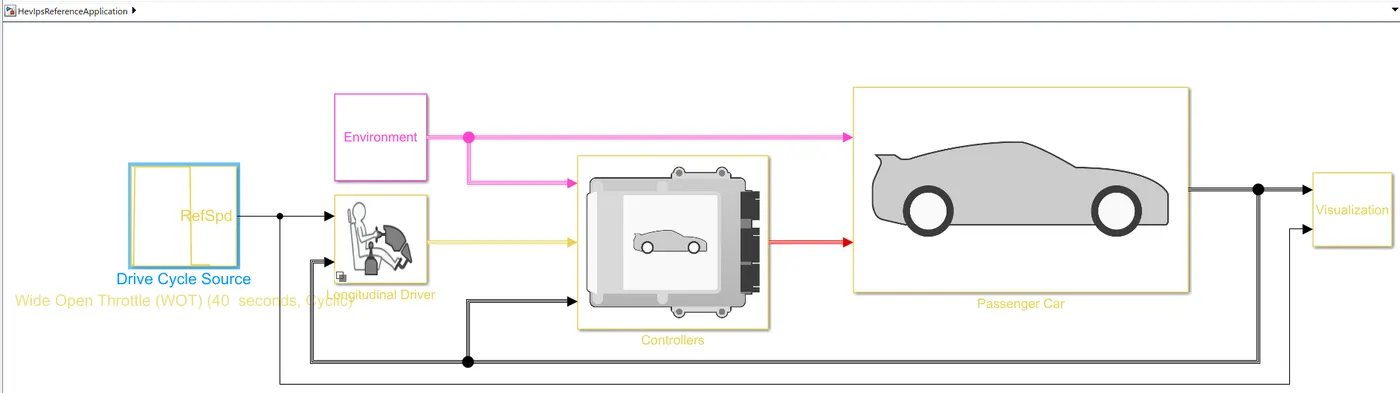
Case-1
Wind velocity and grade kept zero
Total cycle time = 60sec
WOT condition
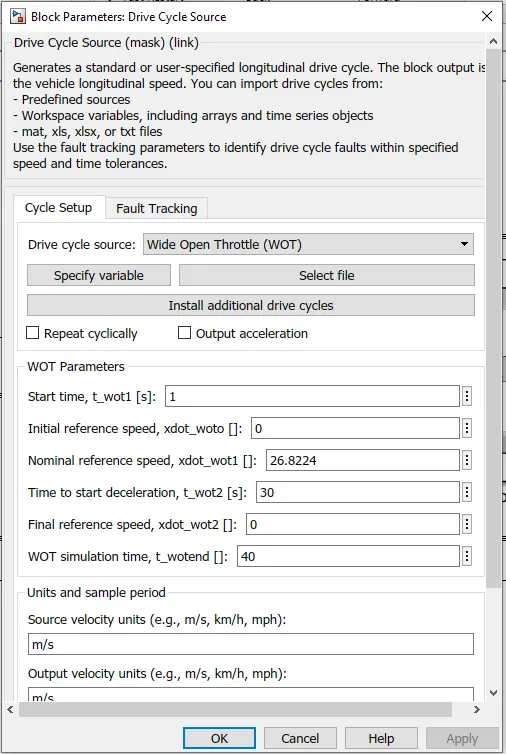
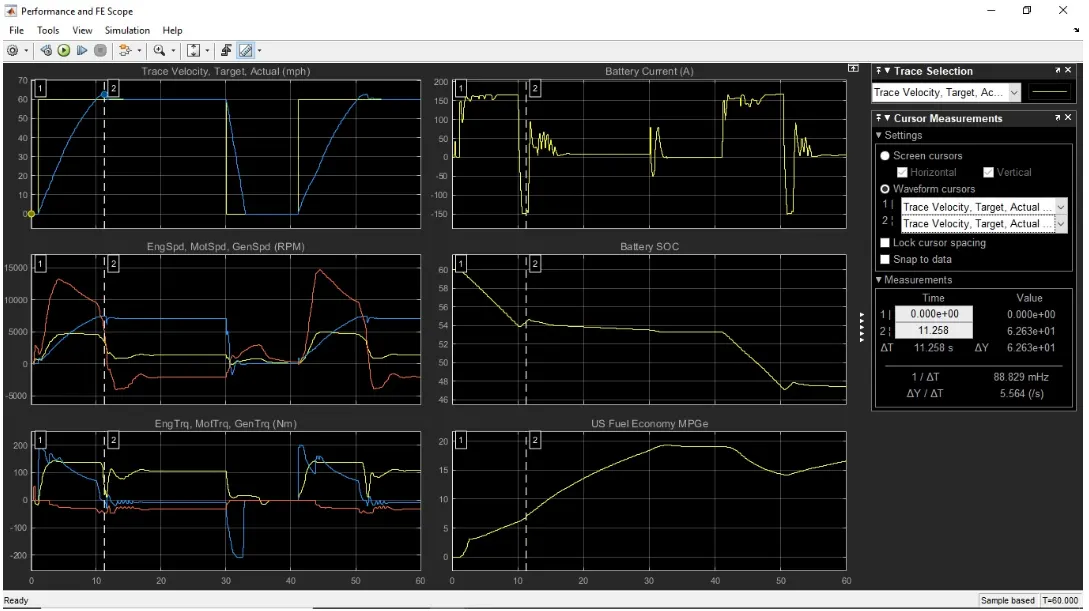
Result
Case-2
keeping grade angle 8 degree and wind velocity 10m/s and keeping other parameters same
Result
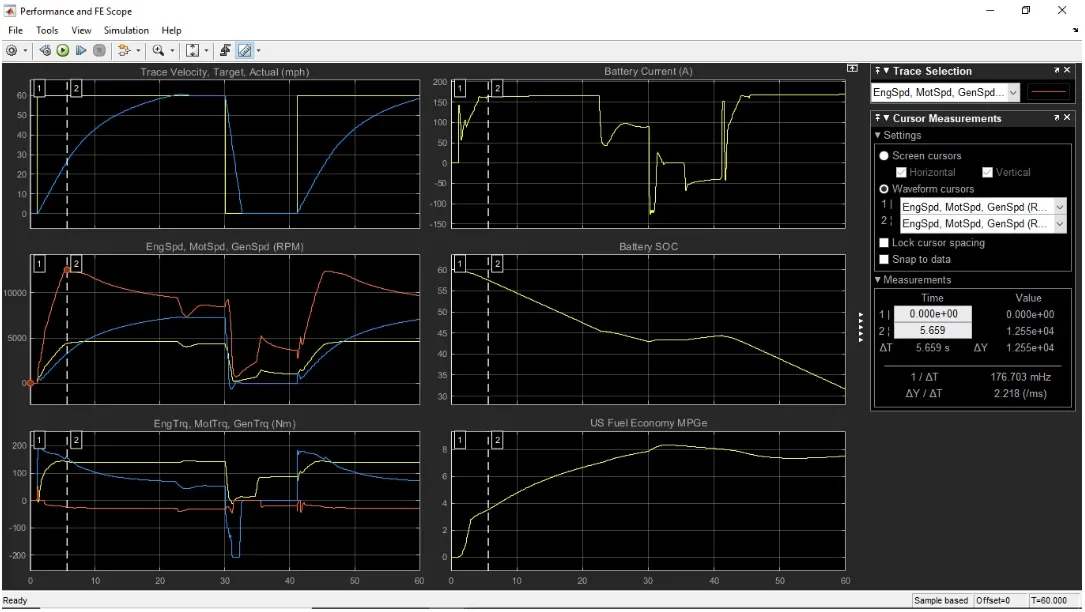
Results comparison
| Parameters | Case-1 | Case-2 |
| Grade (Deg) | 0 | 8 degree |
| Wind velocity (m/s) | 0 | 10 |
| Top speed | 63 mph | 60 mph |
| Acceleration time to reach 60mph | 11.258 sec | 22.21 sec |
| Deceleration time from 60mph to minimum | 3.164s ec | 2.79 sec |
| Peak Engine speed | 4787 rpm | 4651 rpm |
| Peak Motor speed | 7437 rpm | 7295 rpm |
| Peak Generator speed | 14610 rpm | 12550rpm |
| Peak Engine torque | 143 Nm | 145 Nm |
| Peak Motor torque | 200 Nm | 202 Nm |
| Peak Generator torque | 51Nm | 52.67 Nm |
| Peak current dischared from battery | 164.63 A | 166 A |
| Peak current charging to the battery | 147.68 A | 125.37 A |
| State of charge | 60 to 47.4% in 60sec | 60 to 28% in 60sec |
From above comparison table we can say that Case-1 is more efficient than Case-2 as there is no wind velocity and grade angle.
___________________________________________________________________________________________________________
4. Keeping all other parameters same, compare the simulated results of hybrid and pure electric powertrains.
Answer:
Pure Electric vehicle
An electric vehicle (EV) is one that operates on an electric motor, instead of an internal-combustion engine that generates power by burning a mix of fuel and gases. Therefore, such as vehicle is seen as a possible replacement for current-generation automobile, in order to address the issue of rising pollution, global warming, depleting natural resources, etc. Though the concept of electric vehicles has been around for a long time, it has drawn a considerable amount of interest in the past decade amid a rising carbon footprint and other environmental impacts of fuel-based vehicles.
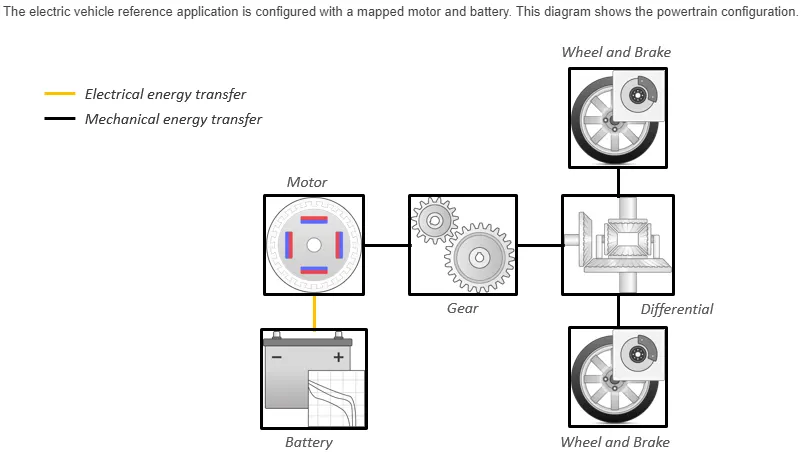
Simulation model
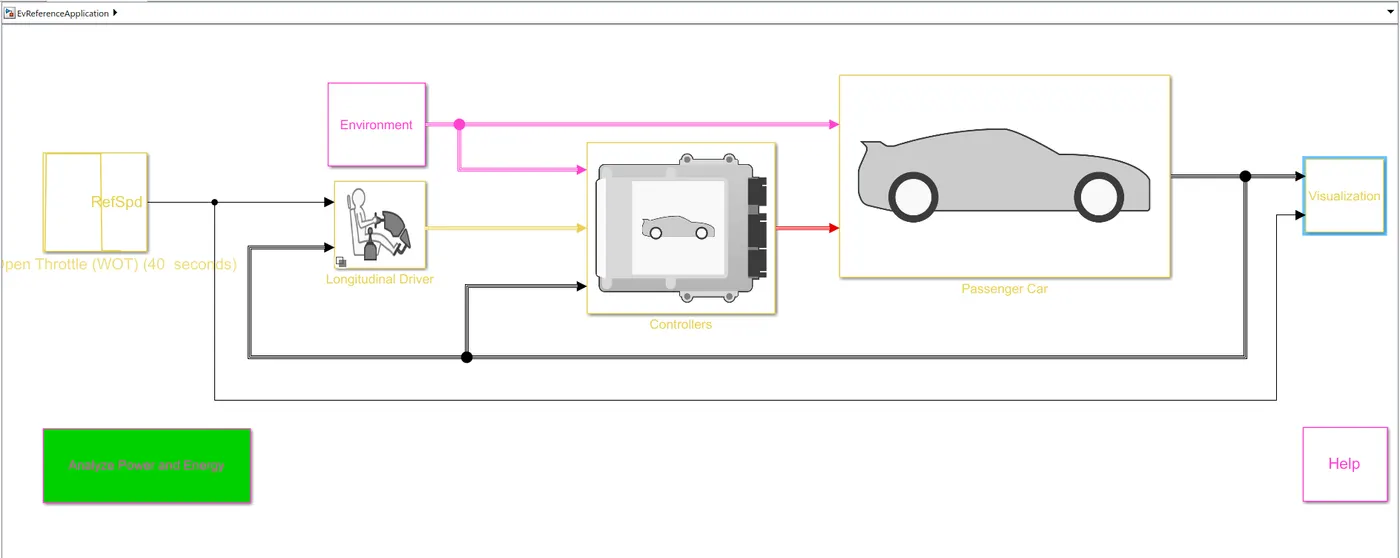
conditions
keeping grade angle 8 degree and wind veloctiy 10m/s
Result
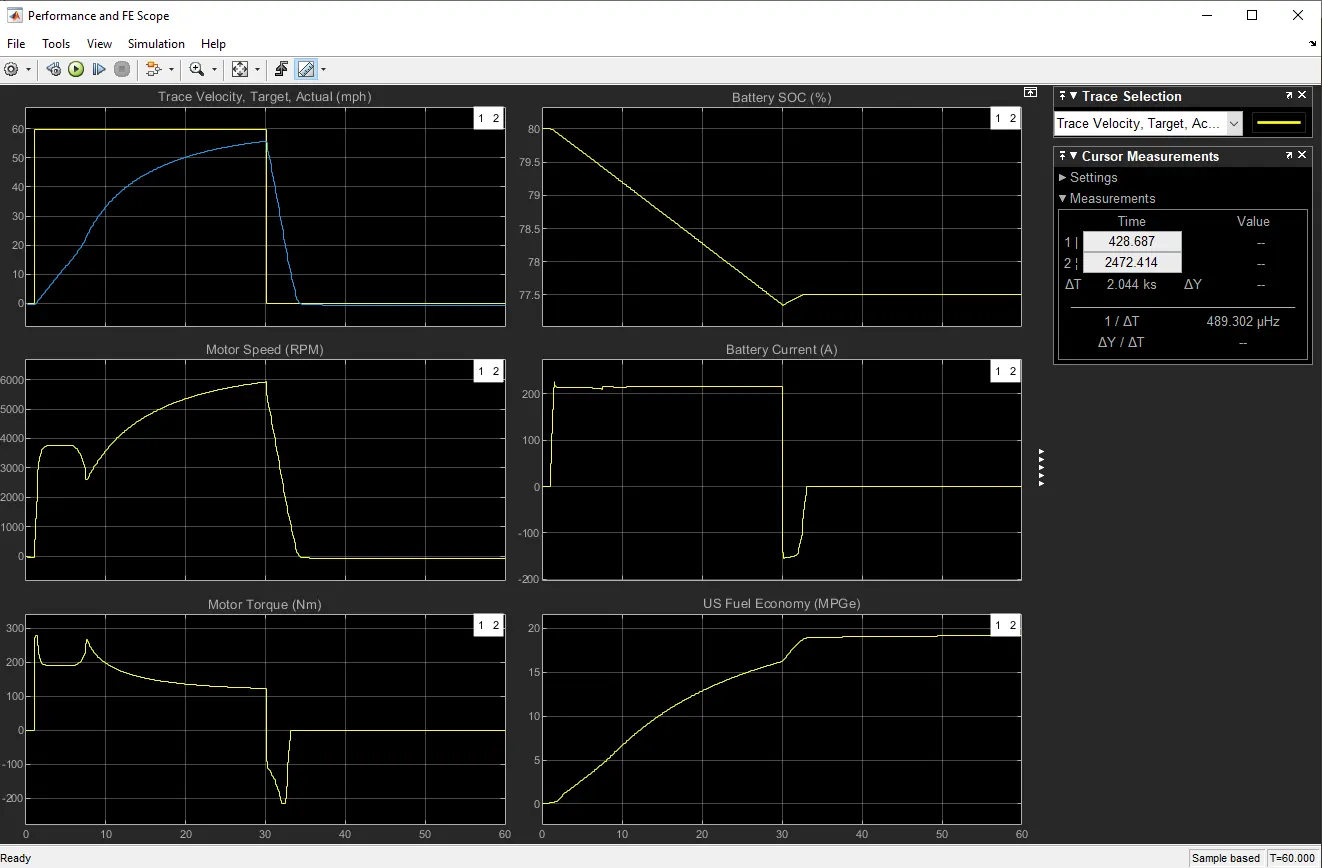
Comparison
| Parameters | HEV | eV |
| Grade (Deg) | 8 degree | 8 degree |
| Wind velocity (m/s) | 10 | 10 |
| Top speed | 60 mph | 55.3 mph |
| Acceleration time to reach 60mph | 22.21 sec | 30 sec |
| Deceleration time from 60mph to minimum | 2.79 sec | 3.3 sec |
| Peak Motor speed | 7295 rpm | 5940 rpm |
| Peak Motor torque | 202 Nm | 280 Nm |
| Peak current dischared from battery | 166 A | 210 A |
| State of charge | 60 to 28% in 60sec | 80 to 77.8% in 60sec |