Challenge on Combustion
Aim: To conduct a combustion study of methane in the air. Another case will be observing the effect of the addition of H2O in the fuel on the emission of pollutant NOx and Soot formation.
Solving Approach: The geometry has specified inlet for air and fuel. The geometry is converted to a 2D geometry. As it is an axisymmetrical problem we specify the axis at the x-axis. The fluid enters through these inlets with a specified velocity inlet condition. The model used to initiate combustion is the eddy dissipation model. To calculate the pollution emission and soot formation we turn on the NOx model and soot model respectively. The results are visualized using the contours of the features to be captured and plotting the variation of concentration of these gases along the radial direction at different axial positions.
Procedure:
Pre-processing:
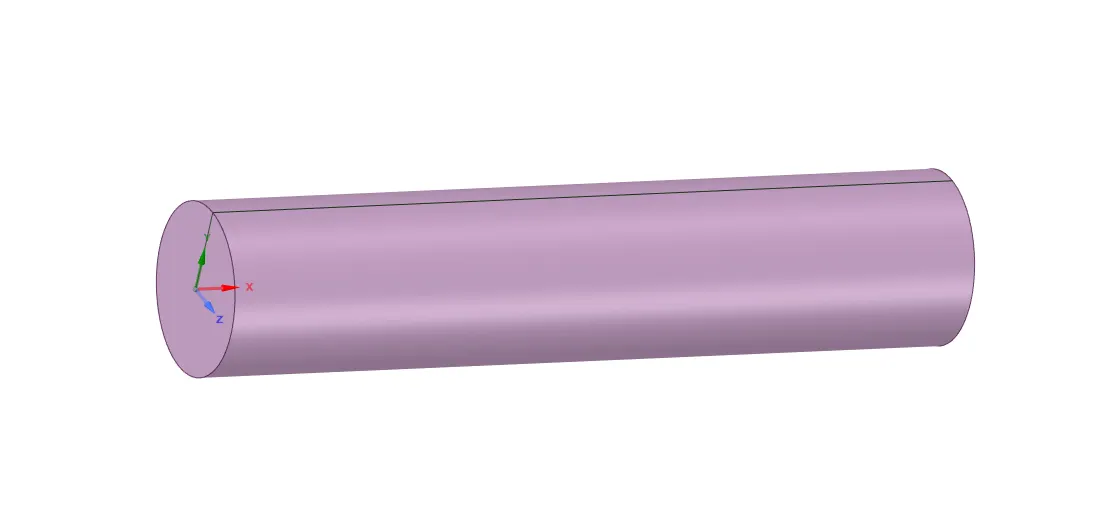
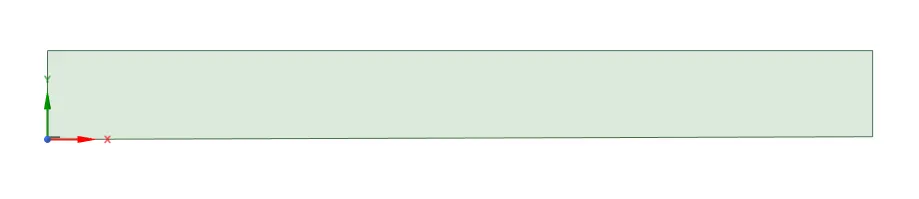
Geometry: The geometry is edited in SpaceClaim. The provided geometry is 3D and as the problem is Axisymmetrical it is preferred to conduct a 2D analysis. For that, click on SpaceClaim, on the right-hand side properties set the analysis type to 2D. Now open SpaceClaim. Follow the given steps:
- Click on combine > select all the solid bodies > click on the green check sign.
- We make a section at the XY plane of the geometry. Trace the geometry border by drawing lines on the 1st quadrant of the XY plane.
- Make sure that the solid bodies are suppressed for physics.
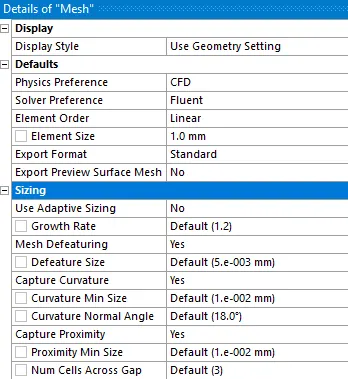
Mesh: Here we add a mesh method called all triangles mesh. And the mesh size specified for my analysis was 5mm. We need to make sure that we capture the proximity of the body which is done by turning on capture proximity. Also, we must create a named selection for fuel inlet, air inlet, outlet, wall, and most importantly the axis.
Setup:
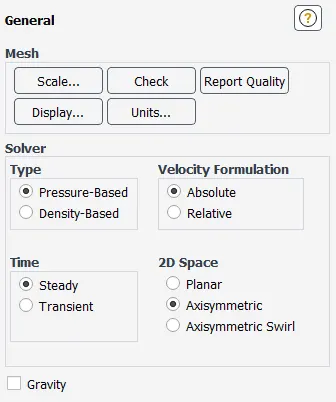
- In general, the analysis type is steady, and the 2D space is Axisymmetry.
- We define the turbulence model which is K-epsilon. This model is best for eddy dissipation and axisymmetry cases.
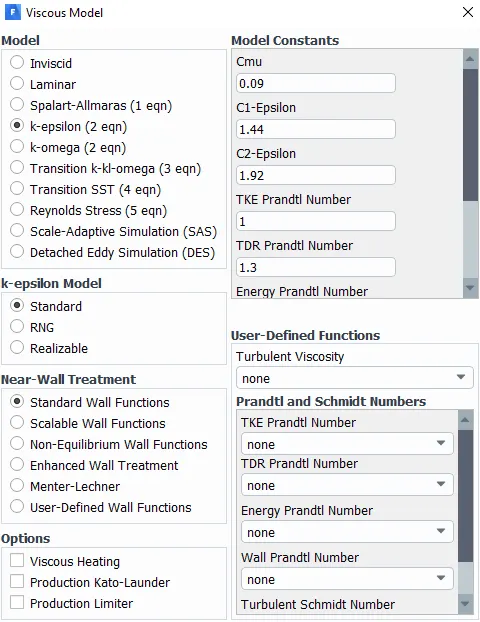
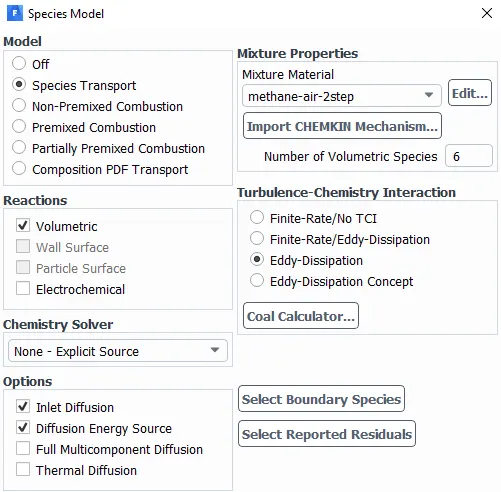
- Set Species Transport, mixture material to methane-air, and the turbulence chemistry to eddy dissipation. Here the reaction is volumetric. Note, for adding H2O in fuel the mixture model must be methane-air-2step.
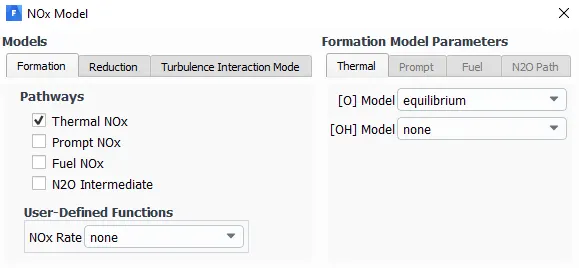
- The NOx model must be turned on. As the NOx is formed due to combustion with air, we use the Thermal NOx model.
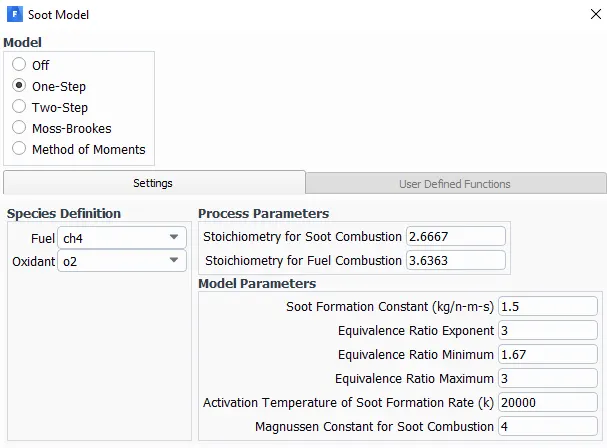
- The Soot model must also be turned on to observe the soot contour and the fuel must be CH4 and oxidant must be O2 obviously.
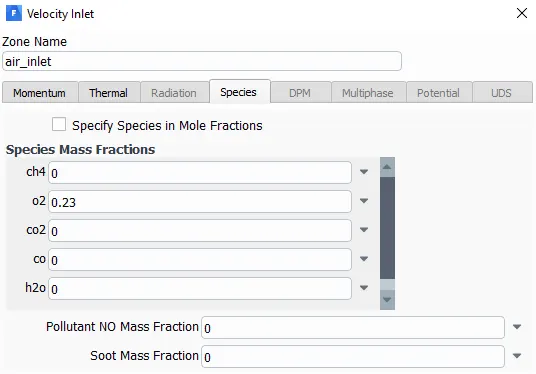
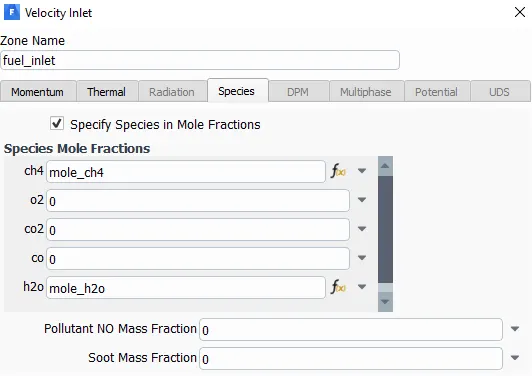
- In the boundary conditions, the air and fuel inlet is set to velocity inlet at 0.5m/s and 80m/s respectively. Set the species content as given below. For part 2 of the problem, we do a parametric study by changing the fuel inlet species condition to mole fraction and creating a new parameter for CH4 and H2O mole fraction.
- The axis boundary condition is the axis.
Solution:
An output parameter is set to compute the emission of NOx for different mole fractions of H2O. Soot and NOx contours are also plotted to verify setup.
Post-Processing: The post-processing is done in the CFD post. Contours of mass fractions of CO2, O2, N2, Ch4, H2O, pollutant NOx, Soot, and also the Temperature is obtained. Lines at different radial locations are created to obtain XY plots of NOx mass fraction and soot mass fraction.
Results and Discussion
Part I:
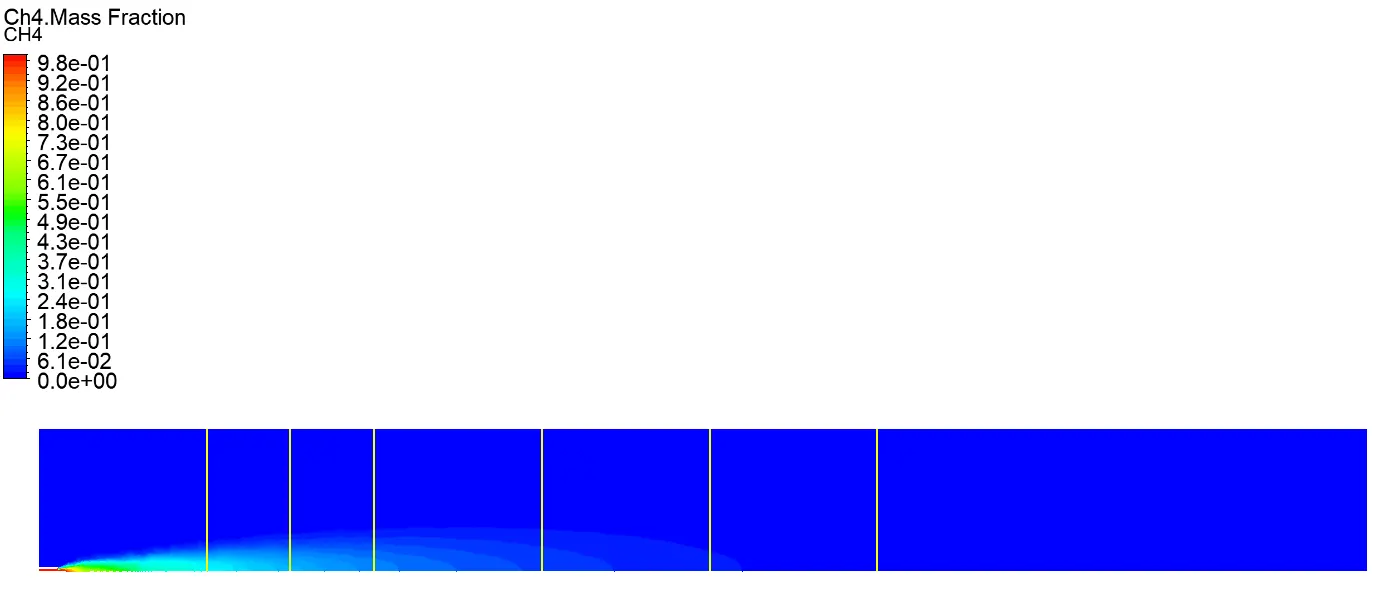
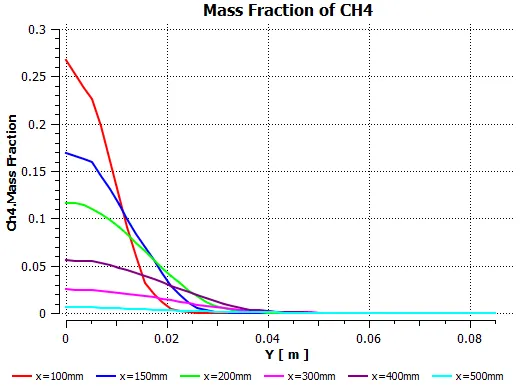
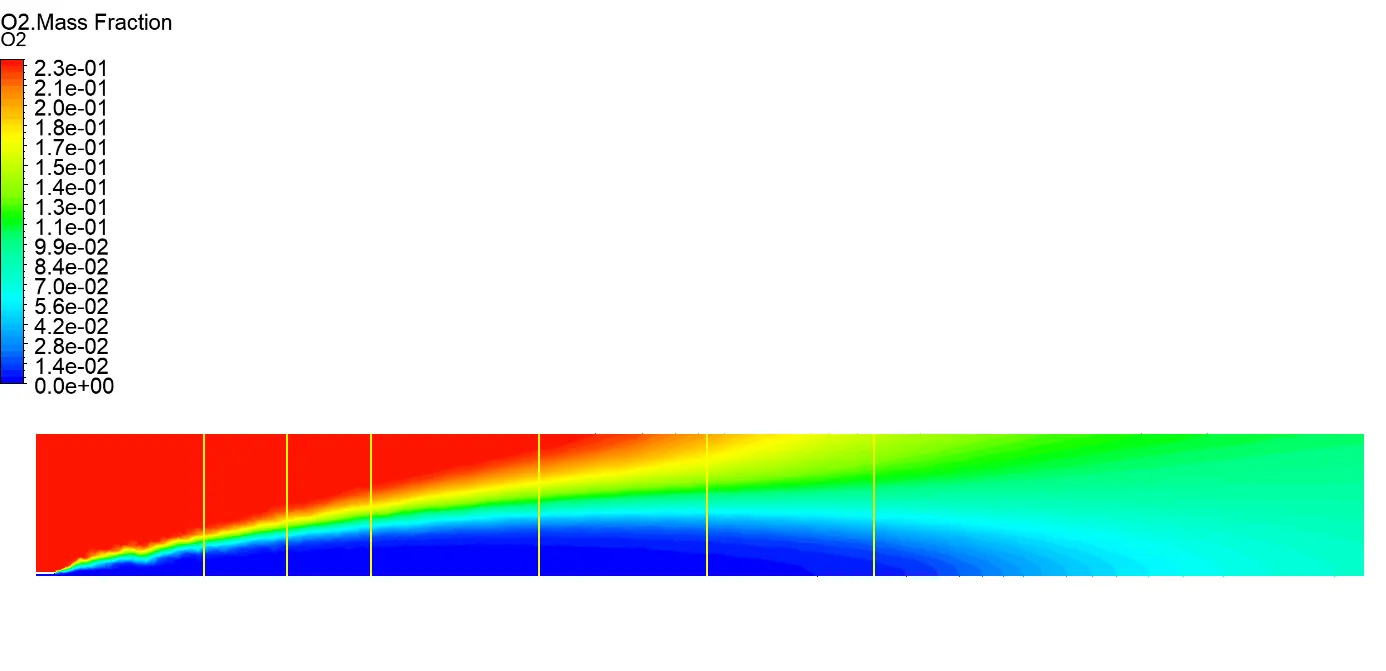
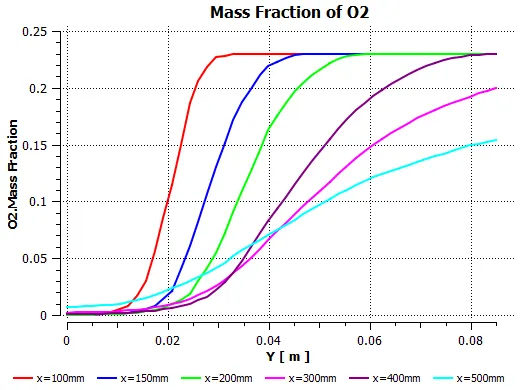
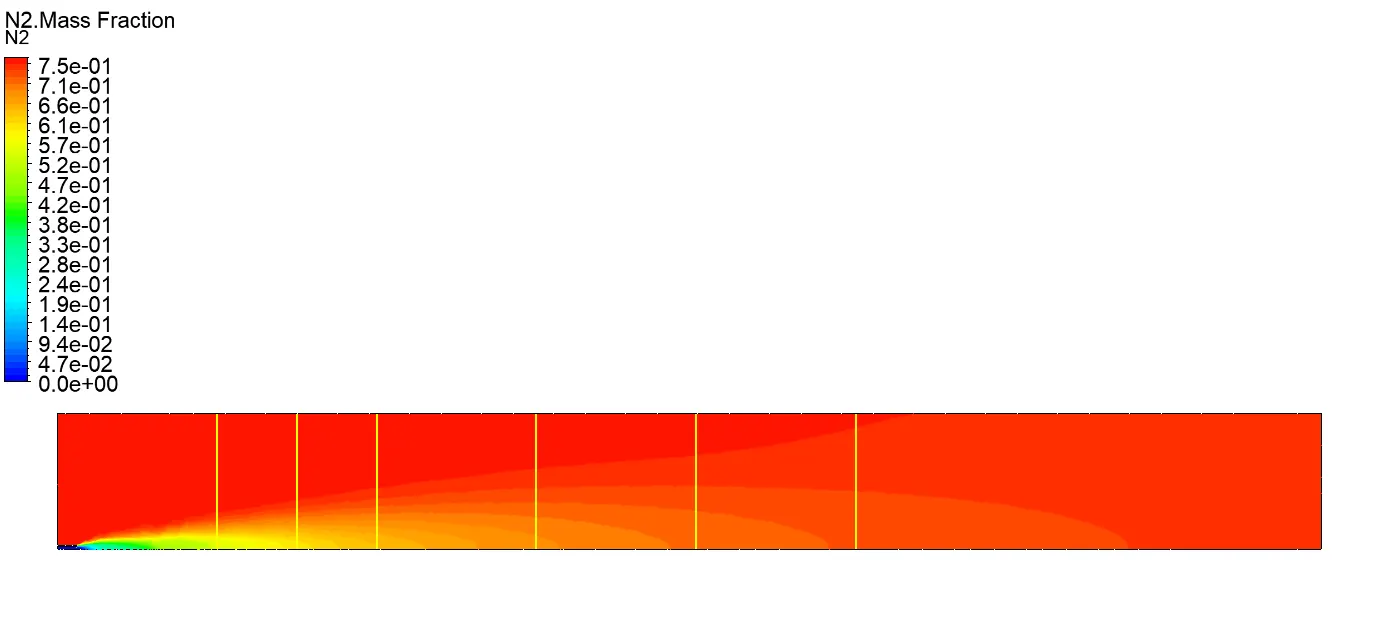
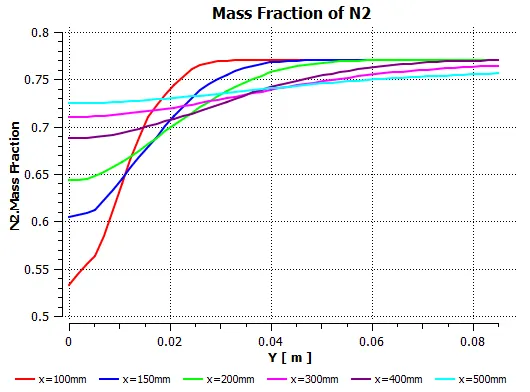
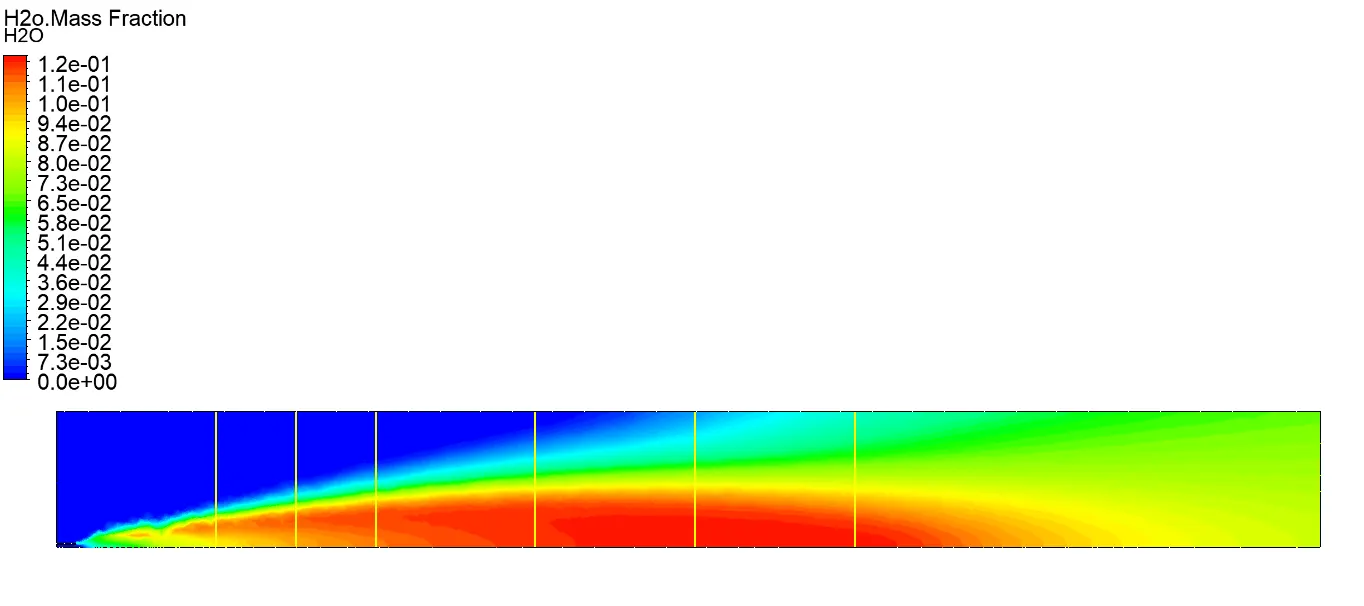
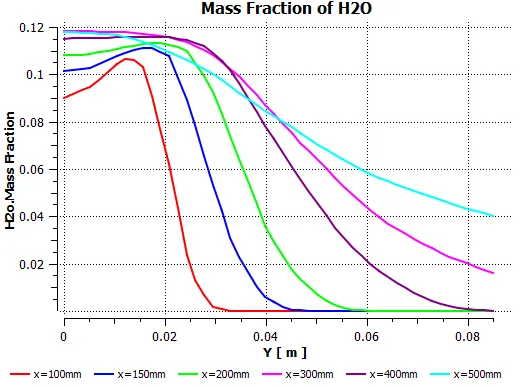
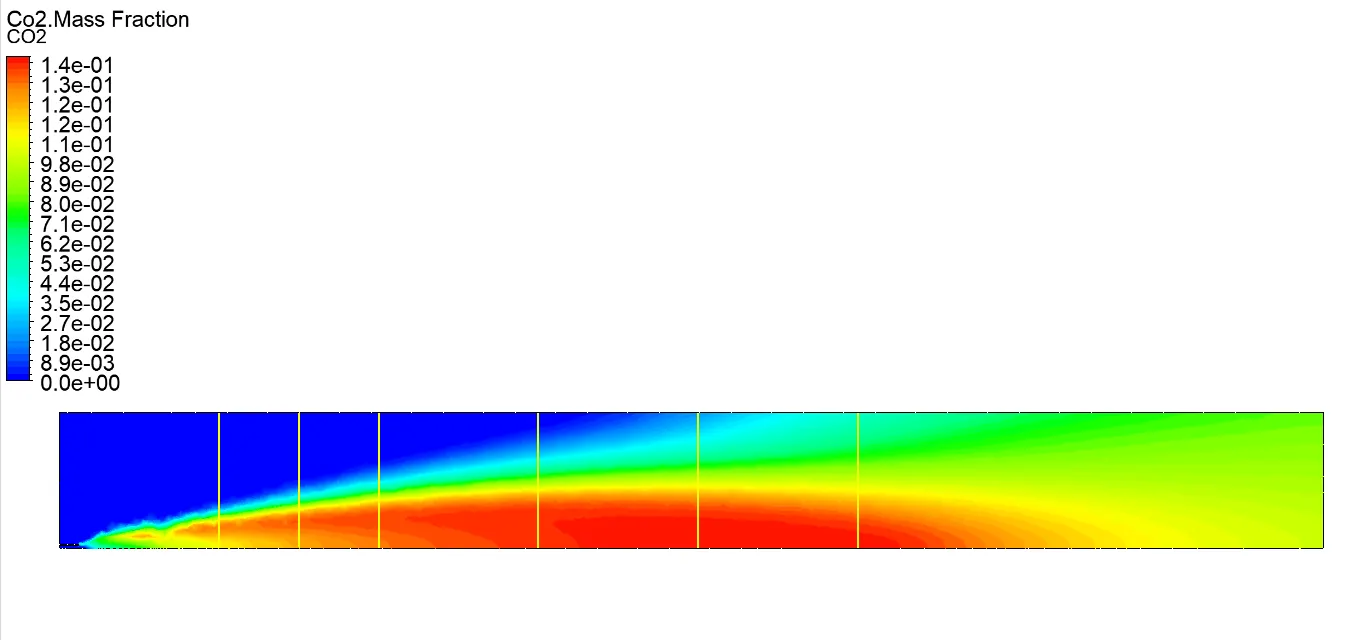
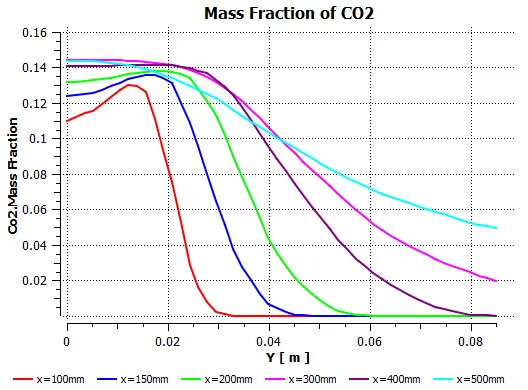
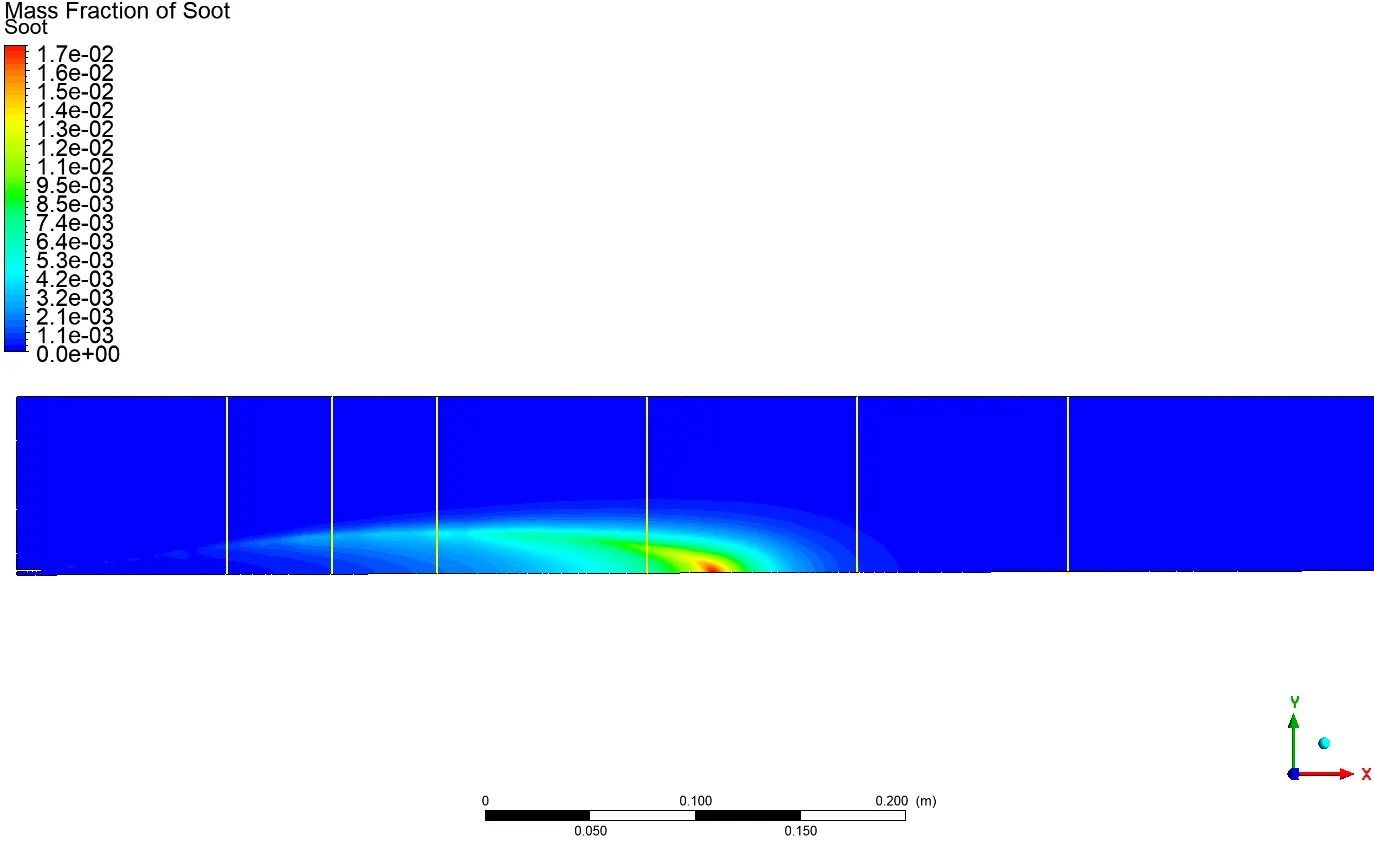
The lines in the contours is the position used in obtaining the plot data. The following are the contours plot of mass fraction for the different species.
CH4: The mass fraction of CH4 is maximum at the inlet which satisfies the essential boundary condition and decreases as you move along the axis. This can be noticed in the plot. The mass fraction of fuel increases as you move towards the axis and decreases as you move towards the outlet.
O2: Moving along the axis towards the outlet the mass fraction of O2 is very less almost to none as the concentration of the products of the reaction is more at that region. in the region near the air inlet the mass fraction of O2 is the maximum which complies with the essential boundary condition. At a particular section in the X-axis, the mass fraction of oxygen increases when we move away from the center of the combustion chamber.
N2: As air consists of 77% of Nitrogen the mass fraction of N2 does not change much in the region away from the combustion region. Whereas in the combustion region the mass fraction of N2 is low and that increases as we move towards the outlet.
H2O & CO2: As H2O and CO2 are the only products in the reaction the contours and plots of the variation of their mass fraction is the same throughout the chamber. That is the concentration of the products in the region of combustion is the maximum and decreases as we move away from it.
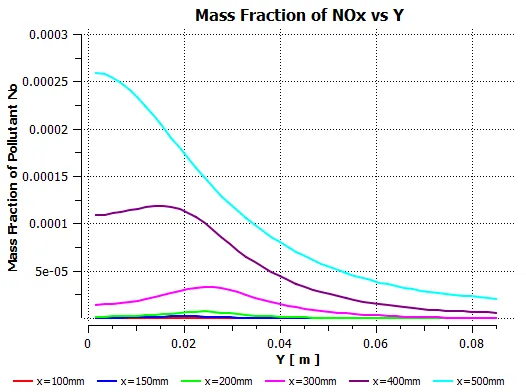
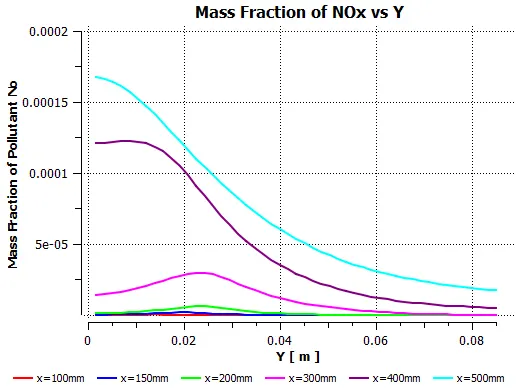
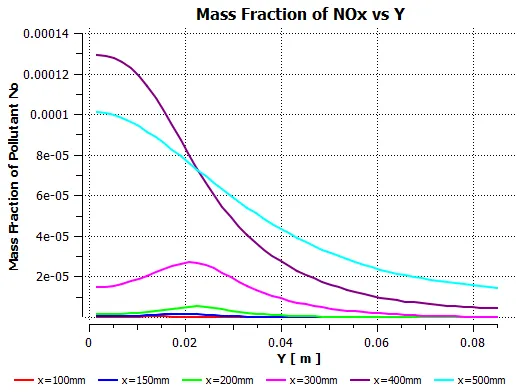
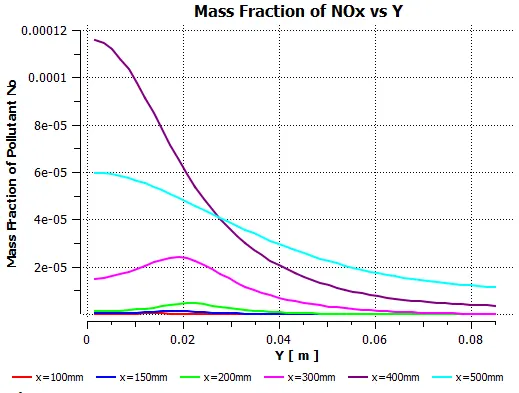
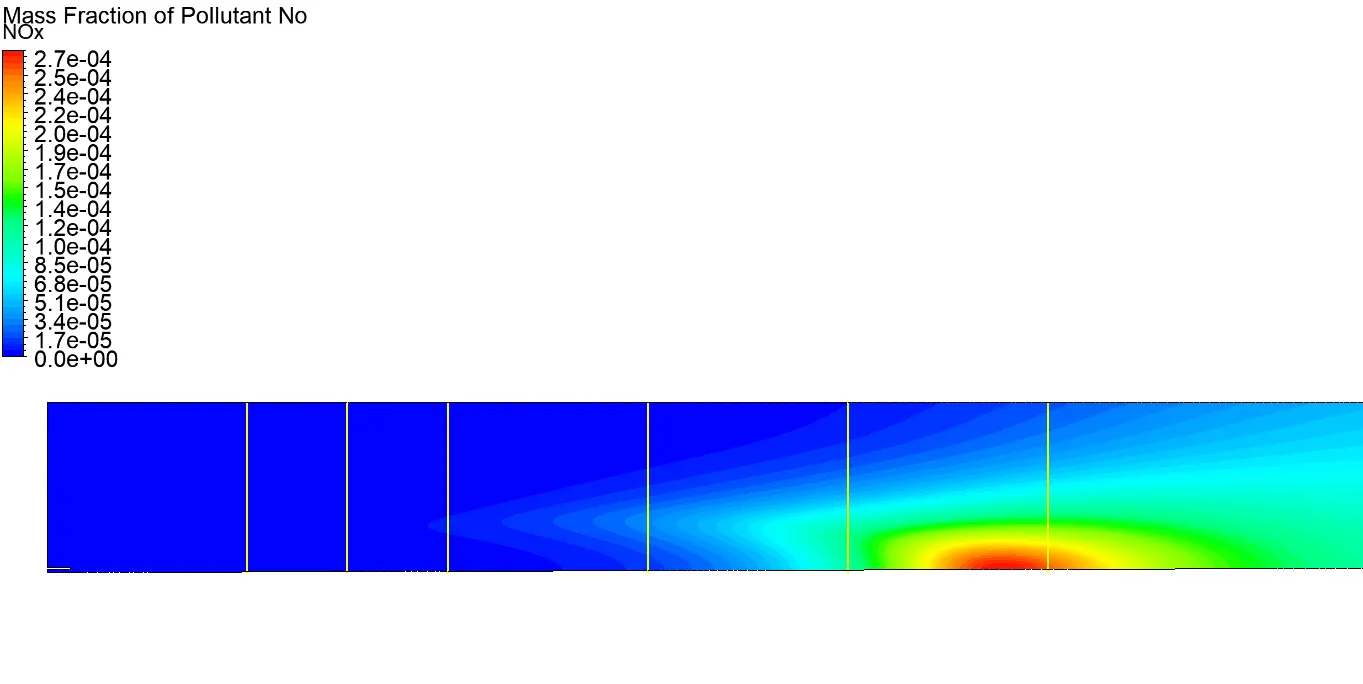
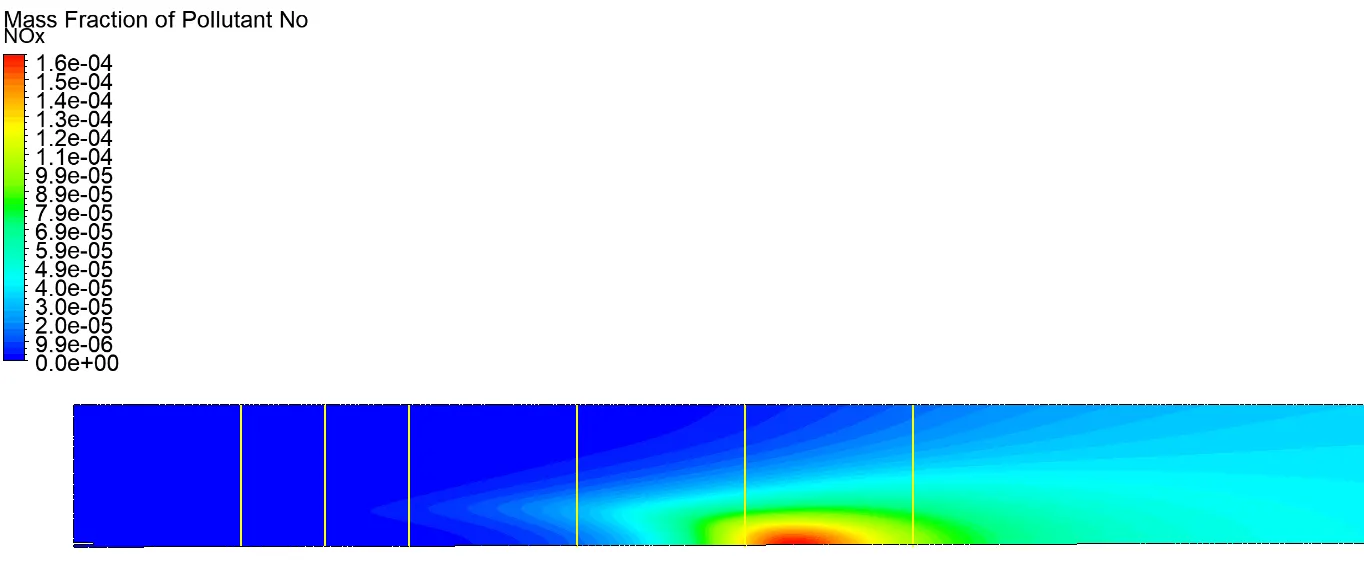
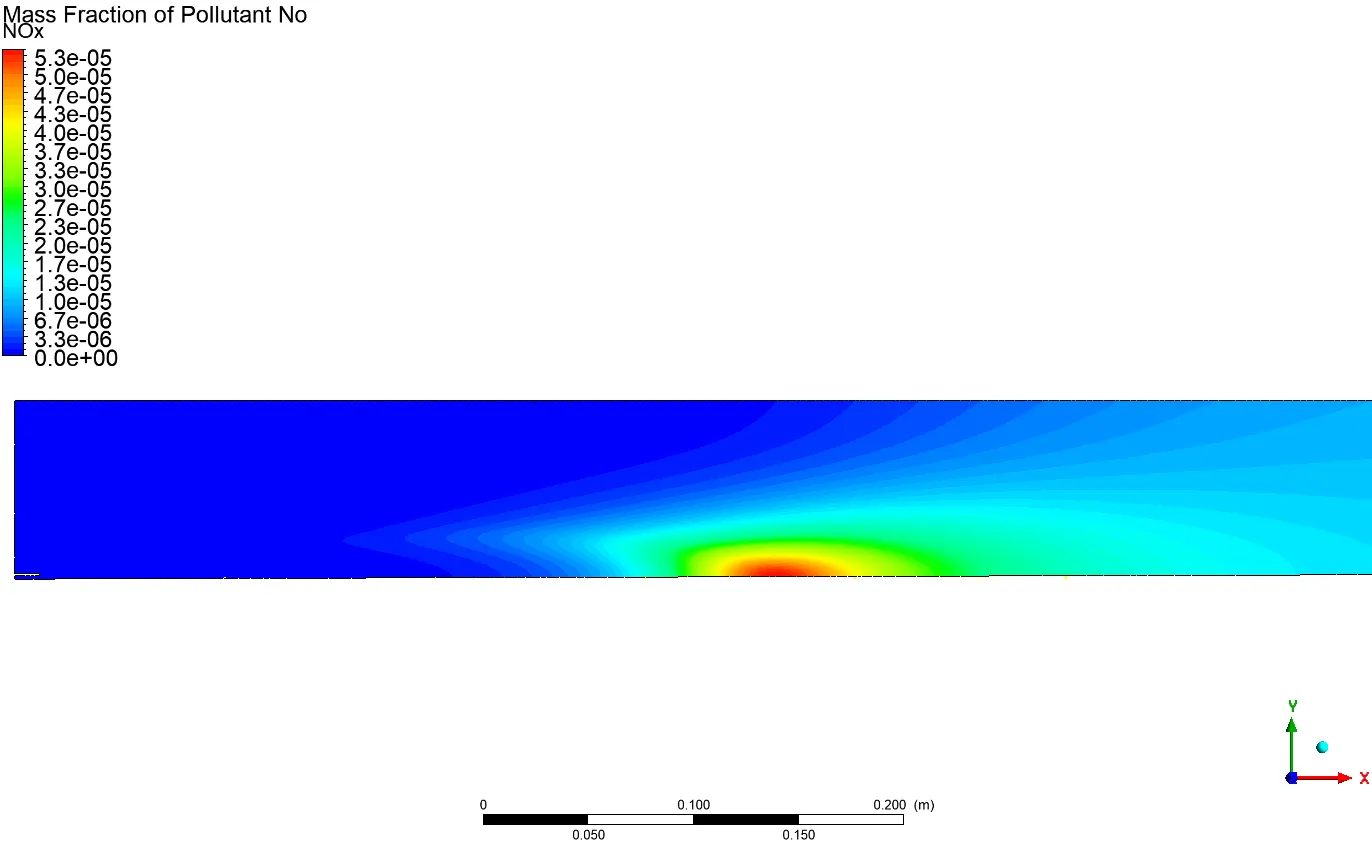
NOx Emission: The Pollutants are formed at the end of the combustion chamber (x=500mm). In the plots, we see that the pollutants at x=100,150,200 & 300mm the pollutant mass fraction is very very small. Then from 300mm to 400mm, there is a little spike in the mass fraction of NOx. And from 400mm to 500mm the NOx emission increases drastically. The mass fraction increases as we move forward from 500mm too.
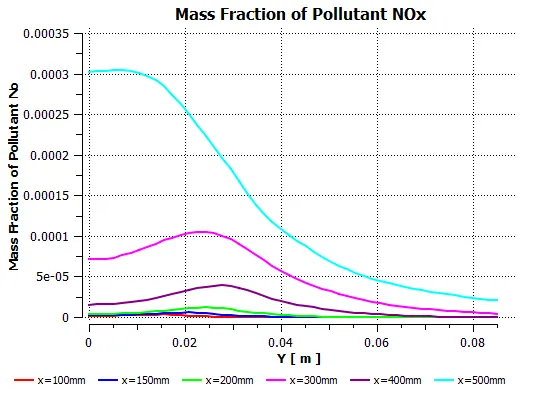
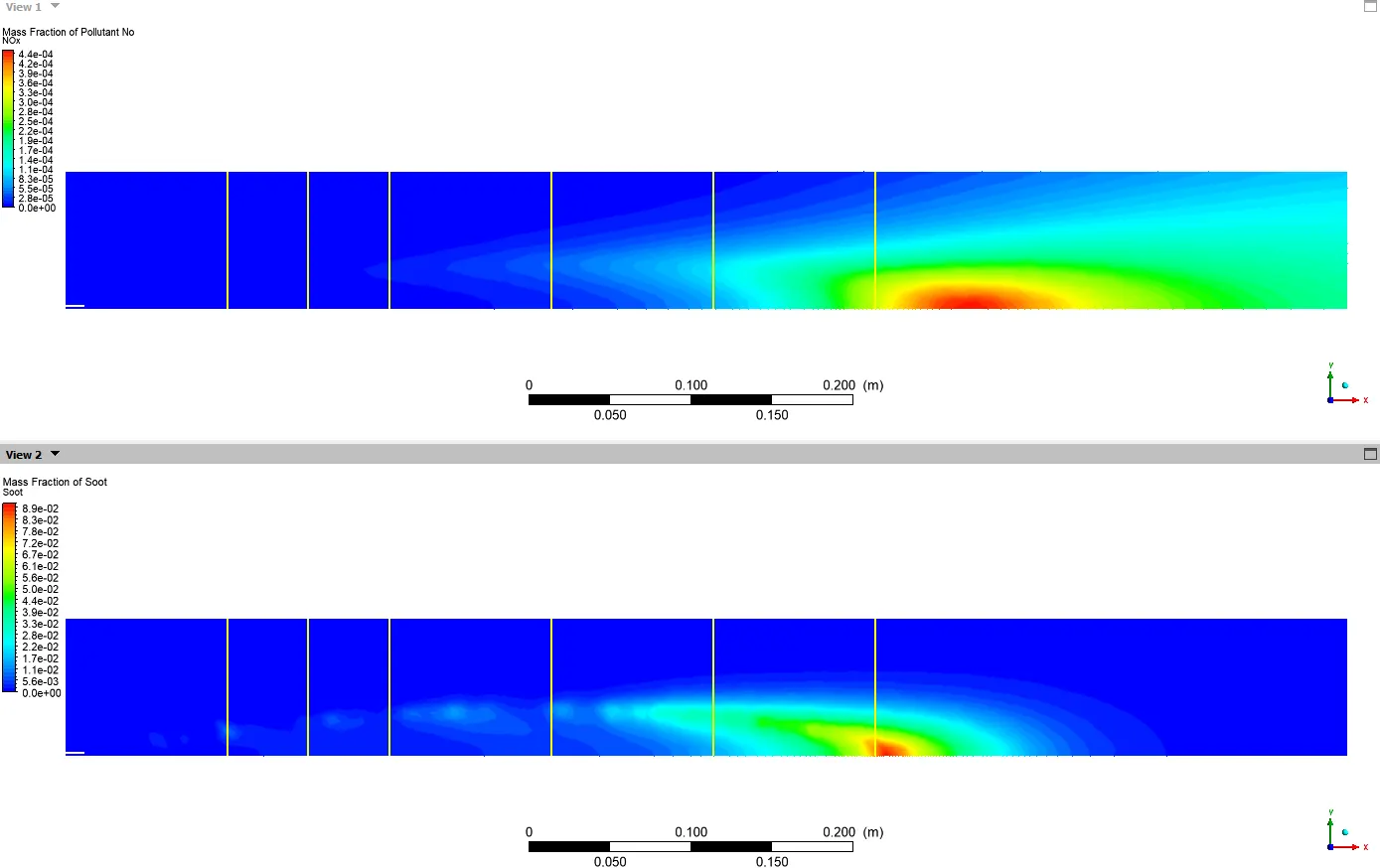
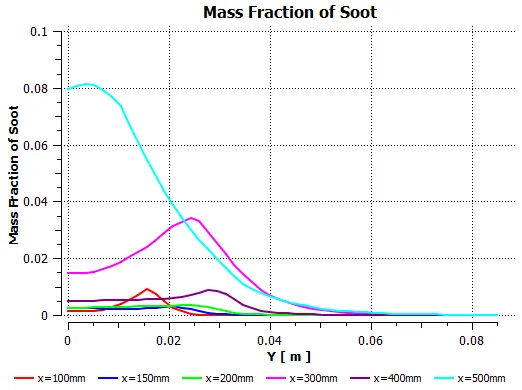
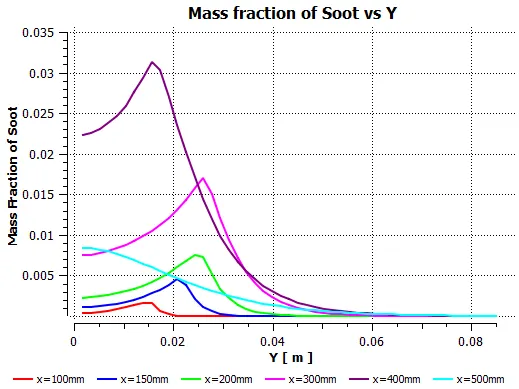
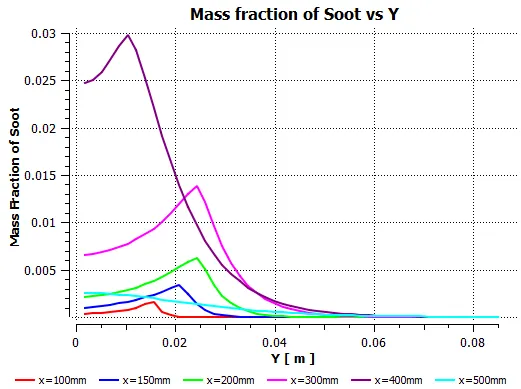
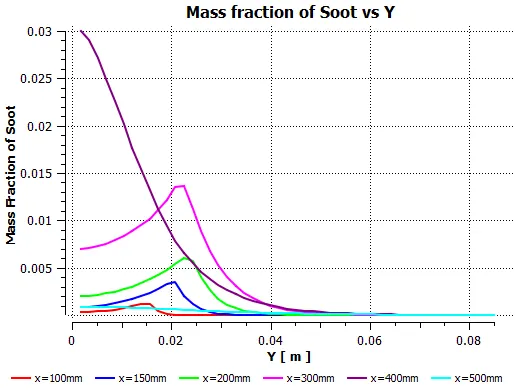
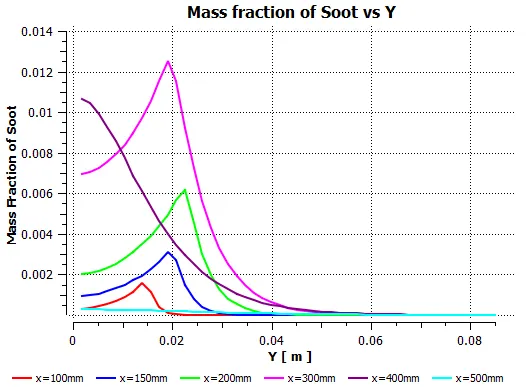
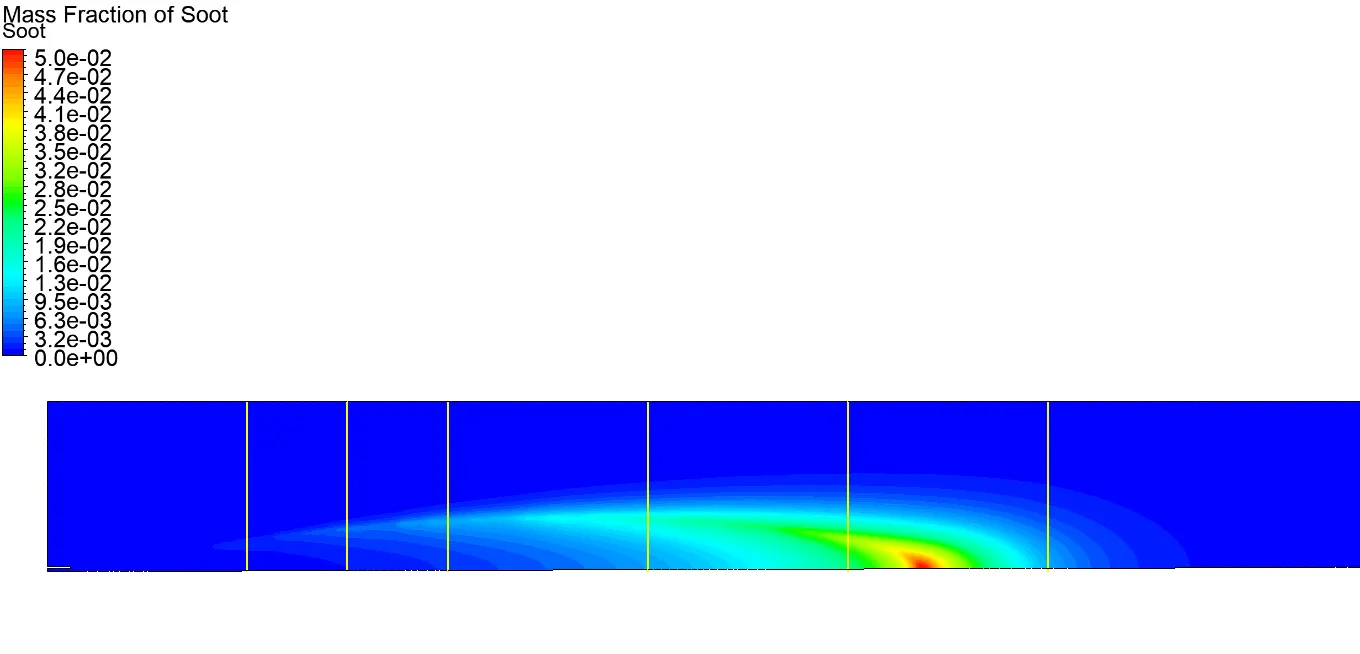
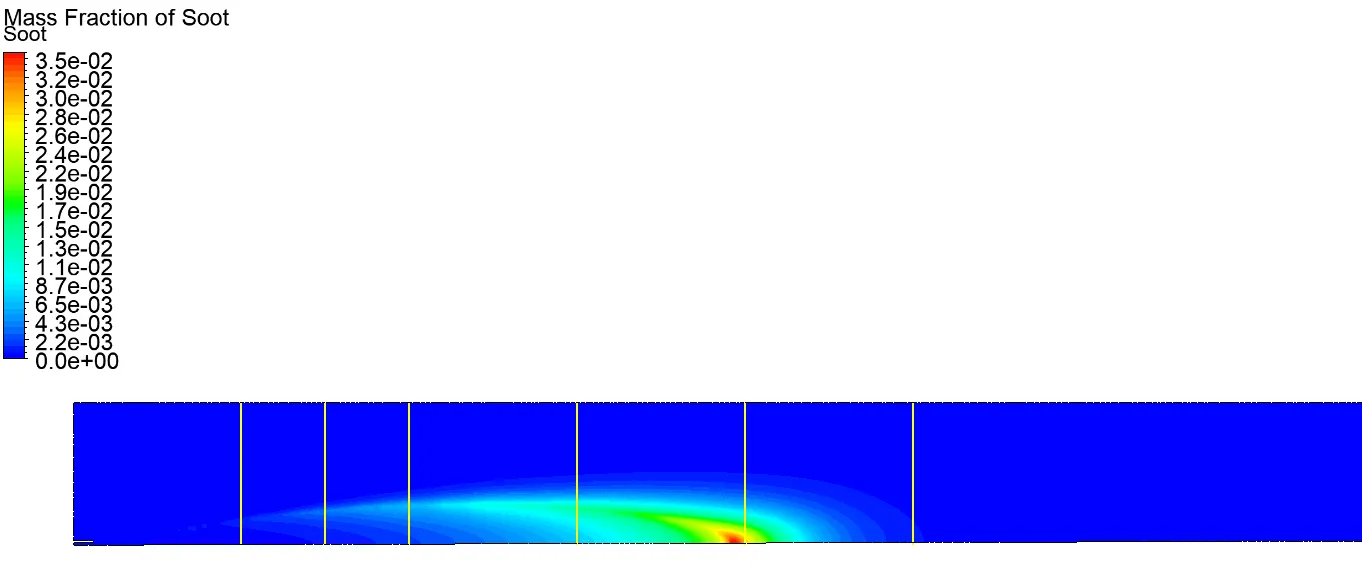
Soot: The variation of soot mass fraction was the same as the mass fraction of NOx but its peak is reached at the 500mm and then decreases gradually. The shame of the soot is parabolic which is most common. And the NOx emission increases at the apex of the soot.
Part II
Here we conducted a parametric study and obtained the area-weighted average of the mass fraction of NOx for the different parameter sets.
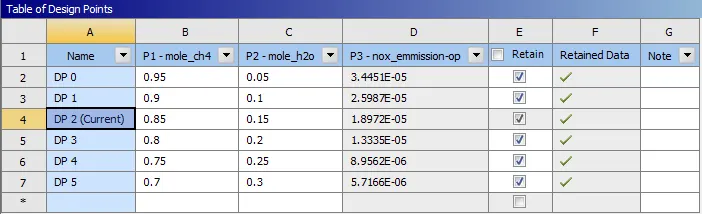
Here we notice, the NOx emission for 30% H2O is 5.76e-06 which is 10 times less than the NOx emission for 5% H2O. This also shows that with the increase in the mole fraction of H2O in fuel the NOx emission decreases. Following are the plots of NOx emission for the different cases .i.e. 5% H2O to 30% H2O
5% H2O
10% H2O
15% H2O
20% H2O
25% H2O
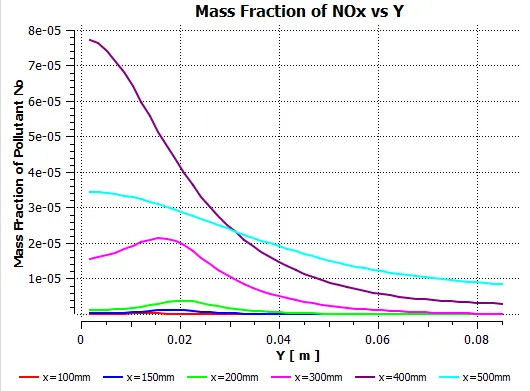
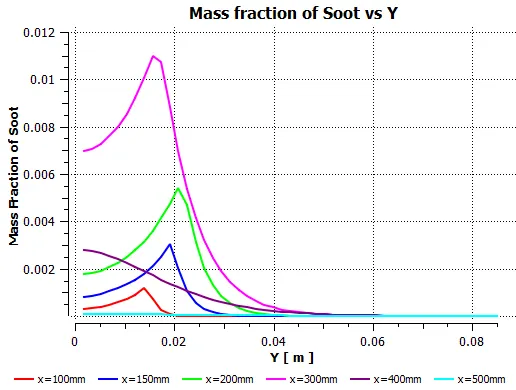
30% H2O
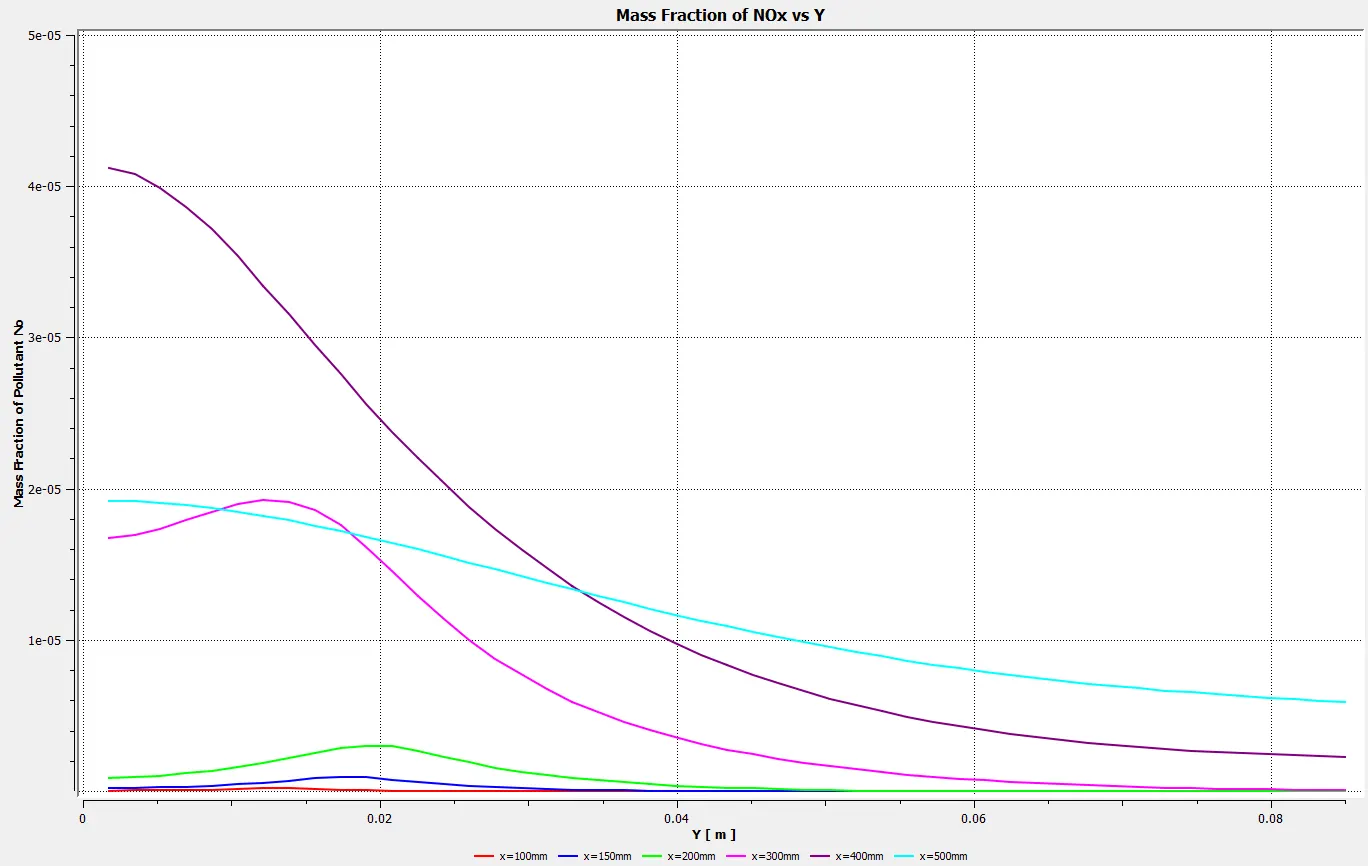
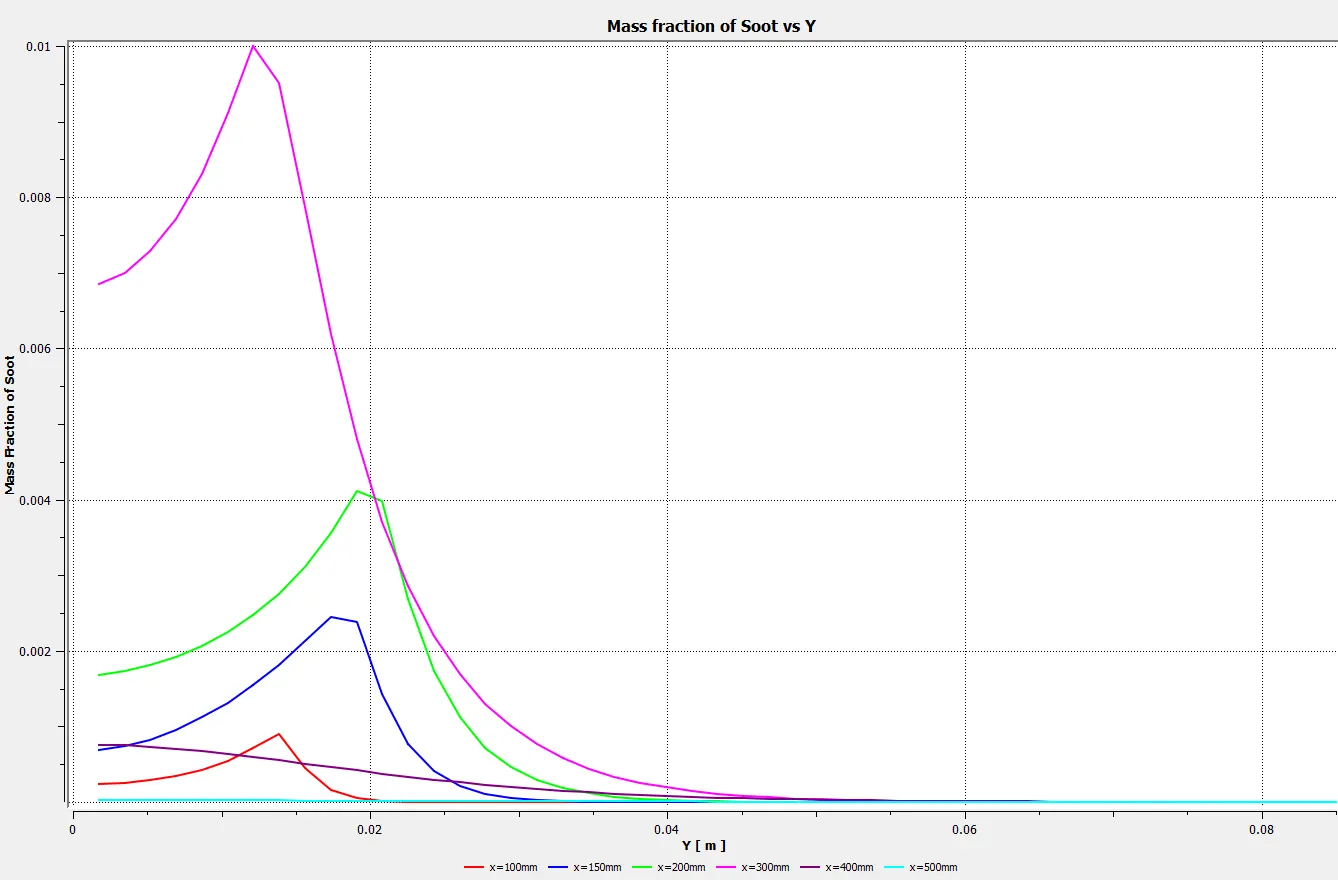
Contours Interpretation: The position of the core of the emission of NOx moves back towards the inlet and also the concentration is reduced. This also tells that smaller soot is formed with reduced mass fraction, also the position of the soot moves backward.
5%H2O
15% H2O
30% H2O
Conclusion: The simulations were conducted successfully and it can be inferred from the above results that the NOx emission can be decreases by increases the mole fraction of water in the fuel (CH4).
** ALL THE IMAGES ARE ATTACHED WITH THE REPORT**