Challenge 7
- What are Pier caps and explain the operations of launching of pier caps
Ans. Pier caps transfer the loads from the superstructure to the piers. They hold the bridge girders on bearing pads and disperse the loads from the bearings to the piers. Bridges with piers will all have pier caps to transfer the load from the superstructure.
Begin by choosing a concrete pier cap to use as a cap for your composites columns or wall.
- Lift The Cap by suitable gantry And Place The Piece On The Top Of The Pier.
- Ensure That The Pier Cap Is Wider Than The pier Or Wall On Each Face.
- Check If The Cap Contains A Drip Groove On The Underside So That The Water Can Easily Fall Before It Reaches The Wall.
- Use A Masonic Tracing Marker To Run The Profile Of The Wall Into The Pier Cap.
- Next Use A Diamond Blade Wet Saw To Cut The Marked Or Traced Lines Along The Marked Parts.
- Now If You Still Notice Some Sharp Edges, Ease Out The Sharp Edges Using A Chisel And Hammer To Smoothen The Corners Until You Get The Desired Curve And Shape.
- Thereafter, Place The Pier Cap On The Pier Top and check whether the dowel bars are in right position.
- Now, Mix The Cement In A Mixture Consisting Of Three Parts Sand To One Part Cement. Mix The Materials Using A Trowel, Gradually Adding Water Until The Cement Becomes Wet But Dry And Breakable.
- Thereafter, Place The Concrete Pier With A 1/4th Inch Of Cement Mixture Using, Ensuring An Even Spread Of The Concrete Mix That Extends To The Edges Of The Concrete Pier
- Alternatively, You May Also Use Modern Concrete Adhesive But They Are More Expensive And Need Professional Handling With Care. However, Curing Is Faster Than Mortar And The Application Of Bonding Is Also Less Time-Consuming That Mortar.
- Place A Continuous Line Of Adhesive To The Top Of The Block And Place Cap.
- Put The Pier Cap Back On The Concrete Pier And Push It Down To Make It Bond. Repeat The Process For Each Cap For Your Entrance And Until The Wall Is Completely Done.
- After The Mortar Or Adhesive Has Been Set, The Pier Caps Should Be Brushed Down With A Stiff Fibre Brush, Then Carefully Rinsed With Water To Remove Any Accumulation Of Stains
- What are two types of pier caps available, Substantiate the choice with the advantages & limitations of the various types.
Ans. Pier caps can be of different shapes of PSC and RCC type.
Advantages of RCC pier cap – This is easy to construct and skilled labour is not required. It is easy to design and easy to handle.
Limitations of RCC pier cap– For heavy loading it requires heavy depth which increases the cost of construction and also headroom clearance for vehicles running below reduces and loadings of eccentricity more than 2m will not be accommodated.
Advantages of PSC pier cap – For heavy loading and larger eccentricity PSC can be designed with efficient size. This reduces the concrete quantity and it can be easily carried by cranes of lower capacity.
Limitations of RCC pier cap – This requires skilled labour to handle the construction.
- Explain about the IRS CBC Table 11 Stress limitations in SLS for a PSC & RCC pier caps.
Ans.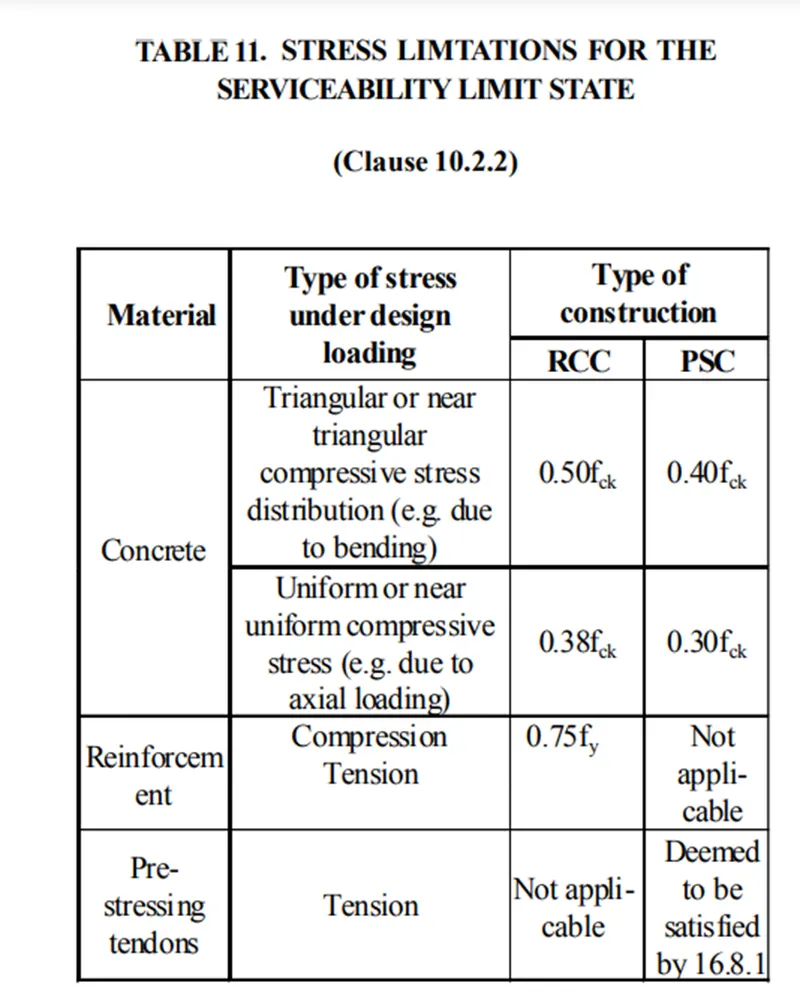
In RCC concrete with triangular distribution 0.5fck will only be at the top fibre and it will keep on reducing on inner fibres finally zero at neutral axis.
In uniform distribution average stress is calculated hence the value is reduced to 0.38fck which will be equally distributed to all fibres.
In PSC stresses limitations are less compared to RCC i.e. 0.4fck & 0.3fck which is observed during transfer of prestressing cable.
In prestress section we know that it has maximum compressive stress when external load is minimum and prestress has just been transferred to the section in that case we do not want to crush the section by applying load immediately after prestressing. When external load of DL,SIDL,LL etc. comes into action, tensile stresses are taken by prestress tendons. So compressive & tensile stresses are negated. But during construction stage it cant be negated hence lesser stress limitaton is allowed for PSC.
For prestressing tendons, Immediately after anchoring the force in the prestressing tendon shall not exceed 70% of the characteristic strength for posttensioned tendons, or 75% for pre-tensioned tendons. The jacking force may be increased to 80% during stressing, provided that additional consideration is given to safety, to the stress- strain characteristics of the tendon, and to the assessment of the friction losses.

As per Cl 16.4.3.1, the increased 15% increased applied moment. i.e., ration of applied moment to ultimate moment should be less than 1, which avoids the catastrophic failures of pier caps.
- Explain the allowable crack width limit for a pier cap and explain the impact of design crack widths.
Ans.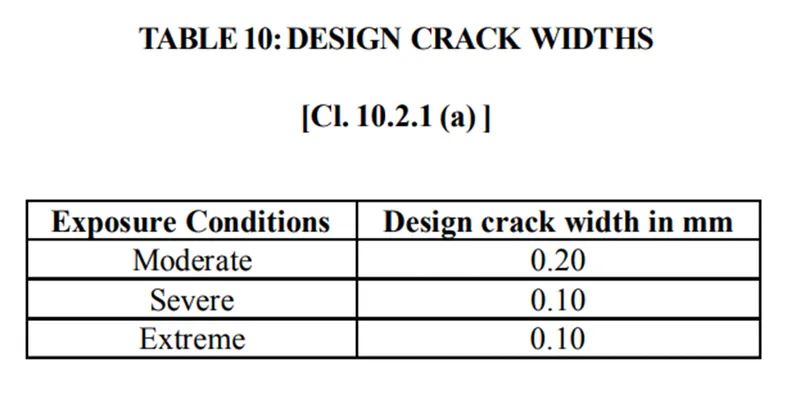
Moderate - Concrete surface protected against weather or aggressive conditions. Concrete surface sheltered from severe rain or freezing whilst wet. Concrete exposed to condensation, concrete structure continuously under water. Concrete in contact with non-aggressive soil/ground water.
Severe- Concrete surface exposed to severe rain, alternate wetting and drying or occasional freezing or severe condensation. Concrete exposed to aggressive sub-soil/ ground water or coastal environment.
Extreme - Concrete surface exposed to sea water spray, corrosive fumes or severe freezing conditions whilst wet. Concrete structure surfaces exposed to abrasive action, surfaces of members in tidal zone. All other exposure conditions which are adverse to exposure conditions covered above.
Based on the exposure conditions crack width limitations is decided.
It is assumed that human eye cannot see a crack of less than 0.3mm hence to keep a crack not visible is taken into consideration. Apart from it crack width creates a room for corrosion of reinforcement, lesser the crack width lesser will be exposure of reinforcement. Higher crack width reduces the durability of of the pier cap making it weak to take the stresses.
- Why pier caps are designed as a cantilever section
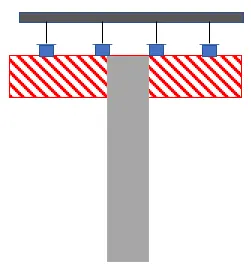
Ans. As the pier cap rests on pier the load that comes from the superstructure goes to pier through the pier cap. So the portion of pier cap on top of pier need not be designed as the load gets transferred directly to the pier. The portion of pier cap on left and right side of pier will act as cantilever now. Hence pier caps are designed as cantilever.The portion in red hatch will be designed as cantilever.
- What are the key elements considered in finalizing a pier cap length for a metro viaduct design?
Ans. There are mainly 3 key elements for finalizing pier cap length:
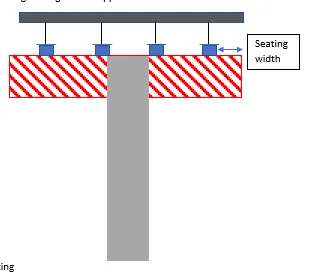
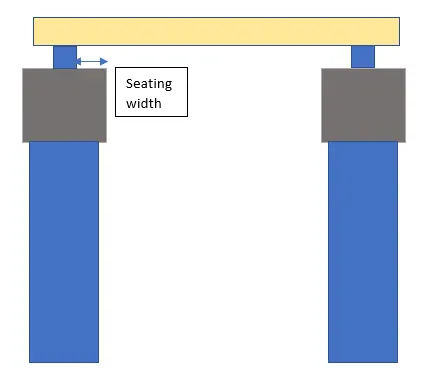
- Seating width arrangement and bearing arrangement
Enough space shall be provided to accommodate pedestal of bearing and seating width to avoid negative effects if ever bearing dislodgement happens.
- Provision for jacking
Enough space shall be provided between the bearings so as to provide jacks in future when bearing fails to replace it.
- Drain pipe arrangement
Drain pipes shall be provided for superstructure which will pass through pier cap and then to pier and then to ground. Reinforcement shall be away from the holes provided for drainage pipes.
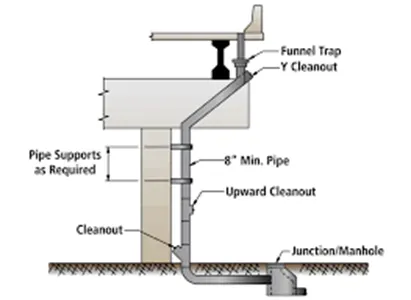
- What are the key elements considered in designing the drainage arrangement of a pier cap for a metro viaduct?
Ans. It shall be taken care that water flows only through pipe and not leak outside. So the pressure flow of water shall be estimated properly. Camber shall be provided for flow of water into the pipe.
- What are the key elements considered in finalizing a pier cap width for a metro viaduct design?
Ans. Pier cap width should be enough to accommodate bearing and seating width and drain pipe
- What is aesthetic requirements consideration of pier caps in a design of a metro viaduct?
Ans. Pier cap requires aesthetic consideration as it is open to public view. People may think to travel if it is not attractive. It plays a major role in load transfer so making it aesthetic may remove sense of danger from peoples mind.