Challenge 2
1. Answer: The bridge consists of following components
- Superstructure
- Substructure
- Foundations
- Parapet wall
- Crash barieer
- wingwall
- Bearings
- retainig wall etc..
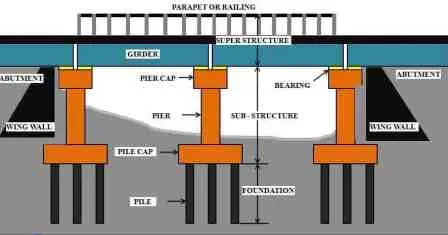
SuperStructure : The components of the bridge above the bearing are known as superstructures. There are many types of superstructure solid slab, T-girders, I girders, Voided slab ,Box girders, segmental girders etc...
SubStructure :
The structure of the bridge below the level of bearings is known as the Substructure. It consists of the following. The function of the substructure is to support the superstructure components and transmit their loads safely to the foundation.
Foundations:
The structure of the bridge below the level of Substructure is known as the Foundation. It consists of the following. The function of theFoundation is to support the Substructure components and transmit their loads safely to the subsoil.
Types of Foundation
- Open Foundations : Mainly Preffered in Hard strata of soil
- Pile Foundations : Mainl preffered at soft soil soil location
- Well Foundations: Mainly preffered at river locations and soft soil starta locations.
2. What is Super Imposed Dead Load means? What are loads that needs to be considered as SIDL for a metro viaduct bridge?
Answer : Superimposed dead load to account for the weight of the non-structural and semi-permanent members. Like crash barreir,railing load,OHE loads wearing coat load, snow load etc..
The following SIDL Loads are to be considered in the metro viaduct
- Parepet wall / crash Barrier loads
- Railing loads
- OHE Loads
- Slipper Loads
- Track bed loads
- Noise Barriers
3. What are the different types of girders that can be used for a metro viaduct?
Answer : In Metro Viaducts mainly 4 Types of girders used
- U- Girders
- Box Girders
- I- Girders
- Composite Steel Girders (Special cases)
4.What are bearings in a metro viaduct. Explain the types of bearings and analyses the types with respect to their advantages and disadvantages?
Answer :
In a metro viaduct, bearings are structural elements that support and allow the movement of the superstructure and transfer of forces and vibrations to the supporting structure.
There are several types of bearings commonly used in metro viaducts. Let's discuss three main types:
-
Pot Bearings:
- Pot bearings consist of a concave pot-shaped steel element filled with elastomeric material, usually neoprene, and an upper flat steel plate.
- Advantages:
- Allow for rotational movements around multiple axes, providing flexibility to the superstructure.
- Easy to install and maintain.
- Disadvantages:
- Limited sliding capacity, which may require additional expansion joints in long viaducts.
-
Elastomeric Bearings:
- Elastomeric bearings are made of layered elastomeric pads, typically reinforced with steel plates on the top and bottom.
- Advantages:
- Offer high flexibility, allowing rotational and translational movements.
- Provide excellent vibration isolation and damping characteristics.
- Can accommodate high vertical loads and horizontal displacements.
- Relatively low cost compared to other types.
- Disadvantages:
- Susceptible to aging and degradation due to environmental factors.
- Limited sliding capacity, similar to pot bearings.
-
Sliding Bearings:
- Sliding bearings, also known as PTFE (polytetrafluoroethylene) bearings, consist of a flat PTFE surface mounted on a steel plate.
- Advantages:
- Allow for horizontal sliding movements, accommodating thermal expansion and contraction.
- Long service life with minimal maintenance requirements.
- Disadvantages:
- Limited vertical load-carrying capacity.
- Inadequate resistance against rotational movements.
- Require precise design and installation to ensure proper functioning.
5.During the construction of metro viaducts across water passages, explain the topographical check list that needs to be considered for the designing the height of the viaducts?
Answer: The main points to be considered while designing the metro viaduct accros the River or water bodies
- HFL (Highest Flood Level) -Returns of 100 years data required
- MFL (Minimum Flood level)
- MSL(Maximum Scour Level)
- Discharge of water (Maximum discharge of water in cumecs)
The height of the viaduct is primarily determined by fixing the calculated Highest Flood Level (HFL) or the HFL data provided by the local water department. Once the HFL is established, the discharge is calculated based on the cumecs (cubic meters per second), and the afflux is calculated. The minimum vertical clearance between the soffit level and HFL is then determined. Finally, the height of the viaduct is calculated as the sum of (HFL, minimum vertical clearance for the calculated discharge, afflux, bearing thickness, superstructure height, and depth of the track bed with railing).
6. What are the different types of girders that can be used in a metro viaduct construction? Explain the differences of the girders and elucidate how a designer has to choose his girder type whilst designing.
Answer: In metro viaduct construction, various types of girders can be used based on the design requirements, structural considerations, and project constraints. The choice of girder type depends on factors such as span length, load-carrying capacity, construction method, site conditions, and cost-effectiveness. Here are some common types of girders used in metro viaducts:
In Metro Viaducts mainly 4 Types of girders used
- U- Girders
- Box Girders
- I- Girders
- Composite Steel Girders (Special cases)
U- Girders: U-girders have a U-shaped cross-section, with a bottom flange and vertical stem. These are the commnly used girders for metro viaducts. The span length of the girder is should not more than 27 mts to 28 mts.The U- Girders are easy to constrcut and installation. The U- Girders are very less in weigth and it effects to reduce the dimensions of the substructre and foundation and finally savings to the contractor.
Disadvantages : The U-girder is weak in torsion due to open to sky on the top of the strcuture.
Box Girders:
- Box girders have a rectangular or trapezoidal shape when viewed in cross-section. They consist of a top slab, bottom slab, and vertical webs connecting them.
Disadvantages : The depth of box girders high compared to depth of U- girder and I - Girders. Due to the depth the vertical clearence will reduce at underpass locations.
I - Girders:
- The I-girders are composite type girders, which are easy to cast and erected at all type of site conditions.In metro viaduct mainly this type of girders used in the crossover locations where the metro rolling stock can easily change from one track to another track.
Disadvantage: The PSC I girders cannot resist the trosion, when they are subjected to lateral torsion bulking during the stression.
Composite Steel Girders (Special cases):
- This type of girders are used at the railway crossing locations which are easily to install at site, the girders can errect in very short time.
Disadvantages: This type girders are not economy compared to the PSC girders.
7. Explain why the choice of metro designers would be precast U girders in India?
Answer: The Precast U-Girder are easily to construction and installed at site. The thicknees of the open web structure is very less compared to the box girders, that will reduce the loads on the substructure and foundation.
8.What is an open web structure? Brief the advantages of the system.
Answer:
The open web structure is also known as U-girders have a U-shaped cross-section, with a bottom flange and vertical stem. These are the commnly used girders for metro viaducts. The span length of the girder is should not more than 27 mts to 28 mts.The U- Girders are easy to constrcut and installation. The U- Girders are very less in weigth and it effects to reduce the dimensions of the substructre and foundation and finally savings to the contractor.
The main advantages for this type of structural configuration of superstructure are:
- Built in sound barrier.
- Built in cable support and system function.
- Possibility to lower the longitudinal profile by approximately 1m compared to conventional design of box girders.
- One span can be erected in a single night hence leading to faster pace of construction.
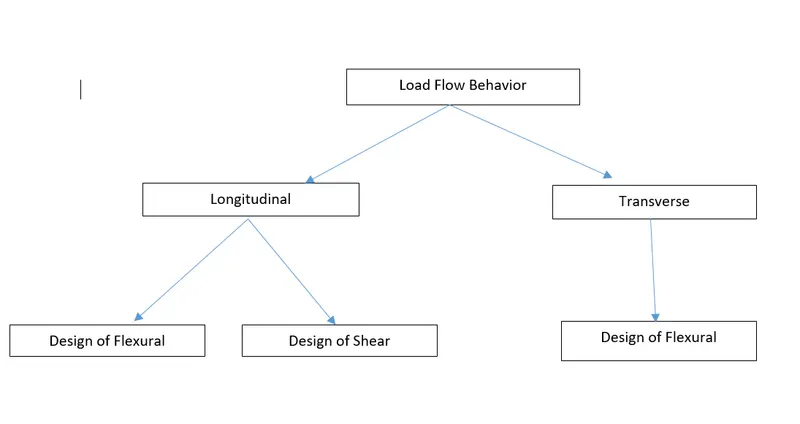
9. Explain the load flow behavior in a open web girder.
Answer: The load flow behaviour in the open web structures are as follows
10.As per IRS CBC, Table 11(Clause 10.2.2) the stress limitations of SLS, Explain your understanding of the table and how it correlated while designing a viaduct for metro rail construction.
Answer:
To prevent unacceptable deformations from occurring, compressive stresses in concrete and stresses in steel should be calculated by linear elastic analysis for the load combinations.
In metro viaducts the all superstructures are PSC so in strees limititation as per table .11 is followed in psc the stress limitation for concrete due to bending is 0.40fck, and for axial load the strees in concrete allows 0.30fck.
Where in reinforcment RCC type of structure the stress in steel is 0.75fy and for PSC the no tension is steel is allowed.
In RCC substructure & foundation the strees limitation as follows, for bending 0.5fck & for axial loading 0.38fck.
As per IRS CBC the strees limitations to be followed.
11.Explain your understanding of crack widths. Brief the three different design crack width with respect to IRS CBC
Answer: Crack width is an important parameter to consider because it can provide insights into the structural integrity and durability of the structure. Excessive crack widths can indicate potential problems, such as reduced load-bearing capacity, water penetration leading to corrosion of reinforcement, or even structural failure.
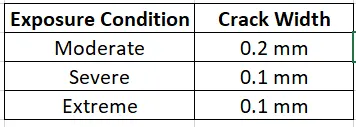
As per IRS CBC Table 10 (clause 10.2.1a) the crack widths are 3 types based on the exposure condition as shown below.