Forces Acting on a Vehicle
AIM
- To calculate the maximum speed of the motor, with given type data :
i. 90/100 R10 53J
ii. 90/90 R18 51P
2. Prepare a simple excel calculator to identify vehicle propulsion power based on given inputs and outputs.
Inputs: Kerb Weight (kg), Payload (kg), Coefficient of rolling resistance, Air density (kg/m3), Width (m),
Height (m), Drag coefficient, Speed.
Output: Total power in kW
What are the limitations of this calculation?
3. Assuming that tire pressure reduction by 15% results in an increase of rolling resistance effect by two
times, how much will be the difference in total traction power keeping all other parameters the same?
4. See the video of the Range rover sport dragon challenge. How much is the upgradeability? What was the
average speed? Which are the forces acting on the car?
SOLUTION
1. Reading a Tire, e.g., 195/55 R16 87H
- Tire Type: The letter "P" at the beginning of the "Tire Size" tells us the tire is a P-Metric tire, referring to tires made to certain standards within the United States, intended for Passenger vehicles. If a tire size has no letters at the beginning, this indicates a Euro metric tire. P-Metric and Euro-Metric tires may have different load capacities. The letters "LT," either at the beginning or at the end of the tire size indicate the tire was designed for light trucks. Vehicle manufacturers equip some light trucks with "LT" type tires. These tires generally require higher inflation pressures than passenger tires.
- Tire Width: Is the width of the tire measured in millimeters from sidewall to sidewall. The first three-digit number in the tire size refers to the tire width. For instance, in a size 195/55 R16 87H tire, the width is 195 millimeters.
- Aspect Ratio: Is the ratio of the height of the tire's cross-section to its width. The two-digit number after the slash mark in a tire size is the aspect ratio. For example, in a size 195/55 R16 tire, the 55 means that the height is equal to 55% of the tire's width. The bigger the aspect ratio, the bigger the tire's sidewall will be.
- Construction: The letter "R" in a tire size stands for Radial, which means the layers run radially across the tire.
- Wheel Diameter: Is the size of the wheel measured from one end to the other. It tells us the size of the wheel that the tire is intended to fit. A size 195/55 R16 tire is made for a wheel with a 16" diameter.
- Load Index: Indicates the maximum load that the tire can support when properly inflated. You'll also find the maximum load on the tire sidewall, in both pounds and kilograms. As here it is 87 kg.
- Speed Rating: The last letter is the speed rating, which tells you the top speed it’s safe to travel at for a sustained amount of time. A tire with a higher speed rating can handle heat better and provide more control at a faster speed. The maximum operating speed of a vehicle is no more than the lowest speed rating of all tires mounted on the vehicle. For speed rating symbol P here its speed rating is 93 mph.
Solution:1
Given, Tire Parameter are ,90/100 R10 53J
Gera Ratio , G = 7
Electric Scooter Speed ,`v` = 90 Kmph
= (90*1000/3600) = 25 m/s
The angular speed of the motor can be calculated by,
`omega = G (frac{v}{r})` .............................................(i)
But for calculating this we need a radius of the tire ,
Step 1 : From the above tire model, we can see that,
Tire Width, W = 90 mm
Aspect Ratio = 100 `%`
Rim diameter D= `10 * 25.4 = 254 mm`
Step 2. Calculate the tire sidewall height.
`H = frac{AR*W}{100} = frac{100 * 90}{100} = 90 mm`
Step 3. Calculate the wheel diameter
`d_w = D + 2*H = 434 mm`
Step 4. Calculate the tire radius
`r_w = frac{d_w}{2} = frac{434}{2} = 217mm` = 0.217m
Step 4. Calculate the angular velocity of the motor.
`omega = Gfrac{v}{r} = frac{7 * 25}{0.217} = 806.45text(rad/sec)`
Step 5. Calculation of angular velocity in rpm
Angular Velocity,`omega = 806.45 *(9.5493)`
`omega` = 7701 RPM
Solution 2 :
The model selected for this case is 90/90 R18 51P
Step 1 : From the above tire model, we can see that,
Tire Width, W = 90 mm
Aspect Ratio = 90 `%`
Rim diameter D= `18 * 25.4 = 457.2 mm`
Step 2. Calculate the tire sidewall height.
`H = frac{AR*W}{100} = frac{90 * 90}{100} = 81 mm`
Step 3. Calculate the wheel diameter
`d_w = D + 2*H = 619.2 mm`
Step 4. Calculate the tire radius
`r_w = frac{d_w}{2} = frac{619.2}{2} = 309.6mm` = 0.3096m
Step 4. Calculate the angular velocity of the motor.
`omega = Gfrac{v}{r} = frac{7 * 25}{0.3096} = 565.24text(rad/sec)`
Step 5. Calculation of angular velocity in rpm
Angular Velocity,`omega = 565.24 *(9.5493)`
`omega` = 5398 RPM
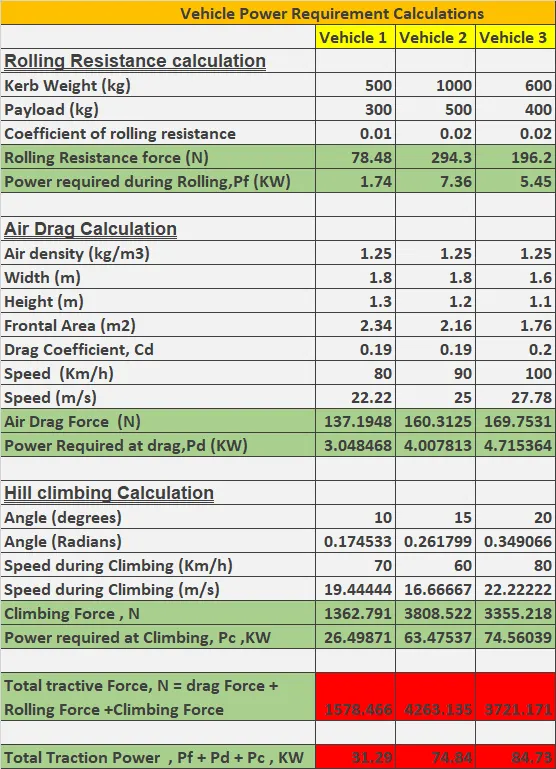
2. Prepare a simple excel calculator to identify vehicle propulsion power based on given inputs and outputs.
The following data has been taken for preparing the below excel sheet :
Formula Used
Air drag: `frac{1}{2}*rho*A*C_d*V^2`
Rolling Resistance: `mu*M*g`
Climbing Resistance: `M*g*sin psi`
Limitations of this calculation
- Excel calculator can't be used for large calculations.
- Here we have to put everything manually, which requires a large time duration, and also if there are any internal losses with the model then we need to define manually.
- Always need to be aware of unit conversion.
CASE 2:
- For this setup, we are assuming, that tire pressure reduction by 15% results which result in an increase of rolling resistance effect by two times.
- For this, we have considered our last design concept, with modification in rolling resistance.
- The result is shown in below excel sheet:
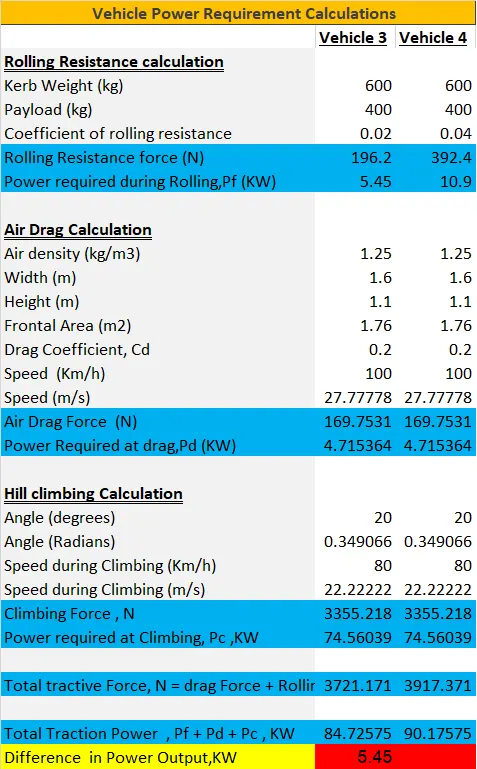
We can see that by increasing the rolling resistance by two times it increase the total power required by the vehicle, with a difference in power of two-vehicle by 5.45 KW.
3. See the video of the Range rover sport dragon challenge. How much is the gradeability? What was the average speed? Which are the forces acting on the car?
Description :
Tianmen Mountain Road in the Hunan Province of China incorporates a dizzying 99 hairpin turns along the 7 miles of mountainside road. At the summit, this road leads toward 999 steps, all of which lead to Heaven’s Gate, a natural rock arch in the mountainside, mythically thought to be a link between the mortal world and the world of the gods. After the road comes to the steps, which at their steepest sit at a towering 45-degree angle.
Range Rover completed the drive that included 99 turns, 999 steps, and the slow maneuvering at the bottom of the steps, in an impressive 22 minutes and 41 seconds.
It produces 404bhp and 500Nm of torque which helped to propel the car to the top of the steps. Total distance cover by car is 11.3 Km
Gradability :
Gradeability is defined as the steepness of grade that a motor vehicle is capable of climbing at an efficient speed. Gradability is dependent on engine power, drivetrain type, gear ratio, weight, weight distribution, car's center of gravity, and traction.
In our case, we can calculate with the help of a given diagram.
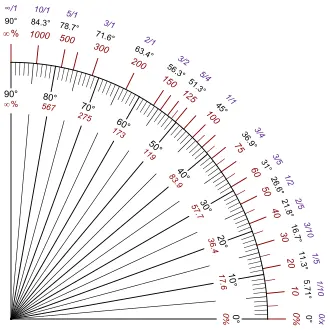
Fro our case with a slope angle of 45-degree gradability is equal to 100 %. At 45 degrees, it would be necessary for a coefficient of friction of the tire to be at or above 1.0 in order to NOT have the vehicle slide downward.
Average Speed :
Distance covered,d= 11.3 Km
Time Taken ,t = 22 min 41 sec = 0.378 hr
So , from formula, `Speed ,v = frac{text(distance)}{time} = frac{11.3}{0.3781} = 29.81`KMPH
Force Acting on Car :
For a given challenge, the force acting on Range Rover on a given slope of 45 degrees are :
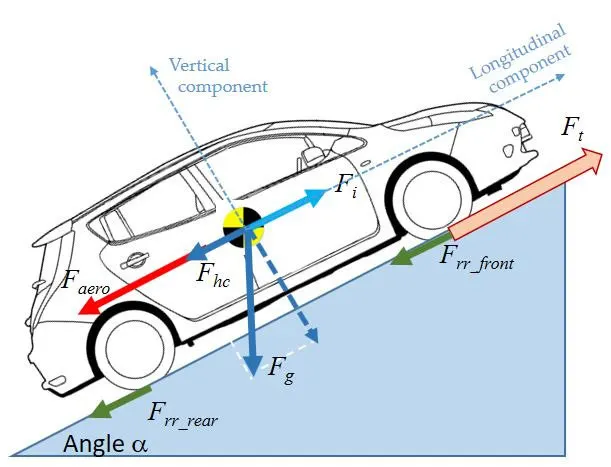
1. Aerodynamics Force,`F_d` = Aerodynamics drag will oppose the motion of Range Over. It is due to the density of air and changing pressure as cars move upward.
2. Rolling Resistance: Rolling resistance will be acted on the wheel which is in contact with the road while moving uphill in an upward direction.
3. Climbing Resistance Force: It will also occur on the vehicle due to the slope angle of the uphill, which affects the movement of the vehicle.
4. Vertical and Longitudinal Force: This force will act on the rear side of the car and the vertical direction of the car moving upward.
Conclusion
The given task has been successfully performed, with given data.
Reference
https://x-engineer.org/automotive-engineering/chassis/vehicle-dynamics/calculate-wheel-radius/