Bird Strike Analysis on Aircraft Leading Edge
Introduction:
The main objective is to perform the bird strike analysis on aircraft leading edge under certain conditions and check the damage on the leading edge from the analysis result. A bird strike is strictly defined as a collision between a bird and an aircraft which is in flight or on a takeoff or landing roll. Bird Strike is common and can be a significant threat to aircraft safety. For smaller aircraft, significant damage may be caused to the aircraft structure and all aircraft, especially jet-engined ones, are vulnerable to the loss of thrust which can follow the ingestion of birds into engine air intakes. This has resulted in a number of fatal accidents.
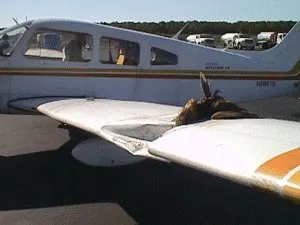 (Source: Google)
Therefore certification of a bird strike is one of the important processes in aircraft design. In particular, for a civil aircraft, there is a specific requirement FAR25.571 for a bird impact as specified by the Federal Aviation Administration(FAA). Even if a 41lb bird collides, the flight should able to complete normally and the aircraft should not be damaged. There have been about 227,005 wildlife strikes with civil aircraft in USA between 1990 and 2019 (about 17,228 strikes at 753 U.S. airports in 2019). An additional 4,275 strikes have been reported by U.S. Air Carriers at foreign airports, 1990-2019.
SPH is a meshless lagrangian numerical technique used to model the fluid equations of motion.SPH has proved to be useful in a certain class of problems where large mesh distortions occur such as high-velocity impact, crash simulations or compressible fluid dynamics. Many researchers have investigated the numerical analysis model for bird strike by SPH technique with dynamic explicit codes such as LS SYNA and PAM CRASH.
Creating the SPH bird model:
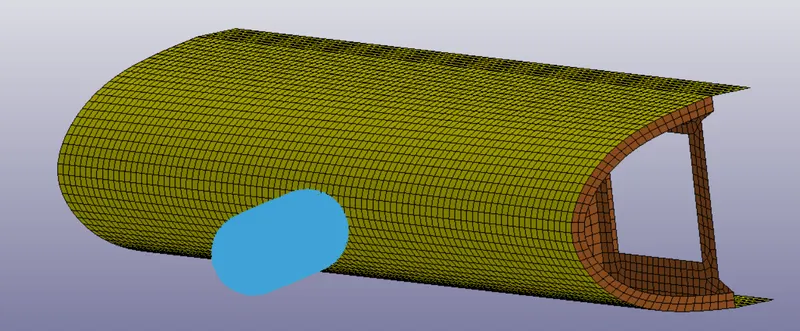
In order to model a bird, a cylindrical shape with rounded ends was applied and SPH particles can be generated through SPH generation using LS Pre-post. Simple shapes such as cylinders, spheres and boxes can be directly created in LS Pre-post.
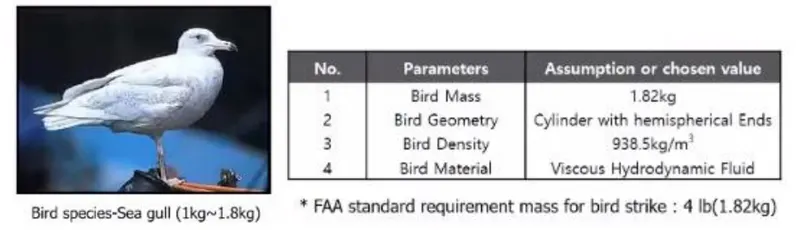
The bird model was created using the solid nodes option which generates the SPH particles at the node points of the provided geometry model . The mass of the bird is about 1.82kg according to FAR regulation and the mass can be calculated based on the density input (Density,1600kg/m3). The basic properties are as follows and are assumed to be similar to the average seagull which is about 1-1.8kg.
Material properties:
The structure of the leading edge is composed of a thin skin structure composed of a 1.2mm aluminium panel and a 3mm inner-frame.
The MAT 24 linear plastic property was used for skin and the frame. The LS-DYNA MAT24 is the most widespread material model in use today for the modelling of a crash, drop and other rate-dependent phenomena.
The bird was modelled using the NULL properties with EOS(Equation of State). Organic creatures such as birds are composed of internal organs, flesh, feathers etc which have bones, beaks, kidneys having almost no physical properties. It can be seen that behaviour almost similar to water.EOS is used to express the ductile properties.
In LS DYNA, EOS is applied to accurately simulate the behaviour of a material. The EOS is a formula that describes a particular state of matter and is primarily used to express the correlation with the pressure, volume, temperature.EOS can be applied to SPH particles and among shell elements. Typical EOS representing the physical properties close to liquid are EOS_linear_polynomial. Bird properties are modelled using EOS and MAT_NULL.
Large deformation occurs in bird strike analysis so hourglass is set to flanagan belytschko viscous form IHQ =2 .
Element Properties:
After defining the properties, the properties should be assigned to the respective part.
For shell elements, a section of 1.2mm for leading-edge and 3mm for the inner frame is created. For sph particles
CSLH value of 1.2mm is entered and in general, it is acceptable, CSLH defines the relationship between the particles.Hmin and Hmax values are entered as 0.2 and 2 and it is the range of particles taking into account when it moves around. The define BOX command is used to set the area considered for collision so that it reduces the analysis time.
Boundary and Contact Condition:
The leading edge is fixed in all six degrees of freedom and the sph particles are given initial velocities of Vx=-38 and Vy=-15.
Eroding nodes to surface contact is used and sph particles are defined as a slave and the parts which are the structure of collision are master surface.
Analysis condition:
Termination time is given as 0.005sec and erode is entered as 1 to enable the element to be removed when the minimum time step is reached and also the required basic analysis conditions are updated.
Results:
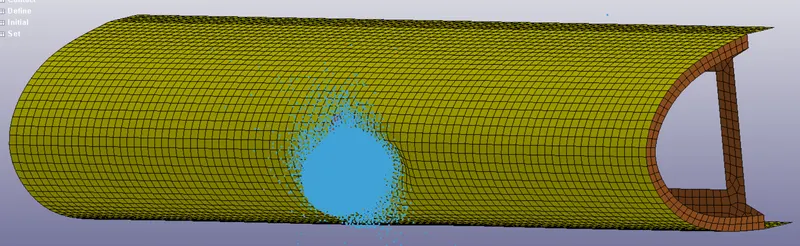
TIME=0.0020sec
TIME=0.0050sec
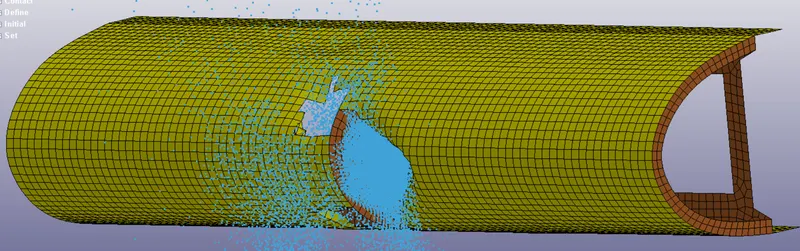
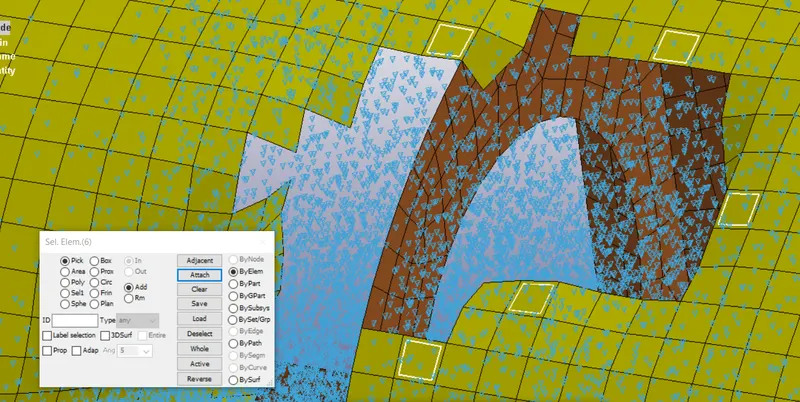
The aluminimum leading edge of 1.2mm is damaged by bird strike is seen from above images and the element erosion occurs at the region of impact and the sph particles penetrated.
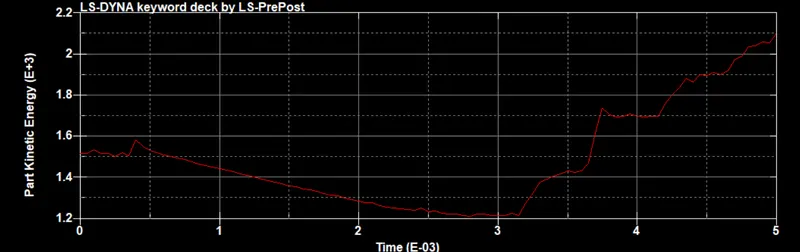
The kinetic energy of sph particles shows that there is decrease in the energy during the time of impact.
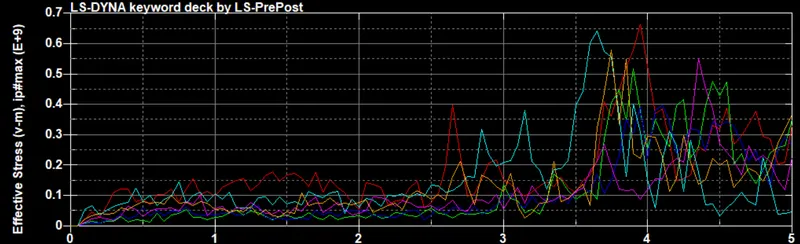
The history of stress is taken from the elements near the impact region

Final result and solution:
The impact analysis was conducted under certain conditions and it is seen that a significant area of the leading edge is damaged due to the bird strike and hence it affects the flight stability.Therefore it does not meet the FAR standard .
The thickness of the aluminium skin can be increased and the calculation can be solved again until it meets FAR standard.