Benchmarking
Benchmarking
Benchmarking involves a structured comparison between similar products,services or processes on some dimensions of performance. For example it can be used to compare the availability and delivery of features in a product and in this form often provides the basis of consumer tests and reviews. These look at products and services and provide recommendations based on which is best or some form of ranking amongst competitors.
It is particularly useful when comparing not only performance but also practice in other words what do the different organizations do to enable that performance to be delivered? And applied in this way it is a powerful tool in process innovation sin e studying how the ‘best’ achieve their performance can provide powerful clues for changing the way processes operate. Process benchmarking of this kind can operate at several levels:
• Between similar processes in the same factory or service branch
• Between different factories or service branches
• Between different competing organizations
• Between different sectors using the same process
Internal benchmarking.
- When a corporation already has established and verified best practises and only needs to communicate them, they employ internal benchmarking. If data from comparable industries is not easily accessible, internal benchmarking may also be required.
Comparative benchmarking
- Comparative benchmarking is utilised when a business has to identify performance goals for industry leadership and when it wants to assess its position.
Strategic benchmarking
- Strategic benchmarking is used to recognise and evaluate performance of the highest calibre.
This kind of benchmarking is most frequently employed when a business has to look outside of its sector.
PROCEDURE FOR BENCHMARKING:
Benchmarking is a straightforward yet thorough five-step procedure.
- Select a service, product, or internal division to benchmark.
- Choose the best-in-class corporations to benchmark against and the organisations to which you will compare your company.
- Obtain data about the company's internal performance metrics.
- To find performance disparities in your firm, compare the data from the two organisations.
- Consider the procedures and regulations followed by the best-in-class performers.
You need to have access to quantitative data in order to benchmark anything. To achieve that, internal procedures must be broken down in order to produce performance measures. Everything should be quantified since only quantifiable norms can be reliably compared.
Requirements
For the following scenario, compare with currently on the market autos.
Mr. D.S. Pughazhyendhii is a married man who resides in the crowded city of Bangalore. His wife, a five-year-old child, his father, and his mother make up his family of five. Every month, he travels the 500 miles to Madurai, his hometown, from Bangalore. Additionally, he will commute to work in his automobile. His spending on transportation ranges from 8 to 10 lakhs. Please provide him with alternatives so that he may purchase a quality vehicle for his family.
Pughazhyendhii like driving large vehicles.
Mr . D.S. Pughazhyendhii's major requirements in a car:
- 5-7 seats for his family members.
- Budget: Rs. 8-10 Lakhs/-, on road price
- Good Mileage
- Good car for easy commuting within city and long drive as well.
Suitable cars :
- Maruti Suzuki Vitara Brezza
- Tata Nexon
- Mahindra XUV 300
- Toyota Urban Cruiser
- Hyundai Venue
| Model (All are base models) | Hyundai Venue | Tata Nexon | Toyota Urban Cruiser | Mahindra XUV 300 | Maruti Suzuki Vitara Brezza |
| Engine | 1197 cc, 4 Cylinders Inline | 1199 cc, 3 Cylinders Inline, 2 | 1462 cc,4 Cylinders Inline | 1197 cc, 3 Cylinders Inline | 1462 cc, 4 Cylinders Inline |
| Engine Type | 1.2 l Kappa | 1.2L | 1.5L | 1.2 | 1.5 L |
| Fuel Type | Petrol | Petrol | Petrol | Petrol | Petrol |
| Max Power (bhp@rpm) | 82 bhp @ 6000 rpm | 118 bhp @ 5500 rpm | 103bhp @ 6,000rpm | 109 bhp @ 5000 rpm | 103 bhp @ 6000 rpm |
| Max Torque (Nm@rpm) | 114 Nm @ 4000 rpm | 170 Nm @ 1750 rpm | 138 Nm@4400rpm | 200 Nm @ 2000 rpm | 138 Nm @ 4400 rpm |
| Mileage (ARAI) (kmpl) | 17.52 | 17.4 | 17.03 kmpl | 17 | 17.03 |
| Emission Standard | BS6 | BS6 | BS6 | BS6 | BS6 |
| Safety | 4 star | 5 star | 4 star | 5 star | 4 star |
| Seating Space | 5 seats | 5 seats | 5 seats | 5 seats | 5 seats |
| Drivetrain | FWD | FWD | FWD | FWD | FWD |
| Ground Clearance Unladen | 190 mm | 209 | 205 | 180 | 200 |
| Price (Avg. Ex-Showroom price) | Rs.9.50 Lakh* (Venue S Opt) | Rs.9.30 Lakh*(Nexon XM S) | Rs.9.03 Lakh*(Urban Cruiser Mid Grade MT) | Rs.10.00 Lakh* (XUV300 W6 Sunroof NT) | ₹ 9.46 Lakh (Brezza Vxi) |
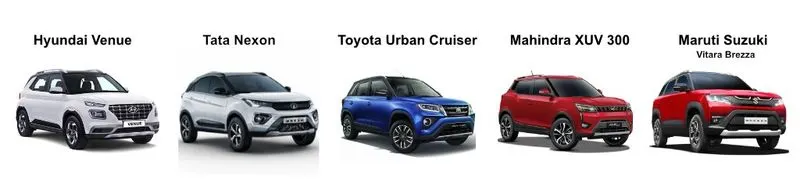
For Mr. D.S. Pughazhyendhii, I would advise the Tata Nexon due to its five-star G-NCAP safety rating, higher power (BHP), BS6 compliant, and more roomy interior compared to competitors.
Overall, it performs well.