Benchmarking
BENCH MARKING
Benchmarking involves a structured comparison between similar products, services or processes on some dimensions of performance. For example it can be used to compare the availability and delivery of features in a product and in this form often provides the basis of consumer tests and reviews. These look at products and services and provide recommendations based on which is best or some form of ranking amongst competitors. It is particularly useful when comparing not only performance but also practice – in other words what do the different organizations do to enable that performance to be delivered? And applied in this way it is a powerful tool in process innovation sin e studying how the ‘best’ achieve their performance can provide powerful clues for changing the way processes operate.
Process benchmarking of this kind can operate at several levels:
• Between similar processes in the same factory or service branch
• Between different factories or service branches
• Between different competing organizations
• Between different sectors using the same proce
1. HYUNDAI VENUE
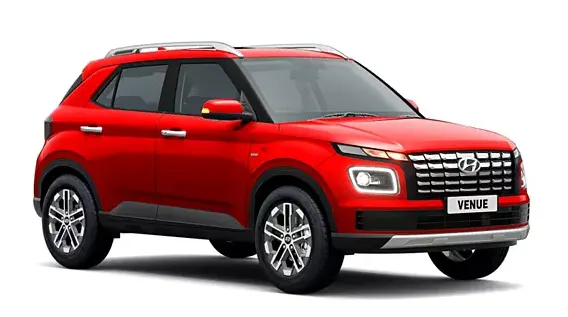
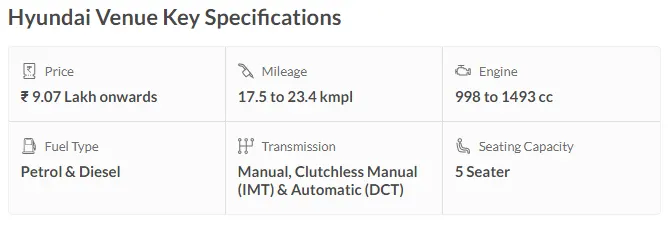
Hyundai Venue Summary
Variants
The Hyundai Venue is available in E, S, S(O), S+, SX, and SX (O) variants.
Market introduction
The Hyundai Venue was first introduced in June 2019 whereas the facelift version was launched on 16 June, 2022.
Engine and Specification
The first one is the 1.2-litre naturally-aspirated petrol engine that puts out 82bhp and 114Nm of torque and is mated only to a five-speed manual gearbox. Next up is the potent 1.0-litre turbo-petrol mill that is paired with a seven-speed DCT and a six-speed clutchless manual transmission. This motor delivers 118bhp and 172Nm of peak torque. The DCT version also benefits from paddle shifters and three drive modes – Eco, Normal, and Sport.
The last one is the 1.5-litre oil-burner alternative that pushes out 99bhp and 240Nm of torque. While most of the competition offers an automatic transmission with their diesel powertrain, the choice on the Venue is limited to a six-speed manual gearbox.
Exterior
Visually, the new Venue is fitted with a new front grille with a small square pattern in chrome finish and black surrounds. The turn indicators are on either side of the bonnet while the headlamps are mounted on the reworked bumpers which now get new wider air inlets instead of fog lamps. Other changes include a chrome window line, a new dual-tone design for alloy wheels, and split tail lamps with a connecting light bar and revised graphics.
Interior
Inside, the cabin looks modern with the utilisation of black and beige colours on the dashboard, door pads, and seat upholstery. The new Hyundai Venue is also equipped with an air purifier, a digital instrument cluster, a four-spoke steering wheel, reclining rear seats, and an electrically-adjustable driver seat.
The touchscreen infotainment system of the Venue has been updated with support for Alexa and Google assistant in 10 regional languages. Other highlights include over 60 connected car features, automatic climate control, electric sunroof, push start/stop button, and cooled glovebox.
Colours
The Hyundai Venue is offered in six colours that include Fiery Red, Phantom Black, Denim Blue, Typhoon Silver, Titan Grey, and Polar White. The Fiery Red shade is also available with a dual-tone contrasting black roof.
Seating capacity
The Hyundai Venue can accommodate five passengers.
2.Hyundai i20
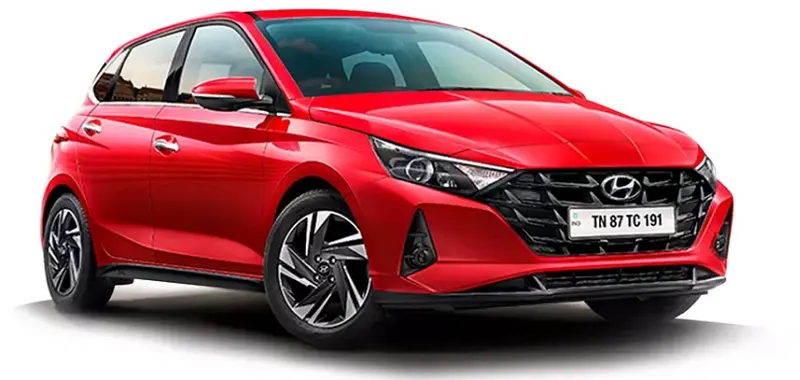
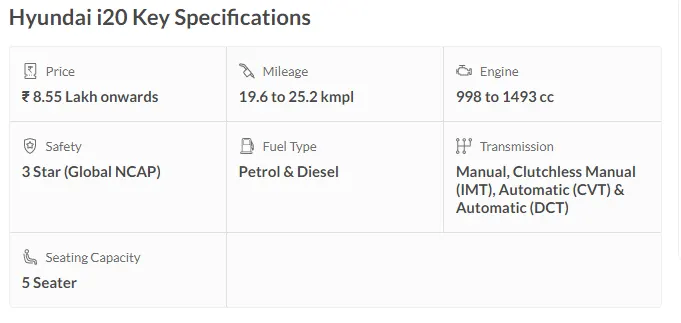
HYUNDAI i20 SUMMARY:
Variants:
The Hyundai i20 is available in four variants such as Magna, Sportz, Asta, and Asta (O).
Market introduction:
The third-generation Hyundai i20 was launched in India on 5 November, 2020.
Engine and specification:
The Hyundai i20 gets three engine options such as the 1.2-litre NA petrol engine, the 1.5-litre diesel engine, and the 1.0-ltire turbo-petrol engine. The latter produces 118bhp and 172Nm of torque, and is offered with a six-speed iMT unit and a seven-speed DCT unit. The 1.5-litre diesel mill produces 99bhp and 240Nm of torque, and is paired to a six-speed manual unit or a six-speed automatic unit. The 1.2-litre NA petrol motor produces 82bhp and 115Nm of torque, with transmission options including a five-speed manual unit and an IVT unit.
Dimension-wise, the Hyundai i20 measures 3,995mm in length, 1,775mm in width, and 1,505mm in height, while the wheelbase stands at 2,580mm.
Exterior design:
In terms of exterior of exterior design, the Hyundai i20 gets LED projector headlamps and fog lights, the signature cascading grille design, triangular-shaped fog light surrounds, a sunroof, 16-inch diamond-cut alloy wheels, Z-shaped LED tail lights, shark-fin antenna, and puddle lamps.
Rivals to the Hyundai i20 include the Maruti Suzuki Baleno, Honda Jazz, Tata Altroz, Maruti Suzuki Swift, and the Volkswagen Polo.
The Hyundai i20 comes equipped with a 10.25-inch touchscreen infotainment system with Apple CarPlay and Android Auto, BlueLink connectivity, a fully digital instrument console, blue ambient lighting, a Bose-sourced seven-speaker music system, and wireless charging with cooling function. The model gets safety features in the form of six airbags, ABS with EBD, rear parking sensors, seat-belt reminder, high-speed alert system, VSM, ESC, HAC, rear parking camera, and TPMS.
Colours:
The Hyundai i20 is offered in six colours that include Typhoon Silver, Titan Grey, Metallic Copper, Starry Night, Polar White, and Fiery Red. The latter two are additionally available in a dual-tone option with a black roof.
Seating capacity:
The Hyundai i20 has a seating capacity of five people.
3.Tata Nexon
TATA NEXON SUMMARY:
Variants :
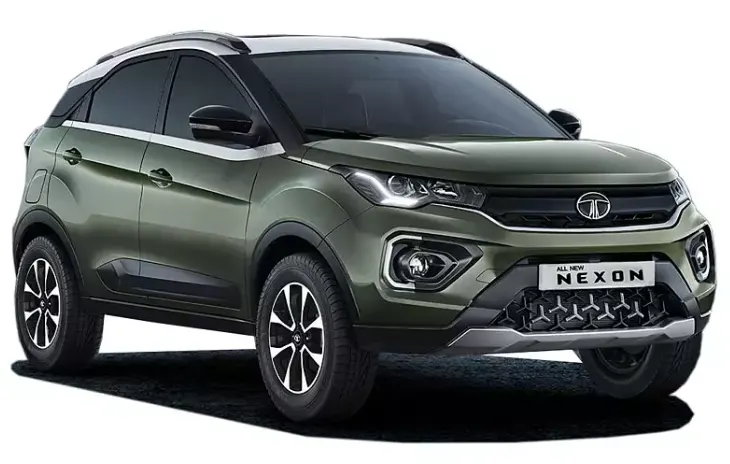
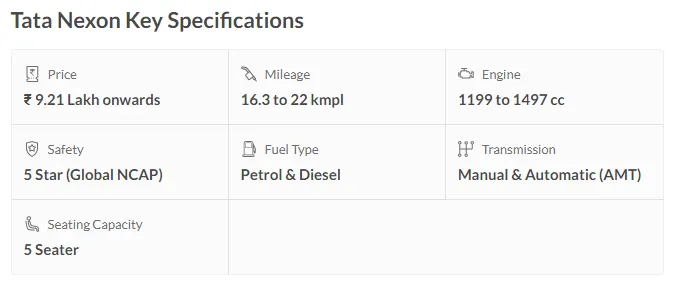
The Tata Nexon is available in multiple variant options that include XE, XM, XM(S), XZ, XZ Plus, XZ Plus dual tone, XZ Plus (O), XZ Plus (O) dual tone, XZ Plus Dark Edition, and XZ Plus (O) Dark Edition.
The AMT variant options include XMA, XMA (S), XZA Plus, XZA Plus dual tone, XZA Plus Dark Edition, XZA Plus (S), XZA Plus dual-tone (S), XZA Plus (O), XZA Plus (O) dual tone, and XZA Plus (O) Dark Edition.
Market introduction:
Early in 2020, Tata introduced the Nexon facelift in India with a fresh set of cosmetic and feature updates. Taking things to the next level, the company introduced the Nexon Dark in July 2021.
Engine and specifications
The Tata Nexon is available in both petrol and diesel engine options. The 1.2-litre turbocharged petrol engine generates 118bhp at 5,500rpm and 170Nm of torque at 1,750rpm. On the other hand, the 1.5-litre diesel engine produces 108bhp at 4,000rpm and 260Nm of torque at 1,500rpm. Transmission options include a six-speed manual gearbox and an optional AMT unit.
Exterior design
The Nexon is now sleeker and features a chiselled look instead of the earlier muscular and rounded-off look. The compact SUV gets a new dual-barrel projector headlamp setup with integrated tri-arrow LED DRLs. The lower air dam is now larger and it features a large ‘tri-arrow’ themed grille. The vehicle rides on 16-inch wheels with a modern set of alloy wheels.
Interior and features
The Tata Nexon gets a neat and uncluttered dashboard layout. The compact SUV gets a new steering wheel featuring a smaller horn pad with premium looking multimedia and cruise control buttons. Behind the steering wheel is a fully digital instrument cluster along with an updated seven-inch touchscreen infotainment system.
Colours:
The Nexon is available in six colour options which include Foliage Green, Flame Red, Pure Silver, Daytona Grey, Calgary White, and Atlas Black.
Seating capacity:
Tata Nexon is available in a five-seat layout.
4. Tata Tiago EV
Tata Tiago EV Summary
Variants
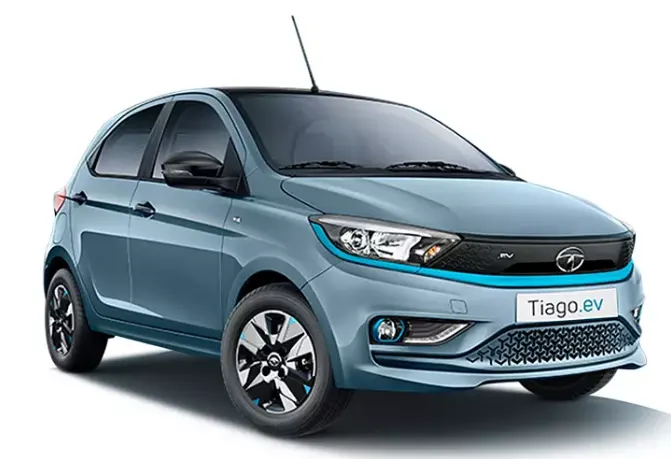
The Tata Tiago EV is available in four variant options: XE, XT, XZ+, and XZ+ Tech Lux.
Market introduction
Tata Motors launched the Tiago EV in India on 28 September, 2022.
Electric powertrain, battery, and charging
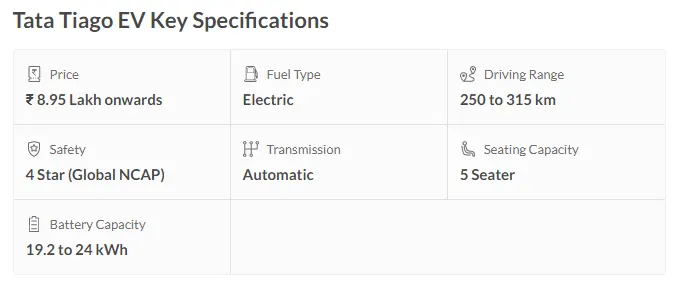
It is powered by two battery packs: 19.2kWh and 24kWh, with a claimed range of 250km and 315km, respectively. The former makes 60bhp/110Nm, while the latter produces 74bhp/114Nm. Meanwhile, the Tiago EV comes with either a 3.3kW or 7.2kW home charger, depending on the variant. With DC fast charging, it can be charged from 10 to 80 per cent in a claimed 57 minutes.
Exterior
The Tiago EV’s fascia is highlighted by a blanked-off grille with the signature tri-arrow pattern on both ends. To distinguish it from the regular model, the electric hatchback gets electric-blue inserts and the EV badge on the grille. Further, the side profile is highlighted by the new dual-tone alloy wheel pattern.
Interior
Like the exterior, the interior also features electric blue hues on the digital instrument cluster and air vents. In terms of features, the Tiago EV is equipped with seven-inch touchscreen infotainment by Harman, Android Auto and Apple CarPlay, a height-adjustable driver seat, automatic climate control, and a flat bottom steering wheel with mounted controls.
Features
It gets with multi-drive modes, cruise control, cooled glovebox, 45 ZConnect features with smartwatch compatibility, four speakers and four tweeters, leatherette seat upholstery, re-gen modes (0, 1, 2, and 3), TPMS, auto headlamps and rain-sensing wipers, a rearview camera with parking sensors, electric auto fold ORVMs, powered boot opening, ABS with EBD, and dual front airbags.
Seating capacity
The electric hatchback can accommodate up to five occupants, including the driver.
conclusion:
I will suggest HYUNDAI VENUE is the best among cars with good mileage, good roof space, good leg room, good comfort, more boot space, good suspension system, with effordable cost, and good saftey system.